科技

Search documents
2025年常用的异业合作对接渠道!
Sou Hu Cai Jing· 2025-11-28 02:54
Core Insights - In a highly competitive environment, companies and individuals are increasingly leveraging "cross-industry collaboration" to enhance exposure and expand resources [1] Summary by Categories 1. Cross-Industry Collaboration Channels - **Industry Communities and Professional Forums**: These are the easiest entry points for collaboration. Platforms like WeChat groups, QQ groups, and vertical forums gather industry professionals and stakeholders. For example, pet product companies can join pet industry groups, while education training firms can connect with parent and institution groups. The advantages include low cost and low entry barriers, but the quality of connections can vary, requiring proactive communication to find suitable partners [4] - **Collaboration Matching Platforms**: These platforms, such as advertising agencies and public relations service providers, facilitate resource matching. They have a structured database of collaborations and standard processes for connecting business needs with resources. This is suitable for teams looking to quickly find reliable partners, especially for promotions, investments, and channel expansions. The benefits include high efficiency, but these platforms often operate on a fee basis, making them more suitable for companies with a sufficient budget [5] - **Industry Exhibitions and Summit Events**: Offline exhibitions are direct collaboration venues, attracting numerous channel merchants, manufacturers, and service providers. Events like e-commerce conferences and technology exhibitions allow for immediate discussions on collaboration. The advantages include high-quality connections with genuine needs and budgets, but they require significant time and effort, making them less feasible for small teams [7] - **B2B Collaboration Platforms**: Platforms like Alibaba and Qifubang cater to business-to-business collaboration needs. Companies can post their products, channels, services, and investment plans while also filtering through peer postings. The advantages are transparency and diverse demands, but competition is intense, and information can be overwhelming, necessitating ongoing account management for stable results [8] - **Social Media and Content Platforms**: Many brands now publicly announce collaboration needs on platforms like Weibo, Xiaohongshu, and Douyin, seeking influencers for reviews, channel distribution, or content collaboration. Following industry accounts can reveal numerous collaboration opportunities. This method is flexible and rapidly updated, ideal for KOL partnerships and content promotion, but requires a certain level of content discernment to evaluate potential partners [9]


滚动更新丨A股三大指数小幅低开,贵金属、油气板块表现活跃
Di Yi Cai Jing· 2025-11-28 01:33
Group 1 - The A-share market opened lower with the Shanghai Composite Index down 0.11%, Shenzhen Component down 0.04%, and ChiNext down 0.04% [2][3] - The Hang Seng Index opened up 0.25%, and the Hang Seng Tech Index rose by 0.43%, with notable gains in tech stocks such as SMIC, which increased by nearly 2% [3][4] - The shipping index (European line) saw a significant increase of over 5.00%, currently reported at 1448.0 points [1] Group 2 - In the A-share market, sectors such as precious metals, aerospace equipment, and oil and gas were active, while sectors like coke and aquaculture showed weakness [1] - The central bank conducted a reverse repurchase operation of 301.3 billion yuan for 7-day terms at an interest rate of 1.40%, with 375 billion yuan of reverse repos maturing today [4] - The RMB/USD central parity rate was reported at 7.0789, depreciating by 10 basis points from the previous trading day's rate of 7.0779 [4]

勒索!欧盟高层怒怼美国!“领跑”,下任美联储主席“呼之欲出”?“并肩合作”俄罗斯与委内瑞拉签多项协议
Xin Lang Cai Jing· 2025-11-28 00:51
Group 1: Precious Metals Market - Gold prices decreased by 0.11% to $4157.61 per ounce, while silver prices increased by 0.07% to $53.3991 per ounce [1] - COMEX gold futures fell by 0.28% to $4153.60 per ounce, and COMEX silver futures rose by 0.47% to $53.165 per ounce [1] - Platinum and palladium saw increases of 1.58% and 1.36%, respectively, with prices at $1614.24 and $1436.28 per ounce [1] Group 2: U.S.-EU Relations - The EU criticized the U.S. for allegedly using coercive tactics to weaken technology regulations in Europe, emphasizing that digital rules are a matter of sovereignty [1] - U.S. Commerce Secretary linked the adjustment of EU tech regulations to the reduction of tariffs on steel and aluminum products [1][2] Group 3: U.S. Federal Reserve Leadership - Kevin Hassett is reported as the leading candidate for the next Federal Reserve Chair, indicating a potential alignment with President Trump's interest in lowering interest rates [3] - Current Fed Chair Jerome Powell's term ends in May 2026, and Trump has expressed dissatisfaction with the Fed's current rate policies [3] Group 4: Federal Reserve Rate Cut Expectations - The probability of a 25 basis point rate cut by the Federal Reserve in December is at 86.9%, with a 13.1% chance of maintaining current rates [4] - By January, the cumulative probability of a 25 basis point cut is 67.3%, while the chance of no change is 9.6% [4] Group 5: Russia-Venezuela Cooperation - Russia and Venezuela signed multiple cooperation agreements across ten sectors, including energy, agriculture, healthcare, and finance [6] - Both countries emphasized their commitment to peace, stability, and fair trade on the international stage [6] Group 6: Egg Market Analysis - Recent trends show a rebound in egg futures prices due to improved expectations and stabilization in spot prices, with the average price rising to 2.91 yuan per jin [8] - Egg inventory levels have shifted from increasing to decreasing, indicating a potential tightening in supply [9] - The current egg supply remains relatively high, but the market anticipates a decline in production as the year-end consumption peak approaches [10]
不出意外,接下来,A股会重演2024年行情了
Sou Hu Cai Jing· 2025-11-28 00:02
Group 1 - The Shanghai Composite Index has reached 4000 points this year, but the actual increase is limited when excluding the major banks and a few tech stocks, suggesting that many weighted industries are still around 3000 points [1] - If major stocks do not experience a rebound, the longer the time passes, the more unfavorable it will be for the index, indicating that the current bull market may have peaked at 4000 points [1] - The market is characterized by a localized bull market rather than a comprehensive one, with many stocks not performing well, and significant declines in tech assets occurring twice this year [3] Group 2 - There is a lack of significant profit effects in the market, with no noticeable increase in new account openings or discussions about the stock market, indicating a disconnect between the index performance and investor sentiment [5] - The trading volume has dropped significantly, with the market operating at bear market levels, and core weighted industries like liquor, securities, insurance, and banks showing low daily trading volumes [5] - The market requires incremental capital to drive growth, which can only come from rebounds in sectors like securities and real estate, similar to the market behavior seen in September 2024 [5][7]

华尔街展望明年美股前景:标普500目标位最高看至 8000点,AI与政策成关键变量
Zhi Tong Cai Jing· 2025-11-27 13:48
Group 1 - Major Wall Street banks have released their outlooks for the S&P 500 index for the end of 2026, with a general consensus that the index will continue to rise due to the ongoing AI investment wave, a shift to loose monetary policy, and expanding profit growth [1][2][8] - HSBC sets a target of 7500 points for the S&P 500 by the end of 2026, expecting a 12% growth in earnings per share for index constituents, driven by macroeconomic stability and the AI investment boom [2][3] - Societe Generale predicts the S&P 500 could reach 7300 points in 2026, with a potential range reflecting significant market volatility due to monetary policy uncertainty [4] Group 2 - Barclays raises its target for the S&P 500 to 7400 points, citing strong performance from large tech stocks and improving monetary and fiscal conditions, while warning of pressure on non-tech sectors due to rising inflation and unemployment [5][6] - UBS forecasts a target of 7500 points for the S&P 500, driven by strong corporate earnings growth of 14.4% in 2026, despite concerns over valuation risks related to AI stocks [8] - Morgan Stanley anticipates the S&P 500 will rise to 7800 points, supported by Fed rate cuts and efficiency gains from AI technology [11] Group 3 - Deutsche Bank presents the most optimistic outlook, setting a target of 8000 points for the S&P 500, driven by expected earnings growth of 14% and a broader market rally beyond the largest tech companies [12] - Morgan Stanley's strategy team emphasizes that the recent market sell-off is nearing its end, viewing it as an opportunity to position for a bullish 2026 [11] - JPMorgan highlights the K-shaped economic recovery, indicating that while large enterprises benefit from AI, the disparity in consumer confidence and spending may lead to market volatility [10]
这一板块,逆市大涨!
Zhong Guo Ji Jin Bao· 2025-11-27 11:43
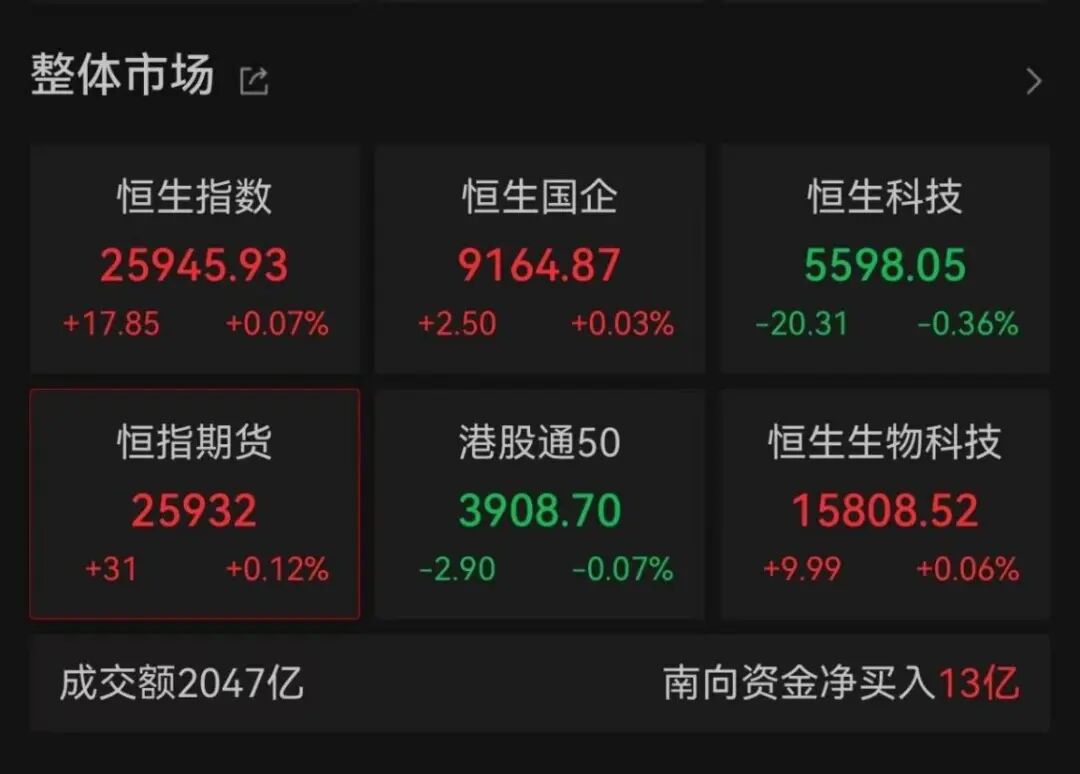
Group 1: Market Overview - The Hong Kong stock market experienced a cautious sentiment with mixed performance among the three major indices, where the Hang Seng Index rose by 0.07% and the Hang Seng Technology Index fell by 0.36% [2] - Southbound capital saw a net inflow of 1.3 billion HKD today, indicating continued interest from mainland investors [2] Group 2: New Consumption Concept Stocks - New consumption concept stocks surged against the market trend, with notable gains from companies like Pop Mart, which rose over 6%, and others such as Lao Pu Gold and Miniso, which increased by 4.45% and 2.73% respectively [7] - A recent policy initiative from six Chinese ministries aims to enhance the supply-demand match in consumer goods, targeting the cultivation of three trillion-level consumption sectors and ten billion-level consumption hotspots by 2027 [7][8] Group 3: Technology Sector Performance - Major technology stocks showed a mixed performance, with Xiaomi, JD.com, and Meituan rising by 2.49%, 1.22%, and 0.19% respectively, while Alibaba, Baidu, and Tencent saw declines of 2.71%, 1.57%, and 1.29% [5][6] - Analysts from Dongwu Securities noted that the AI industry trend is irreversible, and leading tech companies in Hong Kong are expected to benefit significantly from this acceleration [5] Group 4: Innovative Pharmaceutical Sector - The innovative pharmaceutical sector showed signs of recovery, with stocks like Lai Kai Pharmaceutical and Sanleaf Bio rising by 16.07% and 10.08% respectively [11][12] - A report from Founder Securities highlighted that Chinese pharmaceutical companies are gaining global competitiveness in advanced technology fields, and the market is expected to recognize the value of early-stage innovative pipelines [11] Group 5: Commodities Sector - The commodities sector remained active, driven by rising expectations for a Federal Reserve rate cut, with companies like China Silver Group and Jihai Resources increasing by 3.08% and 3.03% respectively [13][14] Group 6: IPO Activity - The online market operator Quantitative派 saw its stock price surge by 88.78% on its first day of trading on the Hong Kong Stock Exchange, raising approximately 131 million HKD through its IPO [16]
瑞银:盈利增长将驱动MSCI中国指数明年实现双位数增长
2 1 Shi Ji Jing Ji Bao Dao· 2025-11-27 10:59
Group 1: MSCI China Index Outlook - UBS expects the MSCI China Index to reach a target of 100 points next year, indicating a double-digit upside from current levels driven by strong corporate earnings growth [1] - The optimistic outlook for the MSCI China Index is primarily based on confidence in corporate earnings growth, with an anticipated overall earnings growth rate of 13% for Chinese companies in 2026, significantly higher than the 2% forecast for 2025 [1] - The technology sector, which comprises nearly 50% of the MSCI China Index, is particularly favored, with expected earnings growth of 37% in 2026 [1] Group 2: Economic Growth Projections - UBS forecasts China's economic growth to reach 4.5% in the fourth quarter and 4.9% for the entire year of 2025, with a target range of 4.5% to 5% for 2026 [2] - Consumer spending is expected to continue its growth trend, projected to increase by 3% next year, while real estate investment is anticipated to decline for the next 1 to 3 years after a drop of over 10% for three consecutive years [2] Group 3: Monetary Policy and Asset Allocation - UBS predicts the RMB/USD exchange rate may strengthen to 7.0 by the end of this year and potentially return to the "6 era" at 6.9 by June next year, alongside expectations of 20 to 30 basis points of interest rate cuts and two reductions totaling 50 to 100 basis points [3] - The company recommends diversifying investment portfolios by including private equity and private debt products, alongside traditional stocks and bonds, to mitigate market volatility risks [3] - UBS maintains a positive outlook on gold, suggesting a 5% to 8% allocation in investment portfolios due to geopolitical risks and the anticipated dollar interest rate cuts [3]
“大湾区金融科技人才发展计划”深圳站圆满举办
彭博Bloomberg· 2025-11-27 07:06
Core Insights - The "2025 Greater Bay Area FinTech Talent Development Program" has successfully expanded to Shenzhen, marking a significant step in cross-border collaboration and talent development in the region [2][7] - The program aims to cultivate the next generation of FinTech leaders in the Greater Bay Area, emphasizing the importance of young talent in driving the future of the industry [4][9] Group 1: Event Overview - The event took place on November 14 and was co-hosted by Bloomberg, the Hong Kong Monetary Authority, and the Hong Kong Youth Association, focusing on fostering cross-border exchanges and cooperation [2] - Over 60 students from Hong Kong and Shenzhen participated, engaging in CEO roundtable discussions and visiting banks, public funds, and large tech companies to gain industry insights [2] Group 2: Key Statements - The Director of FinTech at the Hong Kong Monetary Authority, Peng Xuhui, highlighted the role of the younger generation in shaping the future of FinTech in the Greater Bay Area and encouraged students to stay at the forefront of the industry [4] - Wang Dahai, President of Bloomberg Greater China, noted that the program's expansion to Shenzhen signifies a new level of collaboration in talent development between Hong Kong and Shenzhen [7] Group 3: Program Focus - This year's program centers on artificial intelligence, providing high-quality company visits and interactions with industry leaders to help students understand the latest trends in FinTech and expand their global innovative thinking [9]

ETF资金下半年加速净买入港股资产,港股通互联网ETF、香港证券ETF、港股通非银ETF强势吸金
Ge Long Hui· 2025-11-27 04:23
Group 1 - Southbound funds have significantly increased their net purchases of Hong Kong stocks, totaling 1.38 trillion HKD this year, marking a record high [1] - The Hang Seng Index has seen a year-to-date increase of nearly 30%, while the Hang Seng Tech Index has risen over 25% [1] - In the second half of the year, ETF funds have accelerated their net purchases of Hong Kong assets, with notable inflows into various ETFs, including over 350 million HKD into the Hong Kong Internet ETF and over 200 million HKD into the Hong Kong Securities ETF [1] Group 2 - Hong Kong stocks have unique advantages compared to A-shares, aligning well with current trends in AI, new consumption, and innovative pharmaceuticals [2] - Despite recent adjustments, the mid-term outlook for Hong Kong stocks remains bullish, supported by incremental capital inflows and the gathering of quality assets [2] - The AI-driven technology sector is expected to be the main theme in the Hong Kong market, with dividend-paying stocks benefiting from policy support and low interest rates [2] Group 3 - The "AI bubble" narrative in the US has led to mispricing of Chinese assets, particularly in the tech sector, where the valuation of Hong Kong tech stocks is about half that of the Nasdaq [3] - The adjustment in Hong Kong stocks has been significant, suggesting that the rebound potential may exceed that of A-shares [3] - A "barbell strategy" is recommended, focusing on high-dividend and turnaround assets to navigate market uncertainties while maintaining a long-term growth perspective [3]
帮主郑重早间观察:定存退场+万亿消费红包,中长线资金该往哪去?
Sou Hu Cai Jing· 2025-11-27 03:10
Group 1: Banking Sector Changes - The five-year fixed deposit has been removed from banks, with the longest available term now being three years and interest rates significantly reduced [3] - The narrowing net interest margin is pressuring banks, leading to a shift in consumer investment strategies as traditional savings may not keep pace with inflation [3] Group 2: Consumption Market Development - Six government departments are collaborating to create three trillion-yuan consumption markets and ten billion-yuan consumption hotspots by 2027, focusing on both supply and demand [4] - The emphasis is on producing high-quality consumer goods with cultural significance, addressing supply-demand mismatches, and identifying companies that can meet new consumer needs [4] Group 3: Currency and Investment Outlook - The RMB/USD exchange rate has surpassed 7.08, the highest since October last year, indicating a positive signal for A-shares as foreign investment interest increases [5] - Morgan Asset Management predicts an annualized return of 7.7% for A-shares over the next 10 to 15 years, reflecting confidence in the long-term resilience and valuation potential of the Chinese economy [5] Group 4: Real Estate Sector Insights - Vanke is negotiating a 2 billion yuan bond extension, highlighting the slow process of risk mitigation in the real estate sector, with stable companies likely to see valuation recovery [5] Group 5: Long-term Investment Strategies - Investment strategies should align with policy directions, focusing on trillion-yuan consumption sectors such as smart home, cultural tourism, and green consumption, while selecting companies with stable cash flow and strong brand power [6] - With declining deposit rates, idle funds should be allocated to quality equity assets like index funds or stable industry leaders, emphasizing long-term compounding over short-term gains [6] - High-risk areas, such as companies with significant debt pressure and opaque operations, should be avoided to mitigate investment risks [6]