军工

Search documents
国科军工成交额创上市以来新高
Zheng Quan Shi Bao Wang· 2025-11-24 07:22
Core Insights - The stock of Jiangxi Guoke Military Industry Group Co., Ltd. reached a record trading volume of 1.321 billion RMB, marking the highest since its listing [2] - The latest stock price increased by 13.72%, with a turnover rate of 20.47% [2] - The previous trading day's total transaction volume for the stock was 824 million RMB [2] Company Overview - Jiangxi Guoke Military Industry Group Co., Ltd. was established on December 29, 2007, with a registered capital of 2.0884 billion RMB [2]


三角防务股价涨5.05%,国泰基金旗下1只基金位居十大流通股东,持有373.65万股浮盈赚取526.85万元
Xin Lang Cai Jing· 2025-11-24 07:13
Group 1 - The core viewpoint of the news is that Triangle Defense's stock has seen a significant increase of 5.05%, reaching a price of 29.31 CNY per share, with a trading volume of 1.176 billion CNY and a turnover rate of 7.71%, resulting in a total market capitalization of 16.049 billion CNY [1] - Triangle Defense, established on August 5, 2002, and listed on May 21, 2019, is located in Xi'an, Shaanxi Province, and specializes in the research, production, and service of forged products in industries such as aviation, aerospace, shipbuilding, and non-ferrous metals [1] - The company's main business revenue composition includes 95.17% from die-forged products, 2.85% from free-forged products, and 1.98% from other sources [1] Group 2 - From the perspective of the top ten circulating shareholders of Triangle Defense, Guotai Fund's Guotai Zhongzheng Military Industry ETF (512660) reduced its holdings by 745,800 shares in the third quarter, now holding 3.7365 million shares, which accounts for 0.7% of the circulating shares [2] - The Guotai Zhongzheng Military Industry ETF (512660) was established on July 26, 2016, with a latest scale of 14.109 billion CNY, and has achieved a return of 9.68% this year, ranking 3372 out of 4209 in its category [2] - The fund manager, Ai Xiaojun, has a cumulative tenure of 11 years and 319 days, managing total fund assets of 169.029 billion CNY, with the best fund return during his tenure being 256.49% and the worst being -46.54% [2]

光电股份股价涨5.06%,中邮基金旗下1只基金位居十大流通股东,持有125万股浮盈赚取108.75万元
Xin Lang Cai Jing· 2025-11-24 07:08
Group 1 - The stock price of Guangdian Co., Ltd. increased by 5.06% on November 24, reaching 18.07 yuan per share, with a trading volume of 435 million yuan and a turnover rate of 4.78%, resulting in a total market capitalization of 10.53 billion yuan [1] - Guangdian Co., Ltd. has experienced a continuous increase in stock price for three consecutive days, with a cumulative increase of 1.96% during this period [1] - The company, established on August 31, 2000, and listed on November 6, 2003, is located in Xi'an, Shaanxi Province, and primarily engages in the production, research and development, and sales of defense products and optoelectronic materials and devices [1] Group 2 - The top circulating shareholder of Guangdian Co., Ltd. includes a fund under China Post Fund, specifically the China Post Military-Civilian Integration Flexible Allocation Mixed A (004139), which entered the top ten circulating shareholders in the third quarter with 1.25 million shares, accounting for 0.25% of circulating shares [2] - The fund has generated a floating profit of approximately 1.0875 million yuan today, with a floating profit of 412,500 yuan during the three-day increase [2] - The fund, established on April 1, 2017, has a latest scale of 858 million yuan, with a year-to-date return of 23.83%, ranking 2784 out of 8209 in its category, and a one-year return of 15.46%, ranking 3924 out of 8129 [2]

北方导航股价涨5%,广发基金旗下1只基金重仓,持有3.48万股浮盈赚取2.33万元
Xin Lang Cai Jing· 2025-11-24 06:57
Group 1 - The core point of the news is that Beifang Navigation has seen a stock price increase of 5%, reaching 14.07 CNY per share, with a trading volume of 606 million CNY and a turnover rate of 2.90%, resulting in a total market capitalization of 21.264 billion CNY [1] - Beifang Navigation Technology Co., Ltd. is located in Beijing Economic and Technological Development Zone and was established on September 11, 2000, with its listing date on July 4, 2003 [1] - The company's main business involves guidance control, navigation control, detection control, environmental control, stability control, radio and satellite communication, and electrical connectors, with military products accounting for 99.43% of revenue and civilian products only 0.57% [1] Group 2 - From the perspective of fund holdings, one fund under GF Fund has a significant position in Beifang Navigation, specifically the GF Hengrong 3-Month Holding Period Mixed A Fund, which held 34,800 shares, representing 0.24% of the fund's net value, ranking as the seventh largest holding [2] - The GF Hengrong 3-Month Holding Period Mixed A Fund was established on August 17, 2021, with a latest scale of 93.8127 million CNY, and has achieved a year-to-date return of 4.76%, ranking 6507 out of 8209 in its category [2] - The fund manager, Song Qianqian, has been in position for 5 years and 118 days, overseeing total assets of 91.026 billion CNY, with the best fund return during her tenure being 24.04% and the worst being 0.45% [2]

军工股继续走高 中船防务盘中涨近9% 中航科工午后涨超5%
Zhi Tong Cai Jing· 2025-11-24 06:42
Core Viewpoint - The defense stocks continue to rise, driven by increased global geopolitical uncertainties and expanding military trade demand, particularly highlighted by the recent Dubai Airshow showcasing Chinese military equipment and aircraft [1] Group 1: Stock Performance - China Shipbuilding Defense (600685) increased by 6.6%, reaching HKD 15.82 [1] - AVIC (02357) rose by 4.8%, reaching HKD 3.93 [1] - Aerospace Holdings (00031) saw a rise of 1.96%, reaching HKD 0.52 [1] Group 2: Dubai Airshow Highlights - The Chinese exhibition at the 2025 Dubai International Airshow featured notable equipment including the J-10CE and J-35A fighter jets, Y-20 transport aircraft, and various drones [1] - The C919 large passenger aircraft made its debut in the Middle East [1] - An order for 50 unmanned transport aircraft from Aerospace Feipeng was confirmed at the Dubai event [1] Group 3: Market Analysis - According to Industrial Securities, the Dubai Airshow marks a new window for defense observation [1] - Shenwan Hongyuan's report indicates that the global military trade market is undergoing a structural change due to increasing geopolitical uncertainties [1] - The performance and supply capabilities of Chinese military products are gaining high recognition, with significant demand growth expected in markets like the Middle East and Asia [1]
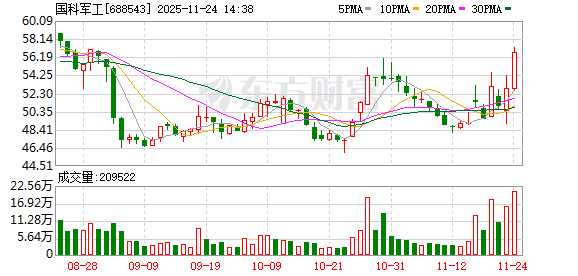
国科军工成交额创2025年5月13日以来新高
Zheng Quan Shi Bao Wang· 2025-11-24 06:37
Core Insights - The trading volume of Guokai Military Industry reached 1.103 billion RMB, marking the highest level since May 13, 2025 [2] - The latest stock price increased by 7.83%, with a turnover rate of 17.22% [2] - The previous trading day recorded a total trading volume of 824 million RMB [2] Company Overview - Jiangxi Guokai Military Industry Group Co., Ltd. was established on December 29, 2007, with a registered capital of 2.0884 billion RMB [2]
港股异动 | 军工股继续走高 中船防务(00317)盘中涨近9% 中航科工(02357)午后涨超5%
Zhi Tong Cai Jing· 2025-11-24 06:17
Core Viewpoint - The military stocks continue to rise, driven by increased global geopolitical uncertainties and expanding military trade demand, particularly highlighted by the recent Dubai Airshow showcasing various Chinese military equipment [1] Group 1: Stock Performance - China Shipbuilding Defense (00317) increased by 6.6%, reaching HKD 15.82 [1] - AVIC (02357) rose by 4.8%, trading at HKD 3.93 [1] - Aerospace Holdings (00031) saw a 1.96% increase, priced at HKD 0.52 [1] Group 2: Dubai Airshow Highlights - The 2025 Dubai International Airshow featured significant Chinese exhibits, including the J-10CE and J-35A fighter jets equipped with PL missiles, the Y-20 transport aircraft, and various drones like the Wing Loong and WZ-7 [1] - The C919 large passenger aircraft made its debut in the Middle East, and an order for 50 unmanned transport aircraft from Aerospace Feipeng was confirmed at the event [1] Group 3: Market Outlook - According to Industrial Securities, the Dubai Airshow marks a new window for defense observation, indicating a shift in the international military trade landscape [1] - Shenwan Hongyuan's report suggests that the increasing global geopolitical uncertainties are leading to a significant expansion in military trade demand, with Chinese products gaining recognition for their performance and supply capabilities [1] - The report anticipates a strong resonance between demand and supply in China's military trade, particularly in the Middle East and Asia, contributing to a future large-scale military trade landscape for China [1]
港股军工股继续走高 中船防务涨超6%
Mei Ri Jing Ji Xin Wen· 2025-11-24 06:17
每经AI快讯,港股军工股继续走高,截至发稿,中船防务(00317.HK)涨6.6%,报15.82港元;中航科工 (02357.HK)涨4.8%,报3.93港元;航天控股(00031.HK)涨1.96%,报0.52港元。 (文章来源:每日经济新闻) ...
亚太局势不确定性加剧,我国装备建设或将提速,关注新质战斗力
Orient Securities· 2025-11-24 05:55
Investment Rating - The report maintains a "Positive" investment rating for the defense and military industry [5] Core Viewpoints - The uncertainty in the Asia-Pacific situation is increasing, which may accelerate the equipment construction in China, focusing on new combat capabilities [2][12] - China's high-end aviation equipment showcased at the Dubai Airshow is expected to further expand the military trade market [12][15] - The Fujian aircraft carrier has conducted its first live training at sea, indicating a significant advancement in operational capabilities and technology [12][18] - The report emphasizes the importance of domestic demand for new combat capabilities and military trade as key growth areas [19] Summary by Sections Investment Suggestions and Targets - The report highlights various investment targets across different segments, including: - Engine and fuel chain: Companies like Xi'an Aero Engine (600893), Western Superconducting (688122), and others [19][20] - New quality and domains: Companies such as Aerospace Electronics (600879), Haige Communication (002465), and others [19][20] - Military electronics: Companies like Aerospace Electric (002025), Zhonghang Optical (002179), and others [19][20] - Military trade and main equipment: Companies such as AVIC Shenyang Aircraft (600760), AVIC Chengfei (302132), and others [19][20] Industry News and Market Performance - The report notes that the defense and military industry index has outperformed the broader market, with a decline of only -1.72% compared to the Shanghai Composite Index's -3.90% [22][25] - The report provides a detailed analysis of weekly market performance, indicating that the defense and military sector remains resilient amid broader market declines [22][25] Key Events and Developments - The report outlines significant recent events, including: - The U.S. government approved a new round of arms sales to Japan, which may heighten regional tensions and prompt China to expedite its military equipment development [12][9] - The successful live training of the Fujian aircraft carrier, showcasing advanced operational capabilities [12][18] - The participation of Chinese high-end military equipment in international exhibitions, enhancing China's presence in the global military trade market [12][15]


中航资本:沪指跌0.34%,煤炭、有色等板块走低,军工板块逆市拉升
Sou Hu Cai Jing· 2025-11-24 05:42
Market Overview - The major stock indices in the market experienced fluctuations and retreated, with the ChiNext index dropping approximately 1% and falling below 2900 points, while around 3200 stocks were in the green [1] - As of the midday close, the Shanghai Composite Index fell by 0.34% to 3821.68 points, the Shenzhen Component Index decreased by 0.59%, and the ChiNext index declined by 0.77%, with a total transaction volume of 1,032.6 billion yuan across the Shanghai and Shenzhen markets [3] Sector Performance - Sectors such as coal, gas, non-ferrous metals, electricity, and stability saw declines, while military and pharmaceutical sectors rose against the trend, with military trade and AI application concepts being particularly active [3] Market Sentiment and Analysis - The current market is characterized by a "three-phase overlap": a consolidation phase in the middle of a bull market, a critical period for verifying economic conditions, and a performance policy gap, leading to market fluctuations and profit-taking as the year-end approaches [3] - Recent disturbances in the overseas environment, including repeated expectations of a Federal Reserve rate cut in December, have shaken global market liquidity expectations; despite Nvidia's earnings exceeding expectations, its stock price experienced volatility, raising concerns about the sustainability of AI spending, which has affected sentiment in the A-share market [3] - Long-term factors supporting a slow bull market remain unchanged; however, in the short term, the strategy should focus on opportunistic positioning, awaiting the Federal Reserve's monetary policy meeting and the central economic work conference in mid-December, with potential for increased buying if adjustments are sufficient, while monitoring support levels at the 60-day and half-year moving averages and market volume conditions [3]