
基建行业

Search documents
经济开门红——全面解读1-2月经济数据
泽平宏观· 2026-03-16 16:06
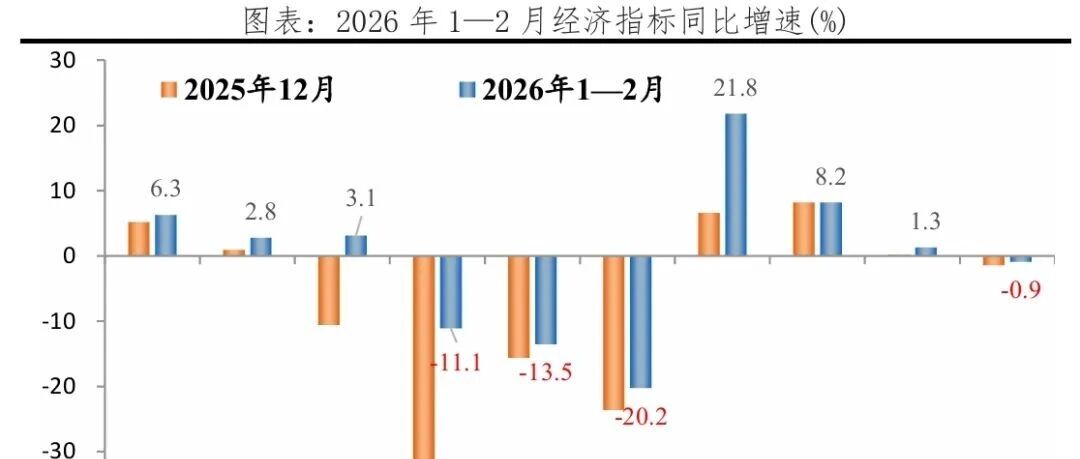
Economic Overview - The national economy showed a "new strong, old weak, external strong, internal stable" trend in the first two months of 2026, with high-tech manufacturing and equipment manufacturing leading the growth [2][3] - Industrial production accelerated, with a year-on-year increase of 6.3% in industrial added value, up 1.1 percentage points from December [2][8] - Fixed asset investment turned positive, growing by 1.8% year-on-year, a significant recovery of 16.9 percentage points from December [2][12] Industrial Production - High-tech manufacturing and equipment manufacturing sectors experienced significant growth, with high-tech manufacturing value-added increasing by 13.1% year-on-year [6][9] - The production of upstream raw materials improved due to rising international oil prices, while midstream machinery and equipment sectors benefited from policy effects [9][10] Investment Trends - Fixed asset investment (excluding rural households) showed a year-on-year increase of 1.8%, with high-tech industry investment growing by 5.1% [12][20] - Infrastructure investment surged by 11.4% year-on-year, driven by the acceleration of major projects and statistical adjustments [17][18] Real Estate Market - The decline in real estate investment narrowed, with sales area and sales amount decreasing by 13.5% and 20.2% respectively, but showing improvement from December [15][16] - Real estate companies are still cautious in land acquisition, with a significant drop in land transaction volume [16] Export Performance - Exports exceeded expectations, with a year-on-year growth of 21.8%, driven by global manufacturing recovery and enhanced competitiveness [25][26] - Exports to countries along the Belt and Road increased by 28.5%, accounting for over 50% of total exports [25][26] Consumer Spending - Social retail sales increased by 2.8% year-on-year, with service consumption performing well due to the long Spring Festival holiday [23][24] - Traditional consumer goods saw a significant demand boost during the holiday period, with restaurant income rising by 4.8% [23] Financial Data - Social financing maintained a stable growth rate of 8.2%, supported by government bonds and bank loans [28][29] - M2 growth remained at 9.0%, while M1 increased by 5.9%, indicating a shift in deposit trends towards non-bank institutions [29] Price Trends - CPI rose by 1.3% year-on-year, the highest in nearly three years, influenced by the timing of the Spring Festival [31][32] - PPI decline narrowed, reflecting input inflation and strong demand in certain technology sectors [31][32]

【广发宏观郭磊】经济开年数据简析
郭磊宏观茶座· 2026-03-16 08:16
Core Viewpoint - The economic data for January-February 2026 shows a positive start, with significant growth in exports and industrial output, a rebound in fixed asset investment, and improvements in retail sales outside of the automotive sector, indicating a reduced risk of short-term economic downturn [5][6][25]. Group 1: Economic Data Overview - The six major economic indicators for January-February 2026 are all better than December 2025, with exports and industrial output showing significant increases, fixed asset investment turning positive year-on-year, and service production index slightly above previous values [6][5]. - Exports grew by 21.8% year-on-year, significantly higher than December's 6.6% and the annual value of 5.5% [7]. - Industrial output increased by 6.3% year-on-year, continuing last year's strong performance, driven mainly by exports and technological innovation [8][12]. - Fixed asset investment rose by 1.8% year-on-year, a recovery from December's -16% and last year's -3.8% [10][17]. Group 2: Sector-Specific Insights - High-tech industries saw a year-on-year increase of 13.1%, expanding their relative advantage, while equipment manufacturing maintained a high growth rate of 9.3% [12][13]. - Retail sales of consumer goods grew by 2.8% year-on-year, with a notable increase of 4.7% when excluding automotive and fuel sales, indicating a rebound in other consumer categories [14][15]. - Fixed asset investment in infrastructure rebounded significantly, with a year-on-year growth of 11.4%, driven by substantial investments in aviation, gas production, and public facilities [16][17]. Group 3: Real Estate Market Trends - Real estate indicators continue to show negative year-on-year growth, but the decline in sales and investment has narrowed, with initial positive changes in housing prices observed [21][22]. - The sales area of commercial housing decreased by 13.5% year-on-year, but the decline is less severe than in previous months [22]. - The price index for new and second-hand residential properties in first-tier cities showed signs of stabilization, with new home prices returning to zero growth for the first time in ten months [23][24]. Group 4: Employment and Consumer Behavior - Employment data slightly exceeded seasonal expectations, with the urban survey unemployment rate decreasing by 0.1 percentage points year-on-year [24]. - The rebound in consumer spending, particularly in food and clothing categories, reflects the positive impact of the Spring Festival holiday [14][15]. Group 5: Overall Economic Outlook - The overall economic data for January-February 2026 suggests a strong start, with key indicators supporting a positive outlook, while geopolitical factors continue to complicate the asset landscape [5][25]. - The market may seek new pricing narratives amid ongoing fluctuations, supported by policy dividends and the gradual implementation of the "14th Five-Year Plan" [5][25].

宏观周报:聚焦两会“十五五”蓝图,美以伊冲突持续升级-20260315
KAIYUAN SECURITIES· 2026-03-15 11:15
Domestic Macro Policy - The growth target for 2026 is set at 4.5%-5%, with an aim to create over 12 million new urban jobs and maintain a CPI increase of around 2%[9] - The "14th Five-Year Plan" outlines 109 major projects across six key areas, including 28 projects focused on advanced technology and productivity, and 25 projects aimed at improving people's livelihoods[10] - Infrastructure investment is estimated to exceed 7 trillion yuan in 2026, focusing on the "six networks" and key sectors[13] Monetary and Fiscal Policy - The monetary policy will remain moderately loose, utilizing various tools such as reserve requirement ratio cuts and interest rate reductions to support domestic demand and innovation[18] - The fiscal policy aims for a deficit rate of around 4%, with a deficit scale of 5.89 trillion yuan, including the issuance of 1.3 trillion yuan in special bonds and 4.4 trillion yuan in local government bonds[20] Real Estate and Financial Regulation - Real estate policies will focus on supporting housing needs for newly married families and multi-child families, while controlling inventory and optimizing supply through various channels[22] - Financial regulation will deepen reforms in the ChiNext board, introducing more inclusive listing standards to support innovative enterprises[26] International Relations and Risks - The ongoing U.S.-Iran conflict has led to significant volatility in global energy markets, with domestic fuel prices experiencing the largest increase in four years[29] - There is a risk of continued divergence in domestic and international monetary policies, with domestic policy execution potentially falling short of expectations[34]
财政部及央行新闻发布会解读:财政金融协同,助力开门红
Shenwan Hongyuan Securities· 2026-01-21 11:04
Group 1: Policy Signals - The Ministry of Finance and the central bank are focusing on stimulating domestic demand, enhancing support for technological innovation, and activating private investment as key areas for policy collaboration[1] - Personal consumption loan interest subsidies have increased significantly, with the maximum subsidy per loan rising from 500 yuan to 3000 yuan, and credit card installment payments now included[1] - The central bank has lowered the interest rates on various structural monetary policy tools by 0.25 percentage points to guide financing costs down[1] Group 2: Addressing Key Issues - In 2025, new household loans dropped to 3600 billion yuan, a decrease of 22910 billion yuan from 2024, indicating a significant decline in consumer credit growth[2] - The overall credit growth rate fell to 6.4% in 2025, with a 1.0 percentage point decline attributed to the drop in household loans[2] - Fixed asset investment decreased by 3.8% in 2025, with equipment purchases showing a growth rate of 11.8%, highlighting the need for policy support to stabilize investment[3] Group 3: Expected Outcomes - Fiscal interest subsidies are expected to stabilize financial data and stimulate domestic demand, despite challenges in loan write-offs and low net interest margins for commercial banks[4] - The expansion of consumer loan interest subsidies is anticipated to support stable consumer spending, particularly in service consumption, as households shift their spending patterns[4] - New policy financial tools, if further enhanced, could provide an additional 1.5 percentage points in fiscal interest subsidies, thereby boosting investment in new infrastructure projects[4]
宏观经济周度高频前瞻报告:经济周周看:本周经济景气度延续回落-20251228
ZHESHANG SECURITIES· 2025-12-28 13:20
Economic Indicators - The GDP weekly high-frequency prosperity index as of December 27 is 4.9%, slightly up from the revised 4.8% of the previous week, indicating marginal economic growth improvement[1] - The industrial weekly prosperity index remains stable at 8.1%, while the service sector index has slightly decreased to 2.9%[7] - The construction sector shows a slight improvement in physical workload, with rebar apparent demand at 202.8 million tons, down from 208.6 million tons the previous week[7] Demand and Consumption - External demand remains the strongest variable, while consumer demand continues to show low-level fluctuations, with a consumer high-frequency index of 2.3%[18] - Real estate sales in 30 major cities decreased to 254.7 million square meters, a 1% week-on-week decline and a 41% year-on-year decline[46] - The container throughput for exports decreased to 620,100 TEUs, down from 658,900 TEUs the previous week, although the year-to-date growth is 5.45%[55] Price Trends - Consumer prices are generally stable, with agricultural product wholesale prices showing a slight decrease of 0.17% week-on-week[64] - The average wholesale price of pork is 17.51 yuan per kilogram, down 0.4% week-on-week, while the average price of six monitored fruits increased by 1.6%[71]
前瞻2026:对中国经济和宏观调控的思考与建议
Hua Xia Shi Bao· 2025-12-01 12:59
Core Insights - In 2025, China's economy demonstrated strong resilience amid internal and external challenges, characterized by two "better than expected" and two "worse than expected" trends, with an overall growth rate showing a "high first, low second" trajectory [2][3][7] - For 2026, a GDP growth target of around 5% is anticipated, with a dual focus on both real and nominal GDP growth to address low inflation [2][11][18] Group 1: Economic Performance in 2025 - China's exports showed strong resilience, with a year-on-year growth of 5.3% from January to October, supported by diversified market layouts and upgraded export structures [3][4] - The capital market outperformed expectations, driven by institutional reforms and increased risk appetite, particularly in technology stocks, leading to a significant bull market [4][5] - The real estate market's recovery was slower than anticipated, with real estate investment declining by 14.7% year-on-year from January to October, exceeding the previous year's decline [5][6] - Consumer spending showed initial improvement but fell short in the latter half of the year, with retail sales of home appliances declining significantly in the last quarter [6][7] Group 2: Economic Challenges and Policy Recommendations for 2026 - The core issues for 2026 will revolve around real estate and local government debt, which are intertwined and pose both short-term and long-term challenges [8][9] - Local government financial capacity is under pressure due to declining land sales revenue, which is expected to drop from 8.7 trillion yuan in 2021 to below 4 trillion yuan in 2025 [8][9] - To stabilize the economy, macroeconomic policies need to be more proactive, with a focus on fiscal policy, monetary policy, and real estate policy working in concert [2][11][19] - A "dual 5" growth target is recommended, aiming for both 5% real and nominal GDP growth, to embed price recovery within growth objectives [18][20] Group 3: Structural Changes and Future Outlook - The economic growth structure is expected to shift, with traditional growth drivers weakening and new drivers, such as service consumption and infrastructure investment, gaining momentum [12][13] - Despite ongoing trade tensions and geopolitical risks, China's exports are projected to remain resilient, supported by new demands from emerging markets and advancements in technology [12][14] - The real estate market is anticipated to undergo a prolonged adjustment period, with potential recovery contingent on easing policies in major cities and adjustments in mortgage rates [15][16] - The government is advised to implement a comprehensive policy framework to stabilize the real estate market, including the establishment of a "Real Estate Stability Fund" and increased fiscal support for local governments [22][23]

亚洲联合基建控股发布中期业绩 股东应占溢利6118.4万港元 同比扭亏为盈
Zhi Tong Cai Jing· 2025-11-27 14:57
Core Viewpoint - Asian United Infrastructure Holdings (00711) reported a significant turnaround in its financial performance for the six months ending September 30, 2025, with total revenue reaching HKD 4.925 billion, a year-on-year increase of 10.69%, and a net profit attributable to shareholders of HKD 61.184 million, compared to a loss of HKD 264 million in the same period last year [1] Financial Performance - Total revenue for the period was HKD 4.925 billion, reflecting a growth of 10.69% year-on-year [1] - The company achieved a net profit attributable to shareholders of HKD 61.184 million, a significant recovery from a loss of HKD 264 million in the previous year [1] - Basic earnings per share were reported at HKD 0.0331 [1] - The company proposed an interim dividend of HKD 0.0083 per share [1] Strategic Insights - The growth in total revenue and net profit indicates the effectiveness of the company's strategic adjustments and operational optimizations [1] - The management emphasized the importance of talent development and operational intelligence to maintain long-term competitive advantages [1] - The company aims to provide high-quality services to clients, which is expected to further enhance overall operational performance [1]
经观月度观察|“稳中求进”基调不变 重点转向激发内需与修复工业品价格
Jing Ji Guan Cha Bao· 2025-11-21 14:49
Core Insights - The macroeconomic data for October indicates a short-term increase in economic downward pressure, with a focus on stimulating domestic demand and repairing industrial product prices while maintaining the overall principle of "seeking progress while maintaining stability" [1] CPI - The Consumer Price Index (CPI) rose to 0.2% in October from -0.3% in the previous month, marking a 0.5 percentage point increase [2] - The month-on-month increase was 0.2%, up 0.1 percentage points from the previous month, driven by rising prices of fruits and vegetables [2] PPI - The Producer Price Index (PPI) decreased by 2.1% year-on-year in October, improving from a decline of 2.3% in September, with the mining sector providing significant support [3] - The prices of production materials increased by 0.1%, with mining prices up by 1% [3] PMI - The Manufacturing Purchasing Managers' Index (PMI) fell to 49% in October from 49.8% in September, indicating a contraction in manufacturing activity [4] - The decline in PMI is attributed to high inventory levels, a weakening demand structure, and reduced investment demand due to accelerated debt repayment [5] Fixed Asset Investment - Fixed asset investment (FAI) decreased by 1.7% year-on-year in October, worsening from a decline of 0.5% in September [6] - The decline in infrastructure investment is influenced by multiple factors, including accelerated debt repayment and insufficient project reserves [6] Credit - New credit issuance in October was 220 billion yuan, a decrease of 280 billion yuan compared to the same period last year [7] - The total social financing (TSF) increased by 815 billion yuan, but the growth rate has slowed down [7] M2 - The M2 money supply grew by 8.2% year-on-year in October, down from 8.4% in September, influenced by a rebound in fiscal deposits [8] - The central government allocated 500 billion yuan to local governments to support effective investment and address existing debt issues [9]
重磅经济数据即将发布
第一财经· 2025-11-12 13:07
Core Viewpoint - The article discusses the anticipated slowdown in various macroeconomic indicators for October, influenced by factors such as the elevated base from 2024 and increased external uncertainties. Economists maintain a stable outlook for China's economy, projecting a 5% growth target for the year, with a focus on domestic demand recovery [2][12]. Industrial Growth - The average forecast for October's industrial added value year-on-year growth is 5.7%, down from 6.5% in the previous month. The manufacturing PMI has dropped to 49.0%, indicating a contraction in manufacturing activity [4][6]. - Despite the expected slowdown, some sectors like steel and chemicals show resilience, with steel production rates increasing significantly [5][6]. Consumer Spending - The predicted year-on-year growth for October's retail sales is 2.7%, a decrease from 3% in the previous month. The non-manufacturing business activity index has risen to 50.1%, indicating expansion, driven by holiday consumption [8][9]. - The "old-for-new" policy is expected to boost consumption in specific categories, contributing to a high base effect for October [8]. Automotive Industry - In October, China's automotive production and sales reached 3.359 million and 3.322 million units, respectively, marking a year-on-year increase of 12.1% and 8.8%. New energy vehicles also saw significant growth [9]. Fixed Asset Investment - The forecast for September's fixed asset investment growth is -0.8%, indicating a further decline. However, infrastructure investment may see a narrowing of its decline due to new policy measures [10][11]. - The real estate sector continues to struggle, with significant declines in property transactions and land sales [10][11]. Economic Policy and Outlook - The government is intensifying growth stabilization policies, with significant financial tools deployed to support key investment projects. Local governments are also issuing consumption vouchers to stimulate demand [14][15]. - The overall economic growth target of around 5% for the year is deemed achievable, supported by improved trade conditions and a focus on domestic demand [12][13].

重磅经济数据即将发布,央地加力冲刺全年经济增长目标
Di Yi Cai Jing· 2025-11-12 12:12
Economic Overview - The external environment remains complex and variable, with a focus on domestic demand recovery for the economy [1] - The Chief Economist Confidence Index from First Financial Research Institute stands at 50.3, indicating stable economic performance with a target growth rate of 5% for the year [1] Industrial Growth - The predicted year-on-year growth rate for industrial added value in October is 5.7%, down from 6.5% in the previous month [2] - The manufacturing PMI for October is reported at 49.0%, a decrease of 0.8 percentage points from the previous month, indicating a decline in manufacturing activity [2][3] - High-frequency data shows a strong production trend in the steel sector, with the average blast furnace operating rate at 84.38%, up 3.31 percentage points year-on-year [3] Consumer Spending - The forecast for year-on-year growth in retail sales of consumer goods for October is 2.7%, down from 3% in the previous month [4] - The non-manufacturing business activity index for October is at 50.1%, indicating expansion, driven by holiday consumption [4] - The automotive industry sees record production and sales figures, with October production reaching 3.359 million vehicles, a year-on-year increase of 12.1% [5] Investment Trends - Fixed asset investment is expected to decline by 0.8% year-on-year, with infrastructure investment showing signs of potential recovery due to new policy financial tools [6][7] - Real estate investment continues to face challenges, with significant declines in property transactions in major cities [6][7] Policy and Economic Goals - The government aims to achieve the annual economic growth target despite external challenges, with a focus on effective policy implementation [8] - Recent policies include the issuance of 500 billion yuan in new policy financial tools to support key investment projects [9] - Local governments are actively deploying measures to stimulate consumption and investment, including issuing consumption vouchers and launching major infrastructure projects [10]