
聚酯产业链

Search documents
《能源化工》日报-20260331
Guang Fa Qi Huo· 2026-03-31 07:05
1. Report Industry Investment Ratings - No industry investment ratings are provided in the reports. 2. Core Views of the Reports Rubber Industry - The supply of raw materials in Southeast Asian producing areas is at a low level throughout the year, and the shortage is extreme. The price of glue water has been continuously pushed up in the short term. The tapping rhythm in Yunnan, China, is normal, but the amount of new rubber in the initial stage is limited, and the global supply shortage cannot be alleviated in the short term. The upstream cost supports stock prices. However, as time goes by, the supply pressure will gradually appear. On the demand side, there is still moderate restocking imagination for some agents of un - price - increased brands at the end of the month, and the overall shipment is still supported to a certain extent. However, the terminal demand has no obvious positive guidance, and the market continues to digest inventory. It is expected that the rubber price will fluctuate in a narrow range, with an expected operating range of 15,500 - 17,500. Attention should be paid to the subsequent progress of the US - Iran conflict [1]. Crude Oil Industry - The control of the Strait of Hormuz and the security of the energy supply chain have not been alleviated. With the participation of the Houthi armed forces, the conflict has spread to the Red Sea and the Bab - el - Mandeb Strait. The main line of oil prices is geopolitical support + policy suppression. In the short term, it is necessary to focus on whether there is substantial progress in the negotiation and whether the Mandeb Strait will be blocked. If the situation continues to deteriorate or there are new variables, the crude oil supply will be in a substantial shortage in the near future, and the crude oil still has the momentum to continue to rise. In the medium and long term, attention should be paid to the suppression of global inflation and the economy by high oil prices, the acceleration of energy substitution, and the continuous uncertainty brought about by geopolitical conflicts [2]. Methanol Industry - The methanol futures opened higher and fell slightly at the end of the session. The spot was purchased on demand. The core driver of the current market comes from the supply gap caused by the escalation of the geopolitical conflict in the Middle East. The downstream demand is resilient, and the valuation is low globally. The export volume has increased, and the domestic and foreign prices have risen synchronously. On the supply side, the profit of coal - to - methanol remains good, but there are slightly more unexpected overhauls recently. In the port market, the geopolitical conflict in Iran has escalated again, and there are doubts about the recovery of shipping capacity. The port inventory is expected to decline significantly for the 05 contract. On the demand side, the downstream olefins are driven by the rising oil price, the profit of the inland coal - integrated plant has strengthened, and the demand for MTO in the port also has a warming expectation. Overall, the fundamentals of methanol have improved, but in a high - volatility market environment, it is still necessary to be vigilant against the risk of sharp unilateral fluctuations and the callback risk brought about by the easing of the geopolitical situation [9]. Urea Industry - On the 30th, the urea futures oscillated strongly, and the spot price remained stable. Some urea plants were shut down briefly this week, and the supply decreased slightly. Driven by the previous buying sentiment, the urea inventory was at a relatively low level, which supported the price. However, the supply pattern was still loose, and the daily output of the industry was at a high level of 21 - 220,000 tons. Coupled with the continuous release of reserve supplies, the market supply was still abundant. On the demand side, the agricultural demand entered the connection gap period and gradually weakened. The industrial downstream procurement was mostly cautious and purchased on demand. The overall demand was relatively flat. The market lacked a clear driving force for rise or fall, and it was expected to continue to operate in a narrow range. The main contract should focus on the range of 1,830 - 1,900, and pay attention to the progress of downstream demand and policy dynamics [4]. Caustic Soda and PVC Industry - **Caustic Soda**: On the 30th, the caustic soda futures fell sharply, and the spot price remained stable. The supply of caustic soda increased slightly this week, the number of overhaul devices was small, the industry's operating rate increased, and the profit increased significantly. The chlor - alkali enterprises actively increased the device load, and the inventory accumulated. The price of liquid chlorine also rose synchronously. The previous bullish sentiment in exports ebbed, which led to a sharp correction in the market, and negative sentiment gradually emerged. The operating rate of downstream alumina manufacturers has gradually increased, and the non - aluminum demand has improved, but the overall supply - demand pattern of caustic soda is still weak. After the sentiment ebbs, the market has declined. Without other driving factors, it is expected to oscillate and find the bottom in the short term. Attention should be paid to the cost support below [5]. - **PVC**: On the 30th, the PVC futures oscillated weakly, and the spot market maintained a weak range oscillation. There is no demand gap in Asia, especially in the Asian region. Affected by the large number of low - price exports in the early stage and the wait - and - see sentiment of foreign customers towards high prices, the recent export demand has been poor. The supply - demand contradiction in the domestic market has not been prominent. The non - cost - driven price increase resistance caused by the geopolitical influence in the early stage is relatively large, and the high - price sales of spot goods are difficult. The chemical sentiment has faded, and the PVC price has adjusted accordingly. Overall, the fundamentals of PVC have improved slightly, and the cost side has a large price increase. The price bottom has strong support. Affected by the ebb of the chemical commodity sentiment, it may be weakly adjusted in the short term. Attention should be paid to the geopolitical situation and the actual shutdown rhythm of the devices [5]. Glass and Soda Ash Industry - **Soda Ash**: The spot price is mainly stable, and the transaction is average. On the supply side, many production lines were shut down for overhaul last week, and the overall supply decreased slightly. It is expected that the production lines will resume this week, and the load will increase. On the demand side, the downstream still purchases on a rigid - demand basis. The float glass is continuously reducing production capacity, and many production lines of photovoltaic glass were shut down last week, showing an overall weak trend. In terms of inventory, the in - plant inventory is basically the same as the previous period, and the de - stocking intensity has weakened. In terms of cost and profit, the profit of the combined - alkali method (double - ton) has decreased, and the profit of the ammonia - alkali method has been slightly adjusted. As the spring plowing gradually ends, the profit of the combined - alkali method (double - ton) is expected to continue to decline. In the short term, the pattern of strong supply and weak demand is strengthened. At the same time, with the strong support of the current spot cost, it is expected that the soda ash will generally oscillate in a narrow range. It is recommended to wait and see on a single - side basis and take profit on the 5 - 9 reverse spread [6]. - **Glass**: The spot market has average trading, and the spot price is mainly stable. On the supply side, a 600 - ton production line in Guizhou was shut down over the weekend, and it is expected that there will still be production lines for cold repair this week, and the output will continue to decline. On the demand side, the demand for deep - processing and low - e glass remains weak, and the downstream purchases as needed. In terms of inventory, the in - plant inventory is high year - on - year, and the enterprises have great pressure to de - stock. The fundamentals of supply and demand are weak. At the same time, the glass is currently close to par, and the support of FG605 at the lower edge of the previous oscillation range of about 1,030 is strong. It is expected that the market will oscillate in the future. If there is no improvement in downstream demand or de - stocking intensity, the price may decline further. Attention can be paid to the inventory and warehouse receipts, and it is recommended to wait and see [6]. Pure Benzene and Styrene Industry - **Pure Benzene**: The start - up of some Asian refineries has been substantially affected, the load of some domestic and foreign refineries has decreased, and combined with the planned overhaul of some devices, the supply of pure benzene is expected to decline. The prices of downstream products have risen actively, and the load has been maintained, so the supply - demand expectation of pure benzene has improved. It is reported that the United States intends to negotiate with Iran, but Iran is still tough, and it is expected that there will still be repetitions. The oil price fluctuates greatly at a high level. In the short term, pure benzene may fluctuate with the oil price. Attention should be paid to the geopolitical dynamics in the Middle East. Strategically, it is recommended to wait and see, and shrink the spread between EB05 and BZ05 (currently 1,727) when it is high [7]. - **Styrene**: A set of devices of Zhejiang Petrochemical's overhaul has been postponed, and Ningxia Baofeng has restarted. Currently, the overall supply is maintained. On the demand side, although the downstream load has gradually recovered to a relatively high level, due to the sharp rise in raw material prices, the downstream has a strong resistance to high prices, and PS factories plan to reduce the load, and the high - price procurement is weak. The supply - demand of styrene has weakened month - on - month, but with the previous export shipments, the supply - demand of styrene is still tight. Recently, due to the reduction of supply caused by the reduction of refinery load, the price of raw material ethylene has risen sharply, and the profit of styrene has been continuously compressed. In the short term, the absolute price of styrene fluctuates with the oil price. Attention should be paid to the geopolitical dynamics in the Middle East. Strategically, it is the same as for pure benzene [7]. Polyester Industry - **PX**: As the Strait blockade time prolongs, the risk of raw material supply interruption for PX factories in Asia is increasing. Some refineries in other Asian countries have continued to reduce their loads, but some domestic devices have postponed their overhauls due to sufficient raw materials. Relatively speaking, the risk of supply interruption in China is slightly smaller. The downstream polyester has difficulty in cost transmission under high raw material prices, and some polyester factories have implemented production cuts with increasing intensity. In the short term, the supply and demand of PX are both weak, but the overall supply - demand expectation of PX in April is tight. Coupled with the current low valuation and the continuous geopolitical situation, the PX price still has support. Strategically, it is recommended to go long at a low position and pay attention to the oil price trend [11]. - **PTA**: Although the interruption of crude oil supply in the Middle East has had a substantial impact on Asian PX factories, the overall load of PTA has been maintained. However, affected by the high - price raw materials, the downstream polyester production and sales have been poor. In April, PTA is expected to have an inventory build - up, and the basis has been weak recently. The downstream cost transmission is not smooth, and some polyester factories have implemented production cuts with increasing intensity, and the demand side may drag down the raw materials. Overall, PTA has limited self - driving force in the short term, and the absolute price fluctuates with the cost side. Strategically, it is the same as for PX, and attention should be paid to the oil price trend [11]. - **MEG**: In the second quarter, the impact of the Middle East situation on ethylene glycol will continue to ferment, and the cost support of ethylene glycol is still strong. From the perspective of supply and demand, under the influence of the Middle East conflict, the main contradiction in the fundamentals in the second quarter is the significant decline in the domestic and foreign ethylene glycol supply. Many oil - based ethylene glycol devices have reduced their loads, and the domestic supply of ethylene glycol has decreased significantly in the second quarter. The closure of the Strait of Hormuz directly affects the transportation of goods from Iran, Kuwait, and the east coast of Saudi Arabia, so the import volume is expected to decline significantly in the second quarter, and the port inventory will enter the de - stocking channel. The de - stocking amplitude of ethylene glycol social inventory in the second quarter is considerable. Driven by the Middle East situation, the ethylene glycol price still has the momentum to rise in the second quarter. Strategically, before the restoration of oil transportation in the Middle East, EG still has the momentum to rise, but the market fluctuates greatly. Attention should be paid to the risk of a sharp fall after a rise. It is recommended to buy EG call options lightly at a low position [11]. - **Short - fiber**: The short - term supply - demand of short - fiber has weakened month - on - month due to the increase in supply. The Middle East situation is repeated, the oil price remains high, the terminal is reluctant to follow the price increase, and the direct - spinning polyester short - fiber market is in a tug - of - war. The market is cautious and wait - and - see at a high level, and some short - fiber factories and downstream have the intention to moderately reduce production. In the short term, the short - fiber has weak self - driving force and mainly fluctuates with the raw materials. Attention should be paid to the restoration of the passage of the Strait of Hormuz and the downstream cost transmission. Strategically, it is the same as for PX; when the PF disk processing fee is below 800, it is recommended to expand the spread [11]. - **Bottle - chip**: In April, with the warming of the weather and the limited long - term procurement of the downstream at the end of the first quarter this year, the demand is expected to increase in April. It is expected that there will be high - price rigid - demand restocking or concentrated low - price procurement of bottle - chips by the downstream. At the same time, affected by the tense situation in the Middle East, the supply of polyester raw materials is in short supply, and it is expected that the cost of crude oil and polyester raw materials will remain high in April, and the supply of bottle - chips is limited. Therefore, the supply - demand of bottle - chips in April is expected to be tight, and the processing fee is expected to be strong. Strategically, the unilateral operation of PR is the same as for PTA; it is expected that the processing fee of the PR main contract disk will be strong, and it is recommended to buy PR call options lightly at a low position [11]. Polyolefin Industry - The prices of LLDPE and PP futures fell on the 30th. The upstream price was inverted, the market was priced by futures - spot traders, and the basis strengthened slightly passively. The trading on Monday was generally neutral. LLDPE and PP continue to have a pattern of decreasing supply and increasing demand. PP is de - stocking, and PE inventory is accumulating. Dynamically, the supply pattern of domestic and foreign production cuts, expected decline in imports, and increase in exports makes the end - of - contract inventory of the 05 contract at a low level. Geopolitical premium and cost support, as well as the reduction in the supply side, still dominate. In April, refineries have shifted from preventive production cuts to substantial production cuts, and raw material interruption and high - price procurement have pushed up costs. The domestic device overhauls and the contraction of overseas imports have further solidified the already tight supply pattern. The core is the underlying logic of "strong cost + reduced supply" that dominates the pricing power. It is expected that the spot will tighten and the basis will strengthen in April [12]. 3. Summaries According to Relevant Catalogs Rubber Industry - **Spot Price and Basis**: The price of Yunnan Guofu full - latex decreased by 0.30% to 16,350 yuan/ton; the full - latex basis decreased by 80 yuan/ton to - 190 yuan/ton; the price of Thai standard mixed rubber increased by 0.64% to 15,800 yuan/ton; the non - standard price difference increased by 8.64% to - 740 yuan/ton; the FOB intermediate price of cup rubber in the international market increased by 1.28% to 20.50 Thai baht/kg; the FOB intermediate price of glue water in the international market increased by 2.58% to 79.50; the price of natural rubber lumps in Xishuangbanna Prefecture increased by 1.49% to 13,600 yuan/ton; the price of natural rubber glue water in Xishuangbanna Prefecture increased by 2.07% to 14,800 yuan/ton [1]. - **Monthly Spread**: The 9 - 1 spread increased by 2.61% to - 745 yuan/ton; the 1 - 5 spread decreased by 4.94% to 770 yuan/ton; the 5 - 9 spread increased by 44.44% to - 55 yuan/ton [1]. - **Fundamental Data**: In January, Thailand's production increased by 11.09% to 549.00 (unit not specified); Indonesia's production decreased by 14.90% to 161.10 (ten tons); India's production decreased by 3.48% to 108.10; in December, China's production decreased by 84.50 to 51.20; the weekly operating rate of semi - steel tires for automobiles decreased slightly to 78.24%; the weekly operating rate of full - steel tires for automobiles increased slightly to 70.75%; in December, the domestic tire production increased by 4.65% to 10,656.3; in February, the export volume of new pneumatic rubber tires decreased by 12.40% to 5,607.0 (ten thousand pieces); in February, the total import volume of natural rubber decreased by 28.46% to 46.15; in February, the import volume of natural and synthetic rubber (including latex) decreased by 25.00% to 60.
聚酯产业链:原料供需趋紧地缘局势助推行情
Fang Zheng Zhong Qi Qi Huo· 2026-03-09 07:17
Report Title - Polyester Industry Chain Futures and Options March Report [1] Investment Rating - Not provided in the report Core Viewpoints - The polyester industry chain is affected by factors such as geopolitical situations, supply - demand relationships, and cost changes, with prices generally showing an upward - trending and volatile pattern [4][107][154] Summary by Directory Polyester Industry Chain Market Review - In February 2026, due to the Spring Festival holiday, the polyester industry chain market followed costs with a downward - then - upward trend, mainly in a volatile consolidation. In early March, the Middle East geopolitical conflict, rising oil prices, expected restrictions on polyester raw material imports, and a decline in domestic production boosted prices to a new high since September 2023 [4] Crude Oil - In February 2026, the US military build - up in the Middle East and military attacks on Iran led to a significant increase in oil prices. In early March, the Brent crude oil futures contract exceeded $90 per barrel [9] - OPEC+ suspended production increases, with a month - on - month decline in crude oil production, while US commercial crude oil inventories increased [11] - Gasoline and diesel crack spreads strengthened, and the US refinery utilization rate decreased but was higher year - on - year. In March, affected by the geopolitical conflict, global crude oil supply tightened, and the demand was in a seasonal off - peak, with prices expected to remain volatile and strong [14][16] PX - In February 2026, PX prices were first depressed and then rose, hitting a new high in two and a half years. In March, the supply was expected to decrease, and the demand to increase, with a tightening supply - demand situation. The cost was expected to remain strong, and prices were likely to be volatile and strong [20][58] - The cost side, including naphtha, was in a tight supply - demand situation, with prices and crack spreads expected to be strong [24] - There were no new capacity plans for the first half of 2026, and the operating rate was expected to decline from a high level, with processing margins remaining at a relatively high level [25][31] - Demand was expected to increase month - on - month, imports were expected to decrease, and inventories were expected to decline [34][36][40] PTA - In February 2026, PTA prices were driven by costs, first falling and then rising, reaching a new high in two and a half years. In March, supply and demand were expected to increase, with continued inventory accumulation, but cost strength would drive price increases [61][107] - Production was expected to increase as the operating rate was expected to rise to around 80%. There were no new capacity plans in 2026 [67][68] - Processing fees were under pressure, exports were expected to decline, and polyester capacity was increasing, with the operating rate expected to seasonally recover [71][78][83] Ethylene Glycol - In February 2026, ethylene glycol prices were under pressure due to high operating rates, weak demand, and inventory accumulation. In March, affected by the geopolitical conflict, prices rebounded strongly from the bottom [110] - The operating rate was expected to decline, with no new capacity in March, imports were expected to decrease, and ports were expected to shift from inventory accumulation to destocking [114][119][124] - Downstream polyester profits were under pressure, and the polyester operating rate was expected to seasonally recover, with an increase in demand for ethylene glycol [128][138] Polyester Staple Fiber - In February 2026, polyester staple fiber prices were first depressed and then rose, driven by costs, reaching a new high since October 2024. In March, supply and demand were expected to increase, but demand was relatively weak, and prices were expected to be volatile and strong [157][207] - Production capacity was expected to remain stable in the short term, with an increase in production year - on - year. The operating rate was expected to gradually recover, and processing fees were under pressure [163][166] - Terminal orders were expected to be postponed, textile and clothing exports were expected to be restricted, and inventories were expected to remain stable at around 15 days [169][172][192] Polyester Bottle Chips - In February 2026, polyester bottle chip prices followed costs with a strong - side oscillation, and processing fees were repaired. In March, prices continued to rise, with a tightening supply - demand situation and a decline in inventories [210][246] - The operating rate was expected to remain around 70% and then rise to 80% in the second half of the month. There were no new capacity plans in the short term, and production was expected to increase month - on - month [215][220] - Exports were expected to seasonally increase, domestic demand was expected to gradually recover, and inventories were expected to decline [225][228][230]
《能源化工》日报-20260304
Guang Fa Qi Huo· 2026-03-04 07:10
Report Industry Investment Rating No information provided in the reports. Core Views Polyolefins - The spot market of polyolefins was strong, with upstream ex - factory prices up by 400 yuan/ton. The Middle East geopolitical situation pushed up international oil prices, boosting the market from the cost side. The supply of polyethylene was at a high level, and the losses of oil - based and naphtha - based production routes increased. The resumption of PDH units of polypropylene was slow due to planned maintenance in March and rising raw material prices. The demand side was affected by the Spring Festival, with downstream factory operating rates at a seasonal low. The industry profit was in a historically low range, but the market had strong expectations for post - holiday restocking demand. Attention should be paid to the sustainability of cost support and the actual recovery of downstream operating rates [1]. Methanol - The methanol futures continued to rise and hit the daily limit. The Middle East conflict restricted Iranian methanol exports, leading to concerns about global supply disruptions. Domestically, the operating rate remained high, but imports were affected by the conflict, and the March arrival volume would decline significantly. The demand side was weak, with poor olefin demand at ports and delayed start - up of new MTO units. The port inventory was at a medium - high level, with expectations of destocking. The current price was driven by geopolitical sentiment, and attention should be paid to the actual progress of the conflict and the port destocking rhythm [4]. Urea - The urea futures fluctuated and rose, and the spot price remained stable. The daily production of urea was close to 220,000 tons, with sufficient short - term supply, and the holiday inventory accumulation put pressure on the price. The agricultural fertilizer demand continued to advance, while the industrial demand was average. Affected by the war, international urea prices rose significantly, which might drive up the domestic urea market, but the increase might be limited under the supply guarantee policy and high supply. In the short term, the urea price was expected to remain high, and the main contract was expected to be in the range of 1800 - 1900. Attention should be paid to downstream demand and inventory accumulation [6]. PVC and Caustic Soda - The caustic soda futures fluctuated strongly, and the spot price was stable. The supply was expected to increase as downstream chlorine - consuming industries resumed work, increasing inventory pressure. The demand from the alumina industry was stable, and non - aluminum demand improved. The comprehensive profit of chlor - alkali enterprises was repaired, and the industry load was expected to increase. The short - term market was expected to fluctuate and adjust. - The PVC futures fluctuated higher, and the spot price rose. The cost of bulk commodities was pushed up by the geopolitical conflict. The PVC supply remained high, domestic demand was normal, and foreign trade exports faced risks. The cost transmission from crude oil - ethylene - PVC was uncertain, and the short - term PVC price was expected to continue to rise, but the increase was uncertain due to fundamental and long - term uncertainties [7]. LPG - The LPG futures prices rose, with the main contract PG2603 up 3.67%. The Middle East geopolitical situation affected the LPG market. The refinery inventory ratio and port inventory increased. The upstream refinery operating rate remained stable, while the downstream PDH operating rate decreased slightly. Attention should be paid to the impact of geopolitical factors on the LPG market [8]. Natural Rubber - The supply side had cost support as overseas raw material prices continued to rise, and Thailand's rubber production decreased in January. The demand side was affected by the Middle East situation, with shipping to the Middle East suspended, increasing export resistance. The demand side dragged down the rubber price, and it was recommended to leave long positions and consider going long again around 16000 [10]. Glass and Soda Ash - The soda ash futures fluctuated weakly and rose at the end. The supply side had high - level production, and the demand side was mainly in a wait - and - see state. The inventory increased significantly. The fundamentals of supply exceeding demand continued, and it was recommended to short at high prices or wait and see, with a reference price around 1200. - The glass futures fluctuated weakly and rose at the end. The supply side had low - level production, and the demand side was affected by bad weather and environmental protection policies, with delayed resumption of work. The inventory increased seasonally. It was recommended to short at high prices or wait and see, with a reference high point around 1075, and pay attention to macro and inventory changes [13]. Pure Benzene and Styrene - The supply of pure benzene was expected to decrease due to the impact of geopolitical factors on refinery operations and maintenance plans. The downstream styrene industry had good profits, and the demand was strong in the short term. However, due to high port inventory and import pressure, the price of pure benzene followed the fluctuations of oil prices and downstream styrene. It was recommended to reduce long positions at high levels and short the EB - BZ spread at high levels. - The styrene industry had good profits, and the factory load increased. The supply in March was expected to increase slightly, and the demand was expected to pick up after the holiday. The short - term styrene price was expected to be strong, and it was recommended to reduce long positions at high levels and short the EB04 - BZ04 spread at high levels [14]. Crude Oil - The crude oil prices rose significantly. The blockade of the Strait of Hormuz by Iran increased the risk premium of crude oil. If the risk continued to spread or the Strait of Hormuz was blocked for a long time, the oil price would continue to rise; if the conflict eased, the oil price would face the risk of a premium pull - back. The freight rate increase led to a rise in the SC futures delivery cost, and the domestic premium increased. It was recommended to hold long positions cautiously [15]. Polyester Industry Chain - PX supply was expected to decrease due to refinery maintenance and geopolitical factors, and the demand from downstream PTA units increased. The short - term PX price was expected to be strong, and it was recommended to reduce long positions at high levels and pay attention to oil price trends. - The PTA load increased after the holiday, but the inventory was expected to increase in February. The PTA processing margin was compressed, and the short - term PTA price was driven by the cost side. It was recommended to reduce long positions at high levels and pay attention to oil price trends. - The supply of ethylene glycol was expected to decrease in March, and the demand was expected to pick up seasonally. It was recommended to go long on the EG5 - 9 spread at low levels. - The short - fiber market was weak in both supply and demand. The short - term short - fiber price followed the raw material price, and it was recommended to pay attention to the cost transmission to the downstream. - The supply of polyester bottle chips was expected to increase in March, and the demand was expected to be weak. The bottle chip price followed the cost side, and the processing margin was expected to decline. It was recommended to short the PR main - contract processing margin at high levels and buy call options at low levels [18]. Summary by Directory Polyolefins - **Prices**: L2605, L2609, PP2605, and PP2609 closing prices all rose on March 3, with increases of 2.99%, 1.58%, 3.22%, and 2.12% respectively. The spot prices of East China PP拉丝 and North China LDPE also increased, with increases of 4.35% and 4.41% respectively [1]. - **Inventory**: PE and PP enterprise inventories increased significantly, with increases of 68.66% and 89.14% respectively. The social inventory of PE also increased by 12.65% [1]. - **Operating Rates**: The PE device operating rate decreased slightly, and the downstream weighted operating rate decreased by 7.98%. The PP device operating rate decreased slightly, while the powder operating rate increased by 9.18%, and the downstream weighted operating rate increased by 30.3% [1]. Methanol - **Prices**: MA2605 and MA2609 closing prices rose on March 3, with increases of 8.12% and 3.84% respectively. The spot prices of Inner Mongolia North Line, Henan Luoyang, and Port Taicang also increased [4]. - **Inventory**: The methanol enterprise inventory, port inventory, and social inventory all increased, with increases of 57.30%, 1.01%, and 11.82% respectively [4]. - **Operating Rates**: The domestic upstream operating rate decreased slightly, while the overseas upstream operating rate increased by 6.98%. The downstream MTO device operating rate remained unchanged, and the formaldehyde operating rate increased by 24.12% [4]. Urea - **Prices**: The urea futures fluctuated and rose, and the spot price remained stable. The main contract closed at 1819 yuan/ton, up 0.11% [6]. - **Supply and Demand**: The daily production of urea was close to 220,000 tons, and the short - term supply was sufficient. The agricultural fertilizer demand continued to advance, while the industrial demand was average [6]. - **Inventory**: The domestic urea factory inventory and port inventory increased, with increases of 14.13% and 4.82% respectively [6]. PVC and Caustic Soda - **Prices**: The prices of East China calcium - carbide - based PVC and ethylene - based PVC increased on March 3, with increases of 1.1% and 2.0% respectively. The caustic soda price remained stable [7]. - **Supply and Demand**: The supply of caustic soda was expected to increase as downstream chlorine - consuming industries resumed work, and the demand from the alumina industry was stable. The PVC supply remained high, and domestic demand was normal, while foreign trade exports faced risks [7]. - **Inventory**: The caustic soda factory inventory increased by 22.1%, and the PVC upstream factory inventory and total social inventory decreased slightly [7]. LPG - **Prices**: The LPG futures prices rose, with the main contract PG2603 up 3.67%. The spot prices of South China civil gas and deliverable spot also increased [8]. - **Inventory**: The LPG refinery inventory ratio and port inventory increased, with increases of 11.94% and 5.95% respectively [8]. - **Operating Rates**: The upstream refinery operating rate remained stable, while the downstream PDH operating rate decreased slightly [8]. Natural Rubber - **Prices**: The price of Yunnan state - owned standard rubber increased by 0.30%, and the full - latex basis increased by 103.37% [10]. - **Supply and Demand**: The supply side had cost support, and Thailand's rubber production decreased in January. The demand side was affected by the Middle East situation, with shipping to the Middle East suspended, increasing export resistance [10]. - **Inventory**: The bonded area inventory increased by 1.82%, and the Shanghai Futures Exchange factory - warehouse futures inventory decreased by 0.40% [10]. Glass and Soda Ash - **Prices**: The glass and soda ash futures prices rose on March 3. The glass 2605 and 2609 closing prices increased by 1.05% and 1.39% respectively, and the soda ash 2605 and 2609 closing prices increased by 2.53% and 1.92% respectively [13]. - **Supply and Demand**: The soda ash supply was at a high level, and the demand was mainly in a wait - and - see state. The glass supply was at a low level, and the demand was affected by bad weather and environmental protection policies [13]. - **Inventory**: The glass factory inventory and soda ash factory inventory increased significantly, with increases of 37.32% and 19.29% respectively [13]. Pure Benzene and Styrene - **Prices**: The prices of Brent crude oil, WTI crude oil, and CFR China pure benzene increased on March 3, with increases of 4.7%, 4.7%, and 5.1% respectively. The prices of styrene East China spot and EB futures also increased [14]. - **Inventory**: The pure benzene Jiangsu port inventory decreased slightly, and the styrene Jiangsu port inventory increased by 11.1% [14]. - **Operating Rates**: The Asian pure benzene operating rate remained unchanged, and the domestic pure benzene, hydrogenated benzene, and styrene operating rates increased [14]. Crude Oil - **Prices**: Brent, WTI, and SC crude oil prices rose on March 3, with increases of 4.71%, 4.67%, and 10.06% respectively [15]. - **Spreads**: The spreads of Brent M1 - M3, WTI M1 - M3, and SC M1 - M3 all changed significantly [15]. - **Outlook**: The blockade of the Strait of Hormuz by Iran increased the risk premium of crude oil. The oil price was affected by geopolitical factors, and it was recommended to hold long positions cautiously [15]. Polyester Industry Chain - **Prices**: The prices of upstream raw materials such as Brent crude oil, WTI crude oil, and CFR Japan naphtha increased. The prices of downstream polyester products such as POY, FDY, and DTY also increased [18]. - **Inventory**: The MEG port inventory increased by 2.0% [18]. - **Operating Rates**: The operating rates of PX, PTA, MEG, and polyester products all changed to varying degrees [18].
聚酯产业链景气周期初现
Qi Huo Ri Bao Wang· 2026-02-26 16:44
Core Viewpoint - The domestic chemical market is experiencing significant differentiation due to geopolitical disturbances and fundamental differences, marking a critical window for the chemical sector [1] Group 1: Market Dynamics - The chemical sector is witnessing a clear divide, with the polyester industry chain showing signs of a favorable economic cycle, while methanol and PVC face substantial supply-demand pressures [1] - The PTA industry is at the end of a 7-year capacity cycle, with no new PTA production plans in 2026, leading to a supply gap and increased demand from downstream polyester sectors [1][2] Group 2: Supply and Demand Analysis - As of February 13, the domestic PTA capacity utilization rate was only 74.22%, the lowest in nearly four years, which supports price stability; PTA prices have rebounded, with processing fees exceeding 400 yuan/ton, significantly improving industry profitability [2] - In contrast, PVC, methanol, soda ash, and glass are under pressure from high inventory and weak demand, making them the weaker segments of the post-holiday chemical market [2] Group 3: Investment Strategy - The investment strategy suggests focusing on strong sectors like the polyester chain, particularly PTA, which has medium to long-term support, while remaining cautious on weak sectors like PVC and methanol [3] - It is essential to monitor key data such as downstream operating rates and order volumes in the next 2-3 weeks to gauge market dynamics during the demand verification period [3] Group 4: Future Outlook - The chemical industry is at a pivotal point for supply optimization and demand structural transformation, with the "anti-involution" trend driving the elimination of outdated capacities and new growth opportunities emerging in semiconductor materials, new energy materials, and robotics materials [3]
《能源化工》日报-20260128
Guang Fa Qi Huo· 2026-01-28 06:56
Report Industry Investment Ratings - No industry investment ratings are provided in the reports. Core Views Natural Rubber - The supply is shrinking as northern Thailand and northern - central Vietnam transition to reduced production and suspension of tapping, and overseas raw material prices are likely to rise, strengthening cost support. Demand is weak, with slow domestic sales and high inventory. The price is expected to fluctuate within the range of 15,500 - 16,500 [1]. Polyolefins - Affected by capital rotation and geopolitical tensions, prices are strong. Fundamentally, supply and demand are both decreasing, and inventory is being depleted. PP's supply pressure is relieved due to maintenance, while PE's standard product pressure increases. In the future, attention should be paid to the implementation of marginal device maintenance [2]. LPG - The price is affected by factors such as inventory and upstream - downstream operating rates. The downstream PDH operating rate has decreased significantly, and the market situation needs to be further observed [3]. Urea - The supply is sufficient, and demand is weak. The market is expected to fluctuate and consolidate in the short - term, with the main contract of urea focusing on the range of 1,760 - 1,800 [4]. PVC and Caustic Soda - Caustic soda is expected to be weakly volatile due to high inventory and weak demand. PVC is expected to have a downward adjustment in the market, with the main contract focusing on the range of 4,820 - 5,000 [6]. Glass and Soda Ash - Both glass and soda ash are expected to have a weakly volatile market. Soda ash is affected by inventory and demand, while glass is in a situation of weak supply and demand during the pre - holiday off - season [7]. Styrene and Pure Benzene - Pure benzene's price may be under pressure at high levels due to factors such as increased import expectations. Styrene's supply - demand is expected to weaken, and its price is also expected to be under pressure at high levels [8]. Crude Oil - Short - term geopolitical premiums and supply - side factors support the rise in oil prices. Attention should be paid to changes in geopolitical conflicts in the Middle East [10]. Methanol - The methanol market has weak supply and demand. The inventory in the inland area is being depleted, but high production restricts the rebound space. The port inventory is slightly increasing, and the demand for MTO is weak [14]. Polyester Industry Chain - PX, PTA, and other products are affected by factors such as supply - demand and seasonality. PX and PTA are expected to fluctuate in the short - term and be bullish in the medium - term. Ethylene glycol has a pattern of weak near - term and strong far - term supply - demand [16]. Summary by Related Catalogs Natural Rubber - **Spot Prices and Basis**: The prices of Yunnan state - owned full - latex, Thai standard mixed rubber, etc. have changed to varying degrees, and the basis has also fluctuated [1]. - **Monthly Spreads**: The spreads between different contracts have changed, such as the 9 - 1 spread and 1 - 5 spread [1]. - **Fundamental Data**: Thailand, Indonesia, and other countries' production in November has changed, and indicators such as tire production, export volume, and import volume in December have also changed [1]. - **Inventory Changes**: The inventory of bonded areas and factory warehouses has changed, and the inbound and outbound rates of dry glue in Qingdao have also changed [1]. Polyolefins - **Prices and Spreads**: The closing prices of L2605, PP2605, etc. have decreased, and the spreads between different contracts have also changed [2]. - **Upstream - Downstream Operating Rates and Inventory**: The operating rates of PE and PP devices and downstream industries have changed, and the inventory of enterprises and society has decreased [2]. LPG - **Prices and Spreads**: The prices of PG2603, PG2604, etc. have decreased, and the spreads between different contracts and the basis have changed [3]. - **Inventory and Upstream - Downstream Operating Rates**: LPG refinery storage capacity ratio has increased, port inventory has decreased, and upstream - downstream operating rates have changed [3]. Urea - **Futures Prices and Spreads**: The prices of urea futures contracts have fluctuated, and the spreads between different contracts have changed [4]. - **Supply - Demand and Inventory**: Domestic urea daily and weekly production has increased, inventory has decreased, and demand is weak [4]. PVC and Caustic Soda - **Spot and Futures Prices**: The prices of PVC and caustic soda spot and futures have decreased to varying degrees [6]. - **Overseas Quotes and Export Profits**: The overseas quotes and export profits of PVC and caustic soda have changed [6]. - **Supply and Demand**: The operating rates of the chlor - alkali industry and downstream industries have changed, and inventory has increased [6]. Glass and Soda Ash - **Prices and Spreads**: The prices of glass and soda ash spot and futures have decreased, and the basis has changed [7]. - **Supply and Inventory**: The production and inventory of glass and soda ash have changed, and real - estate data has also changed [7]. Styrene and Pure Benzene - **Upstream Prices and Spreads**: The prices of Brent crude oil, WTI crude oil, etc. have increased, and the spreads between different products have changed [8]. - **Styrene - Related Prices and Spreads**: The prices of styrene spot and futures have decreased, and the spreads and cash flows have changed [8]. - **Inventory and Operating Rates**: The inventory of pure benzene and styrene in Jiangsu ports has increased, and the operating rates of related industries have changed [8]. Crude Oil - **Prices and Spreads**: The prices of Brent, WTI, and SC crude oil have changed, and the spreads between different products and contracts have also changed [10]. - **Refined Oil Prices and Spreads**: The prices of NYM RBOB, NYM ULSD, etc. have increased, and the spreads between different contracts have changed [10]. - **Refined Oil Crack Spreads**: The crack spreads of refined oil in different regions have changed [10]. Methanol - **Prices and Spreads**: The prices of MA2605, MA2609, etc. have decreased, and the spreads and basis have changed [14]. - **Inventory and Upstream - Downstream Operating Rates**: Methanol enterprise and port inventory have changed, and upstream - downstream operating rates have also changed [14]. Polyester Industry Chain - **Upstream Prices**: The prices of Brent crude oil, CFR Japan naphtha, etc. have changed [16]. - **Downstream Polyester Product Prices and Cash Flows**: The prices and cash flows of POY, FDY, etc. have changed [16]. - **PX - Related Prices and Spreads**: The prices and spreads of PX have changed [16]. - **PTA - Related Prices and Spreads**: The prices and spreads of PTA have changed [16]. - **MEG - Related Prices and Spreads**: The prices and spreads of MEG have changed, and inventory and operating rates have also changed [16].
拐点已至!板块迅速起飞
Sou Hu Cai Jing· 2026-01-22 10:51
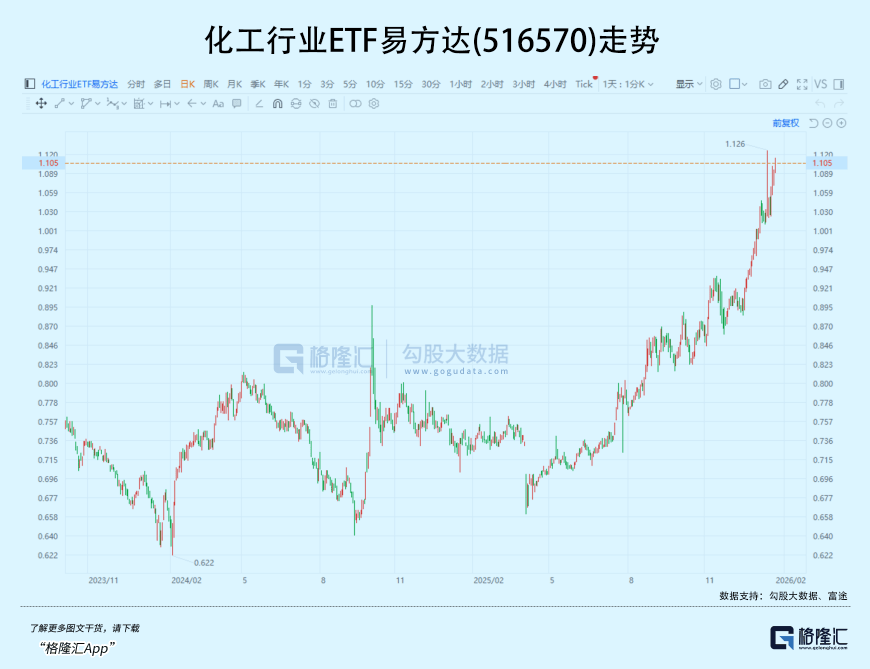
Group 1 - The A-share market experienced a collective rise, with the Shanghai Composite Index increasing by 0.14%, the Shenzhen Component Index by 0.5%, and the ChiNext Index by 1.01% [1] - The oil and petrochemical sector saw a rapid increase, with significant gains from the "three major oil companies," which boosted the chemical industry ETF E Fund (516570) by 1.92% [1] - Brent crude oil prices rose to $64.92 per barrel, up 5.85% from the beginning of the month [3] Group 2 - The chemical sector's strength is not solely attributed to oil price fluctuations; 2024 may be an optimal time for investors to position themselves in this sector [4] - The E Fund chemical industry ETF has surged over 24% in the last 25 trading days, reaching a new high since 2022, with net inflows exceeding 127 million yuan in the past 20 trading days [5] - The chemical industry has undergone a prolonged capacity digestion period over the past three years, with a significant supply pressure expected to ease by 2025 [8] Group 3 - The inventory cycle is shifting from "passive destocking" to "active restocking," with inventory levels in most segments at historical lows since Q3 2025 [11] - The central government's policy changes aim to prevent "involution-style" competition, establishing new operational principles for the industry [14] - The chemical industry is transitioning from a focus on market share to return-oriented strategies, which is expected to elevate the industry's profit margins [14] Group 4 - The phosphate and fluorine chemical sectors are experiencing a revaluation from "cyclical" to "resource" products, driven by the scarcity of phosphate rock and increasing demand from the lithium iron phosphate battery market [15][17] - The fluorochemical sector is witnessing a shift due to the implementation of third-generation refrigerant quotas, leading to a recovery from previous losses [19] Group 5 - The chemical sector is poised for valuation recovery, with the chemical industry ETF E Fund (516570) currently showing a price-to-earnings ratio of 16.09 and a dividend yield of 2.81% [20] - The overall net profit of the petrochemical industry index is expected to grow by 8.78% in 2026, indicating a stabilization in profitability [22] - The E Fund ETF offers a cost-effective investment option with a low fee structure of 0.2% per year, making it attractive for long-term investors [27] Group 6 - The chemical industry is entering a significant turning point, supported by macroeconomic recovery, stable oil prices, and supply-side reforms [27] - Each segment within the chemical industry is experiencing its unique narrative of "supply-demand rebalancing" and "value re-evaluation," indicating a promising outlook for the sector [27]

化工ETF(159870)收涨1.47%获净申购超14亿份,反内卷推进及人民币升值带来原油采购成本下降,大炼化行业景气上行可期
Xin Lang Cai Jing· 2026-01-20 07:52
Group 1 - The chemical sector is experiencing a strong rise due to the ongoing anti-involution efforts and the appreciation of the RMB, which has led to a decrease in crude oil procurement costs. The chemical ETF (159870) saw a net subscription of 1.412 billion units today, marking 14 consecutive days of net inflow [1] - The Ministry of Industry and Information Technology and four other departments issued a notice for the assessment of outdated petrochemical facilities, with progress exceeding 60% in Liaoning's efforts to eliminate and upgrade these facilities by January 9, 2026 [1] - The refining capacity in China is nearing the 1 billion ton threshold, with limited new capacity expected. The exit of outdated facilities is anticipated to improve the supply-demand dynamics in the refining industry [1] Group 2 - The PX market is showing upward momentum, with a day-on-day increase of 0.64% and a year-on-year increase of 6.27% as of January 13. The price spread is $339/ton, which is $100/ton higher than the average of $239/ton in 2025. The import volume of PX accounts for about 20% of total demand, and with limited new capacity, the supply-demand situation is expected to tighten due to growing downstream polyester demand [1] - The polyester industry chain's capacity expansion is nearing completion, with increasing consumer demand in end markets such as textiles and drinking water, as well as growth in Southeast Asia. The industry supply-demand dynamics are improving, awaiting the PTA anti-involution meeting to further enhance the overall chain's outlook [2] - As of January 20, 2026, the CSI sub-sector chemical industry theme index (000813) rose by 1.52%, with significant gains in constituent stocks such as Sankeshu (up 10.00%), Luxi Chemical (up 8.89%), and Satellite Chemical (up 6.67%). The chemical ETF (159870) increased by 1.47%, with the latest price at 0.9 yuan [2]
《能源化工》日报-20260115
Guang Fa Qi Huo· 2026-01-15 01:58
1. Report Industry Investment Rating No relevant information provided in the reports. 2. Core Views of the Reports Polyolefin Industry - LLDPE: Supply is expected to increase marginally, and demand enters the seasonal off - season with weakening downstream开工率. There is a positive feedback in the spot market, and the sustainability of demand should be monitored [1]. - PP: Both supply and demand are weak. There are many maintenance plans, and there is an expectation of inventory reduction in January. The balance has improved significantly, and attention should be paid to the implementation of maintenance plans [1]. Methanol Industry - The methanol futures are oscillating strongly. The inland price is expected to oscillate, and the port price is restricted by factors such as low MTO profits and potential maintenance of MTO devices [3]. Pure Benzene - Styrene Industry - Pure benzene: The short - term supply - demand pattern is weak, but it is driven by the strong performance of styrene and oil prices. The short - term trend is strong. It is recommended to wait and see for BZ2603 unilaterally and narrow the EB - BZ spread when it is high [5]. - Styrene: The short - term supply - demand is tight, but there is an expectation of inventory accumulation around the Spring Festival, and the upward space is limited. It is recommended to look for shorting opportunities for EB03 and narrow the EB processing fee when it is high [5]. Natural Rubber Industry - The rubber price is expected to oscillate in the range of 15,500 - 16,500. The raw material price provides support at the lower end, and the weak demand suppresses the upper end. Attention should be paid to the raw material output in Thailand [6]. Glass - Soda Ash Industry - Soda ash: The futures price is expected to oscillate weakly in the short term. Attention should be paid to the production load adjustment and inventory situation of soda ash plants [9]. - Glass: The price is expected to continue to weaken in the short term and can be treated bearishly [9]. Crude Oil Industry - The oil price is generally strong due to the instability in Iran, but the increase is limited by the weak supply - demand expectation. Attention should be paid to geopolitical conflicts such as the Russia - Ukraine peace talks and the Middle East situation [11]. LPG Industry No specific views provided in the report other than price and inventory data. Polyester Industry - PX: The short - term price is expected to oscillate at a high level before the Spring Festival, and the mid - term can be treated bullishly at low levels. It is recommended to do a long - short spread for PX5 - 9 at a low level [16]. - PTA: The short - term price is expected to oscillate between 5,000 - 5,300, and the mid - term can be treated bullishly at low levels. It is recommended to do a long - short spread for TA5 - 9 at a low level [16]. - MEG: The price is under pressure. It is recommended to pay attention to the pressure at around 4,000 for EG2605, do a short - long spread for EG5 - 9 at a high level, and sell out - of - the - money call options EG2605 - C - 4100 at a high level [16]. - Short fiber: The price is driven by raw materials in the short term. It is recommended to have the same strategy as PTA unilaterally and narrow the PF processing fee when it is high [16]. - Bottle chips: The price and processing fee are expected to follow the cost side. It is recommended to have the same strategy as PTA unilaterally [16]. PVC - Caustic Soda Industry - Caustic soda: The price is expected to be stable and weak. Attention should be paid to the procurement volume of the main downstream and the price fluctuation of liquid chlorine [18]. - PVC: The fundamentals are still under pressure, but the short - term price fluctuates emotionally. It is recommended to wait and see for short positions [18]. Urea Industry - The urea price is expected to be strong in the short term. Attention should be paid to the follow - up of downstream agricultural demand and the resumption rhythm of devices [19]. 3. Summaries According to Relevant Catalogs Polyolefin Industry - **Prices and Spreads**: Futures and spot prices of LLDPE and PP increased, and there were changes in various spreads such as L59, PP59, and LP05 [1]. - **Inventory**: PE enterprise inventory decreased by 11.41%, and PP trader inventory decreased by 5.28% [1]. - **开工率**: PE装置开工率 increased by 0.52%, and PP装置开工率 decreased by 1.65% [1]. Methanol Industry - **Prices and Spreads**: Methanol futures and spot prices increased, and there were changes in various spreads such as MA59 and regional spreads [3]. - **Inventory**: Methanol enterprise inventory increased by 0.73%, and port inventory decreased by 6.63% [3]. - **开工率**: The upstream domestic enterprise开工率 increased by 0.54%, and some downstream device开工率 decreased [3]. Pure Benzene - Styrene Industry - **Prices and Spreads**: The prices of pure benzene, styrene, and related products increased, and there were changes in various spreads such as EB - BZ [5]. - **Inventory**: The pure benzene port inventory reached a record high, and the styrene port inventory decreased significantly [5]. - **开工率**: The开工率 of some pure benzene and styrene downstream industries changed, with some increasing and some decreasing [5]. Natural Rubber Industry - **Prices and Spreads**: The spot price of natural rubber increased, and there were changes in various spreads such as the 9 - 1 spread [6]. - **Inventory**: The bonded area inventory increased by 3.62%, and the factory - warehouse futures inventory decreased by 1.74% [6]. - **Production and开工率**: The production in Thailand, Indonesia, and other countries decreased in November, and the开工率 of automobile tires changed [6]. Glass - Soda Ash Industry - **Prices and Spreads**: The spot prices of glass and soda ash were generally stable, and there were changes in futures prices and spreads [9]. - **Inventory**: The glass factory - warehouse inventory decreased by 5.69%, and the soda ash factory - warehouse inventory increased by 4.25% [9]. - **Supply and开工率**: The开工率 and supply of soda ash remained at a high level, and the glass melting volume and产能利用率 decreased slightly [9]. Crude Oil Industry - **Prices and Spreads**: The prices of Brent, WTI, and SC crude oil increased, and there were changes in various spreads such as Brent - WTI [11]. - **Refined Oil**: The prices of refined oil products such as NYM RBOB and NYM ULSD increased, and there were changes in cracking spreads [11]. LPG Industry - **Prices and Spreads**: The LPG futures prices changed slightly, and the spot price increased. There were changes in various spreads such as PG02 - 03 [14]. - **Inventory**: The LPG refinery storage capacity ratio decreased by 1.94%, and the port inventory decreased by 0.41% [14]. - **开工率**: The upstream main refinery开工率 increased by 2.49%, and the downstream PDH开工率 increased by 0.68% [14]. Polyester Industry - **Prices and Spreads**: The prices of PX, PTA, MEG, and polyester products changed, and there were changes in various spreads such as PX - naphtha [16]. - **Inventory**: The MEG port inventory increased [16]. - **开工率**: The开工率 of PX, PTA, and polyester products changed, with some increasing and some decreasing [16]. PVC - Caustic Soda Industry - **Prices and Spreads**: The prices of PVC and caustic soda decreased slightly, and there were changes in various spreads such as V2605 - V2601 [18]. - **Inventory**: The inventory of liquid caustic soda and PVC increased [18]. - **开工率**: The开工率 of the caustic soda and PVC industries changed, with some increasing and some decreasing [18]. Urea Industry - **Prices and Spreads**: The urea futures price increased, and the spot price was stable with a slight upward trend. There were changes in various spreads and basis [19]. - **Inventory**: The domestic urea factory - warehouse inventory decreased by 3.53%, and the port inventory remained unchanged [19]. - **Supply and Demand**: The daily and weekly production of urea increased, and the agricultural demand in some regions increased [19].
涨价投资机遇梳理 -五大行业
2025-12-25 02:43
Summary of Key Points from Conference Call Records Industry Overview - **Chemicals Industry**: Benefiting from anti-involution policies and domestic demand recovery, with specific sectors like pesticides, refrigerants, organosilicon, and phosphate chemicals seeing improved profitability. The chemical sector index has significantly risen since July 2025, indicating a potential oil price bottom in the first half of 2026 [1][3][6]. - **New Energy Materials**: Experiencing explosive growth in downstream demand, particularly in electric vehicles and energy storage, while upstream resources are limited and midstream capacity expansion lags behind demand, leading to price increases for lithium and cobalt [1][3]. - **Electronics Industry**: Supported by AI hardware demand, semiconductor capacity expansion, and domestic policies, with increased demand for electronic chemicals and storage chips [1][4]. - **Non-ferrous Metals**: Supply constraints due to resource scarcity, rising extraction costs, and geopolitical disturbances, alongside sustained demand from photovoltaics and energy storage, have driven prices of copper, gold, and silver to historical highs, with expectations for copper prices to continue rising in the first half of 2026 [1][4][19]. Core Insights and Arguments - **Chemical Sector Performance**: The chemical sector index has risen nearly 40% since July 2025, despite marginal performance declines in Q2 to Q4. The reversal in supply-demand dynamics, particularly on the supply side, has been a key driver of stock price increases [6][12]. - **Investment Opportunities**: The polyester industry chain, particularly PTA and its derivatives, is highlighted as having significant price elasticity and potential for investment due to high concentration and recent price increases driven by global oil demand [7][9]. - **Refrigerants Market**: The refrigerants industry is expected to see price increases due to changes in supply-demand dynamics and anti-dumping measures, with applications in automotive and liquid cooling sectors [10][11]. Additional Important Insights - **PPI Recovery**: The Producer Price Index (PPI) has shown signs of recovery, with a notable decrease of 2.3% year-on-year in September, but the decline has narrowed significantly [5]. - **Weak Dollar Environment**: The overall weak dollar trend is expected to persist, providing unexpected opportunities despite changes in interest rate expectations [5]. - **Electronics Price Trends**: Significant price increases have been observed in the electronics supply chain, particularly in wafer manufacturing, storage, and analog devices, driven by increased demand and supply constraints [13]. - **Communication Sector**: The optical device sector is experiencing price increases due to rising demand for 1.6T optical modules and 800 laser modules, with expectations for continued price growth in the fiber optics market [15][16]. Future Outlook - **Chemical Industry**: The chemical sector is still in the early stages of a bull market, with expectations for significant performance improvements in 2026 [12]. - **Non-ferrous Metals**: Continued price increases are anticipated for major metals like copper and aluminum, with a focus on demand-side changes in the latter half of 2026 [22]. - **Lithium Battery Materials**: Prices for lithium and its derivatives are expected to rise due to strong demand growth outpacing supply, with projections for lithium carbonate prices to reach 150,000 to 200,000 yuan [24][25]. - **Copper Foil and Membrane Materials**: The copper foil industry is expected to see significant elasticity due to potential supply-demand gaps, while the membrane industry is facing challenges due to long expansion cycles [27][28].
《能源化工》日报-20251225
Guang Fa Qi Huo· 2025-12-25 01:43
1. Report Industry Investment Ratings No information about industry investment ratings is provided in the documents. 2. Core Views of the Reports Natural Rubber - Short - term fundamentals change little. The rubber price rises due to the increasing preference for commodities, but there is a risk of a sharp fall after a rise [1]. Methanol - The port may face inventory accumulation pressure in December, but the supply - demand balance sheet is expected to turn to inventory reduction in the first quarter of the next year. The supply - demand pattern in the inland area is expected to be stable, and the price will fluctuate within a narrow range [4]. Polyolefins - For PP, supply increases while demand decreases, with low marginal device valuation and a slight reduction in inventory. For PE, both supply and demand are weak, with a decrease in the marginal supply of standard products, low valuation, and the futures price rising with reduced positions [8]. Pure Benzene and Styrene - Pure benzene may maintain a volatile trend in the short term, with the BZ2603 contract likely to fluctuate between 5300 - 5600. Styrene's rebound space is limited, and the EB02 contract may fluctuate between 6300 - 6700 [9]. Glass and Soda Ash - Soda ash's supply - demand pattern is bearish, and the price is in a downward - fluctuating pattern. It is recommended to consider short - selling opportunities after the rebound. Glass's market still faces pressure, and the 01 contract will follow the delivery logic in December [10]. PVC and Caustic Soda - Caustic soda's price is expected to be weak in the short term, and its rebound range is limited. PVC is expected to continue to move in a range, and its rebound height is limited [11]. Crude Oil - Crude oil prices are expected to fluctuate between 60 - 65 dollars per barrel, and it is necessary to continue to pay attention to the geopolitical situation after the holiday [12]. Urea - Urea prices may fluctuate between 1700 - 1750. It is necessary to pay attention to the enterprise's replenishment demand and the progress of export policies [14]. LPG - No clear overall view is provided in the LPG - related content. Polyester Industry Chain - PX may continue to be strong in the short term, but caution is needed. PTA's upward movement is limited. MEG is expected to fluctuate and consolidate. Short - fiber's absolute price has limited drivers. Bottle - chip's processing fees are expected to be compressed [18]. 3. Summaries According to Relevant Catalogs Natural Rubber Spot Prices and Basis - The price of Yunnan state - owned whole - latex (SCRWF) in Shanghai rose by 250 yuan/ton to 15100 yuan/ton, with a 1.68% increase. The whole - latex basis decreased by 110 yuan/ton to - 550 yuan/ton, a 25.00% decline [1]. Monthly Spreads - The 9 - 1 spread increased by 70 yuan/ton to 5 yuan/ton, a 107.69% increase. The 1 - 5 spread decreased by 65 yuan/ton to - 30 yuan/ton, a 185.71% decline [1]. Production and Inventory - Thailand's October production decreased by 48.3 thousand tons to 466.2 thousand tons, a 9.39% decline. The bonded - area inventory increased by 16339 tons to 515227 tons, a 3.28% increase [1]. Methanol Prices and Spreads - The MA2601 closing price rose by 4 yuan/ton to 2134 yuan/ton, a 0.19% increase. The MA15 spread decreased by 12 yuan/ton to - 38 yuan/ton, a 46.15% increase [4]. Inventory - Methanol enterprise inventory increased by 1.28 million tons to 40.397 million tons, a 3.28% increase. Methanol port inventory increased by 19.37 million tons to 141.3 million tons, a 15.89% increase [4]. Operating Rates - The upstream domestic enterprise operating rate increased by 0.99 percentage points to 77.63%, a 1.29% increase. The downstream MTO device operating rate increased by 1.51 percentage points to 86%, a 1.79% increase [4]. Polyolefins Prices and Spreads - The L2601 closing price rose by 104 yuan/ton to 6320 yuan/ton, a 1.67% increase. The L15 spread decreased by 8 yuan/ton to - 28 yuan/ton, a 16.00% decline [8]. Inventory - PE enterprise inventory decreased by 2.92 million tons to 45.9 million tons, a 5.99% decline. PP trade - dealer inventory decreased by 2.01 million tons to 18.7 million tons, a 9.70% decline [8]. Operating Rates - The PE device operating rate decreased by 0.25 percentage points to 83.9%, a 0.30% decline. The PP device operating rate increased by 1.08 percentage points to 79.4%, a 1.37% increase [8]. Pure Benzene and Styrene Upstream Prices and Spreads - Brent crude oil (February) decreased by 0.14 dollars per barrel to 62.24 dollars per barrel, a 0.2% decline. The pure benzene - to - naphtha spread increased by 4 dollars per ton to 128 dollars per ton, a 3.2% increase [9]. Styrene - Related Prices and Spreads - Styrene's East - China spot price rose by 90 yuan/ton to 6650 yuan/ton, a 1.4% increase. The EB02 - EB03 spread decreased by 7 yuan/ton to - 64 yuan/ton, a 12.3% increase [9]. Inventory and Operating Rates - Pure benzene's Jiangsu port inventory increased by 1.3 million tons to 27.3 million tons, a 5.0% increase. The domestic pure benzene operating rate decreased by 0.2 percentage points to 74.9%, a 0.2% decline [9]. Glass and Soda Ash Prices and Spreads - The glass 2601 price rose by 3 yuan/ton to 941 yuan/ton, a 0.32% increase. The soda ash 2605 price rose by 9 yuan/ton to 1184 yuan/ton, a 0.81% increase [10]. Production and Inventory - Soda ash's weekly production decreased by 1.4 million tons to 72.14 million tons, a 1.90% decline. Glass factory inventory increased by 33.1 million tons to 5855.8 million tons, a 0.57% increase [10]. PVC and Caustic Soda Prices and Spreads - The East - China calcium - carbide - based PVC market price rose by 60 yuan/ton to 4480 yuan/ton, a 1.4% increase. The SH2601 price rose by 12 yuan/ton to 2150 yuan/ton, a 0.6% increase [11]. Supply and Demand - The caustic - soda industry operating rate decreased by 1.4 percentage points to 88.5%, a 1.5% decline. The PVC total operating rate decreased by 2.3 percentage points to 16.1%, a 2.9% decline [11]. Inventory - The liquid - caustic East - China factory inventory decreased by 1.4 million tons to 22.7 million tons, a 5.7% decline. The PVC upstream factory inventory decreased by 1.6 million tons to 32.9 million tons, a 4.6% decline [11]. Crude Oil Prices and Spreads - Brent crude oil rose by 0.31 dollars per barrel to 62.38 dollars per barrel, a 0.50% increase. The Brent M1 - M3 spread increased by 0.12 dollars per barrel to - 3.16 dollars per barrel, a 3.66% decline [12]. Refined Oil - NYM RBOB rose by 10.75 cents per gallon to 627.25 cents per gallon, a 1.74% increase. The RBOB M1 - M3 spread decreased by 0.34 cents per gallon to - 3.15 cents per gallon, a 12.10% increase [12]. Urea Prices and Spreads - The methanol - main - contract price rose by 16 yuan/ton to 2172 yuan/ton, a 0.74% increase. The 01 - contract - to - 05 - contract spread decreased by 6 yuan/ton to - 62 yuan/ton, a 9.68% decline [14]. Supply and Demand - The domestic urea daily production decreased to 19.5 million tons, a 0.00% change. The urea production factory operating rate remained at 80.62%, a 0.00% change [14]. Inventory - The domestic urea factory inventory decreased by 11.08 million tons to 106.89 million tons, a 9.39% decline. The domestic urea port inventory remained at 13.8 million tons, a 0.00% change [14]. LPG Prices and Spreads - The main PG2601 contract price rose by 36 yuan/ton to 4221 yuan/ton, a 0.86% increase. The PG01 - 02 spread decreased by 15 yuan/ton to 139 yuan/ton, a 9.74% decline [16]. Inventory and Operating Rates - The LPG port inventory decreased by 22.4 million tons to 261 million tons, a 7.89% decline. The downstream PDH operating rate increased by 2.1 percentage points to 75.0%, a 2.92% increase [16]. Polyester Industry Chain Upstream and Downstream Prices - Brent crude oil (February) decreased by 0.14 dollars per barrel to 62.24 dollars per barrel, a 0.2% decline. The POY150/48 price remained at 6395 yuan/ton, a 0.0% change [18]. PX - Related - CFR China PX rose by 5 dollars per ton to 901 dollars per ton, a 0.6% increase. The PX - to - naphtha spread increased by 6 dollars per ton to 447 dollars per ton, a 1.4% increase [18]. PTA and MEG - The PTA East - China spot price rose by 60 yuan/ton to 5015 yuan/ton, a 1.2% increase. The MEG port inventory increased by 3.0 million tons to 71.6 million tons, a 4.4% increase [18].