
两融资金

Search documents
目前个别大中型券商的两融资金已用完
Mei Ri Jing Ji Xin Wen· 2026-01-14 23:51
Core Viewpoint - Some large and medium-sized brokerages have exhausted their margin financing funds, indicating a significant increase in market sentiment and financing willingness, despite many brokerages raising their margin financing limits last year [1] Group 1 - The current market sentiment is high, leading to unprecedented financing willingness among investors [1] - Multiple brokerages are experiencing a shortage of margin financing quotas, suggesting a potential liquidity issue in the market [1] - Brokerages may intentionally slow down the release of liquidity as a risk management measure [1]
天风证券:酝酿新一轮交易脉冲
Xin Lang Cai Jing· 2025-12-08 10:33
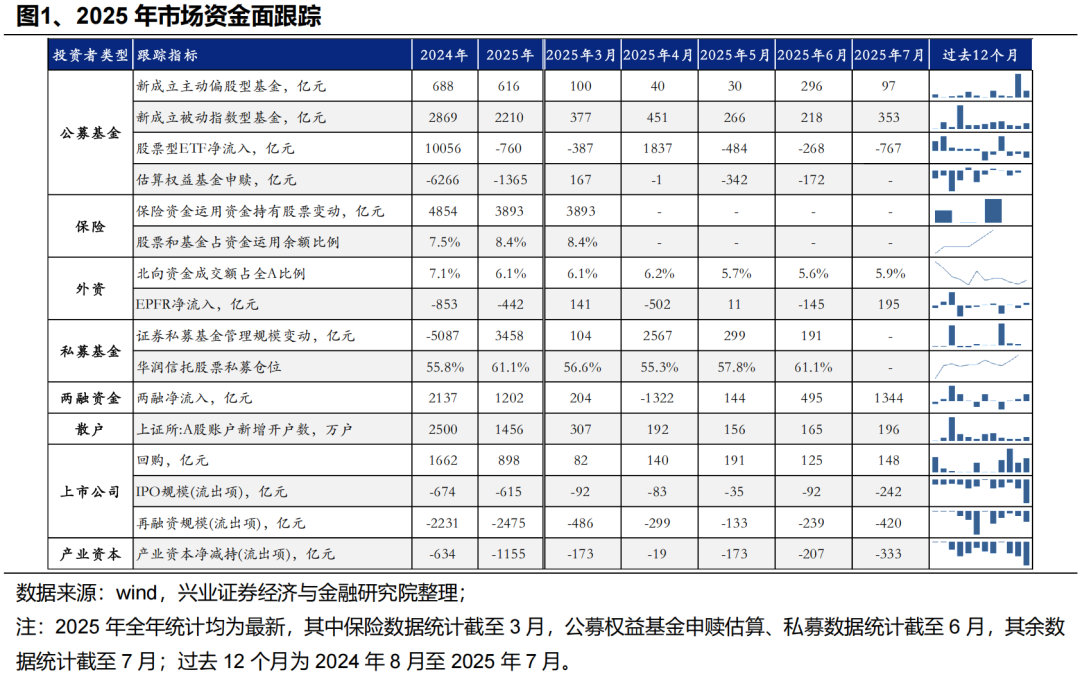
Group 1: Public Funds - In November, the newly established equity public fund shares reached 716.44 billion, an increase of 168.21 billion from the previous month, placing it in the 94.44 percentile over the past three years [12][73] - The new issuance of active equity funds in November was 255.00 billion, up by 96.12 billion month-on-month, while passive equity funds saw an increase of 288.92 billion, up by 63.54 billion [13][73] - The net subscription for stock ETFs in November was 177.00 billion, a decrease of 335.87 billion from the previous month, with broad-based ETFs being the main direction of fund outflow [17][73] Group 2: Private Securities Funds - The scale of private securities funds in October was 7.01 trillion, showing a significant increase compared to September [24][68] - The number of newly issued stock products in October was 995, a decrease of 53 from September, indicating a slight downward trend [24][68] - The average position of private equity long-only indices in September was 66.22%, up 2.40 percentage points from August, reflecting a rising trend in market risk appetite [26][68] Group 3: Northbound Capital - In November, the average daily trading volume of northbound capital was 2212.42 billion, down 14.35% from the previous month, with its share of total A-share trading falling to 11.56% [27][68] - The decline in northbound trading volume may be attributed to the recent hawkish comments from some Federal Reserve officials, tightening market liquidity expectations [27][68] Group 4: Margin Financing - As of the end of November, the total margin financing balance was 2.47 trillion, a decrease of 0.52% from the previous month [31][68] - The net outflow of margin financing in November was 126.13 billion, with the trading volume of margin financing accounting for 10.44% [34][68] Group 5: Incremental Capital - In November, the number of new institutional accounts opened on the Shanghai Stock Exchange was 0.97 million, a year-on-year increase of 28.49% [38][69] - The number of new personal accounts was approximately 2.37 million, showing a year-on-year decline of 11.86%, but the decline was significantly narrowed compared to the previous period [38][69] Group 6: Insurance Capital - In Q3 2025, the net increase in equity assets held by property and life insurance companies was 8639.94 billion [42][69] - The proportion of equity assets in the total investment of insurance funds reached 15.49%, an increase of 1.96 percentage points [42][69] Group 7: Bank Wealth Management - In November, the number of wealth management products issued was 6651, an increase of 35.73% from the previous month [49][69] - The number of products reaching maturity was 3702, up 96.91% month-on-month, indicating a significant recovery in issuance [49][69] Group 8: Industrial Capital - In November, the overall net reduction in industrial capital was 401.31 billion, with a daily average net reduction of 20.07 billion [55][69] - The reduction trend continues, but it remains at a historically low level, particularly in the electronics and defense industries [55][69] Group 9: Three Major Capital Flow Indicators - As of November 28, the capital flow indicator value was -0.04, indicating a decrease in trading activity in the equity market [61][70] - The narrowing decline in the indicator suggests that the market adjustment may be nearing its end, with potential entry points for foreign capital and public institutions [61][70]



股指月报:美联储释放偏鹰信号,金融条件收紧抑制股市-20251103
Zheng Xin Qi Huo· 2025-11-03 07:27
Report Industry Investment Rating No relevant content provided. Core Views - After the macro events such as the China-US summit and the Fed's interest rate meeting, the market's positive factors have been fully realized. However, the Fed has released a hawkish guidance, which exerts downward pressure on risk assets in Q4. The domestic economy still faces significant pressure, with the manufacturing PMI hitting a new low, indicating insufficient demand. But the incremental fiscal funds are expected to support the economy [4]. - The domestic economic data continues to be weak, especially in the consumption and real estate sectors. The high-frequency real estate sales data has declined significantly without incremental positive policies. The export orders shown by the PMI have dropped sharply, related to the end of the rush to export. The anti-involution policy is being promoted, resulting in a weak supply and demand in the real economy [4]. - The domestic liquidity is generally loose, with the government debt financing rising continuously and the marginal increase in open market money supply. The short-term liquidity is neutral, but the credit impulse in Q4 is marginally tightening. Passive ETF funds continue to be subscribed, and margin trading funds continue to flow in stably. The reduction intensity of industrial capital has slowed down. Overseas liquidity is marginally tightening under the Fed's hawkish guidance, and foreign capital has a marginal outflow tendency. The overall supply and demand of market funds are relatively optimistic, but there are also some differences, so beware of the risk of high-level style switching [4]. - After a sharp short-term rise, the valuations of various indices have reached relatively high levels in history. The stock-bond risk premiums at home and abroad are low, and the attractiveness of allocation funds is average [4]. - Currently, the broad-based index market has high valuations, especially the growth style. The risk premium indices at home and abroad have dropped to low levels, and the attractiveness of the stock market has decreased marginally. With the large market scale, the limited liquidity is difficult to drive continuous growth. After the short-term macro positive factors are fully realized, the market enters a policy vacuum period. With the marginal support of fiscal funds for the economy in Q4, the overall macro fluctuations are expected to be small. The market may maintain a high-level range-bound trend, similar to that in Q4 last year. Focus on structural opportunities. It is recommended to adopt a high-sell and low-buy strategy for stock indices in November. Consider shorting IF, IC, and IM stock indices in the high-rebound area and going long on IF and IH stock indices in the sharp-drop low area. Pay attention to the arbitrage opportunity of going long on the cyclical style and shorting the growth style [4]. Summary by Relevant Catalogs Market Review - In the past month, among global stock markets, the Nikkei 225 led the rise, while the Hang Seng Tech Index led the decline. Among domestic stock markets, the Shanghai Composite Index rose 1.85%, and the Hang Seng China Enterprises Index fell 4.05% [8][9]. - In the past month, among industries, coal led the rise, while media led the decline [12]. - In the past month, the basis rates of the four major stock index futures (IH, IF, IC, and IM) changed by 0.19%, 0.14%, -0.35%, and 0.65% respectively. The discounts of IC and IM widened, while the discounts of IF and IH narrowed slightly. The changes in the inter - period spreads of the four major stock index futures were generally small, but the long - term discounts of IC and IM widened significantly [18]. Fund Flow - In October, margin trading funds flowed in 104.93 billion yuan to reach 2.5 trillion yuan, and the proportion of margin trading balance to the circulating market value of the Shanghai and Shenzhen stock markets increased by 0.08% to 2.58%. The scale of passive stock ETF funds was 3.73373 trillion yuan, an increase of 125.81 billion yuan from the previous month. The share was 211.724 billion shares, with a subscription of 76.25 billion shares from the previous month, and a subscription of 5.89 billion shares in the latest week, with the scale increasing by 15.36 billion yuan [21]. - In October, equity financing was 49.44 billion yuan, with 6 companies. IPO financing was 12.16 billion yuan, private placement was 37.27 billion yuan, and convertible bond financing was 5.48 billion yuan. The equity financing scale decreased significantly, mainly due to the reduction in private placement. The market value of restricted - share lifting in October was 246.84 billion yuan, a decrease of 58.14 billion yuan from the previous month, mainly due to the one - week less trading time during the National Day holiday. The reduction scale in the recent week decreased marginally, with the monthly - annualized scale dropping to 211.28 billion yuan [24]. Liquidity - In October, the central bank's OMO reverse repurchase expired 5.8572 trillion yuan, with a reverse repurchase issuance of 5.2761 trillion yuan, resulting in a net money withdrawal of 58.11 billion yuan. The liquidity in the open - market business tightened. The MLF issued 900 billion yuan and expired 700 billion yuan in October, with a net issuance of 20 billion yuan. The MLF has had a net issuance for 8 consecutive months, and the overall liquidity supply is neutral to loose [26]. - In October, the DR007, R001, and SHIBOR overnight rates changed by 1.7bp, - 12.6bp, and - 5.8bp respectively to 1.46%, 1.41%, and 1.32%. The issuance rate of inter - bank certificates of deposit decreased by 8.5bp, and the CD rate issued by joint - stock banks dropped by 2.1bp to 1.64%. The capital supply tended to be loose, and the debt financing demand was strong. The capital price generally fluctuated at a low level [32]. - In October, the yield of the 10 - year Treasury bond changed by - 8.1bp, the 5 - year Treasury bond yield changed by - 5.6bp, and the 2 - year Treasury bond yield changed by - 10.9bp. The 10 - year CDB bond yield changed by - 11.1bp, the 5 - year CDB bond yield changed by - 7.3bp, and the 2 - year CDB bond yield changed by - 6.8bp. Overall, the yield term structure steepened slightly in October, and both long - and short - term interest rates decreased significantly, mainly due to the weak economic data and the decline in financing demand. The credit spread between Treasury bonds and CDB bonds narrowed significantly at the long end, indicating a cooling of the broad - credit expectation [36]. - As of October 31, the 10 - year US Treasury bond rate changed by - 5.0bp to 4.11%, the inflation expectation changed by - 6.0bp to 2.30%, and the real interest rate changed by 1.00bp to 1.81%. The risk asset prices were first boosted and then suppressed by the financial conditions. The 10 - 2Y spread of US Treasury bonds changed by - 5.00bp to 51.00bp. The inversion of the China - US interest rate spread widened slightly by 1.12bp to - 231.42bp, and the offshore RMB appreciated by 0.11%. The US dollar against the RMB fluctuated at a level below the mid - point of the three - year range [39]. Macroeconomic Fundamentals - As of October 30, the weekly trading area of commercial housing in 30 large - and medium - sized cities was 2.074 million square meters, a slight decrease from the previous week's 2.101 million square meters, returning to a relatively low level in the same period. Compared with the same period in 2019 before the pandemic, it decreased by 45.4%. The second - hand housing sales decreased seasonally and significantly from the previous month, returning to a relatively low level in the past seven years. The real estate market sales showed a weak performance overall, with the sales center oscillating at a low level, and there were signs of marginal acceleration of weakening in the short term [43]. - As of October 31, the weekly average daily subway passenger volume in 28 large - and medium - sized cities in China remained at a high level, reaching 83.8 million person - times, a year - on - year increase of 3.1% and a 32% increase compared with the same period in 2021. The economic activity in the service industry heated up marginally. The traffic congestion delay index in 100 cities rebounded from the previous week, remaining at a neutral level in the past three years. Overall, the economic activity in the service industry tended to a natural and stable growth level, with insignificant monthly changes [46]. - In October, the overall capacity utilization rate of the manufacturing industry decreased. The capacity utilization rate of steel mills changed by - 2.25%, the asphalt capacity utilization rate changed by - 8.6%, the cement clinker enterprise capacity utilization rate changed by 5%, the coking enterprise capacity utilization rate changed by - 1.99%, and the average operating rate of the chemical industry chain related to external demand changed by - 0.5% from the previous month. On the one hand, the implementation of the anti - involution policy led to a decrease in capacity utilization; on the other hand, the weakening of domestic and foreign demand in the manufacturing industry led to a reduction in enterprise operating rates [50]. - In terms of exports, after the tariff policies of the US on major countries have been finalized and the China - US summit postponed the tariff policy exemption for one year, the risk of a full - scale escalation of trade frictions has dropped sharply. After the previous export impulse effect, there is a risk of a pulse decline in Q4. China's manufacturing export competitiveness is strong, and after the decline in trade friction risks, it is expected to maintain its potential growth rate for a long time, supporting the economic center [58]. - In September, the US CPI inflation continued to rebound, while the core CPI inflation unexpectedly decreased, with a month - on - month decline of 0.1% to 3%. In terms of structure, energy prices contributed the main increase, the growth of food and beverages related to commodity inflation did not expand, and the housing and medical sub - items related to core inflation declined significantly, especially the housing sub - item, which decreased by 0.2% in a single month, indicating that the policy of expelling illegal immigrants began to affect core inflation again. Assuming that the month - on - month growth rate in October remains at 0.3% and drops to 0.2% from November to December, the annualized month - on - month rate at the end of the year will drop to 2.84%, and the Fed has limited room for further interest rate cuts this year [59]. - The Fed cut interest rates by 25 basis points in October as expected by the market, but Powell released a hawkish guidance in the press conference, expressing concerns about the lag effect of tariffs on inflation and stating that the overall economic pressure was not large, and the preventive interest rate cuts were expected to end. The financial market significantly revised the overly optimistic market expectation of the Fed's interest rate cuts. According to the CME's FedWatch tool, the probability of another interest rate cut in December 2025 dropped significantly to 63%, and the market will maintain a wait - and - see attitude until next April. The expected terminal interest rate for this year's interest rate cuts is between 3.5% - 3.75% [63]. Other Analyses - In the past month, the stock - bond risk premium was 2.56%, a decrease of 0.04% from the previous month, at the 44.1% quantile. The foreign - capital risk premium index was 3.39%, a decrease of 0.1% from the previous month, at the 16.7% quantile. The attractiveness of foreign capital was at a relatively low level [66]. - The valuations of the Shanghai 50, CSI 300, CSI 500, and CSI 1000 indices were at the 86.4%, 86.6%, 95.7%, and 85.3% quantiles respectively in the past five years, with relatively high valuation levels. The quantiles changed by 0.3%, - 1.6%, - 4%, and - 0.3% respectively from the previous month, and the attractiveness of the CSI 300 and CSI 500 indices increased marginally [70]. - According to the seasonal pattern analysis, the stock market in November is in a period of seasonal oscillation and structural differentiation. In terms of style, the growth style takes the lead first, followed by the cyclical style, with an overall high - level oscillation. The profit - making effect of the stock market in November is generally poor, and the style switches frequently. Considering the high valuation of the current growth style, the weak real - economy situation, and the full realization of positive factors, it is prone to high - level adjustments. Since the IF, IH, and IC are highly related to AI technology, all styles have adjustment risks. It is recommended to pay attention to the opportunity of the cyclical style's supplementary increase and the switch from the growth style to AI applications. Go long on IF and IH in case of a sharp drop, and conduct high - sell and low - buy operations on IC and IM [74].
多家公募发布四季度策略 看好赚钱效应持续演绎
2 1 Shi Ji Jing Ji Bao Dao· 2025-10-03 09:03
Core Viewpoint - The optimism in the A-share and Hong Kong stock markets for the fourth quarter of 2025 is driven by the continuous inflow of overseas funds and the relocation of resident deposits, with a focus on technology stocks, new consumption, the internet, and innovative pharmaceuticals as key investment areas [1][2]. Group 1: Market Sentiment and Policy Support - Fund managers express confidence in the market due to supportive policies and the influx of new capital, with the A-share index breaking a ten-year high, indicating a return to reasonable pricing [2][4]. - The combination of proactive fiscal policies and moderately loose monetary policies is stabilizing the economy, while regulatory measures are encouraging long-term capital inflow and stabilizing market sentiment [2][3]. Group 2: Sector Focus and Investment Strategies - The technology sector is highlighted as a leading driver of market momentum, with breakthroughs in artificial intelligence, robotics, semiconductors, military technology, innovative pharmaceuticals, and new consumption creating new growth opportunities [3][5]. - Fund companies recommend focusing on sectors with strong certainty, particularly technology stocks, new consumption, the internet, and innovative pharmaceuticals, as these areas are expected to see significant growth [5][6]. Group 3: Capital Inflow and Market Dynamics - There has been an acceleration in the supply of new capital, with institutional investors increasing equity allocations and retail investor sentiment turning positive, leading to heightened trading activity [3][4]. - The shift in capital dynamics, with a focus on industry and thematic ETFs, indicates a robust market environment, supported by the recovery of corporate earnings and improved liquidity conditions [3][6]. Group 4: Hong Kong Market Outlook - The Hong Kong market is viewed as having good investment value, particularly in new consumption and technology sectors, with expectations of earnings recovery and liquidity improvement [6][7]. - The potential for foreign capital inflow, driven by favorable conditions such as U.S. interest rate cuts, is expected to provide additional support for the Hong Kong stock market [6][7].
A股七大资金主体面面观:谁的牛市?
Tianfeng Securities· 2025-09-05 11:48
Group 1 - The report highlights a significant increase in the issuance of equity mutual funds, with 66.147 billion units established in August, marking a month-on-month increase of 20.189 billion units, placing it in the 97.22 percentile over the past three years [8][9][10] - The report indicates that the issuance of active equity funds in August reached 16.961 billion units, up by 7.260 billion units from the previous month, while passive equity funds saw an issuance of 44.586 billion units, an increase of 9.284 billion units [10][11] - The report notes that the net subscription of existing equity ETFs in July was -3.349 billion yuan, but this figure improved significantly in August, with a net redemption scale narrowing [15][16] Group 2 - The report states that the scale of private securities funds increased significantly, with the total scale reaching 5.88 trillion yuan in July, reflecting a month-on-month increase [25][26] - The average position of private equity long strategies rose to 62.78% in July, an increase of 1.73 percentage points from June, indicating a recovery trend in private fund positions [26][31] - The report mentions that the monthly average trading volume of northbound funds in August was 294.227 billion yuan, a 51.96% increase from the previous month, with northbound trading accounting for 12.75% of total A-share trading [29][32] Group 3 - The report highlights that the margin financing balance reached 2.25 trillion yuan by the end of August, reflecting a month-on-month increase of 13.92%, indicating a rise in trading activity [34][36] - The report indicates that the net inflow of margin financing in August was 272.986 billion yuan, with margin financing transactions accounting for 10.98% of total trading [38][40] - The report notes that institutional investor accounts saw a significant increase, with approximately 10,000 new institutional accounts opened in August, a year-on-year increase of 98.37% [43][45] Group 4 - The report states that the scale of equity assets held by insurance companies increased by 261.914 billion yuan in the second quarter of 2025, reflecting a strong position in equity investments [47][49] - The report mentions that policies are being implemented to encourage insurance funds to invest 30% of new premiums in A-shares starting in 2025, which is expected to further boost equity market participation [51][52] - The report indicates that the issuance of wealth management products in August was 6,120, with the number of products reaching maturity increasing by 27.19% month-on-month [55][57] Group 5 - The report highlights that industrial capital saw a net reduction of 31.458 billion yuan in August, with a daily average net reduction of 1.498 billion yuan, indicating a trend of profit-taking at high market levels [62][63] - The report notes that the three major capital flow indicators reached a value of 0.64 as of August 29, placing it in the 96th percentile since the end of 2015, indicating a heated trading environment [70][71] - The report suggests that the current market sentiment is high, with increased risk appetite among investors, driven by favorable domestic and international developments [8][10][29]
兴业证券:7月高风偏资金主导流入 外资险资配置同步升温
智通财经网· 2025-08-10 00:07
Group 1 - The market is gradually shifting towards a bullish mindset, with higher risk tolerance funds showing significant net inflows in July, while lower risk tolerance funds are actively seeking structural opportunities in underpriced segments [1] - In July, higher risk tolerance funds' net inflows were primarily from leveraged funds and private equity, while ETFs experienced net outflows, particularly in broad market ETFs, with thematic ETFs contributing positively [1] - Insurance funds continue to increase their allocation to equity assets, expanding from narrow dividend assets to a broader range of dividend assets [1] Group 2 - The issuance and redemption of actively managed equity funds showed marginal improvement in July, indicating a potential exit from the low point of the funding cycle [2][5] - The net inflow of leveraged funds accelerated in July, with a notable increase in margin trading balances, surpassing 2 trillion yuan for the first time since 2015 [23] - Insurance capital has become a significant incremental funding source in the capital market, with stock holdings reaching the highest proportion recorded [27][28] Group 3 - Foreign capital turned net inflow in July, with overseas funds investing 20 billion yuan in A-shares, primarily through passive funds [36] - Private equity fund management scale and stock long positions have both increased significantly, indicating a bullish sentiment among private equity investors [41] - The number of new A-share accounts increased in July, but the growth rate was relatively slow compared to earlier in the year, suggesting that individual investors are not the main incremental funding source in the current market [44] Group 4 - The IPO and refinancing scale of listed companies showed a noticeable increase in July, although the overall financing level remains low compared to previous bull markets [47] - Industrial capital net reduction increased in July, indicating a trend of selling pressure from corporate insiders [52]

8月市场观点:把握景气趋势,博弈低位补涨-20250806
GOLDEN SUN SECURITIES· 2025-08-06 10:41
Group 1 - The report highlights that since the 1990s, China has experienced seven notable rounds of price increases, with the current phase expected to follow a supply-side logic leading to a lag in stock market performance compared to PPI [1][16][19] - It emphasizes that demand determines potential returns while supply influences certainty, indicating that the current supply-side "anti-involution" is clear, and further guidance from the demand side is awaited [1][17][19] - The report suggests that if demand-side policies are implemented, sectors with relatively high certainty and elasticity, such as cement, glass, pharmaceuticals, and electrical machinery, are likely to benefit [1][19] Group 2 - The monthly market review indicates that despite various external factors, market sentiment has improved, with major indices reaching new highs, particularly in the steel, pharmaceuticals, and construction materials sectors [2][23] - The report notes that the core contradiction in the market remains internal, with expectations for profit improvement driving the market, while external factors are expected to have a muted impact [3][23] - It recommends focusing on sectors with strong growth signals and those in an upward trend, such as military, pharmaceuticals, communication equipment, and insurance, while also considering potential rebound opportunities in semiconductor and robotics sectors [4][19] Group 3 - The report provides insights into the current capacity utilization rates across various industries, indicating that sectors like non-metallic mineral products, pharmaceuticals, and electrical machinery are under significant pressure due to overcapacity [20][22] - It highlights that the capacity utilization rates for key industrial products are at historically low levels, suggesting potential for recovery if demand-side policies are enacted [20][22] - The report also tracks the performance of different sectors, noting that steel, pharmaceuticals, and construction materials have led the market, while banking and public utilities have seen declines [2][23]
微观流动性监测,银行大规模定增
2025-07-02 01:24
Summary of Key Points from Conference Call Records Industry Overview - The conference call discusses the performance of the equity fund market, particularly focusing on public equity funds and their issuance trends amid geopolitical risks and market sentiment fluctuations [1][4]. Core Insights and Arguments - **Equity Fund Issuance**: The new issuance of equity public funds reached 296.6 billion, marking a 17% increase from the previous period. However, the overall issuance remains low compared to historical levels, with recent weeks showing significant fluctuations [3]. - **Market Sentiment**: The market is experiencing heightened risk aversion due to ongoing geopolitical tensions, particularly the Russia-Ukraine and Israel-Palestine conflicts, which have contributed to a low issuance environment for equity funds [4]. - **Northbound Capital Activity**: As of June 22, northbound capital accounted for 12% of total trading volume, showing a slight decline. The trading activity remains at a low level due to cautious attitudes from emerging foreign investors and a rebound in US stocks [5]. - **Two-way Financing Trends**: The balance of margin financing was reported at 1.79 trillion, with a net inflow of 50 billion, indicating a 30% decrease from the previous period. The inflow is primarily concentrated in downstream consumer and upstream raw material support sectors [5]. - **ETF and IPO Dynamics**: The net subscription for existing stock ETFs was negative 28 billion, a significant improvement from negative 85 billion previously. Upcoming IPOs are expected to total 26.5 billion, with a substantial increase in equity financing to 4.3 trillion, largely driven by major banks' capital increases [6][7]. Additional Important Insights - **Capital Reduction Trends**: The net reduction of industrial capital was 85.75 billion, with significant reductions in the machinery, electronics, and basic chemicals sectors. Conversely, slight increases were noted in food and beverage, petrochemicals, and steel sectors [2][8]. - **Southbound Capital Flow**: Southbound capital saw a net inflow of 290 billion, a decrease from the previous 394 billion. This trend indicates a gradual recovery in market sentiment, influenced by geopolitical developments and expectations of potential interest rate cuts by the Federal Reserve [9]. - **Lock-up Expiration Impact**: The market is facing a lock-up expiration value of 1.078 trillion, a 162.85% increase from the previous period, with significant pressure expected from the defense and military sectors [8].



股指月报:美国关税豁免将到期,关注特朗普极限施压风险-20250630
Zheng Xin Qi Huo· 2025-06-30 05:19
Report Industry Investment Rating No relevant information provided. Core Views - The results of the second Sino-US meeting were not significant. The US initiated new home appliance tariff policies and restrictions on key chip equipment. With the 90-day exemption period for various countries ending soon, there is a risk of tariffs impacting the market again in the next two weeks. It's necessary to guard against Trump's potential extreme pressure, similar to the situation in 2018. The domestic economy is entering a seasonal recovery window, and potential macroeconomic positives from the Politburo meeting in late June - July should be watched [4]. - The real estate sales are seasonally recovering from a low level, but the peak season is not booming. The service industry shows structural differentiation and a slight decline from its high level. In May, production and investment in the real economy declined, while consumption took the lead with the boost of fiscal subsidies. The logic of manufacturing rush exports continues, the domestic supply - demand contradiction is marginally cooling, and prices are expected to oscillate upwards. Attention should be paid to whether fiscal policy will further support the economic center in the second half of the year [4]. - Domestic liquidity is generally loose, and overseas liquidity is also tending to be loose due to the Fed's dovish guidance and declining economic data. Financial conditions have significantly improved. Coupled with the expected rebound of the US dollar index, the domestic stock market will receive incremental funds, with inflows from passive ETFs and margin trading funds, while IPO and other equity financing and unlocking pressures remain [4]. - After a short - term rebound, the valuations of various indices are still at a relatively high level in the historical neutral range. The stock - bond risk premiums at home and abroad are low, and the attractiveness of allocation funds is average [4]. - The pressure on the macro and industrial fundamentals is facing a marginal reversal, financial conditions are generally loose, and the valuations of broad - based index markets are generally not cheap. Coupled with the expected return of US tariff policy pressure, the stock market's upward path in the third quarter may be characterized by frequent setbacks, with an overall oscillatory upward trend. Policy - level macro expectations, excessive domestic liquidity, and the support of stable funds will support the lower limit of the stock market adjustment. It is recommended to actively go long on stock index futures during sharp declines in July. In terms of style, first go long on IC and IM, then on IF and IH, or conduct an arbitrage strategy of going long on IM and short on IF [4]. Summary by Directory 1. Market Review - **Global Stock Market Performance**: In the past month, A - shares led the global stock market rally, while European stocks led the decline. The performance order is: ChiNext > Dow Jones > Nikkei 225 > FTSE Emerging Markets > Hang Seng Tech > CSI 300 > German stocks > FTSE Europe. Specific index increases include: Shanghai Composite Index 2.29%, Shenzhen Component Index 3.37%, ChiNext Index 6.58%, etc. [8][9] - **Industry Performance**: In the past month, the comprehensive finance sector led the rise, while the food and beverage sector led the decline [12]. - **Futures Performance**: The basis rates of the four major stock index futures (IH, IF, IC, and IM) changed by 0.48%, 0.53%, 0.91%, and 1.26% respectively, with significant narrowing of the discounts. The inter - period spread rates (current month and next month) of the four major stock index futures changed by - 0.16%, - 0.2%, 0.16%, and 0.16% respectively. The inter - period discount of IH increased slightly, while those of IF, IC, and IM narrowed slightly. The inter - period spread rates (next quarter and current month) of the four major stock index futures changed by - 0.08%, - 0.12%, 0.21%, and 0.35% respectively. The long - term discounts of IH and IF increased slightly, while those of IC and IM narrowed slightly [16][17] 2. Fund Flow - **Margin Trading and Market - Stabilizing Funds**: In June, margin trading funds flowed in 37.5 billion yuan, reaching 1.84 trillion yuan. The proportion of margin trading balance to the circulating market value of the Shanghai and Shenzhen stock markets decreased by 0.02% to 2.27%. The scale of passive stock ETF funds reached 3.0185 trillion yuan, exceeding 3 trillion yuan for the first time, an increase of 68.35 billion yuan from the previous month. The share was 199.594 billion shares, with a redemption of 7.92 billion shares from the previous month [22]. - **Industrial Capital**: In June, equity financing was 541.96 billion yuan, with 6 companies involved. Among them, IPO financing was 8.73 billion yuan, private placement was 533.23 billion yuan, and convertible bond financing was 4.35 billion yuan. The scale of equity financing rebounded significantly to a high level. The market value of restricted - share unlockings (including additional issuance, placement, rights issue, equity incentive, etc.) was 218.5 billion yuan, an increase of 109.98 billion yuan from the previous month, showing a continuous marginal increase and ranking second highest in the year [25] 3. Liquidity - **Money Supply**: In June, the central bank's OMO reverse repurchase matured at 5.298 trillion yuan, and reverse repurchase was issued at 6.3795 trillion yuan, with a net money injection of 1.0815 trillion yuan. The liquidity in the open - market business was marginally loose at the end of the quarter. The MLF was issued at 300 billion yuan and matured at 182 billion yuan in June, with net issuance for four consecutive months, and the overall liquidity supply was neutral and tending to be loose [27]. - **Money Demand**: In June, the issuance of national bonds was 1.5958 trillion yuan, and the maturity was 889.65 billion yuan, with a net money demand of 706.15 billion yuan; the issuance of local bonds was 1.34898 trillion yuan, and the maturity was 484.32 billion yuan, with a net money demand of 864.65 billion yuan; the issuance of other bonds was 7.22604 trillion yuan, and the maturity was 6.6366 trillion yuan, with a net money demand of 589.43 billion yuan. The total bond market issuance was 10.17082 trillion yuan, and the maturity was 8.01058 trillion yuan, with a net money demand of 2.16023 trillion yuan. The debt financing demand in the bond market remained high, driven by the joint efforts of national bonds, local government bonds, and corporate debt financing [30]. - **Fund Price**: Last month, DR007, R001, and SHIBOR overnight rates changed by 3.2bp, - 12.6bp, and - 10bp respectively, reaching 1.7%, 1.44%, and 1.37%. The issuance rate of inter - bank certificates of deposit rebounded by 0.7bp, and the CD rate issued by joint - stock banks dropped by 3bp to 1.67%. The fund rate was significantly lower than the 1 - year MLF rate of 2% and slightly lower than the policy rate DR007 of 1.7%. The fund supply was loose, the debt financing demand was strong, but the real - economy financing was weak, and the fund price generally oscillated at a low level [33]. - **Term Structure**: Last month, the yield of the 10 - year national bond changed by - 2.3bp, the yield of the 5 - year national bond changed by - 5.6bp, and the yield of the 2 - year national bond changed by - 10.3bp; the yield of the 10 - year policy - bank bond changed by - 2.1bp, the yield of the 5 - year policy - bank bond changed by - 5.2bp, and the yield of the 2 - year policy - bank bond changed by - 5.2bp. Overall, the yield term structure steepened significantly in June due to the central bank's liquidity injection in the open market, which led to a significant decline in the short - end. The credit spread between national bonds and policy - bank bonds widened at the short - end [37]. - **Sino - US Interest Rate Spread**: In June, the yield of the US 10 - year Treasury bond changed by - 14.0bp to 4.29%, the inflation expectation changed by - 3.0bp to 2.29%, and the real interest rate changed by - 11.0bp to 2.00%. Risk - asset prices rose due to the improvement of financial conditions. The 10 - 2Y spread of US Treasury bonds changed by 5.0bp to 56.0bp. The inversion of the Sino - US interest rate spread narrowed by 9.8bp to - 264.38bp, and the offshore RMB appreciated by 0.47%. The US dollar - RMB exchange rate oscillated around the central level of the past three - year range [40] 4. Macroeconomic Fundamentals - **Real Estate Demand**: As of June 26, the weekly trading area of commercial housing in 30 large - and medium - sized cities was 2.928 million square meters, a seasonal increase from 2.021 million square meters of the previous week, but at a relatively low level compared to the same period. Compared with the same period in 2019 before the pandemic, it decreased by 32.1%. Second - hand housing sales declined seasonally, with a slight month - on - month decrease, at a relatively low level in the past seven years. The high - frequency sales trends of new and second - hand housing in the real estate market diverged last month, with new housing recovering but second - hand housing falling back to a low level. Overall, the real estate market remained weak, and the pulse effect of the new real estate policies faded. The overall sales center of the real estate market returned to a low level, and more incremental policies were awaited for boosting [43] - **Service Industry Activity**: As of June 27, the weekly average daily passenger volume of the subway in 28 large - and medium - sized cities remained at a high level, reaching 81.26 million person - times, an increase of 1.8% compared to the same period last year and 32.5% compared to the same period in 2021. The economic activity in the service industry declined seasonally from a high level. The Baidu congestion delay index of 100 cities rebounded compared to the previous week, at a neutral level in the past three years. Overall, the economic activity in the service industry tended to a natural and stable growth level, with insignificant monthly changes [47] - **Manufacturing Tracking**: In June, the capacity utilization rates of the manufacturing industry showed mixed trends. The capacity utilization rate of steel mills changed by 0.14%, that of asphalt by 3.8%, that of cement clinker enterprises by 2.06%, and that of coke enterprises by - 2.31%. The average operating rate of the chemical industry chain related to external demand changed by - 0.24% compared to the previous month. Overall, the domestic demand trend in the manufacturing industry rebounded, while the external demand was weak [51] - **Cargo Flow**: Both cargo and passenger flows remained at relatively high levels. The postal express industry dominated by e - commerce and the civil aviation flight guarantee sector dominated by tourism consumption showed strong growth, with continuous weekly increases. The highway and railway transportation were relatively weak, with limited growth rates. Attention should be paid to the potential seasonal decline risk from July to August [56] - **Import and Export**: In terms of exports, the logic of rush exports after the Sino - US trade talks continued to play out. The port cargo throughput and container throughput rebounded after a short - term decline. From July to August, the risk of a second decline after the end of the 90 - day exemption period and the resurgence of tariff frictions should be guarded against [59] - **Overseas Situation**: In May, the US PCE inflation rebounded slightly, with the core PCE reaching 2.68%, an increase of 0.1% from the previous month. Structurally, it was mainly due to the significant rebound in the food and commodity sectors, which began to be affected by tariffs. The service and market - based sub - items rebounded slightly, and the decline of the energy sub - item narrowed, with the month - on - month growth rate returning to 0.2%. Assuming the tariff impact continues for the next three months with a 0.2% month - on - month growth rate, the annualized month - on - month rate is expected to rebound to 2.43%, still below the 2.5% level, providing data support for the Fed's interest - rate cut. Fed Chairman Powell sent a dovish signal during the Senate and House hearings. Coupled with the significant downward revision of the US GDP in the first quarter and the significant decline in residents' PCE income and consumption in May, the financial market began to optimistically revise its expectations for the Fed's interest - rate path. According to the CME's FedWatch tool, the market expects the number of interest - rate cuts in 2025 to increase to 3 times, with a cut range of about 50 - 75bp. The expected interest - rate cut times are in September, October, and December. The probability of an interest - rate cut in July rebounded to 18%, and the probability in September increased significantly. The terminal interest rate after the interest - rate cuts within the year is expected to be in the range of 3.5% - 3.75% [61][65] 5. Other Analyses - **Valuation**: The stock - bond risk premium in the past month was 3.41%, a decrease of 0.18% from the previous month, at the 71.3% quantile. The foreign - capital risk premium index was 4.45%, a decrease of 0.32% from the previous month, at the 29.3% quantile. The attractiveness of foreign capital was at a relatively low neutral level. The valuations of the Shanghai 50, CSI 300, CSI 500, and CSI 1000 indices were at the 77.4%, 68.4%, 75.8%, and 59.1% quantiles of the past five years respectively, with relatively high valuation levels. The valuation quantiles changed by 8.8%, 14.9%, - 0.7%, and - 4.6% respectively compared to the previous month, indicating a marginal slight increase in the attractiveness of small - cap stocks and a marginal significant decrease in the attractiveness of large - cap stocks [68][73] - **Quantitative Diagnosis**: According to the seasonal pattern analysis, the stock market is in a period of seasonal oscillatory rise and structural differentiation in July. Growth stocks are relatively dominant in style, and the cyclical style first rises and then falls. Generally, the stock market tends to rise in July. Attention should be paid to the opportunities of going long on IC and IM during corrections, short - term trading on IF and IH after sharp rises, and medium - term long - term trading on IF and IH after sharp declines [76]