
美元兑离岸人民币

Search documents
2026年春节假期期间国际品种涨跌幅
Ge Lin Qi Huo· 2026-02-24 08:03
Report Summary 1. Core View - The report presents the price changes of various international varieties from February 13th, 15:00 to February 23rd, 18:00 in 2026, including stock indices, commodities, and currency indices [3]. 2. Key Points by Category Stock Indices - The FTSE A50 Index rose from 14,684 to 14,919, a 1.60% increase [3]. - The Hang Seng Index increased from 26,595.15 to 27,081.91, a 1.83% rise [3]. - The Dow Jones Industrial Index went up from 49,451.98 to 49,625.97, a 0.35% increase [3]. - The S&P 500 Index climbed from 6,832.76 to 6,909.51, a 1.12% gain [3]. - The NASDAQ Composite Index advanced from 22,597.15 to 22,886.07, a 1.28% increase [3]. - The Nikkei 225 Index dropped from 56,941.97 to 56,825.7, a 0.20% decline [3]. Commodity Indices - The Baltic Dry Index decreased from 2,083 to 2,043, a 1.92% fall [3]. Energy Commodities - Brent Crude Oil rose from $67.55 to $71.04, a 5.17% increase [3]. - US Crude Oil increased from $62.83 to $66.23, a 5.41% rise [3]. Precious Metals - CMX Gold climbed from $4,986.7 to $5,170.1, a 3.68% gain [3]. - CMX Silver advanced from $77.105 to $86.515, a 12.20% increase [3]. Base Metals - LME Copper rose from $12,894.5 to $12,966, a 0.55% increase [3]. - LME Aluminum increased from $3,062.5 to $3,102.5, a 1.31% rise [3]. - LME Zinc went up from $3,352.5 to $3,377.5, a 0.75% increase [3]. - LME Lead dropped from $1,976.5 to $1,963, a 0.68% decline [3]. - LME Nickel advanced from $17,255 to $17,600, a 2.00% increase [3]. - LME Tin climbed from $46,940 to $47,500, a 1.19% gain [3]. Iron Ore - TSI Iron Ore decreased from $97.15 to $95.85, a 1.34% fall [3]. Agricultural Commodities - CBOT Soybeans rose from $1,134.75 to $1,146.75, a 1.06% increase [3]. - CBOT Soybean Meal increased from $308.6 to $309.7, a 0.36% rise [3]. - CBOT Soybean Oil advanced from $57.26 to $59.67, a 4.21% increase [3]. - CBOT Corn climbed from $430.25 to $438.75, a 1.98% gain [3]. - CBOT Wheat rose from $550.75 to $575.75, a 4.54% increase [3]. - MDE Crude Palm Oil increased from 3,996 to 4,084, a 2.20% rise [3]. - ICE No. 2 Cotton advanced from 64.26 to 65.46, a 1.87% increase [3]. - ICE No. 11 Sugar climbed from 13.53 to 13.9, a 2.73% gain [3]. Currency Indices - The US Dollar Index rose from 97.0775 to 97.6349, a 0.57% increase [3]. Currency Pairs - The US Dollar against Offshore RMB decreased from 6.908 to 6.8852, a 0.33% decline [3].
中加基金配置周报|特朗普提名美联储新任主席,商品价格大幅波动
Xin Lang Cai Jing· 2026-02-03 07:41
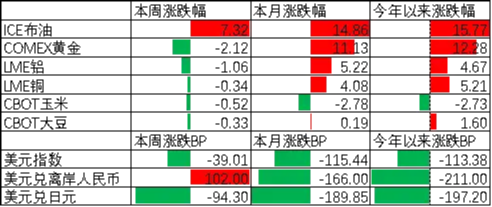
Key Points - The Federal Reserve maintained the benchmark interest rate at 3.50%-3.75%, pausing after three consecutive 25 basis point cuts, aligning with market expectations. Fed Chair Powell indicated that rate hikes are not a basic assumption for future actions, emphasizing the Fed's independence [1][19] - President Trump nominated former Fed Governor Kevin Walsh to succeed Powell as Fed Chair, pending Senate approval. However, Senate leaders from both parties have expressed intentions to block Walsh's nomination unless investigations into Powell are dropped. Analysts suggest that Walsh's leadership could lead to significant changes in Fed policy, potentially combining rate cuts with balance sheet reduction [2][20] - Walsh's nomination triggered hawkish expectations, causing a historic drop in global precious metals markets. Silver fell over 35%, gold dropped nearly 13%, and platinum and palladium also saw significant declines [3][20] - China's January manufacturing PMI was reported at 49.3, a decrease of 0.8 percentage points, indicating a decline in manufacturing activity. The non-manufacturing PMI also fell to 49.4, reflecting reduced business activity in the construction sector [4][21] - In the U.S., durable goods orders for November 2025 increased by 5.3%, the largest growth in six months, surpassing the expected 3.7% increase. Core durable goods orders rose by 0.5%, marking the eighth consecutive month of growth [5][21] - Trump stated that he is not concerned about the dollar's performance, suggesting it is returning to its appropriate level. Following his comments, the dollar index fell over 1%, reaching a nearly four-year low [6][21] Market Review Futures Market - ICE Brent crude oil rose by 7.32% to $69.83, while COMEX gold fell by 2.12% to $4907.5. The dollar index decreased by 39.01 basis points, leading to a depreciation of the yuan by 102 basis points [22][24] Stock Market - The A-share market saw a decline, with the small-cap index dropping 3.78%, while the Shanghai 50 index increased by 1.13%. The overall market sentiment has softened as the spring rally comes to an end [26][30] Bond Market - In the bond market, credit bonds generally declined, with 3Y and AA- bonds down by 7 basis points. Government bonds also saw slight declines, with 3Y, 5Y, and 10Y bonds down by 2 basis points [13][32]

中加基金配置周报|中美领导人通话,俄乌谈判取得进展
Xin Lang Cai Jing· 2025-12-04 09:50
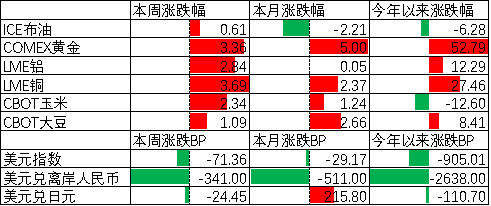
Key Points - The official manufacturing PMI in China for November is reported at 49.2, slightly up from the previous value of 49, while the non-manufacturing business activity index decreased to 49.5, down by 0.6 percentage points from the previous month [1][17] - In the U.S., the PPI for September increased by 0.3% month-on-month, with core PPI rising by 0.1%, indicating a notable acceleration in inflation [1][17] - U.S. retail sales for September grew by 0.2% month-on-month, marking the fourth consecutive month of positive growth but showing a significant slowdown and falling short of market expectations [1][17] - Durable goods orders in the U.S. for September showed an initial month-on-month increase of 0.5%, a significant deceleration from the revised 3% in the previous month, while core capital goods orders rose by 0.9%, exceeding market expectations of 0.3% [1][17] - Chinese President Xi Jinping and U.S. President Trump discussed the stability and positive direction of U.S.-China relations, emphasizing mutual benefits and cooperation [2][18] - Trump announced significant progress in the peace plan for the Russia-Ukraine conflict, with a special envoy set to meet with President Putin to finalize the agreement [3][19] - San Francisco Fed President Daly expressed support for a rate cut in December, citing a greater risk of sudden job market deterioration compared to inflation spikes [3][19] Market Review Futures Market - ICE Brent crude oil rose by 0.61% to $62.32, while COMEX gold increased by 3.36% to $4256.4 [4][22] - The U.S. dollar index fell by 71.36 basis points, with the Chinese yuan appreciating by 341 basis points against the dollar [5][22] Stock Market - The A-share market saw gains, with the ChiNext index rising by 4.54%, the largest increase among major indices, driven by improved risk appetite following the U.S.-China leaders' call [6][23] - The Hang Seng Index increased by 2.53%, and the Hang Seng Tech Index rose by 3.77%, reflecting a recovery in risk appetite [7][24] - U.S. stock markets also rebounded, with the Nasdaq index gaining 4.91%, supported by signs of resolution in the Russia-Ukraine conflict and increased rate cut expectations [8][25] Bond Market - In the bond market, credit bonds saw an upward trend, with 3Y AAA bonds rising by 5 basis points, while long-term bonds increased more than short-term ones [9][27] - U.S. Treasury yields generally declined, with the 20Y yield down by 5 basis points, influenced by Fed officials' support for a rate cut [10][28] Asset Allocation Perspective - The November PMI data indicates a slight recovery in manufacturing, while the service sector shows signs of contraction, suggesting a bottoming-out phase for the Chinese economy [11][29] - The expectation for a rate cut by the Federal Reserve has strengthened, with the probability of a December cut rising from 71% to 86% [11][29]
中加基金配置周报|中日关系持续恶化,全球风险偏好回落
Xin Lang Ji Jin· 2025-11-27 08:10
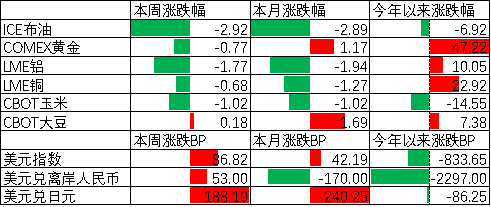
Group 1 - The new LPR in China remains stable for the sixth consecutive month, with the 1-year and 5-year rates at 3.0% and 3.5% respectively [1] - The U.S. non-farm employment increased by 119,000 in September, exceeding expectations, but the unemployment rate unexpectedly rose to 4.4%, the highest since October 2021 [1] - The U.S. manufacturing PMI for November is at 51.9, a four-month low, while the services PMI is at 55, a four-month high, indicating mixed economic signals [1] Group 2 - The Federal Reserve's October meeting minutes reveal significant divisions among officials regarding future rate cuts, with some advocating for a potential cut in December [2] - New York Fed President Williams suggests there is still room for further rate cuts as the labor market cools, while other officials express caution about high asset valuations [2] - Market expectations for a December rate cut have increased, with probabilities rising from 44% to 71% following supportive comments from several Fed officials [13] Group 3 - In the futures market, various commodities experienced price declines, with ICE Brent crude oil down 2.92% and COMEX gold down 0.77% [4] - The U.S. dollar index rose by 86.82 basis points, influenced by deteriorating Sino-Japanese relations and Fed meeting minutes that dampened rate cut expectations [4] - The A-share market saw declines across major indices, with the ChiNext index dropping 6.15%, attributed to falling risk appetite and Fed meeting outcomes [6] Group 4 - The bond market showed mixed movements, with credit bonds slightly rising while interest rate bonds experienced minor fluctuations [10] - U.S. Treasury yields generally declined, particularly the 5-year yield, which fell by 12 basis points, amid mixed economic signals and Fed officials' support for potential rate cuts [12]
集运指数(欧线):或延续弱势震荡
Guo Tai Jun An Qi Huo· 2025-08-26 01:20
1. Report Industry Investment Rating - No information provided in the content 2. Core Viewpoints of the Report - The container shipping index (European route) is expected to continue its weak oscillation. The freight rate in September is on a downward trend, with a possible slowdown in the decline in the second week, but the downward pressure on freight rates in the second half of the month is still significant. In the short term, the spot market is expected to remain weak; in the medium term, if the loading rate further declines and the FAK freight rate approaches the shipping company's cash - flow cost line, some shipping companies may increase the suspension of voyages, and the further downward space for freight rates may be limited [7]. - For the 2510 contract, it is recommended to close short positions on dips. For the 2512 and 2602 contracts, it is advisable to wait and see in terms of single - side valuation, and pay attention to the opportunity to enter the 12 - 04 calendar spread trade in the next 1 - 2 weeks [9]. 3. Summary According to Relevant Catalogs 3.1 Fundamental Tracking - **Futures Data**: On August 26, 2025, the closing prices of EC2510, EC2512, and EC2602 were 1,358.0 (up 2.57%), 1,696.7 (up 0.50%), and 1,496.9 (up 0.78%) respectively. The trading volumes were 39,234, 7,289, and 1,070, and the open interests were 54,357, 13,515, and 4,497 respectively. The open interest changes were +102, +220, and +42 respectively [1]. - **Freight Rate Index**: The SCFIS European route index was 1,990.20 points, down 8.7% week - on - week; the SCFIS US - West route index was 1,041.38 points, down 5.9% week - on - week. The SCFI European route index was $1,668/TEU, down 8.4% bi - weekly; the SCFI US - West route index was $1,644/FEU, down 6.5% bi - weekly [1]. - **Spot Freight Rates**: The average FAK in the first week of September was around $2,270/FEU, a drop of $1,100/FEU from the peak in early August. The average values of the Gemini, OA, and PA alliances in the first week of September were $2,170/FEU, $2,330/FEU, and $2,240/FEU respectively. MSC reduced the price by $250 to $2,340/FEU on August 26, and the SPOT price was reported at $2,140/FEU [5]. 3.2 Supply and Demand Analysis - **Supply Side**: In September, the number of undetermined ships decreased by 1 to 1, and the number of blank sailings decreased by 1 to 5. The weekly average capacity in September was slightly revised up from 29.7 to 30.0 million TEU/week. The capacity in September decreased by about 6% compared with August, significantly lower than the 14% decline in the same period in 2024. In the second week of September, the capacity reduction was relatively large, and the decline in the freight rate center is expected to slow down. In October, the number of undetermined ships remained at 6, and the number of blank sailings remained at 4. Without considering undetermined voyages, the weekly average capacity was 29.1 million TEU/week [6]. - **Demand Side**: At the end of the month, the cargo - collecting situations of shipping companies varied. Maersk's cargo - collecting results were better than the company's target due to significant and early price cuts in the 35th week. The long - term contract customers of COSCO decreased, and the cargo - collecting pressure on some voyages at the end of the month increased significantly [6]. 3.3 Market Outlook and Strategy - **Market Outlook**: In the short term, due to the expected decline in spot prices, the futures price oscillated downward, and the discount of the 2510 contract decreased from 22% to 18%. In the medium term, if the loading rate further declines and the FAK freight rate approaches the shipping company's cash - flow cost line of $1,300 - 1,600/FEU, some shipping companies may increase the suspension of voyages, and the further downward space for freight rates may be limited [7]. - **Strategy**: Close short positions of the 2510 contract on dips. Wait and see for the single - side valuation of the 2512 and 2602 contracts, and pay attention to the opportunity to enter the 12 - 04 calendar spread trade in the next 1 - 2 weeks [9]. 3.4 Historical Market Review - In 2024, the weighted index of the European route stopped falling on September 10. There was a short - term speculation about the strike at US - West ports in late September. After the strike was resolved during the National Day holiday, the premium of the "strike" was given back on the first trading day after the holiday. On the second trading day, the market started to trade the shipping company's price increase announcement. Maersk announced a price increase to $4,500/FEU effective from November 4, and the actual price increase in early November was around $4,000/FEU. Subsequently, shipping companies announced price increases in late November, early December, and late December. The peak freight rate appeared in the first week of December [8].
高盛宏观:你需要了解的五件事!
Goldman Sachs· 2025-07-15 01:58
Investment Rating - The report indicates a bullish outlook for US equities, expecting them to outperform European equities, with a consensus on shorting the dollar [18][20]. Core Insights - The USDCNH is projected to reach 7.10 in the next 2-3 months, driven by recent trends in the US-China trade relationship and currency movements [12][14]. - There is a strong consensus among investors for shorting the dollar, with expectations for EURUSD to end the year in the 1.15 - 1.25 range [24][23]. - The report highlights a rebound in AI-related investments, with 66% of respondents maintaining or increasing their positions in the "Mag 7" stocks [22]. - The Australian dollar (AUD) forecast has been revised upward to 0.68, influenced by urban stimulus speculation in China's property market [29][30]. Summary by Sections Currency and FX Insights - The report notes a significant washout in the Brazilian real (BRL) due to tariff headlines, but the impact on Brazil's economy is expected to be limited as trade with the US represents less than 2% of GDP [4]. - The report emphasizes the potential for a downside in USDCNH, with recent movements indicating a new YTD low in USDCNY [5][12]. - Hedging costs are at their lowest of the year, suggesting favorable conditions for currency trades [8]. Economic Activity and Forecasts - Industrial production in China is expected to grow by 5.9% year-on-year in June, reflecting improved export growth and manufacturing conditions [45][46]. - Fixed asset investment growth is projected to rebound to 4.3% year-on-year in June, supported by government bond issuance and construction activity [47][48]. - Retail sales growth is anticipated to decline to 4.6% year-on-year in June, indicating potential headwinds for the second half of the year [49][50]. - The GDP growth forecast for Q2 has been slightly upgraded to 3.5% quarter-on-quarter annualized, while the Q3 forecast has been downgraded to 2.5% [51][52].
早报 (05.30)| 关税重大变数!暂时恢复;特朗普第二任期首次会见鲍威尔;DeepSeek完成R1更新:思考更深,推理更强
Ge Long Hui· 2025-05-30 00:10
Group 1 - The Trump administration's tariffs faced legal challenges, with a federal appeals court temporarily halting a lower court's ruling that blocked several tariff orders [2] - The U.S. stock market showed positive performance, with the Dow Jones up 0.28%, Nasdaq up 0.39%, and S&P 500 up 0.4% [3][5] - Major Chinese concept stocks mostly rose, with the Nasdaq China Golden Dragon Index increasing by 1.44% [4] Group 2 - The White House indicated that a judge's ruling on tariffs would be overturned, and multiple trade agreements are nearing completion [8] - The Federal Reserve's Goolsbee suggested that if trade policies revert to pre-tariff conditions, there could be room for interest rate cuts [9][10] - Goldman Sachs predicted gold prices could reach $4,000 per ounce by mid-next year, viewing gold as a safer hedge compared to Bitcoin [11] Group 3 - Nvidia's CEO plans to sell up to 6 million shares, potentially worth around $809 million based on recent closing prices [12] - Dell Technologies saw a significant stock increase after reporting Q1 revenue of $23.38 billion, exceeding analyst expectations [13] - Hyundai is considering a 1% price increase on all its U.S. products to mitigate the impact of Trump’s tariffs [14] Group 4 - NIO reported Q1 revenue of 25.93 billion yuan, a year-on-year increase of 1.1%, with a delivery volume of 92,864 vehicles, up 15.5% [17] - JD.com and Xiaohongshu launched a strategic cooperation plan to enhance business growth for brands and merchants [18] - Tesla plans to deliver its first autonomous Model Y vehicles in June, ahead of schedule [19]




融达期货宏观日报0401
Hua Rong Rong Da Qi Huo· 2025-04-01 00:40
Economic Indicators - In March, China's manufacturing PMI, non-manufacturing PMI, and composite PMI were 50.5%, 50.8%, and 51.4%, respectively, all showing an increase of 0.3 to 0.4 percentage points from the previous month, indicating a clear economic recovery trend[2] - Goldman Sachs raised the probability of a U.S. recession from 20% to 35% and lowered the 2025 GDP growth forecast from 2% to 1.5%[2] Market Reactions - Following the announcement of a potential 20% special tariff on all imports by President Trump, the Nikkei 225 index fell over 4%, closing below 36,000 points, marking a decline of over 10% from its peak in December[2] - The Hang Seng Index dropped by 1.31%, while the Dow Jones Industrial Average increased by 1.00%[4] Commodity Performance - NYMEX crude oil rose by 3.42% to $71.40, while LME copper fell by 1.07% to $9,690.00[4] - Agricultural products mostly increased, with notable gains in cotton and sugar, while black metals saw declines, with coking coal down by 1.5%[3] Bond Market - The yield on 10-year Chinese government bonds was 1.82%, reflecting a 0.29% increase, while the 2-year yield rose by 2.35% to 1.57%[4] - The U.S. 10-year Treasury yield was at 4.23%, showing a slight decrease of 0.04%[4] Currency Trends - The U.S. dollar index stood at 104.19, with a minor increase of 0.15%[4] - The offshore RMB exchange rate against the U.S. dollar was 7.27, reflecting a decrease of 0.06%[4]
融达期货宏观日报0318
Hua Rong Rong Da Qi Huo· 2025-03-18 00:40
Economic Indicators - In the first two months of this year, China's industrial added value, service production index, retail sales of consumer goods, and fixed asset investment grew by 5.9%, 5.6%, 4%, and 4.1% year-on-year, respectively, accelerating by 0.1, 0.4, 0.5, and 0.9 percentage points compared to the previous year[1] - Real estate development investment decreased by 9.8% year-on-year, while the sales area of new commercial housing fell by 5.1%, with both declines narrowing[1] Housing Market Trends - New home prices in first-tier cities continued to rise month-on-month, while second-tier cities' prices remained flat after a 0.1% increase last month[1] - In February, 18 cities saw month-on-month increases in new home prices, a decrease of 6 cities from the previous month, with Nanjing leading for three consecutive months[1] U.S. Economic Data - U.S. retail sales rose by 0.2% month-on-month in February, falling short of the expected 0.6%, with January revised down to a 1.2% decline, the largest drop since July 2021[2] Commodity Market Performance - Energy and chemical products, black series, and agricultural products generally declined, with caustic soda, coke, and palm oil dropping over 1%[2] - Basic metals mostly fell, with nickel down 1.78%, stainless steel down 0.7%, and zinc down 0.58%[2] Global Asset Performance - NYMEX crude oil closed at $67.48, down 19.66% year-on-year[2] - COMEX gold rose by 0.55% to $3010.10, with a year-on-year increase of 32.46%[2] - The Shanghai Composite Index closed at 3426.13, up 11.33% year-on-year[2] Interest Rates and Currency - The 10-year Chinese government bond yield was 1.89%, up 2.48% day-on-day[2] - The U.S. dollar index stood at 103.40, down 1.49% year-on-year[2]