Guan Cha Zhe Wang

Search documents
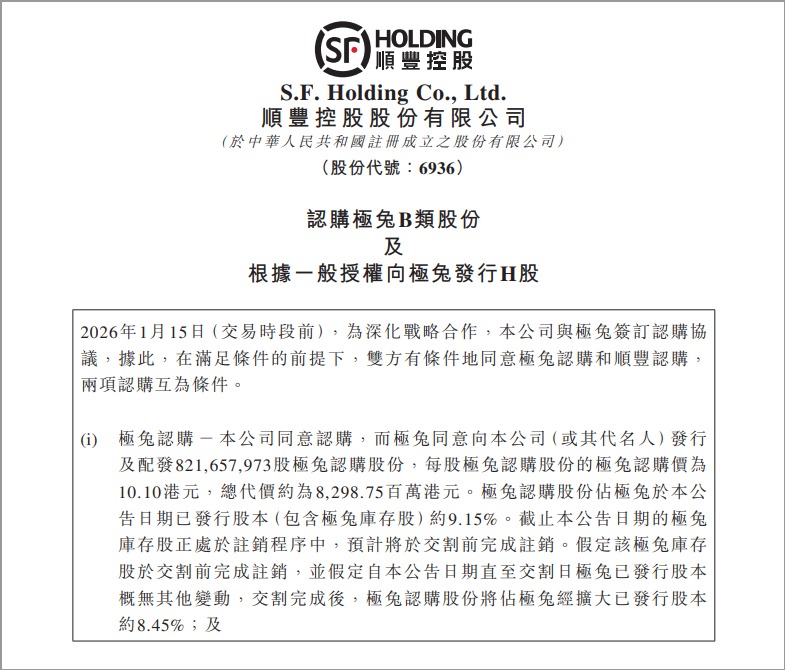
顺丰极兔“联姻”,“反内卷”背后的电商议价权之争
Guan Cha Zhe Wang· 2026-01-16 12:03
Core Viewpoint - SF Holding and Jitu Express have announced a strategic mutual shareholding agreement worth up to HKD 8.3 billion, marking a significant move in the domestic express delivery industry towards reducing internal competition and fostering industry consolidation [1][3]. Group 1: Strategic Partnership - SF Holding will issue 226 million H shares to Jitu Express at HKD 36.74 per share, while Jitu Express will issue 822 million Class B shares to SF Holding at HKD 10.10 per share [3]. - Post-transaction, SF Holding will hold 10% of Jitu Express, and Jitu Express will hold 4.29% of SF Holding [3]. - The partnership is expected to enhance operational efficiency and pricing power in the face of competition from e-commerce platforms [3][4]. Group 2: Industry Context - The Chinese express delivery market is projected to reach a revenue of CNY 1.8 trillion and handle 216.5 billion parcels by 2025, with a year-on-year growth of 6.4% and 11.5% respectively [4]. - Despite growth, the industry faces challenges with low profit margins, often relying on extreme price competition, leading to a situation where the cost of delivery is unsustainable [4][6]. - The average revenue per parcel for major express companies has been declining, with significant drops noted for companies like YTO and ZTO [5]. Group 3: Market Dynamics - The industry is experiencing a shift towards price increases, with regulatory bodies pushing for better pricing strategies to combat the "involution" phenomenon [6][8]. - Major express companies are beginning to raise prices, although the long-standing culture of low pricing remains a significant hurdle [8][9]. - The consolidation of the market is evident, with major players like Jitu and SF Holding seeking to enhance their market positions through strategic partnerships [10]. Group 4: Cross-Border Opportunities - The partnership aims to leverage cross-border logistics, with SF Holding focusing on high-end logistics and Jitu Express on e-commerce deliveries, creating a complementary business model [11][16]. - The international logistics market is expanding, with significant growth in overseas warehouse construction and parcel volume, particularly in Southeast Asia [11][14]. - Both companies are positioned to enhance their competitive edge in international markets, where profit margins are generally higher than in the domestic market [11][17]. Group 5: Pricing Power Challenges - The express delivery sector faces challenges in regaining pricing power against e-commerce platforms, which exert significant influence over logistics costs [17][20]. - Recent trends indicate that platforms like Shopee are increasingly building their logistics capabilities, which could further pressure express companies to lower prices [17][20]. - SF Holding's recent negotiations with Douyin highlight the importance of maintaining pricing power in lucrative segments like returns logistics [21][22].


构建全链条规范监管体系,三部门解读《废旧动力电池回收利用管理暂行办法 》
Guan Cha Zhe Wang· 2026-01-16 09:25
Core Viewpoint - The Ministry of Industry and Information Technology (MIIT), in collaboration with the Ministry of Ecology and Environment and the State Administration for Market Regulation, introduced the "Interim Measures for the Recycling and Comprehensive Utilization of Waste Power Batteries from New Energy Vehicles," aiming to establish a regulated, safe, and efficient recycling system for waste batteries [1][3]. Group 1: Policy Framework - The new measures are designed to clarify responsibilities across various stakeholders in the recycling process, enhancing legal enforceability compared to previous regulations [5]. - The framework emphasizes "coordinated development and safety" and "extended producer responsibility," establishing a comprehensive management system covering all channels, chains, and life cycles of battery usage [5][6]. Group 2: Industry Impact - By 2025, it is projected that the comprehensive utilization of waste power batteries will exceed 400,000 tons, reflecting a year-on-year growth of 32.9%, with leading companies achieving metal recovery rates on par with international standards [4]. - The anticipated production and sales of new energy vehicles in China for 2025 are expected to reach 16.626 million and 16.49 million units, respectively, marking a year-on-year increase of 29% and 28.2%, with new vehicle sales accounting for 47.9% of total automobile sales [3]. Group 3: Stakeholder Responsibilities - The measures delineate dual responsibilities for battery and vehicle manufacturers, including ecological design and recovery obligations, mandating the establishment of recovery networks at both provincial and municipal levels [8][6]. - Companies involved in battery exchange services, vehicle maintenance, and scrapping must ensure that waste batteries are handed over to certified recycling enterprises, adhering to environmental and safety regulations [8]. Group 4: Technological and Regulatory Developments - The MIIT has implemented various policies and standards, including over 30 national and industry standards, to support the recycling ecosystem [3][9]. - The establishment of a digital identification system for batteries will facilitate tracking and monitoring throughout their lifecycle, enhancing transparency and compliance [6].
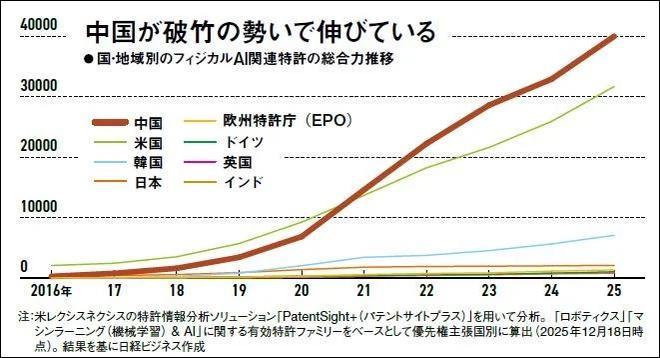
比拼物理AI:中国世界第一,中企包揽专利竞争力前三
Guan Cha Zhe Wang· 2026-01-16 09:19
Core Insights - Physical AI is a key area of global technological competition, with Chinese companies emerging as leaders in the field of humanoid robots, automotive applications, and other physical AI patents [1][3] - According to a recent analysis, China ranks first globally in terms of comprehensive strength in patent applications, followed closely by the United States [1][3] - Major Chinese tech firms such as Baidu, Huawei, and Tencent lead in patent scores, while China Ping An Insurance ranks sixth [1][4] Patent Rankings - The analysis ranks Baidu, Huawei, and Tencent as the top three companies in the field of Physical AI, with scores of 4126, 3645, and 3043 respectively [4] - Samsung Electronics from South Korea ranks fourth with a score of 2734, followed by NVIDIA (2154) and China Ping An Insurance (1881) [4] - Other notable companies include Intel (1543), LG Electronics (1393), Alphabet (1325), and the Chinese Academy of Sciences (835) [4] Industry Context - The analysis indicates that while Chinese companies have a strong patent quantity, they still lag behind U.S. competitors like Intel, NVIDIA, and Alphabet in terms of patent quality [1][3] - The shift towards AI technologies is emphasized in China's 14th Five-Year Plan, which highlights the importance of high-quality development and technological advancement [4] - The CES 2024 showcased various Physical AI applications, indicating a competitive landscape among tech companies from China, the U.S., and South Korea [5] Future Developments - The Chinese government is actively supporting Physical AI as a national strategy, with plans to enhance AI integration across various industrial sectors by 2025 [5][6] - The application of AI in industrial enterprises is projected to rise significantly, with a forecasted increase from 9.6% in 2024 to 47.5% in 2025 [7] - China has established over 7000 advanced smart factories, demonstrating significant progress in the integration of AI and manufacturing [7]

小米玄戒O2被曝继续用台积电3nm
Guan Cha Zhe Wang· 2026-01-16 09:07
Core Viewpoint - Xiaomi is planning to adopt TSMC's N3P process for its second-generation self-developed SoC, the Xuanjie O2, instead of the latest 2nm process, and aims to expand the application of its self-developed chips beyond smartphones [1][2] Group 1: Product Development and Strategy - The Xuanjie O2 is expected to be applied in "non-smartphone" products, indicating Xiaomi's intention to broaden its chip usage [1] - The first-generation SoC, Xuanjie O1, was launched last year but was only used in a limited number of products, such as the Xiaomi 15S Pro and Xiaomi Pad 7 series [1] - Industry insiders suggest that the Xuanjie O1 served primarily to test Xiaomi's technical capabilities and market acceptance rather than to replace existing SoC suppliers like Qualcomm and MediaTek [1] Group 2: Market Competition and Challenges - Qualcomm and MediaTek are transitioning to more advanced 2nm processes for their flagship SoCs, which could weaken the market competitiveness of Xiaomi's Xuanjie O2 if it uses the N3P process [2] - TSMC's 2nm process has limited initial capacity, already allocated to major clients like Apple and Nvidia, making it difficult for Xiaomi to secure early production capacity [2] - The cost of 2nm processes is significantly higher than that of 3nm, which, combined with rising memory chip prices, has increased the overall material costs for smartphones by over 25% [2] Group 3: Pricing and Financial Implications - The launch price of the Xiaomi 17 Ultra has increased by around 500 yuan compared to its predecessor, indicating a trend of rising product prices [3] - Xiaomi's president has indicated that significant price increases are expected across the industry in the coming year, which may further pressure profit margins if higher-cost processes are adopted [3] - Xiaomi is likely to use its self-developed processors in mid-range and sub-flagship products, potentially exerting pressure on MediaTek, which primarily supplies non-flagship models [3] Group 4: Future Innovations and Investments - Xiaomi's founder has stated that by 2026, the company aims to achieve a "triple integration" of self-developed chips, operating systems, and AI models in a single product, marking a significant technological milestone [4] - Over the past five years, Xiaomi has committed approximately 105 billion yuan to core technology research and plans to invest 200 billion yuan over the next five years [4] - The company is targeting comprehensive chip coverage across its entire product line, including tablets, PCs, and automobiles, with the Xuanjie O2 leading this initiative [3][4]


证监会:全年上市公司现金分红回购合计2.68万亿元
Guan Cha Zhe Wang· 2026-01-16 08:35
Core Viewpoint - The China Securities Regulatory Commission (CSRC) emphasizes the importance of risk prevention, strong regulation, and promoting high-quality development in the capital market for 2026, following a year of significant challenges and achievements in 2025 [2][3]. Group 1: Market Stability and Development - The CSRC aims to consolidate the positive momentum in the market by enhancing monitoring and regulatory measures to prevent excessive volatility and ensure fair trading practices [4]. - In 2025, the total cash dividends and buybacks from listed companies reached 2.68 trillion yuan, indicating a focus on high-quality development [2]. - The total amount raised through IPOs and refinancing was 1.26 trillion yuan, while the bond market issued various bonds totaling 16.3 trillion yuan, showcasing the effective functioning of the multi-level capital market [2]. Group 2: Regulatory Enhancements - The CSRC has strengthened its regulatory framework by implementing a comprehensive punishment and prevention system for financial fraud, resulting in the investigation of 701 cases and fines totaling 15.47 billion yuan [2]. - The introduction of the "1+6" policy measures for the Sci-Tech Innovation Board and the activation of a third set of standards for the Growth Enterprise Market are part of ongoing reforms to enhance the investment environment [2][4]. - The CSRC is committed to improving the effectiveness of regulatory enforcement, particularly against financial fraud, market manipulation, and insider trading [4][5]. Group 3: Legal and Governance Improvements - The CSRC is focused on enhancing the governance of listed companies by implementing new regulations and improving the operational standards of these companies [5][6]. - The commission is also working on strengthening the legal framework to protect the rights of small and medium investors, thereby reinforcing the investor protection "safety net" [2][3]. - The emphasis on political supervision and the implementation of anti-corruption measures within the CSRC aims to ensure a clean and accountable regulatory environment [7][8].
独家|欧美“围猎”海外中资半导体
Guan Cha Zhe Wang· 2026-01-16 08:27
去年10月以来,全球汽车和消费电子行业的重要供应商——安世半导体的控制权之争,一直是中国和荷 兰政府、企业间的关注焦点。期间历经中美经贸会谈、荷兰派员来华磋商、美国延期"50%股权穿透规 则"、荷兰暂停"冻结"行政令等关键节点,至今这一事件仍悬而未决,不仅导致安世半导体中荷业务"脱 钩",也严重冲击了全球汽车供应链。 (文/观察者网 吕栋 编辑/张广凯) "安世半导体股权遭荷兰冻结"、"飞特半导体被英国强制出售"、"特朗普强制'涉中资公司'剥离美国芯片 资产"......交割数年后,一批优秀的中资海外半导体资产正在被欧美"围猎"。 "英国《国家安全与投资法》有一个回溯审查条款,特别有争议。虽然法案生效的日期晚,但它有追溯 机制,可以对法案生效之前的事情进行回溯审查,让合法交易可能变得不合法,相当于用了很霸道的条 款对项目做了审查。"一位关注飞特交易的人士独家对观察者网表示。 无论安世还是飞特等争端,海外政府强制干预的特征都非常明显,很大程度上对外传递出欧美投资环境 政治风险高企、法律确定性丧失的负面信号。此类事件若不被遏制,不仅将打击中国企业对欧美投资的 信心,更可能对中欧经贸关系的政治互信与合作基础造成结构 ...


A股三大指数收跌,沪指险守4100点
Guan Cha Zhe Wang· 2026-01-16 07:33
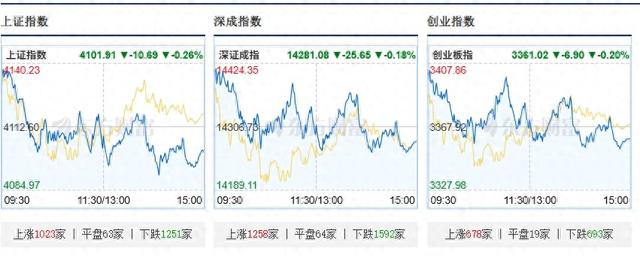
Market Performance - The A-share market opened high but closed lower, with the Shanghai Composite Index down by 0.26%, barely holding above the 4100-point mark [1] - The Shenzhen Component Index fell by 0.18%, closing at 14281.08 points, while the ChiNext Index decreased by 0.2%, ending at 3361.02 points [1] Sector Performance - Approximately 3000 stocks in the Shanghai and Shenzhen markets were in the red, with total trading volume reaching 3.06 trillion [3] - The semiconductor, robotics, electric grid equipment, and computing hardware sectors saw significant gains, with stocks like Tianyue Advanced and Tongfu Microelectronics hitting the daily limit [3] - Robotics concept stocks also performed well, with companies such as Wuzhou New Spring and Founder Electric reaching their daily limit [3] - The electric grid equipment sector surged, with stocks like Siyuan Electric and Jicheng Electronics also hitting the daily limit [3] - Conversely, sectors such as AI applications, oil and gas, pharmaceuticals, and digital currencies experienced declines, with AI application stocks facing a wave of limit-downs, including Xinhua Du and Tianxia Xiu [3]
中信银行晋级“十万亿俱乐部”
Guan Cha Zhe Wang· 2026-01-16 07:23
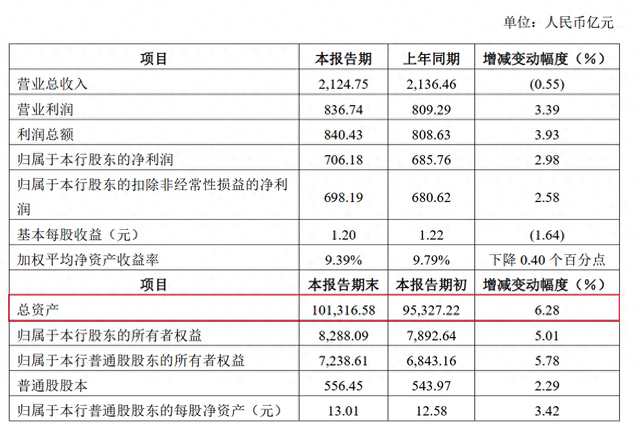
【文/羽扇观金工作室】 截至2025年三季度末,42家上市银行中,有8家银行资产总额过10万亿元,除了6家国有大行(工商银 行、农业银行、中国银行、建设银行、交通银行、邮储银行),还包括招商银行、兴业银行,前者于 2022年总资产突破10万亿元,后者在2023年成功跻身"10万亿俱乐部"。 浦发银行1月13日发布的2025年度业绩快报公告显示,该行资产总额正式突破10万亿元大关,达10.08万 亿元。 还有哪些银行有加入"10万亿俱乐部"的潜力? 财报数据显示,总资产紧跟上述4家股份行之后的是民生银行和光大银行,2025年9月末总资产分别为 7.87万亿元、7.22万亿元,其余银行则均低于6万亿元。由此可见,除已晋级的四家之外,其他股份行距 离十万亿门槛仍有较远距离。 | 项目 | 本报告期 | 上年同期 | 增减变动幅度(%) | | --- | --- | --- | --- | | 营业总收入 | 2.124.75 | 2,136.46 | (0.55) | | 营业利润 | 836.74 | 809.29 | 3.39 | | 利润总额 | 840.43 | 808.63 | 3.93 | | 归属于 ...

明抢!美商务部长:台湾四成半导体供应链搬到美国
Guan Cha Zhe Wang· 2026-01-16 07:02
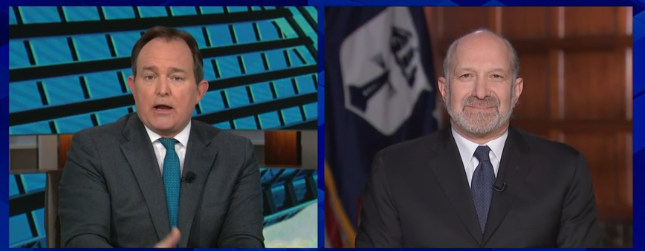
Core Points - The U.S. Department of Commerce announced a "trade agreement" with Taiwan, requiring Taiwanese chip and tech companies to invest at least $250 billion in capacity building and provide an additional $250 billion in credit guarantees [1][10] - In exchange, the U.S. will reduce tariffs on Taiwan from 20% to 15% and exempt certain goods from tariffs [11][12] - U.S. Commerce Secretary Gina Raimondo stated that Taiwanese chip companies not building factories in the U.S. could face a 100% tariff, aiming to transfer 40% of Taiwan's semiconductor supply chain to the U.S. [12][4] Investment and Capacity Building - Taiwanese companies, particularly TSMC, are under pressure to expand their manufacturing capabilities in the U.S. as part of the agreement [12][15] - TSMC has already invested $40 billion in Arizona to produce chips for U.S. companies like Apple and NVIDIA [12][10] Economic Implications - The agreement includes provisions that allow Taiwanese companies to import products tax-free during the construction phase of new factories, with adjustments to tax exemptions based on U.S. production capacity [14][4] - The high labor and depreciation costs in the U.S. have raised concerns about TSMC's profitability, with labor costs per wafer rising from $1,800 in Taiwan to $3,600 in the U.S. [17][15] - TSMC's U.S. factory has faced significant financial challenges, with a reported gross margin of only 8% compared to 62% in Taiwan [17][15] Political Context - The agreement has been criticized by Taiwan's State Council spokesperson, who described it as economic exploitation by the U.S. and a threat to Taiwan's economic future [18][8] - The Taiwanese government is perceived as capitulating to U.S. demands, potentially undermining its own economic interests [18][8]

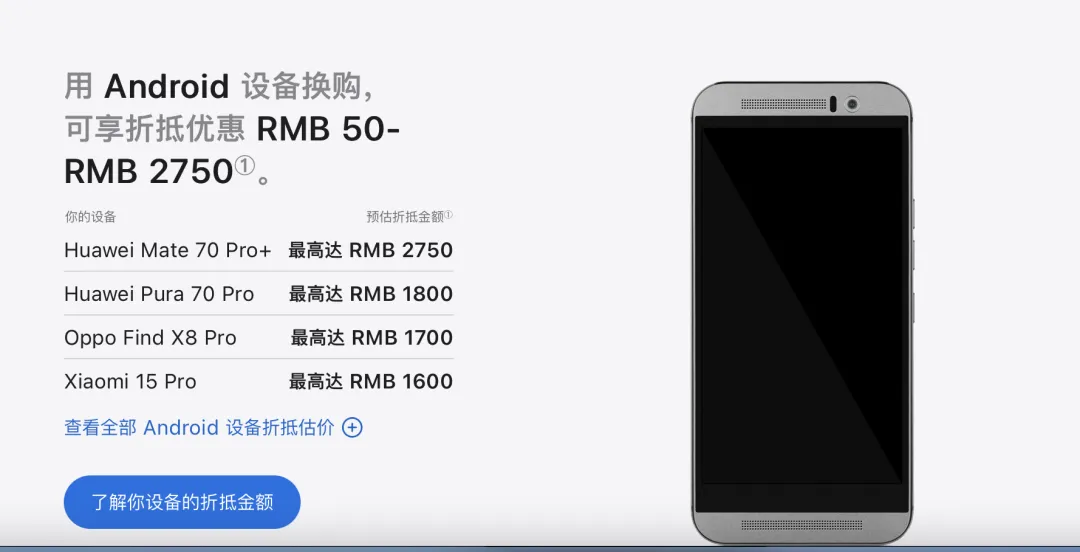
苹果官网活动扩容:华为、小米、OV也能“以旧换新”了
Guan Cha Zhe Wang· 2026-01-16 06:31
Core Insights - Apple's "Trade in" program has expanded to include devices from Chinese brands such as Huawei, Xiaomi, OPPO, and vivo, in addition to its own products [1][3] Group 1: Trade-in Program Details - The trade-in values for selected devices are as follows: Huawei Mate 70 Pro+ can be traded in for up to RMB 2750, Huawei Pura 70 Pro for up to RMB 1800, OPPO Find X8 Pro for up to RMB 1700, Xiaomi 15 Pro for up to RMB 1600, and vivo iQOO 13 for up to RMB 1600 [3][5] - Huawei devices dominate the trade-in list, including models like Huawei Mate X5, Mate X3, Mate 70 series, and P60 series, while OPPO follows with devices like OPPO Find N3 and Find X8 series [3][4] Group 2: Market Performance - According to IDC, the total shipment of smartphones in China for 2025 is projected to be approximately 285 million units, a slight decline of 0.6% year-on-year [6] - Huawei leads the Chinese market with a shipment of 46.7 million units, a year-on-year decrease of 1.9%, holding a market share of 16.4% [6] - Apple follows closely with 46.2 million units shipped, marking a 4% increase year-on-year and a market share of 16.2% [6] - In the fourth quarter, Apple achieved a shipment of 16 million units, securing a market share of 21.1%, with a significant year-on-year increase of 21.5% [7]