
Zhong Guo Qi Che Bao Wang

Search documents
观车 · 论势 || 转型为科技企业,车企向左还是右?
Zhong Guo Qi Che Bao Wang· 2025-12-09 01:33
Core Viewpoint - The automotive industry is undergoing a transformation characterized by electrification, intelligence, and ecological integration, with companies facing strategic choices based on their understanding of the industry's essence [1][6]. Group 1: Conservative Approach - Conservative companies focus on core automotive technologies, aiming for breakthroughs in battery energy density and intelligent driving algorithms, which helps maintain profitability during market fluctuations [2]. - The conservative strategy is driven by a deep understanding of the industry and a rational focus on resources, allowing companies like Great Wall Motors and Leap Motor to establish strong user recognition in specific market segments [1][2]. - The conservative approach may lead to challenges such as price wars due to hardware standardization and global overcapacity pressures, necessitating continuous software innovation [2]. Group 2: Transformative Approach - Transformative companies view the automotive industry as part of a larger interconnected ecosystem, leveraging AI and cross-industry collaborations to create competitive advantages [3][4]. - Companies like Xpeng and Geely are investing in technologies such as intelligent robots and satellite communications to enhance their product offerings and create unique selling points [3][4]. - The transformative strategy is supported by strong capital backing and the ability to repurpose existing technology for new applications, although it carries higher risks due to significant R&D investments and complex management challenges [4][5]. Group 3: Strategic Divergence and Integration - The fundamental difference between conservative and transformative strategies lies in their strategic motivations and technological paths, with conservative firms focusing on survival and stability while transformative firms pursue growth and innovation [5]. - Companies like BYD and Huawei exemplify a blend of both strategies, integrating vertical control and ecosystem collaboration to enhance their core business while exploring new opportunities [5]. - The future of the automotive industry may see a dynamic integration of both strategies, where conservative firms extend their boundaries after achieving technological breakthroughs, and transformative firms reinforce their core strengths through ecosystem development [5][6][7].
维保企业提质增效新引擎:将“热流量”化为“长留量”
Zhong Guo Qi Che Bao Wang· 2025-12-08 14:48
Core Insights - The automotive repair industry is facing severe challenges, with many shops closing down and others struggling to maintain operations due to a significant decline in performance [3][5] - Key issues include an aging vehicle fleet, high fixed costs, shrinking demand for traditional fuel vehicle maintenance, and increased competition leading to a shift from price wars to capital wars [5][6] Industry Challenges - Over half of the automotive repair shops in certain areas have closed, indicating a drastic downturn in the industry [3] - The industry is experiencing a structural change, with older vehicles exiting the market, which diminishes the customer base for repair shops [5] - High fixed costs are making profitability increasingly difficult, prompting some operators to consider partnership models or reduce service offerings to cut costs [5] Market Dynamics - The demand for traditional fuel vehicle maintenance is declining, impacting core business operations [5] - The after-sales market for electric vehicles is challenging to penetrate, as many shops lack the necessary service capabilities [5] - Competition has evolved from price-based strategies to capital-intensive strategies, complicating decision-making for shop owners [5] Strategic Recommendations - Automotive repair shops should focus on precise customer targeting and develop service packages that meet specific customer needs [6] - Emphasizing differentiation and enhancing customer experience through standardized service offerings can improve competitiveness [6] - Integrating public and private domain operations to optimize customer management and utilizing intelligent systems for data management is essential [6] Marketing Strategies - Video marketing should focus on authenticity and product quality, particularly in showcasing genuine parts [7] - Regular content updates and a focus on local exposure through platforms like Douyin can enhance visibility and customer engagement [7] Operational Focus - Specializing in specific services, such as chassis maintenance, can lead to higher profitability, with potential monthly revenues of 80,000 to 150,000 yuan from chassis-related services [8][9] - Understanding the functionality of chassis components and providing technical solutions can enhance sales effectiveness [9] Talent Management - The manufacturing sector is increasingly reliant on international markets, necessitating the development of foreign trade teams to navigate rising costs and competitive pressures [10] - Effective talent management strategies, including optimizing team structures and implementing incentive mechanisms, are crucial for maintaining operational efficiency [10]


锁电困局:安全与性能的“跷跷板”难题
Zhong Guo Qi Che Bao Wang· 2025-12-08 14:48
近期,某高端品牌纯电动汽车因实施召回锁电操作,引发车主集体投诉的事件登上热搜,这也再次引发了对锁电安全性与车辆性能损失的深入思考。 车企通过锁电手段提高车辆安全性,然而此举却导致车辆的续驶里程、动力性能和充放电效率等指标大幅下滑,严重影响了车主的使用体验,进而引发了 对车辆品牌的广泛抱怨。锁电为何广受诟病但车企却屡次使用,能否平衡锁电带来的安全效益与性能损失,已成为车企必须认真面对和解决的重要问题。 锁电纠纷时有发生 在最近发生的集体投诉中,车主表示,品牌方在实施召回后采取了锁电措施,导致车辆续驶里程缩水30%,充电功率下降,严重侵害了消费者的知情权。 据悉,该品牌此次召回锁电后,部分车辆满电续驶里程从450km降至270km,缩水幅度高达35%;充电功率受限后,部分车型的直流快充功率也降低了近 一半,充电时间显著增长。 据企业解释,由于电池管理系统软件设计缺陷,高压电池在极端情况下可能发生热失控,进而导致车辆起火事故,存在安全隐患。为消除隐患,品牌方通 过授权经销商对受影响的万余辆该车型进行电池管理系统软件升级。然而,部分车主指出,4S店以保护电池为由进行软件升级,却未提前告知性能将受 限制,涉嫌侵犯消费者 ...

新能源“烂尾车”逆袭二手车市场
Zhong Guo Qi Che Bao Wang· 2025-12-08 14:32
近期,在二手车市场上,品牌倒下或企业破产的新能源汽车受到一些消费者尤其是年轻消费者的追捧,这些高性价比的"烂尾车"成为年轻玩家的"心 头好"。尽管这些"烂尾车"找到了接盘者,使其价值得以发挥,但潜在的安全隐患依然存在。有分析人士指出,新能源"烂尾车"重新走向市场是物尽其用 的市场行为,但其与燃油车在维修保养上存在一定区别,消费者需要更加谨慎,同时管理部门也应提供指导意见,降低"烂尾车"可能带来的风险。 性价比打动年轻消费者 "我不是在买车,我是在买一套移动的硬件组合。"关于为何选择购买新能源"烂尾车",记者在走访时听到消费者的想法尤为简单和务实。 "即便车企倒闭,服务器关闭,车机系统失效,但只要电池未衰减,悬挂无异响,就已足够。智能驾驶不过是锦上添花,我真正需要的是一辆车。" "价格低廉是吸引年轻消费者购买"烂尾车"的根本原因。"这位车商坦言,高性价比是消费者愿意选择"烂尾车"的关键,过去二三十万元的新车,如今 五六万元即可购得,有效缓解了消费者的购车压力。"我只有10万元的预算,买新车绝对无法拥有如此高的配置,(烂尾车)非常划算。"一位消费者说。 一位刚被裁员的IT工程师坦言,在预算有限的情况下,选择硬件配 ...

MPV市场“群雄逐鹿”
Zhong Guo Qi Che Bao Wang· 2025-12-08 14:24
与此同时,露营文化的普及进一步激活了市场需求。MPV的大空间优势得以充分发挥,放倒第三排可腾出1200L的储物空间,轻松容纳婴儿车、露营 装备等,这种"一车多用"的属性是SUV难以比拟的。在某汽车论坛上的用户调研显示,超过60%的MPV潜在消费者将"露营出行"列为核心使用场景。 告别"小众标签" 长期以来,高油耗、操控不佳、智能化不足等痛点,使MPV始终难以摆脱"小众"标签。然而,新能源与智能化技术的突破,正从根本上改变这一现 状,大幅降低了用户的使用门槛。 "以前挑选家用车时,目光仅限于轿车和SUV,如今打开汽车App,满屏皆是MPV推荐。"北京消费者王先生的感慨,反映了当前车市的现状。自11月 以来,MPV市场迎来了前所未有的密集上新潮:五菱星光730搅动入门级市场,小鹏X9增程版凭借1602km的综合续驶里程进入30万元级别赛道,别克至 境世家以旗舰级配置冲击高端市场,锐胜M8、吉利银河V900等车型紧随其后。短短半个月内,5款MPV集中预售或上市,市场关注度一度超越了SUV。 这一现象并非偶然。从曾经的"冷门产品"蜕变为如今的"兵家必争之地",MPV市场华丽转身的背后,是需求迭代、技术突破与车企战略布 ...

最后一个月!16家车企全年目标完成度大盘点!
Zhong Guo Qi Che Bao Wang· 2025-12-08 12:24
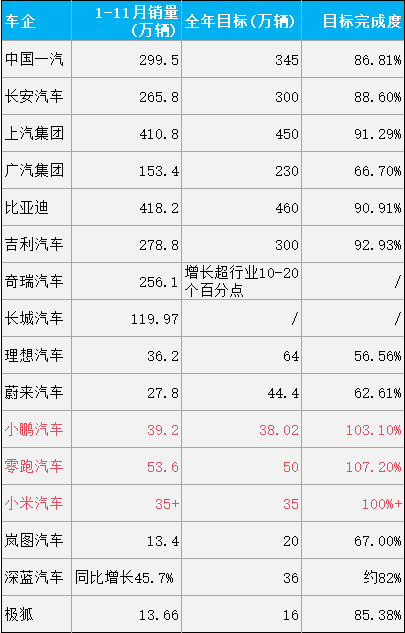
Summary of Key Points Core Viewpoint - The automotive industry in China is nearing the end of 2025, with various companies reporting their sales performance against annual targets, revealing a mix of successes and challenges across the sector. Group 1: Company Performance - China FAW Group achieved a cumulative sales of 2.995 million units from January to November, with a target completion rate of 86.81% against an annual goal of 3.45 million units, showing a year-on-year growth of 4.8% [3][4] - Changan Automobile reported cumulative sales of 2.658 million units, achieving 88.6% of its 3 million unit target, with a notable 54.66% year-on-year growth in its new energy vehicle sales [6] - SAIC Motor Corporation reached 4.108 million units in cumulative sales, completing 91.29% of its 4.5 million target, with a 16.4% year-on-year growth [8] - GAC Group's cumulative sales were 1.534 million units, achieving only 66.7% of its 2.3 million target, reflecting a 10.8% year-on-year decline [10] - BYD's cumulative sales stood at 4.182 million units, completing 90.9% of its revised target of 4.6 million units, with significant contributions from overseas markets [12] - Geely Automobile achieved 2.788 million units in sales, with a completion rate of 92.93%, reflecting a strong 42% year-on-year growth [14] - Chery Group's cumulative sales were 2.561 million units, with a year-on-year growth of 11.1%, aiming to exceed industry growth by 10-20 percentage points [16] - Li Auto reported 362,000 units sold, achieving only 56.56% of its 640,000 target, facing challenges in product cycles and market competition [18] - NIO's cumulative sales were 278,000 units, achieving 62.61% of its 444,000 target, with a year-on-year growth of 45.6% [20] - XPeng Motors exceeded its target with 392,000 units sold, achieving 103.1% of its goal [22][23] - Leap Motor surpassed its target with 536,000 units sold, achieving 107.2% of its goal [25] - Xiaomi's automotive division exceeded its target of 350,000 units, with expectations to surpass 400,000 units [27] - Lantu's cumulative sales were 134,000 units, achieving 67% of its 200,000 target, with a year-on-year growth of 82% [29] - Deep Blue reported a year-on-year growth of 45.7%, with a target of 360,000 units [31][32] - Arcfox aimed for significant growth, achieving 85.38% of its target with 136,600 units sold [34] Group 2: Industry Insights - The performance metrics of these companies reflect their strategic positioning in technology, market strategy, and organizational resilience, indicating a transition in the Chinese automotive industry from quantity accumulation to quality improvement [34]





再上新台阶 潍柴2025交出了亮眼答卷
Zhong Guo Qi Che Bao Wang· 2025-12-08 09:19
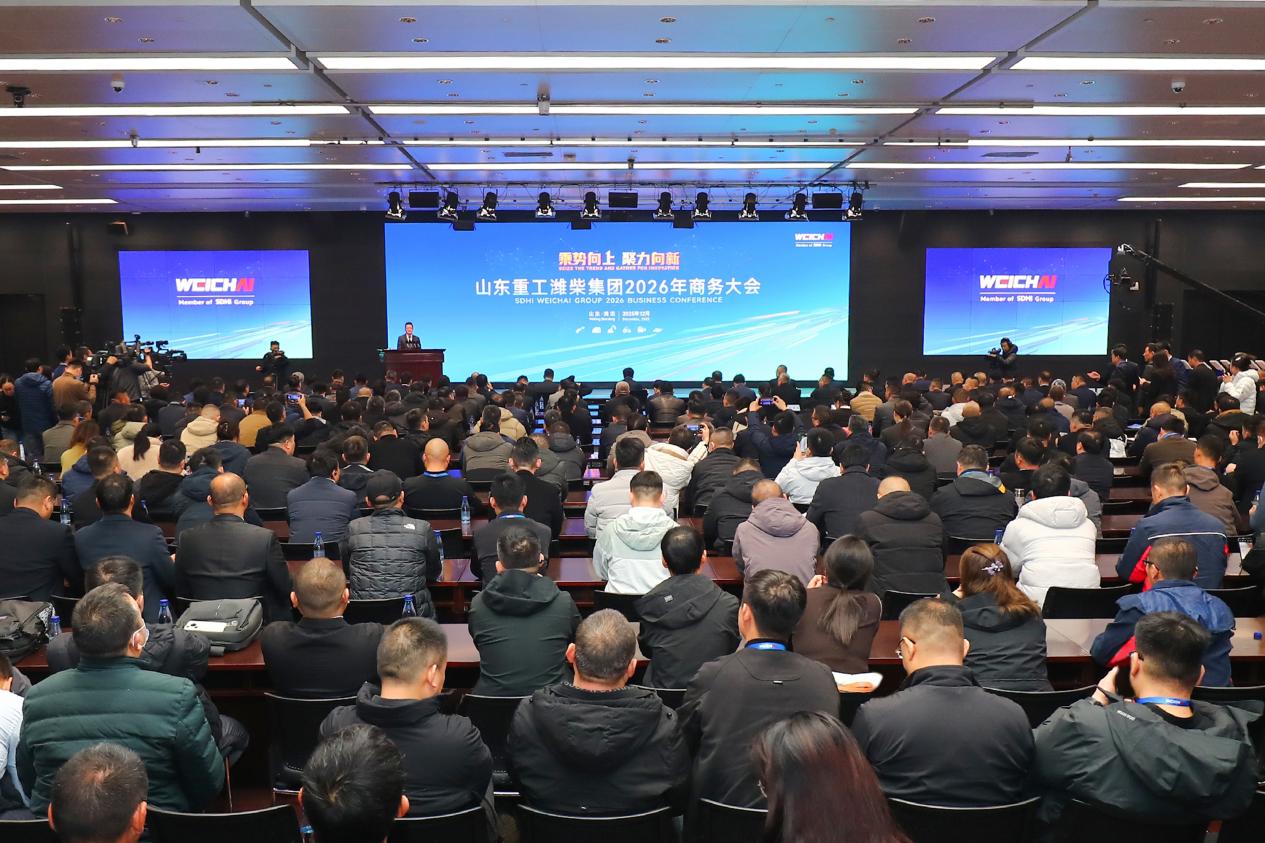
Core Insights - Shandong Heavy Industry Weichai Group held its 2026 Business Conference, showcasing over 150 green, low-carbon high-end products and launching more than ten new products and service models, highlighting its product mix advantages and technological strength [1] Group 1: Company Performance - Weichai has become a leading industrial equipment multinational group in China, with annual revenue exceeding 300 billion yuan, and ranks 87th in the "2025 China Enterprise 500" list with projected revenue of 312.29 billion yuan for 2024 [3][5] - The company is focusing on innovation-driven growth, aiming to enhance its multi-dimensional power industry structure and contribute to the upgrade of China's manufacturing industry [3][5] Group 2: Market Position and Product Development - Weichai's market leadership is reinforced, with its engine market share remaining the highest in the domestic industry, and significant sales growth in strategic markets such as Southeast Asia, Latin America, and Europe [6][10] - The company has launched the world's first 5-megawatt high-speed diesel generator set, achieving the highest power density globally, and has made breakthroughs in solid oxide fuel cell technology [8][10] Group 3: Future Strategy and Growth Areas - Weichai plans to leverage its strengths in high-end products, expand into new energy and hydraulic markets, and enhance its after-market service solutions, transitioning from a parts sales model to a service-oriented approach [10][12] - The company aims to deepen strategic collaboration, enhance digital capabilities, and build a new ecosystem in the power industry, positioning itself as a leader in technology and green development [12]
扩产来不及、不扩产跟不上,动力电池产能告急下进退两难
Zhong Guo Qi Che Bao Wang· 2025-12-08 09:19
Core Insights - The Chinese electric vehicle (EV) market is experiencing a "battle for battery supply" as companies rush to secure battery resources ahead of a significant tax policy change set to take effect on January 1, 2026 [2][3] - The impending reduction of the EV purchase tax from full exemption to a 50% reduction has triggered a surge in demand, leading to a scramble among automakers to lock in battery supplies [3][4] - The rapid growth in EV demand is creating a mismatch with battery production capacity, exacerbated by structural issues within the battery industry [2][5] Demand Surge - The demand for EVs has surged due to the impending tax policy change, with automakers offering purchase tax guarantees to customers to stimulate sales [3][4] - In the first ten months of 2025, China's EV production and sales reached 13.015 million and 12.943 million units, respectively, both showing over 30% year-on-year growth [4] - The domestic battery installation volume reached 84.1 GWh in October 2025, marking a 10.7% month-on-month increase and a 42.1% year-on-year increase [4] Supply Constraints - Battery production capacity is lagging behind demand, with a typical production line taking 18 months to become operational, and high investment costs of 150-200 million yuan per GWh [5] - The supply chain is further strained by rising prices of key raw materials like lithium carbonate, which increased by 20% year-on-year to 93,900 yuan per ton as of December 3, 2025 [5][10] - The current supply-demand mismatch is characterized as a structural issue rather than an absolute shortage, with experts predicting a return to more rational demand levels post-policy implementation [6] Technological Advancements - The battery industry is undergoing rapid technological innovation, with advancements in lithium iron phosphate and nickel-rich batteries posing challenges to existing production capacities [7][8] - The shift towards new battery technologies creates risks for production investments, as companies must adapt to avoid obsolescence [8] - The market is increasingly concentrated, with the top five battery manufacturers holding an 81.8% market share, indicating a decline in capacity utilization among smaller firms [8] Resource Allocation Challenges - The explosive growth of the energy storage sector is diverting battery production capacity, as both energy storage and EV batteries share similar technological resources [9][10] - Companies are prioritizing energy storage orders due to higher profit margins, which complicates the balance between energy storage and EV battery production [10] - The Chinese government is taking steps to regulate competition in the battery industry to promote high-quality development and address capacity allocation issues [10] International Market Dynamics - While the Chinese market faces battery supply shortages, the U.S. market is experiencing a contraction in battery projects due to concerns over oversupply and insufficient demand [11][12] - The disparity between the two markets is attributed to different stages of industry development, with China in a growth phase and the U.S. still in a cultivation phase [12] - Chinese battery companies are positioned to leverage their technological and cost advantages to expand into international markets, particularly in regions experiencing rapid EV growth [12]



记者观察 || 加强协同合作 构筑安全可控供应链
Zhong Guo Qi Che Bao Wang· 2025-12-08 09:19
动力电池产能吃紧的背后,是需求增长、技术迭代、资源分流和全球竞争等多重因素的综合作用。 记者认为,解决这一问题,不能仅依靠单一环节的努力,而需要整车企业、电池企业、原材料企业、政 府部门等多方协同,构建安全可控的供应链生态。 对于电池企业而言,精准的产能规划是核心。企业应建立常态化的市场监测机制,结合新能源汽车和储 能市场的发展趋势,科学预测需求增长,避免盲目扩产或扩产不足。同时,加大柔性产能建设投入,提 升产线对技术迭代的适应性,降低产能闲置风险。在技术研发方面,应聚焦固态电池、钠离子电池等下 一代技术,提前布局相关产能,抢占未来市场先机。 整车企业与电池企业的深度协同至关重要。当前,车企与电池厂的绑定合作模式已成为行业趋势,比亚 迪与自身整车业务的协同、宁德时代与特斯拉的长期合作,都证明了这种模式的有效性。双方可通过联 合研发、长期协议、股权合作等方式,稳定供需关系,共同应对技术迭代和市场波动。例如,车企可提 前向电池企业反馈车型规划和技术需求,帮助电池企业精准布局产能;电池企业则可将技术研发方向与 车企需求相结合,提升产品匹配度。 上游原材料产业的配套升级是基础。原材料企业应加快扩产步伐,尤其是锂、镍、 ...
观车 · 论势 || 在“存量优化”和“增量创造”中寻找消费新空间
Zhong Guo Qi Che Bao Wang· 2025-12-08 08:33
Core Viewpoint - The Chinese government is implementing new policies to stimulate automobile consumption, focusing on both optimizing existing vehicle stock and creating new demand in the automotive sector [1][6]. Group 1: Stock Optimization - The domestic automobile market has transitioned from a growth market to a stock market, with stock optimization being a key focus for current and future automobile consumption [2]. - As of September 2025, the total number of vehicles in China is projected to reach 360 million, with many vehicles entering the replacement phase [2]. - The core strategy for stock optimization is the vehicle trade-in program, which has seen over 3.4 million applications for scrapping and over 6 million for replacement as of October 22 this year, totaling over 10 million vehicles [2]. - In 2024, the scrapping and replacement of vehicles is expected to generate over 920 billion yuan in sales, significantly contributing to automobile consumption growth [2]. Group 2: Incremental Creation - Incremental creation is seen as a way to explore new consumption opportunities in the automotive ecosystem, with the modified vehicle market expected to exceed 200 billion yuan this year [4]. - The camping vehicle industry, supported by policies, is maturing, leading to increased sales and related consumption in campsite construction and equipment rental, creating a trillion-yuan consumption scenario in "automobile + tourism" [4]. - The changing consumption patterns, particularly among the "Z generation," are shifting focus from functional needs to social attributes and cultural experiences associated with smart and connected vehicles [4]. Group 3: Full-Chain Expansion - Policies are being introduced to eliminate systemic barriers and enhance the automotive consumption ecosystem, including establishing a reverse invoicing system for used cars and standardizing vehicle modification practices [5]. - Infrastructure development is ongoing, with improvements in charging facilities supporting the multi-scenario use of new energy vehicles [5]. - The integration of online and offline automotive consumption ecosystems is deepening, with consumers increasingly using digital platforms for information and services [5]. Group 4: Future Outlook - The new policies are expected to guide automobile consumption from deep value extraction in the stock market to innovative scenarios in the incremental market, ultimately expanding to a full-chain approach [6]. - The combined efforts of policy measures and market demand are anticipated to enhance the scale and quality of automobile consumption, providing long-term growth support for the automotive industry [6]. - The release of potential in the automotive consumption market is expected to bring new momentum and dividends to China's economy during the "14th Five-Year Plan" and into the "15th Five-Year Plan" [6].