
Di Yi Cai Jing Zi Xun

Search documents
CES中企展位最大面积背后:45岁的TCL,正站在全球化的新起点
Di Yi Cai Jing Zi Xun· 2026-01-07 07:03
Core Viewpoint - The China-Korea Business Forum held on January 5, 2026, highlighted the deepening economic cooperation between China and South Korea, with TCL as a key player in global market expansion and technological innovation [1][3]. Group 1: Economic Cooperation - The forum was attended by over 400 participants, including government officials and business leaders from both countries, emphasizing the importance of collaboration in various sectors [1]. - TCL aims to strengthen its global presence by collaborating with South Korean companies, particularly in technology-intensive industries [1][6]. - The cooperation between TCL and South Korean firms covers materials, equipment, and core electronic categories, enhancing supply chain stability [6][7]. Group 2: Technological Advancements - TCL is focusing on next-generation display technologies, including Mini LED and printed OLED, to enhance its product offerings and maintain competitive advantages [13][14]. - The company has made significant strides in AI integration, showcasing products like AI-powered air conditioners and AR glasses at CES [15][14]. - TCL's R&D efforts have led to breakthroughs in display technology, positioning the company as a leader in the global market [13][16]. Group 3: Market Position and Growth - TCL's global TV shipment volume is projected to reach 29 million units in 2024, ranking second worldwide, with a market share of 14.3% [16]. - The company has seen substantial growth in Mini LED TV shipments, with a year-on-year increase of 153.3% and a market share of 29.4% [16]. - TCL's strategic partnerships and technological advancements are expected to further enhance its market position and global influence [16].


中国机器人“刷屏”CES
Di Yi Cai Jing Zi Xun· 2026-01-07 06:02
Core Insights - The CES 2026 in Las Vegas showcased a strong presence of Chinese humanoid robotics companies, indicating a shift from laboratory innovations to real-world applications [2][3] - The event highlighted the increasing popularity and competitiveness of Chinese robotics in the global market, with many companies making their debut at CES [3][6] Group 1: Company Highlights - Unitree Technology's booth attracted significant attention with a robot fighting demonstration, showcasing the capabilities of their G1 humanoid robots [3][5] - The debut of ZhiYuan Robotics featured a dancing humanoid robot, which captivated foreign audiences and emphasized China's innovative edge in robotics [6] - Fourier's "Care-bot" concept prototype aims to explore emotional companionship through a lightweight design, targeting over 2,000 medical institutions globally [10][11] Group 2: Market Trends - The event saw a notable focus on consumer-oriented (C-end) products, with companies like VITAPOWER introducing interactive four-legged robots that can autonomously follow users [10][15] - Magic Atom reported that over 60% of its revenue comes from overseas, highlighting the global demand for their robots, including the MagicBot Gen1 for industrial applications [15] - Companies are leveraging CES for brand exposure and to secure overseas orders, aiming to establish a foothold in international markets [15]

宜家:7家门店停止运营
Di Yi Cai Jing Zi Xun· 2026-01-07 04:30
第一财经记者1月7日从宜家获悉,宜家决定自2026年2月2日起停止运营包括宜家上海宝山商场、宜家广 州番禺商场、宜家天津中北商场、宜家南通商场、宜家徐州商场、宜家宁波商场和宜家哈尔滨商场在内 的七个线下触点。 当地顾客仍可通过所在城市(例如上海、广州、天津)的其他宜家商场或宜家官网、宜家APP、宜家微 信可购物小程序、天猫旗舰店及京东旗舰店等全渠道继续体验宜家产品和服务。 宜家称,这一决定是宜家在中国深化转型过程中的重要一步,旨在为未来的业务增长构建更具韧性的基 础,并聚焦本土相关性,以提供可负担的家居产品与解决方案。 在接下来的两年内宜家计划开设超过十家小型门店,包括将于2026年2月开业的宜家东莞商场和将于 2026年4月开业的北京通州商场。 记者|乐琰 编辑|瑜见 ...
“蔚来还活着,活着就有机会”
Di Yi Cai Jing Zi Xun· 2026-01-07 03:56
Core Viewpoint - NIO has reached a significant milestone by producing its one millionth electric vehicle, marking its entry into the "million club" alongside other new energy vehicle manufacturers, and it aims to focus on future growth and profitability [1][2][9]. Group 1: Milestone Achievement - NIO's one millionth electric vehicle rolled off the production line, making it the second global brand after Tesla to achieve this milestone [1]. - The company has faced scrutiny regarding its survival, but reaching this production milestone is seen as a turning point [2][9]. Group 2: Financial Performance and Goals - NIO reported a non-GAAP loss of 2.7 billion RMB in Q3 2025, with a focus on achieving profitability in Q4 2025 [2]. - The company aims to deliver an average of 50,000 vehicles per month in Q4, but actual deliveries fell short at 124,800 units for the quarter, missing the target by approximately 20% [3]. - NIO's annual sales target for 2025 was set at 440,000 units, but it only achieved 326,000 units, indicating a completion rate of less than 80% [4]. Group 3: Market Competition and Challenges - NIO faces increasing competition from state-owned enterprises and joint ventures, as well as new entrants like Huawei and Xiaomi, which are impacting market dynamics [5]. - The main brand's sales declined by 11.13% from 2024 to 2025, contributing to the shortfall in meeting sales targets [5]. Group 4: Growth Strategy - NIO aims for annual growth of 40% to 50%, projecting sales of 1.75 million vehicles by 2030 based on its current performance [6]. - The company plans to enhance its sales and service network, targeting over 210 cities for coverage [5]. Group 5: Cost and Infrastructure Challenges - NIO has invested 65 billion RMB in R&D and 18 billion RMB in charging infrastructure, but faces cost pressures from supply chain fluctuations, particularly in lithium and chip prices [7]. - The company is also focused on building a robust infrastructure, with plans to establish 1,000 battery swap stations by 2026 and over 10,000 by 2030 [8]. Group 6: Long-term Vision - NIO continues to define itself as a startup, emphasizing the need to maintain an entrepreneurial mindset and improve its market share [9]. - The company acknowledges that while it has overcome immediate survival challenges, the path to profitability remains a critical focus [10].

创新跨境金融服务 浙商银行助力外贸企业“踏浪远航”
Di Yi Cai Jing Zi Xun· 2026-01-07 00:59
Core Viewpoint - The article emphasizes the importance of stabilizing foreign trade and foreign investment as key supports for economic stability, highlighting Zhejiang Commercial Bank's proactive measures to align with national strategies for expanding international circulation and promoting trade innovation [1]. Group 1: Cross-Border Financial Services - Zhejiang Commercial Bank has introduced five major cross-border financial services, including global accounts and settlement, integrated liquidity financing, one-stop investment and financing services, immersive foreign exchange trading, and scenario-based new foreign trade services, to support foreign trade enterprises in international markets [1]. - During the 14th Five-Year Plan period, Zhejiang Commercial Bank provided over $17,000 million in cross-border settlement services and over $7,000 million in foreign exchange risk hedging services, along with a cross-border financing balance exceeding 150 billion yuan [1]. Group 2: Addressing Challenges for SMEs - A survey targeting small and medium-sized foreign trade enterprises indicates a growing demand for efficient and low-cost payment settlement processes, particularly for new foreign trade models involving numerous small transactions [2]. - Zhejiang Commercial Bank has responded to the challenges faced by enterprises expanding into emerging markets like ASEAN, the Middle East, and Africa by launching innovative services such as global collection and cross-border easy collection, which enhance collection efficiency and reduce costs [2]. Group 3: Cross-Border Asset Pool Innovation - The case of YN Technology, which has expanded its international operations, illustrates the need for efficient and low-cost financing support as it faces challenges in obtaining financing for its overseas subsidiaries due to their short establishment time and lack of credit history [3][5]. - Zhejiang Commercial Bank provided 38 million yuan in funding support to YN Technology's overseas subsidiary through an innovative "cross-border asset pool" service, which allows for efficient credit connection between the parent company and its subsidiaries [5]. Group 4: Comprehensive Support for Global Operations - Zhejiang Commercial Bank has developed a systematic cross-border financial service capability to address the full chain of foreign trade enterprise needs, offering a one-stop, immersive support system [7]. - The five major services are interconnected, enhancing the overall efficiency of fund utilization for enterprises and aligning with the national strategy to promote trade innovation and international circulation [7].
降准降息可期!央行2026年政策定调,非银流动性机制有望破题
Di Yi Cai Jing Zi Xun· 2026-01-06 12:15
Group 1: Monetary Policy Direction - The People's Bank of China (PBOC) emphasizes promoting high-quality economic development and reasonable price recovery as key considerations for monetary policy in 2026, utilizing various tools such as reserve requirement ratio (RRR) cuts and interest rate reductions flexibly and efficiently [1][2] - The 2026 monetary policy will focus on both total and structural policies, maintaining ample liquidity and relatively loose social financing conditions to align the growth of social financing and money supply with economic growth and price level expectations [2][3] Group 2: Exchange Rate Management - The PBOC aims to maintain the stability of the RMB exchange rate at a reasonable and balanced level while preventing excessive fluctuations, with recent trends showing a strong recovery of the RMB against the USD [4][5] - Analysts predict that the RMB may experience moderate appreciation in 2026, supported by a favorable external environment, including the ongoing easing cycle of the Federal Reserve [4][6] Group 3: Financial Risk Prevention - The PBOC identifies the resolution of financial risks in key areas as a top priority for 2026, with measures to address risks related to financing platforms, small financial institutions, and financial markets [7] - A proposed mechanism for providing liquidity support to non-bank financial institutions in specific scenarios aims to enhance the financial stability framework, responding to potential systemic pressures [7][8]
中国汽车第一城易主
Di Yi Cai Jing Zi Xun· 2026-01-06 01:20
Core Insights - The competition for the title of "Automobile Capital" in China by 2025 is intensifying, with Chongqing currently leading in overall vehicle production and Hefei excelling in the new energy vehicle segment [1][2]. Group 1: Chongqing's Position - Chongqing's vehicle production reached 2.4981 million units from January to November 2025, marking a 12.1% year-on-year increase, solidifying its status as a leading automobile city [2]. - The city is home to traditional brands like Changan and emerging players like Seres, contributing to its competitive edge [2]. Group 2: Hefei's Growth - Hefei produced 1.246 million new energy vehicles in the same period, ranking first among cities in this category [4]. - The city aims to achieve a scale of 700 billion yuan in its new energy vehicle industry by 2025, with a target of producing over 3 million vehicles [4]. Group 3: Other Competitors - Anhui province, with a total vehicle production of 3.335 million units and 1.635 million new energy vehicles, has surpassed Guangdong to become the leading province [3]. - Cities like Wuhu and Liuzhou are also making significant strides, with Wuhu's production expected to rise and Liuzhou achieving a vehicle production of 1.331 million units, a 37.8% increase [5][4]. Group 4: Emerging Cities - Cities such as Xi'an, Zhengzhou, and Qingdao are approaching the "million vehicle" production threshold, with Xi'an producing 1.576 million vehicles and Zhengzhou showing a significant year-on-year growth of 89.72% [9]. - Qingdao's production reached 911,700 units, supported by major manufacturers like SAIC-GM Wuling and Chery [10]. Group 5: Challenges for Major Cities - Shenzhen's automotive production has declined, with the city no longer maintaining a competitive edge in vehicle production due to statistical adjustments [7]. - Guangzhou's traditional vehicle production fell by 20%, indicating a significant transition challenge [8].

黄金、白银、铜,年轻人正在贵金属市场里“交作业”
Di Yi Cai Jing Zi Xun· 2026-01-05 12:29
Core Insights - The article highlights a growing trend among young investors, particularly in China, who are increasingly engaging in gold and other metal investments, driven by macroeconomic factors and the AI industry revolution [1][6][8] Group 1: Young Investors' Behavior - Young investors, like the character Yuanyuan, are actively researching and investing in gold, silver, and copper, moving beyond traditional savings to more complex investment strategies [1][4] - The concept of "doing homework" in gold investment has emerged, where young investors share their strategies and achievements in social groups, turning investment decisions into a form of social currency [2][3] - The demographic of investors is shifting, with over 50% of gold investors being born in the 1990s, indicating a preference for flexible and lightweight investment options [3] Group 2: Market Dynamics - The price of gold has seen significant increases, with a reported rise of over 66% since early 2025, marking the highest annual increase in nearly 46 years [6][7] - Analysts suggest that the current gold bull market is not overvalued compared to historical trends, with potential for continued growth due to concerns over the U.S. dollar and global monetary policies [7][8] - The demand for strategic metals like copper and silver is expected to rise, driven by industrial changes and the AI revolution, which may lead to a structural increase in prices [8][9] Group 3: Future Outlook - The future of precious metals investment remains optimistic, with expectations that gold's upward trend will continue, albeit at a potentially slower rate [6][7] - The relationship between gold and other metals like silver and copper is highlighted, with the potential for these metals to experience price increases as they gain recognition for their roles in the AI industry [8][9] - However, there are warnings that once the narrative around AI becomes clearer, the current high valuations of gold may decline, leading to a more rational assessment of silver's value [9]
“一人一团队”来了,企业预测2026年将成多智能体“上岗”元年
Di Yi Cai Jing Zi Xun· 2026-01-05 09:33
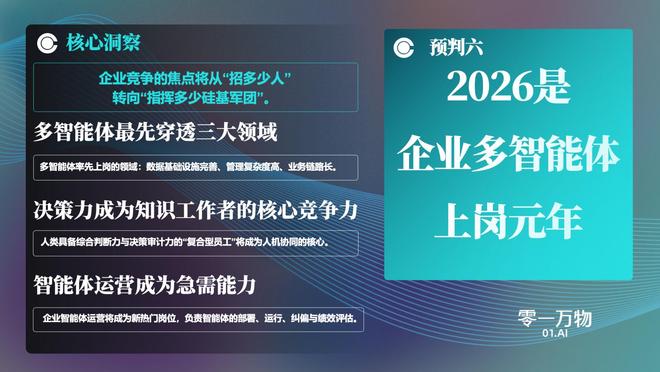
零一万物预测,智能体将从"一人一工具"进阶"一人一团队",多智能体需具备TAB( 团队作战、业务裂 变、商业重构)三要素,中国将成为全球多智能体"超级引擎","一把手工程"是赢取AI红利的关键路 径,智能体反哺将开启数字基建"自主进化",以及2026年是企业多智能体上岗元年。 从基础模型研发到推动AI落地提效,大模型正在越来越靠近一线生产端。过去一年时间,零一万物团 队在能源、采矿、制造、养殖、零售等行业落地实践,发现企业已不再满足于只在一线使用AI,而是 越来越大胆地将AI能力向上推,与公司管理层、经营层越来越近。 作为AI落地形式之一,Agent在2025年被热议。从行业技术发展脉络来看,智能体经历过工作流、推理 Agent、多智能体阶段。国际市场中,微软推出 AutoGen 框架实现智能体分工协作,谷歌 DeepMind 通 过多智能体强化学习攻克复杂任务,国内火山引擎等企业也在相关领域布局,行业竞争日趋激烈。 对于与大厂之间的差异,零一万物中国区解决方案和交付总经理韩炜在采访中表示,零一万物不再沿用 大厂销售标准化产品模式,而是更注重基于客户需求进行梳理和设计,将其转化为产品原型。他认为以 往大厂的产 ...
港股汽车股走低,蔚来跌超6%
Di Yi Cai Jing Zi Xun· 2026-01-05 07:48
2026年,新能源汽车行业迎来两大政策变动,一是新能源汽车车辆购置税优惠力度"退坡",从全额免征 调整为减半征收(按5%税率);二是汽车"两新"政策补贴方式出现变化,将定额补贴调整为按车价比 例补贴,虽然补贴上限保持不变,但低价车型补贴力度实际上也在"退坡"。 元旦假期期间,多家汽车经销商销售人员向第一财经记者表示,造车新势力因平均售价较高,所以报废 补贴和置换更新补贴的变化对其影响不大;但新能源汽车购置税"退坡"确实增加了消费者的购车成本。 记者了解到,虽然很多车企出台了"兜底"措施,但并不能完全抵消购置税成本的提升。蔚来门店销售 称,以买断价11.98万元的萤火虫车型为例,消费者2026年购买需缴纳购置税近6000元,蔚来仅提供 2000元的选配金补贴。相比2025年,消费者购买成本"会高一点点"。 1月5日,港股汽车股持续走低,截至当日下午三时许,蔚来跌超6%;长城汽车跌近6%;小鹏汽车跌超 5%;奇瑞汽车跌近4%,创下2025年9月底上市以来的新低。其他港股汽车个股如零跑汽车、吉利汽 车、理想汽车、比亚迪股份股价也均有不同程度的下跌。 消息面上,1月4日晚间,一份名为《2026元旦车市客流下滑交流》的 ...