Qi Huo Ri Bao

Search documents
点“糖”成金:解读中国糖企的“期货密码”
Qi Huo Ri Bao· 2026-01-15 16:13
Core Viewpoint - The Chinese sugar futures market has evolved over the past 20 years, transforming from a reliance on price predictions to a strategic use of financial derivatives for risk management and operational stability, marking a significant shift in the industry’s operational philosophy [1]. Group 1: Evolution of Business Models - Traditional sugar companies relied heavily on price forecasts, leading to volatile performance based on market conditions [2]. - Companies are now adopting proactive strategies, utilizing futures contracts and risk management tools to stabilize operations and optimize supply chains [2][3]. - The shift from passive to active market engagement signifies a fundamental change in the operational mindset of Chinese sugar enterprises [2]. Group 2: Advanced Derivative Strategies - The use of options and structured trades represents an advanced level of financial strategy, moving beyond basic hedging to more complex risk management techniques [3]. - Companies like COFCO Sugar have innovatively used call options to generate premium income while managing price risks effectively [3][4]. - The introduction of structured options in trade contracts simplifies complex financial instruments, making them more accessible for companies [4]. Group 3: Flexibility in Delivery and Trading - Companies like Yunnan Yingmao Sugar have demonstrated the value of flexible delivery options, optimizing their operations based on market conditions [5]. - The ability to choose optimal delivery locations enhances profitability and supply chain efficiency [5]. Group 4: Systemic Restructuring of the Industry - The adoption of basis trading has redefined the value chain in the sugar industry, allowing for collaborative pricing strategies between producers and downstream enterprises [6]. - This collaborative approach fosters a more stable trading environment, moving away from adversarial price negotiations [6][7]. - The integration of financial derivatives into traditional operations is seen as a critical factor for the future competitiveness of sugar companies [7]. Group 5: Future Outlook - The ability to leverage financial tools is becoming an essential "soft skill" for modern sugar enterprises, indicating a shift towards a more integrated approach between production and finance [7]. - The evolution of the sugar industry reflects a broader trend of traditional sectors embracing financial innovations to enhance resilience and efficiency [7].
央行发声!今年还有一定的降准降息空间
Qi Huo Ri Bao· 2026-01-15 09:47
Group 1: Monetary Policy and Economic Support - The People's Bank of China (PBOC) is implementing a moderately loose monetary policy to support stable economic growth and high-quality development, with a focus on both stock and incremental policy effects [4][7] - In 2025, the PBOC conducted a net injection of 6 trillion yuan through open market operations, including a net buy of government bonds amounting to 120 billion yuan [2] - The PBOC plans to continue using various monetary policy tools, including potential interest rate cuts and reserve requirement ratio (RRR) reductions, to maintain liquidity and support economic stability [4][5] Group 2: Government Bond Operations - The PBOC's operations in government bonds aim to enhance the pricing benchmark role of the yield curve and prevent market volatility, with a total issuance of 16 trillion yuan in government bonds in 2025 [2][3] - The PBOC's buyback operations have contributed to a government bond balance of nearly 7 trillion yuan, improving market liquidity [2][3] - The PBOC will flexibly conduct government bond operations based on market conditions and liquidity needs to ensure a conducive environment for government bond issuance [3] Group 3: Price Stability and Inflation Management - Recent data shows a positive trend in China's price levels, with the Consumer Price Index (CPI) rising by 0.8% year-on-year in December 2025, the highest since March 2023 [7] - The PBOC emphasizes the importance of maintaining a supportive monetary policy stance to promote reasonable price recovery and ensure that monetary supply growth aligns with economic growth and price expectations [7] - The PBOC will continue to monitor price trends closely and implement policies to foster a favorable monetary environment for price stability [7] Group 4: Exchange Rate Risk Management - There is an increasing awareness among enterprises regarding exchange rate fluctuations, with the scale of using foreign exchange derivatives for risk management exceeding 1.9 trillion USD in 2025, nearly doubling since 2020 [8] - The State Administration of Foreign Exchange (SAFE) plans to enhance services for enterprises in managing exchange rate risks, including promoting risk-neutral concepts and providing practical examples for hedging strategies [8] - SAFE aims to support compliant enterprises in conducting foreign exchange derivative transactions more conveniently, thereby improving their ability to hedge against exchange rate risks [8]
重磅!央行将推出八项政策措施
Qi Huo Ri Bao· 2026-01-15 07:55
邹澜介绍,根据当前经济金融形势需要,中国人民银行将先行推出两方面政策措施。一方面是下调各类 结构性货币政策工具利率,提高银行重点领域信贷投放的积极性。另一方面是完善结构性工具并加大支 持力度,进一步助力经济结构转型优化。具体包括以下几项: 一是下调各类结构性货币政策工具利率0.25个百分点。各类再贷款一年期利率从目前的1.5%下调到 1.25%,其他期限档次利率同步调整。 二是将支农支小再贷款与再贴现打通使用,增加额度,并单设民营企业再贷款。合并使用支农支小再贷 款与再贴现额度,增加支农支小再贷款额度5000亿元,总额度中单设一项民营企业再贷款,额度1万亿 元,重点支持中小民营企业。 1月15日下午,国务院新闻办公室举行新闻发布会,介绍货币金融政策支持实体经济高质量发展成效。 中国人民银行新闻发言人、副行长邹澜在新闻发布会上表示,中央经济工作会议已经明确,2026年要继 续实施适度宽松的货币政策,中国人民银行将按照党中央、国务院决策部署,加大逆周期和跨周期调节 力度,有效支持"十五五"开好局、起好步。 七是会同金融监管总局将商业用房购房贷款最低首付比例下调至30%,支持推动商办房地产市场去库 存。 四是合并设 ...


氧化铝涨势能否延续
Qi Huo Ri Bao· 2026-01-15 07:51
Core Viewpoint - The aluminum oxide market is experiencing high operational capacity and inventory levels, with potential price fluctuations influenced by supply and demand dynamics. Group 1: Production and Capacity - As of the end of December 2025, China's total bauxite production reached 60.154 million tons, a year-on-year increase of 3.6% [1] - The total production of metallurgical-grade aluminum oxide in China for 2025 is projected to be 89.417 million tons, reflecting a year-on-year increase of 6.8% [2] - The built capacity for metallurgical-grade aluminum oxide remains stable at 11.032 million tons per year, with operational capacity at 8.882 million tons per year, and a weekly operating rate of 80.51% [2] Group 2: Inventory and Pricing - Domestic aluminum oxide inventory stands at 5.318 million tons, with a significant increase in inventory levels observed [3] - The current spot price for aluminum oxide is 2,688 yuan per ton, showing a slight decrease of about 10 yuan per ton since the beginning of January [3] - The port inventory of aluminum oxide has increased since December, indicating a net import status in November [2] Group 3: Downstream Demand - China's total electrolytic aluminum production reached 4.392 million tons, an increase of approximately 80,000 tons, with a growth rate of 1.8% [4] - The operational capacity of electrolytic aluminum is expected to see slight growth in January, with weekly production reaching 857,000 tons post-New Year [4] - Despite high profits in the electrolytic aluminum sector, the potential for increased demand for aluminum oxide remains limited due to capacity constraints [4]
国泰君安协助深圳某头部焊锡焊料厂完成仓单串换:用“无形搬运”破解跨区域供应链困局
Qi Huo Ri Bao· 2026-01-15 06:00
华南某头部焊锡焊料企业的生产基地位于广东深圳,多年来一直通过买入期货合约交割进行原材料风险 管理,在有效规避价格波动风险的同时,也饱受交割到非华南地区仓单的困扰。国泰君安期货有限公司 的风险子公司国泰君安风险管理有限公司(以下简称国泰君安)在了解到客户需求后,通过提供仓单串 换方案,将该企业持有的华东地区交割库仓单置换为广东本地同规格仓单,为该企业解决了期货交割无 法完全满足适配区域的问题。 项目背景 行业共性问题 有色金属是国内最早接触期货市场的行业之一。自锡期货上市以来,行业上下游企业大量参与期货交 割,通过期货市场直接进行原材料或成品价格波动风险管理。我国电子加工产业集中度较高,形成了华 东、华南两大锡消费中心。有色金属期货品种上市较早,交割配套服务优势明显,使得华东地区交割资 源更为丰富。据统计,华南地区锡锭交割库库容仅占全国总量的20%,日常仓单占比不足40%。这导致 同等条件下,珠三角地区电子制造企业匹配到所在地区仓单的概率普遍低于长三角地区。而交易所的交 割配对原则使企业可能获得不符合地区要求的仓单。 锡的高价值、低用量特点使企业对库存管理精细度要求更高。区域错配的仓单会让企业面临"跨区调配 成 ...

申万期货服务天然橡胶贸易企业:跨境协同助力产业客户实现内外盘一体化风险管理
Qi Huo Ri Bao· 2026-01-15 05:54
在全球经济一体化浪潮下,青岛某大宗商品贸易企业积极扩大天然橡胶大宗商品进口业务,但在业务拓展过程中,却 遭遇了内外盘交易割裂,交易难以执行的问题。企业需要同步管理国内橡胶销售市场价格波动风险(内盘期货)以及海 外橡胶采购成本及汇率风险(外盘期货)。由于其缺乏境外交易资质,而且小型经纪商跨市场协同效率低下,使得该企 业难以把握稍纵即逝的橡胶价格风险对冲和贸易利润套期保值机会,严重制约该企业的盈利能力、风险管理效率和业 务拓展速度。 项目背景 在此背景下,申万期货国际业务部积极响应《上海市推进国际金融中心建设条例》中"促进期货市场高水平对外开 放"的要求,充分发挥上海作为国际金融枢纽的优势,携手申万期货青岛营业部,探索出一条服务大宗商品外贸企业跨 境风险管理的新路径,为产业客户提供了内外盘一体化的风险管理解决方案。 创新解决方案 在服务模式创新方面,申万期货国际业务部联合青岛营业部,创新性地构建了"境内期货国际业务端+境内分支机构端 +境外持牌经纪商端"的三方沟通机制。申万期货国际业务部作为协调者,充分发挥其在跨境业务中的专业优势和资源 整合能力,联动群益期货香港有限公司(外盘执行方)与申万期货(内盘通道),为客 ...
齐盛期货:焦煤上行高度受限
Qi Huo Ri Bao· 2026-01-15 03:07
Core Viewpoint - The recent rebound in coking coal futures is driven by ample liquidity and a temporary increase in industrial inventory demand, but the upside potential is limited due to supply pressures from coal mine restarts and cautious downstream winter storage sentiment [1] Group 1: Market Dynamics - The macroeconomic environment has improved, providing solid support for commodity prices, with expectations of interest rate cuts abroad and a marginal improvement in domestic inflation data [1] - The strong performance of non-ferrous and precious metals, particularly silver and copper, has positively influenced the entire industrial sector, making coking coal an attractive option for investors seeking to capitalize on lower valuations [1] - Recent rumors of production cuts in coal capacity in regions like Shaanxi and Inner Mongolia have amplified market sentiment, although the actual impact on supply remains limited [2] Group 2: Supply and Demand Factors - The pace of imported Mongolian coal has slowed, with daily customs clearance volumes around 1,200 trucks, indicating reduced import pressure [3] - Domestic coking coal production has begun to recover in January, with previously halted mines resuming operations, although the increase is not expected to be rapid due to ongoing safety regulations [3] - Steel mills have shown a slight recovery in iron output, with daily production rising from 2.2743 million tons to 2.295 million tons, providing some support for coking coal demand [4] Group 3: Inventory and Pricing Trends - The auction situation for coking coal has improved, with a significant decrease in the failure rate and stabilizing transaction prices [4] - Current inventory levels at steel mills indicate a cautious approach to winter storage, with an average usable days of coking coal inventory around 12.8 days, suggesting limited aggressive purchasing [4] - The overall market sentiment is characterized by low inventory and low transaction volumes, indicating that while there is demand, it lacks the strength to drive a significant price increase [4] Group 4: Future Outlook - The rebound in coking coal futures is seen as a valuation correction rather than a sign of a strong market, with ongoing supply increases and cautious demand limiting upward price movement [5] - The market is expected to continue a volatile but generally strong trend in the short term, with potential risks if iron output recovery falls short of expectations or if coal mine restarts accelerate [5]
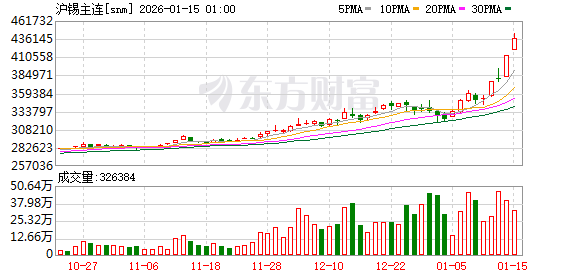
沪锡期价一度突破44万元/吨,行业协会发文→
Qi Huo Ri Bao· 2026-01-15 01:12
Core Viewpoint - The recent surge in tin prices is driven by optimistic macroeconomic sentiment and fundamental expectations, with significant demand from emerging industries such as electric vehicles, photovoltaics, and artificial intelligence [1][2]. Group 1: Market Dynamics - Tin futures on the Shanghai Futures Exchange (SHFE) have seen a strong increase, with the main contract reaching 413,170 yuan/ton and later surpassing 440,000 yuan/ton, marking an increase of over 9% [1]. - The London Metal Exchange (LME) also reported a rise in tin prices, peaking at 52,495 USD/ton [1]. - The market is experiencing a "rush for exports" due to the recent cancellation of export tax rebates on photovoltaic products, which is expected to significantly boost tin demand in the short term [1]. Group 2: Supply and Demand Factors - The supply side remains constrained, with expectations of a supply gap despite the resumption of tin mining in Myanmar [1][2]. - The demand for tin is being driven by strategic investments in sectors like semiconductor and AI technologies, which are anticipated to support consumption growth [2][3]. - Current market conditions indicate a low acceptance of high tin prices among downstream and end-user enterprises, leading to issues with price transmission [4]. Group 3: Regulatory and Industry Responses - The Shanghai Futures Exchange has implemented multiple risk warnings and control measures to guide rational market participation amid rising volatility in metal prices [2]. - Industry associations have issued initiatives to promote rational pricing and discourage speculative behavior, aiming to stabilize the market environment [3]. - Analysts suggest that while the current demand outlook is optimistic, there are concerns that the anticipated demand growth in the semiconductor sector may be overestimated, and traditional demand may be underestimated [3].
期货日报:金银价格再创历史新高 普通人还能“上车”吗?
Qi Huo Ri Bao· 2026-01-15 01:03
Core Insights - The prices of gold and silver have been rising significantly since last year, leading to increased public interest and investment in these precious metals [1][2] - Despite the overall market interest, retail sales of gold jewelry and bars have seen a decline due to high prices, with many consumers opting for investment in gold bars instead of jewelry [1][2] - Analysts remain optimistic about the long-term prospects for gold, with predictions of prices reaching as high as $5000 per ounce by 2026 [3][4] Group 1: Market Trends - Gold prices have reached historical highs, with COMEX gold futures hitting $4647.6 per ounce and silver futures reaching $91.37 per ounce, marking increases of over 3.5% [2] - Retail gold shops are experiencing lower foot traffic, with promotional activities in place to attract customers, but many consumers are deterred by high prices [1][2] Group 2: Investment Recommendations - Analysts suggest that gold still holds value for investment, but caution against buying at peak prices; they recommend waiting for price corrections to invest in physical gold or ETFs [4] - The current geopolitical tensions and changes in international relations are expected to support the long-term rise in precious metal prices, encouraging investors to consider accumulating gold during price dips [4]
凌晨暴涨!沪锡期价一度突破44万元/吨 行业协会发文
Qi Huo Ri Bao· 2026-01-15 00:22
Group 1 - The core viewpoint of the articles highlights the strong upward trend in tin prices driven by macroeconomic sentiment and external market influences, with the Shanghai Futures Exchange tin futures reaching over 400,000 yuan/ton and the London Metal Exchange tin prices peaking at 52,495 USD/ton [2] - Recent optimism in the market is attributed to dual factors: expectations of U.S. fiscal and monetary easing, and a weaker dollar, alongside domestic policy expectations for increased measures in the new five-year plan [2] - The resumption of tin mining in Myanmar is expected to improve supply, but there remains a projected supply gap for the year, while demand from emerging industries such as electric vehicles, photovoltaics, and artificial intelligence is significantly increasing [2] Group 2 - The continuous rise in tin prices reflects long-term supply disruptions centered around the restructuring of Myanmar's Wa State tin industry and the strategic metal premium driven by investments in smart chips and semiconductors [3] - The Shanghai Futures Exchange has issued multiple risk warnings and control measures since December to guide rational market participation amid rising volatility in non-ferrous and precious metal prices [3] - Industry associations have called for a rational approach to maintain market order and stability, urging participants to avoid speculative behaviors and to collaboratively guide prices back to reasonable levels [4] Group 3 - The market currently views tin as a "computing metal," with optimistic demand forecasts, particularly as AI investments are expected to support tin consumption growth through 2026 [4] - However, there are concerns that the acceleration in tin prices may have already priced in long-term demand increases, and the cancellation of export tax rebates for photovoltaic products may only provide a short-term boost to tin consumption [5] - The current market fundamentals have not changed significantly, with stable production from domestic smelters and rising inventories due to weakened consumption, although overall inventory levels remain low [5]