
Jin Shi Shu Ju

Search documents
AI股已脆弱到一触即溃?富国喊话:减仓!
Jin Shi Shu Ju· 2025-11-11 13:40
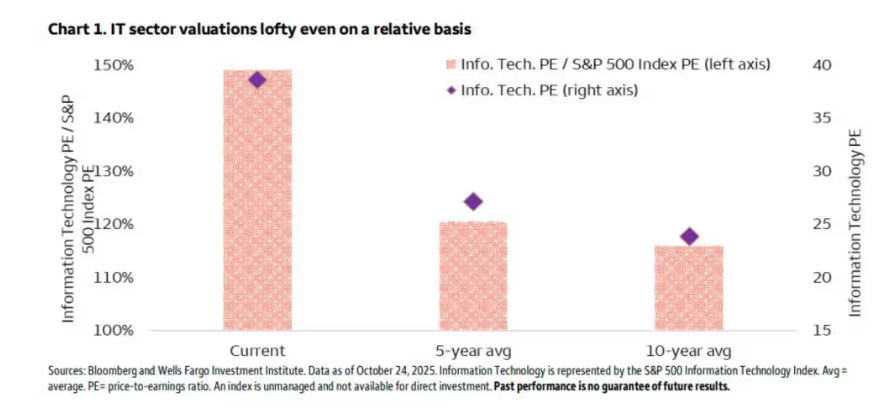
Core Viewpoint - AI stocks, led by Nvidia (NVDA), have shown signs of recovery after a recent pullback, but pressure signals from CoreWeave (CRWV) have cast a shadow over market sentiment [1] - Investors are caught between the fear of missing out on AI gains and concerns about a potential market crash reminiscent of the internet bubble [1] Summary by Sections Market Sentiment and Ratings - Wells Fargo Investment Institute downgraded the rating of the S&P 500 Information Technology sector, which includes AI leaders like Nvidia, Microsoft (MSFT), and Broadcom (AVGO), from "overweight" to "neutral" due to high valuations [1] - The downgrade reverses a previous upgrade on April 4, which was influenced by market volatility following a "liberation day" tariff announcement; since then, the sector has risen 60%, outperforming the S&P 500 by over 25 percentage points [1] Growth and Valuation Concerns - Douglas Beath, a global investment strategist at Wells Fargo, acknowledges that the AI boom will continue to drive revenue and profit growth in the sector, highlighting its relatively low debt levels and strong free cash flow generation [1] - Despite the growth in AI-related capital expenditures, concerns about investment returns and debt financing may still lead to market volatility [2][4] Recommendations for Investors - Beath suggests that the current pullback could be temporary, but the sector remains vulnerable to negative surprises, even from slightly disappointing earnings reports [4] - The recommendation is to reduce exposure to the tech sector to align with its market weight to lock in profits, while reallocating funds to three sectors rated "overweight" by Wells Fargo: industrials, utilities, and financials [4] - The industrial and utility sectors allow investors to participate in AI gains through the growing trend of auxiliary data centers, with valuations lower than the tech sector; the financial sector is expected to benefit from a steepening yield curve and favorable regulatory environment, while also supporting AI development through M&A and debt financing [4]




印巴首都24小时内相继发生爆炸案!两个拥核国家又暗流涌动?
Jin Shi Shu Ju· 2025-11-11 12:33
周一晚间,印度总理纳伦德拉·莫迪(Narendra Modi)领导的政府仍在调查新德里爆炸事件的原因—— 当时一辆汽车在历史悠久的红堡(Red Fort)附近的红绿灯处减速后发生爆炸。而周二下午,伊斯兰堡 一座拥挤的法院外,一名自杀式袭击者在被拒绝进入院内后引爆了自身。 巴基斯坦总理办公室在一份声明中指控印度从阿富汗领土支持针对巴基斯坦的恐怖袭击,并将周二的事 件描述为"印度在该地区发起的国家支持恐怖主义的最恶劣例子之一"。声明未提供任何将爆炸与新德里 关联的证据,而伊斯兰堡此前也多次提出类似指控。 印度和巴基斯坦首都在24小时内接连发生致命爆炸,造成至少20人死亡、多人受伤,加剧了这两个核武 装邻国之间紧张局势重启的担忧。 当天早些时候,莫迪承诺将惩罚新德里爆炸案的"阴谋策划者",但未点名任何嫌疑人,也未将该爆炸定 性为恐怖袭击。 今年早些时候,两国曾爆发为期四天的军事冲突,双方使用导弹、无人机、火炮及其他武器相互打击。 此次爆炸事件发生后,双方的猜忌进一步加深。5月的冲突是自1971年全面战争以来两国间最致命的一 次,起因是有争议的克什米尔(Kashmir)地区发生针对印度游客的袭击,新德里指责该袭击由巴 ...
每日投行/机构观点梳理(2025-11-11)
Jin Shi Shu Ju· 2025-11-11 11:49
Group 1: Gold Market Insights - JPMorgan Private Bank predicts gold prices could reach $5200-$5300 by the end of 2026, driven by continued purchases from central banks in emerging markets, representing an increase of over 25% from current levels [1] - Gold prices have surged over 50% this year, reaching a historical high of over $4380 in October, primarily due to central banks seeking value storage and asset diversification [1] - Singapore's OCBC Bank suggests that the end of the U.S. government shutdown could benefit gold, as delayed economic data may indicate a slowing economy, potentially leading to a more accommodative monetary policy from the Fed [5] Group 2: U.S. Government Shutdown and Economic Impact - TD Securities anticipates the U.S. House will vote on a temporary funding bill, likely leading to the government reopening by Friday, which could result in a quick economic rebound post-shutdown [2] - Standard Chartered notes that the end of the government shutdown may challenge the recent strength of the U.S. dollar, as weak economic data could highlight negative impacts on the economy [3] - UBS forecasts that the Fed's potential rate cuts could lead to a decline in the 10-year U.S. Treasury yield to 3.50% [7] Group 3: Currency and Economic Forecasts - Rabobank's Jane Foley indicates that if delayed U.S. economic data is positive, the dollar may strengthen, improving perceptions of the U.S. economy [4] - Standard Chartered's Steve Englander reports that the dollar is returning to its historical normal relationship after a year of deviation, suggesting a positive outlook for the currency [3] Group 4: Chinese Economic Outlook - CITIC Securities projects China's GDP growth to be around 5.0% in 2025 and 4.9% in 2026, with fiscal spending expected to moderately expand [7] - The firm emphasizes a significant trend of household savings being converted into investments, indicating a potential increase in equity asset allocation [6] Group 5: Automotive Industry Trends - CITIC Jiantou outlines investment strategies for the automotive sector in 2026, focusing on cyclical growth, technological advancements in autonomous driving, and robotics [8] - The report suggests that the automotive industry will see a shift towards overseas expansion and growth, with commercial vehicles showing stable dividend attributes [8]
数据洪峰将至!美联储中间派转鹰,12月降息必要性存疑
Jin Shi Shu Ju· 2025-11-11 09:46
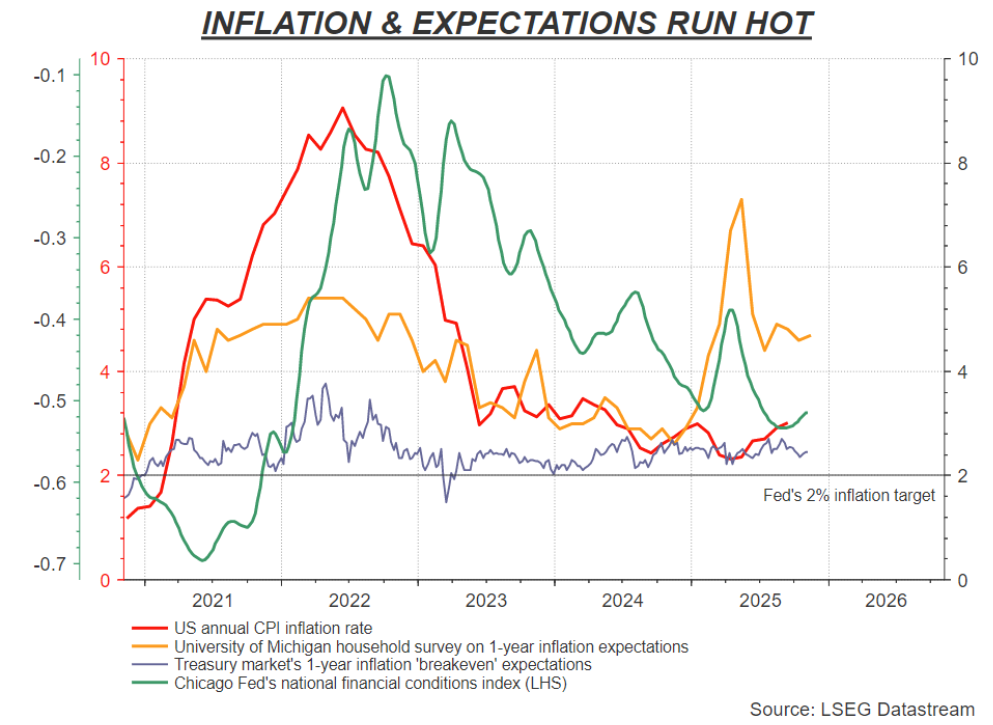
Core Viewpoint - The potential end of the longest government shutdown in U.S. history may lead to the release of delayed economic data, but Federal Reserve officials are increasingly skeptical that this data will show the necessary weakness for another rate cut this year [1] Group 1: Federal Reserve's Stance - Federal Reserve officials believe the labor market remains resilient, financial conditions are still accommodative, and inflation is trending in an unfavorable direction [1] - The likelihood of a third rate cut this year is rapidly diminishing unless the upcoming data shows significant surprises [1] - The futures market still prices in about a two-thirds chance of a rate cut in December, which may be overly optimistic [1] Group 2: FOMC Dynamics - Two moderate members of the Federal Open Market Committee (FOMC) appear inclined to pause rate cuts until at least January [2] - Upcoming personnel changes in the FOMC may not lean entirely dovish, as hawkish members will join the committee [2] - Evidence suggests that moderate members who previously supported rate cuts may shift to support a pause if there is no clear evidence of labor market deterioration [2] Group 3: Labor Market Analysis - Four key reasons support the case for pausing rate cuts in December: high inflation, the need for slightly restrictive policy, resilient labor market conditions, and the time gained from previous rate cuts [3] - There is a consensus among Fed analysts regarding the current inflation and financial conditions, but the labor market remains the biggest uncertainty [3] Group 4: Employment Data Insights - Despite a surge in layoffs reported by Challenger, Gray & Christmas, private sector job growth remains strong, indicating a stable labor market [6] - Weekly unemployment claims data shows only a slight increase, suggesting stability in the labor market despite recent layoffs and the government shutdown [7] - High-frequency employment data from Homebase indicates that net job creation is hovering near zero, reflecting a potential slowdown in employment growth [9][10]
三重利好共振!日股涨势还能再接再厉?
Jin Shi Shu Ju· 2025-11-11 09:13
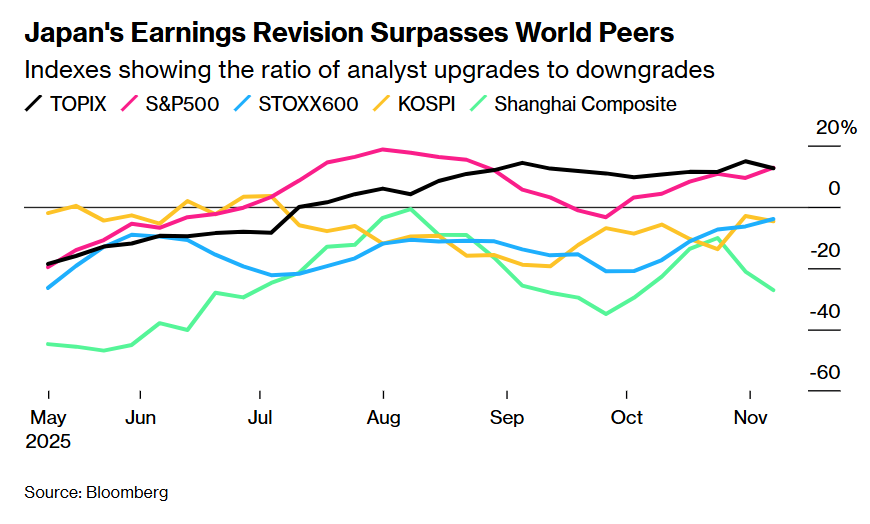
分析师上调日本企业盈利预期的比率超过世界其他国家 "当前国内外环境均对日本经济构成支撑,"日本新金资产管理公司高级基金经理藤原直树(Naoki Fujiwara)表示,"企业盈利稳 步提升,下财年前景改善,我认为市场估值已不再过度昂贵。" 这一数据凸显市场的乐观情绪。根据彭博社11月10日的盈利修正数据,分析师上调东证指数成分股盈利预期的速度,超过全球多 数主要股指。 日本企业财报季捷报频传,越来越多公司凭借人工智能(AI)需求激增、关税影响小于预期及日元贬值三重利好,业绩远超市场 预期,显示股市涨势仍有空间。 彭博社数据显示,在已公布季度财报的东证指数(Topix)成分股中,近60%的公司盈利超过至少两名分析师的平均预期。冈三证 券11月7日的分析显示,这是自2020年第二季度以来已公布财报公司中,超预期比例最高的一次。 关税对盈利的影响减弱,也提振了超预期财报的表现。部分企业已成功将成本转嫁给客户。例如,日立建机(Hitachi Construction Machinery)上月末在财报电话会议上表示,公司正通过提价覆盖关税成本。 不过,部分分析师警告,盈利预期上调数量增加是指数创新高的关键因素,尤其是日 ...
美联储“印钞机”待命,两位数通胀恐卷土重来?
Jin Shi Shu Ju· 2025-11-11 08:53
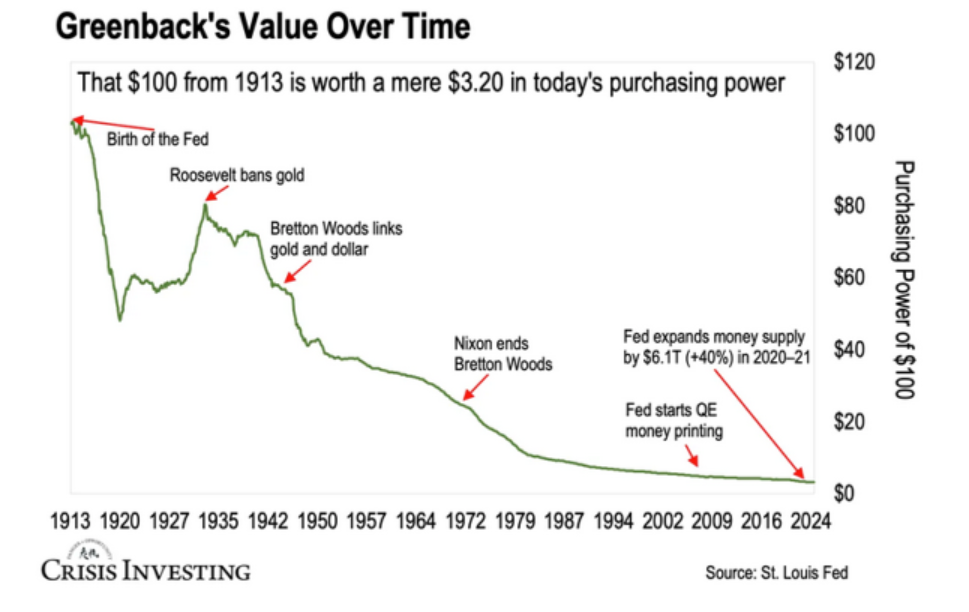
Group 1 - The Federal Reserve Chairman Jerome Powell announced a 25 basis point interest rate cut during the October FOMC meeting, bringing the total rate cut since June of last year to 150 basis points, indicating that more cuts are likely to come [1] - Powell hinted at the end of quantitative tightening (QT) during a meeting in Philadelphia, confirming that the Fed will officially end its balance sheet reduction on December 1 [1] - The historical context shows that since the establishment of the Fed in 1913, the dollar has lost 97% of its purchasing power, with $100 in 1913 now equivalent to $3.20 [1] Group 2 - The primary reason for the dollar's depreciation has been the severing of its link to gold, with the introduction of quantitative easing (QE) in the 21st century, which involves the Fed creating money to purchase government bonds, thus eroding the value of existing dollars [4] - Following the 2008 financial crisis, the Fed expanded its balance sheet from $900 billion to $4.5 trillion through multiple rounds of QE, creating approximately $3.6 trillion, resulting in a 20% decrease in dollar purchasing power by the end of the QE period [4] - During the COVID-19 pandemic, the Fed created $3.3 trillion in 2020 alone, which accounted for about 20% of the total circulating dollars at that time, leading to a significant increase in the balance sheet from $4.2 trillion to $8.9 trillion by April 2022, causing a 25% decline in dollar purchasing power from 2020 to 2025 [4] Group 3 - The Fed is expected to restart QE to lower long-term interest rates, likely starting early next year, with a balance sheet already inflated to approximately $6.6 trillion, which could lead to double-digit inflation [5] - The upcoming monetary policy could result in unprecedented large-scale and rapid currency devaluation in the U.S. economy [5]
孙正义出手!软银清仓英伟达,套现58亿美元转向其它AI投资
Jin Shi Shu Ju· 2025-11-11 07:57
Group 1 - SoftBank Group has completely liquidated its holdings in Nvidia, cashing out approximately $5.8 billion as founder Masayoshi Son plans significant investments focused on AI [1] - The company reported a net profit of 2.5 trillion yen (approximately $162 billion) for the second quarter of the fiscal year ending September, significantly exceeding market analysts' average expectations of 418.2 billion yen [1] - SoftBank's stock price surged by 78% in the three months ending September, marking its best quarterly performance since Q4 2005, driven by substantial gains from its AI-related investments [1] Group 2 - Masayoshi Son is actively betting on the AI and semiconductor industries while reducing investments in other areas, with plans including a $30 billion investment in OpenAI and discussions with TSMC regarding a $1 trillion AI manufacturing center in Arizona [2] - The financial challenge lies in raising funds for new investments, including the $20 billion for OpenAI and $6.5 billion for acquiring Ampere Computing [2] - A report from Finimize indicates that the previous strategy of buying SoftBank for low-cost access to Arm shares and broader AI and tech exposure has exceeded expectations, but the discount opportunity has largely disappeared, suggesting it may be a good time to sell and realize profits [2]
AI扩建引爆融资需求,摩根大通称“几乎所有市场都要上场”
Jin Shi Shu Ju· 2025-11-11 07:27
该报告由塔里克·哈米德(Tarek Hamid)领导的策略师团队撰写,他们表示: "问题不在于'哪个市场将为AI热潮提供资金',而在于'融资结构将如何设计,以便触达所有 资本市场'。" 他们预计,杠杆融资在未来五年内可提供约1500亿美元的资金。即便加上投资级与高收益债券市场的融 资,以及每年最多400亿美元的数据中心证券化融资,仍不足以满足庞大的资金需求。报告估算,私人 信贷与政府资金可能需共同弥补剩余的1.4万亿美元缺口。 摩根大通在报告中计算,整体账单至少为5万亿美元,最高可能达到7万亿美元,这将单独推动债券及银 团贷款市场重新加速增长。 摩根大通的一份分析报告指出,AI超级企业(AI hyperscalers)正疯狂扩建数据中心,未来五年内,这 一进程将需要约1.5万亿美元的投资级债券融资,并且还需来自市场各个领域的广泛资金支持。 上个月,Meta公司发行的300亿美元债券创下高等级债券市场史上最大认购纪录,而上周,甲骨文公司 为建设数据中心园区募集的180亿美元债券,也吸引了投资者的踊跃认购。 尽管分析师估计,为未来五年的扩张筹资所需的金额巨大,但他们警告称,前路不会是一条"稳步上 升"的直线。 他 ...
别高兴太早!美政府重开预期点燃市场,但三大风险逼近
Jin Shi Shu Ju· 2025-11-11 05:58
Group 1 - The U.S. stock market experienced a significant rise due to optimism surrounding a potential agreement to end the longest government shutdown in U.S. history, with the S&P 500 index rising by 1.5% and the Nasdaq composite index increasing by 2.3%, marking the largest single-day percentage gain since mid-May [1] - Technology and communication services sectors saw substantial gains, with the information technology sector up by 2.7% and communication services up by 2.5% on the same day [1] - The reopening of the government is expected to reduce uncertainty in economic data and may pave the way for the Federal Reserve to implement its third interest rate cut of the year in December [1] Group 2 - Recent signs indicate that companies are adjusting their workforce sizes after a period of "labor hoarding" post-pandemic, which is viewed positively for corporate profits as long as large-scale layoffs do not occur [2] - Investors are preparing for a wave of delayed economic data releases, with concerns about the quality and interpretation of this data, particularly regarding potential widespread layoffs [3] Group 3 - Despite optimism from the government reopening, concerns about the high valuations of technology stocks remain, although recent sell-offs have made AI-related stocks more accessible to individual investors [4] - The market is beginning to recognize the high valuations of large tech companies, leading to a phase where AI stocks are expected to demonstrate tangible results from significant investments [5] - The overall sentiment for year-end market performance remains optimistic, contingent on the stability of the bond market and long-term interest rates [5]
我要“安静下来”了:巴菲特最后一封致股东信(全文)
Jin Shi Shu Ju· 2025-11-11 02:43
Group 1 - The company will have a new CEO, Greg Abel, by the end of the year, who is described as an excellent manager and communicator [2] - The company has a unique group of individual shareholders who generously share their wealth with less fortunate groups [2] - The company has a strong focus on maintaining trust and confidence among shareholders, especially during the transition to new leadership [17] Group 2 - The company has a history of successful investments, such as the acquisition of the Omaha Sun newspaper, which later achieved over 100% annual pre-tax returns [6] - The company emphasizes the importance of strong management and the need for vigilance regarding potential health issues among CEOs [19] - The company is committed to operating in a manner that prioritizes shareholder interests and avoids behaviors that could undermine its status as a valuable asset [21]