Xin Lang Ji Jin

Search documents
碳酸锂期货重回7.9万元关口,盛新锂能涨停!制造业需求提振+反内卷助攻,有色龙头ETF(159876)劲涨1.41%
Xin Lang Ji Jin· 2025-10-23 11:51
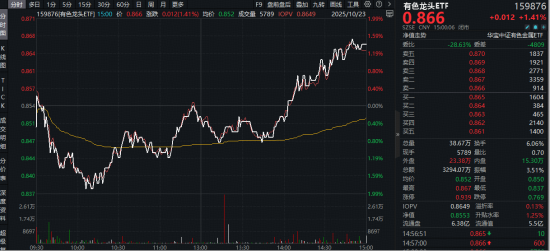
Core Viewpoint - The non-ferrous metal sector has seen significant net inflows of capital, indicating strong investor interest and potential growth opportunities in this industry [1][3]. Group 1: Market Performance - The non-ferrous metal sector recorded a net inflow of 32.97 billion yuan, leading all 31 primary industries in the Shenwan classification [1]. - The Non-Ferrous Metal Leaders ETF (159876) experienced a price fluctuation of 3.51%, closing up 1.41% after initially dropping over 1.8% [1]. - Key stocks in the lithium and aluminum sectors showed strong performance, with leading companies like Shengxin Lithium Energy and Zhongfu Industrial seeing gains of over 5% [3]. Group 2: Sector Analysis - The aluminum sector is facing supply disruptions, with Citic Securities highlighting a high probability of the Mozal plant's shutdown, which could impact the supply chain and market dynamics [3]. - In the lithium sector, the recent New Energy Battery Industry Development Conference emphasized the importance of solid-state battery development, while lithium carbonate futures have returned to the 79,000 yuan mark [4]. - As of October 22, five companies in the non-ferrous metal index reported third-quarter earnings, with Zijin Mining showing a revenue increase of 10.33% year-on-year, reaching 254.2 billion yuan [4][5]. Group 3: Future Outlook - Analysts believe that the current non-ferrous metal industry is in a "golden phase" of simultaneous volume and price increases, with leading companies showing improved profitability and return on equity (ROE) [4]. - The economic recovery expectations are not yet fully reflected in the pricing of cyclical goods, with manufacturing demand anticipated to boost non-ferrous metal prices [5]. - The Non-Ferrous Metal Leaders ETF (159876) provides a diversified investment approach across various metals, reducing risk compared to investing in a single metal sector [7].



港股AI尾盘逆转!阿里夸克“C计划”曝光,百亿港股互联网ETF(513770)水下拉升涨逾1%,全天溢价高企
Xin Lang Ji Jin· 2025-10-23 11:51
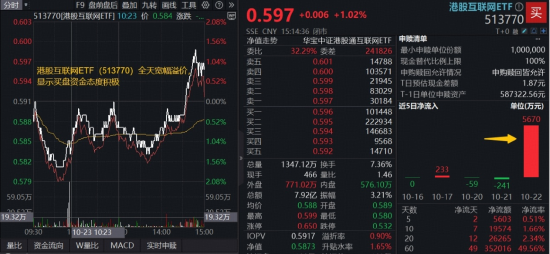
内外利好预期共振,港股午后转升,恒指、恒科指双双收涨,科网龙头多数走强,美团-W涨超4%,阿 里巴巴-W、腾讯控股涨超1%,小米集团-W跟涨飘红。 港股AI核心资产——港股互联网ETF(513770)早盘走势低迷,场内价格一度跌近2%,后震荡企稳, 尾盘直线拉升翻红,收涨1.02%,全天成交额7.92亿元,环比放量。 值得一提的是,港股互联网ETF(513770)全天溢价高企,显示买盘资金态度积极。10月以来港股AI震 荡回调,资金逢机积极吸筹,上交所数据显示,港股互联网ETF(513770)最新单日获资金净流入5670 万元,近10日资金累计净流入1.96亿元,彰显对后市的乐观预期。 港股互联网ETF(513770)最新规模已突破100亿元,年内日均成交额超6亿元,支持日内T+0交易,不 受QDII额度限制,流动性佳! AI主线方面,相关催化密集,10月23日,阿里巴巴旗下旗舰应用夸克正式上线对话助手,传闻中的"C 计划"首次落地。此外,夸克AI眼镜即将开启预售,分析认为,阿里夸克的浏览器、AI眼镜等产品矩 阵,正试图构建一个人机交互的"AI超级入口"。 国泰海通证券表示,港股互联网巨头受益AI叙事发酵,港 ...
极限逆转!周期领衔,化工ETF劲涨2%,大金融助攻,百亿金融科技ETF出手!港股AI尾盘反击,513770水下拉起
Xin Lang Ji Jin· 2025-10-23 11:48
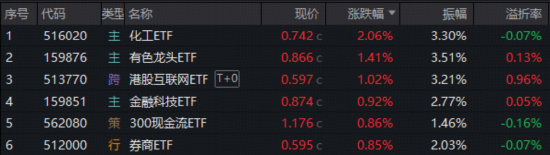
Core Viewpoint - The Chinese asset market experienced a significant reversal on October 23, with both Hong Kong and A-share markets ending their downward trends, driven by strong performances in the chemical and financial sectors. Group 1: Market Performance - The Hong Kong market saw the Hang Seng Index and the Hang Seng Tech Index both end their five-day losing streaks, with a notable increase in trading volume [1] - A-shares also rebounded, with the Shanghai Composite Index and the ChiNext Index both closing in the green, supported by a surge in cyclical stocks [1] - The total trading volume in A-shares reached 1.66 trillion yuan, marking a new low since August 6 [1] Group 2: Sector Highlights - The chemical sector showed strong performance, with the Chemical ETF (516020) rising by 2.06%, driven by significant gains in fluorochemical stocks [5][7] - The financial technology sector also saw a rebound, with the Financial Technology ETF (159851) reversing earlier losses to close nearly 1% higher, supported by strong performances from internet brokerage firms [9][12] - The Hong Kong Internet ETF (513770) experienced a late surge, closing up 1.02%, reflecting positive sentiment towards major tech stocks like Alibaba and Tencent [13][14] Group 3: Investment Opportunities - The Chemical ETF (516020) is noted for its low price-to-book ratio, indicating potential for long-term investment as it covers various segments of the chemical industry [7][8] - The Financial Technology ETF (159851) is highlighted for its strong liquidity and significant net inflows, suggesting renewed investor interest [9][12] - The Hong Kong Internet ETF (513770) is positioned as a core asset for long-term investment, benefiting from the ongoing AI narrative and strong performance of its major holdings [14][15]
供需共振催化工行情,氟化工领衔飙涨!化工ETF(516020)涨超2%,板块戴维斯双击将至?
Xin Lang Ji Jin· 2025-10-23 11:48
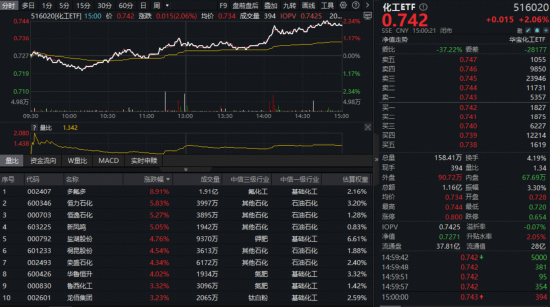
Core Viewpoint - The chemical sector experienced a strong rebound on October 23, with the Chemical ETF (516020) showing a significant increase, reflecting positive market sentiment and performance in various sub-sectors [1][3]. Group 1: Chemical Sector Performance - The Chemical ETF (516020) opened lower but quickly rebounded, achieving a maximum intraday increase of 2.34% and closing up by 2.06% [1]. - Key stocks in the fluorochemical, petrochemical, and potash fertilizer sectors saw notable gains, with Multi-Fluor rising by 8.91%, and several others, including Hengli Petrochemical and Hengyi Petrochemical, increasing by over 5% [1][2]. Group 2: Market Drivers - The fluorochemical sector led the gains, driven by tight supply and rising prices of popular refrigerants, with demand expected to increase as the fourth quarter approaches [2][3]. - National policies are expected to focus on supply-side control in the petrochemical and coal chemical industries, which may benefit companies with effective cost management and those in sectors with steep cost curves [3]. Group 3: Valuation Insights - As of October 22, the Chemical ETF's underlying index had a price-to-book ratio of 2.23, indicating a low valuation relative to the past decade, suggesting a favorable long-term investment opportunity [3][4]. Group 4: Future Outlook - Short-term uncertainties in overseas chemical supply may persist, but China's chemical industry is expected to leverage its competitive advantages to reshape the global chemical landscape [4]. - The Chemical ETF (516020) is recommended for investors looking to capitalize on the rebound in the chemical sector, as it provides exposure to leading companies across various sub-sectors [5].
ETF日报:煤炭价格端或持续强韧,煤炭行业基本面总体稳中有进,关注煤炭ETF
Xin Lang Ji Jin· 2025-10-23 11:12
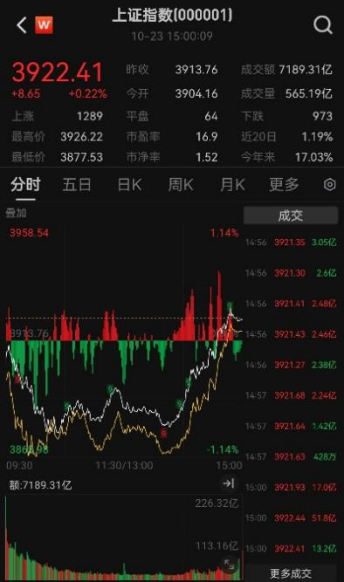
Market Overview - The market rebounded today with major indices closing in the green. The Shanghai and Shenzhen stock exchanges had a total trading volume of 1.64 trillion yuan, a decrease of 23.9 billion yuan compared to the previous trading day. The Shanghai Composite Index rose by 0.22%, the Shenzhen Component Index increased by 0.22%, and the ChiNext Index gained 0.09% [1] Coal Sector Performance - The coal sector continued to show strength, with the coal ETF opening higher and stabilizing, closing up by 2.46% [3][4] - As of October 17, 2025, the price of Q5500 thermal coal at Qinhuangdao Port was 748 yuan per ton, reflecting a week-on-week increase of 43 yuan per ton [7] Supply Side Analysis - In September, the output of industrial raw coal from large-scale enterprises was 410 million tons, a year-on-year decrease of 1.8% but a month-on-month increase of 5.1%. The average daily output was 13.72 million tons. From January to September, the total output was 3.57 billion tons, a year-on-year increase of 2.0% [5] - The National Energy Administration has initiated a coal mine production inspection in eight key coal-producing provinces to ensure stable coal supply. Since July and August, domestic raw coal production has significantly declined due to various factors [5] - Extreme weather has disrupted production in key areas, with heavy rainfall affecting coal mining and transportation [5] Demand Side Analysis - Since October, high temperatures in southern regions have led to a significant increase in coal demand, while northern areas have experienced rapid cooling [6] - In October, coal imports showed a decline, with the first two weeks seeing a shipment volume of 9.85 million tons, a 14.4% decrease from September and a 43.7% decrease year-on-year [6] Future Outlook - The coal price is expected to remain strong due to ongoing supply disruptions and rising winter demand. The overall fundamentals of the coal industry are stable with potential for improvement [10] - Recent expectations for state-owned enterprise reforms have strengthened, with the Red Dividend State-Owned Enterprise ETF rising by 1.00% and the Central Enterprise Win-Win ETF increasing by 1.15% [10]
杨德龙:市场风格频繁切换 大盘维持震荡向上走势
Xin Lang Ji Jin· 2025-10-23 10:36
Group 1: Market Trends - The market is experiencing fluctuations, but the overall trend is upward, with significant rebounds in the new energy sector, particularly in lithium and photovoltaic industries [1][2] - The price of battery-grade lithium carbonate has increased by 1,500 yuan, averaging 77,600 yuan per ton, contributing to the rise in the new energy sector [1][2] Group 2: New Energy Sector Developments - The new energy sector is recovering significantly after a period of internal competition and capacity reduction, with a focus on clean energy as a national policy [2] - The Ministry of Industry and Information Technology (MIIT) emphasizes the need for technological innovation and the development of new battery technologies, including solid-state and metal-air batteries [2] - MIIT's four recommendations aim to enhance the resilience of the supply chain, optimize the development environment, and promote international cooperation in the new energy battery industry [2] Group 3: Banking Sector Insights - A major bank's stock price has reached a historical high, with a price-to-book ratio exceeding 1, indicating a shift in investor interest towards dividend assets amid market volatility [3] - The banking sector's low valuation and high dividend yield appeal to investors seeking stable returns, especially as technology stocks experience corrections [3] Group 4: Robotics Industry Growth - The humanoid robot sector is poised for significant growth, similar to the success seen in the electric vehicle industry, with industrial robot production increasing by nearly 30% in the first three quarters [4] - The supply chain for humanoid robots includes upstream components, midstream manufacturing, and downstream application services, with upstream component manufacturers likely to benefit first [4] Group 5: Investment Opportunities in Humanoid Robots - The investment in the embodied intelligence sector reached 19.5 billion yuan in the first half of 2025, with local governments supporting humanoid robot development [5] - The humanoid robot industry is transitioning from factory production to commercial and household applications, with potential market value reaching trillions in the next 5 to 10 years [5]
杨德龙:十五五期间的首要目标公布 高质量发展取得显著成效 科技自立自强水平大幅提高
Xin Lang Ji Jin· 2025-10-23 10:18
Group 1 - The main goal of the "14th Five-Year Plan" is to achieve significant results in high-quality development, enhance technological self-reliance, deepen reforms, improve social civilization, and elevate the quality of life for the people [1] - By 2035, China's economic, technological, defense, and comprehensive national strength is expected to significantly increase, moving away from the previous high-speed growth model to focus on quality [1] - The emphasis will be on improving total factor productivity, increasing product added value, and achieving self-control over key core technologies, with a target growth rate of around 5% [1] Group 2 - The capital market is identified as a crucial link between technology and industry, with a focus on supporting early-stage hard technology through venture capital and private equity [2] - The A-share market has initiated a "technology bull market," which is expected to attract household savings into equity assets, creating a virtuous cycle of wealth, consumption, and industry [2] - A sustained technology-driven bull market is viewed as a key driver for China's economy, enhancing household income and stimulating consumption while providing long-term capital for technological innovation [2] Group 3 - The formation of a MACD golden cross signal indicates positive momentum in certain stocks [3]
沪指尾盘发力极限翻红,煤炭、能源金属板块表现活跃,机构维持均衡配置观点| 华宝3A日报(2025.10.23)
Xin Lang Ji Jin· 2025-10-23 09:21
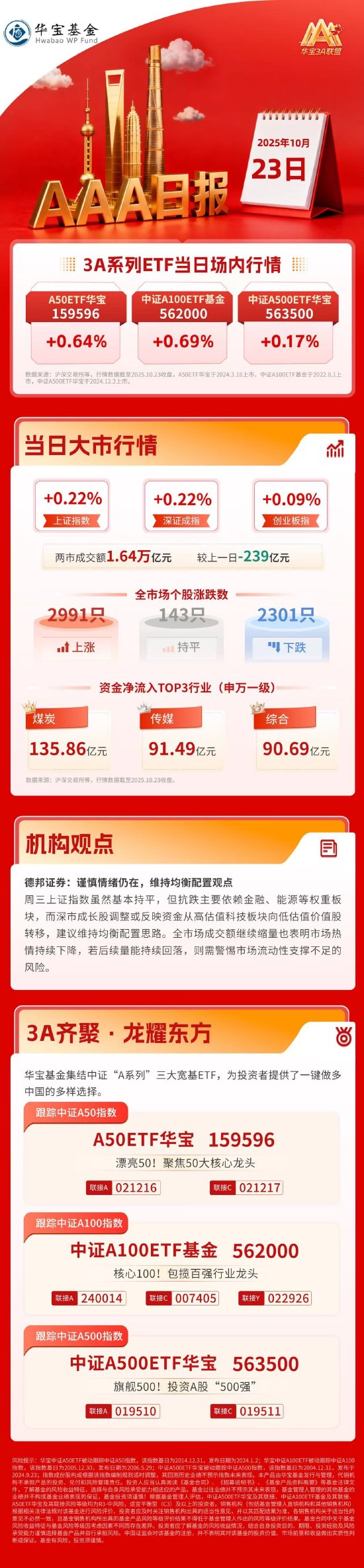
Group 1 - The market showed a slight increase with the Shanghai Composite Index remaining stable, primarily supported by financial and energy sectors, while growth stocks in the Shenzhen market adjusted, indicating a shift of funds from high-valuation tech stocks to undervalued value stocks [2] - The total trading volume in the market decreased to 1.64 trillion yuan, down by 239 billion yuan from the previous day, reflecting a continued decline in market enthusiasm [2] - The three major broad-based ETFs from Huabao Fund provide investors with diverse options to invest in China's market, tracking the CSI A50, CSI A100, and CSI A500 indices [2] Group 2 - The A50 ETF Huabao was launched on March 18, 2024, the China A100 ETF Fund on August 1, 2022, and the CSI A500 ETF Huabao on December 2, 2024 [1] - The market saw a net inflow of funds into specific sectors, indicating potential investment opportunities in those areas [1]
万亿“现金牛”王者归来!300现金流ETF(562080)劲涨0.86%创新高
Xin Lang Ji Jin· 2025-10-23 09:06
Group 1 - The 300 Cash Flow Index rose by 1.08% on October 23, outperforming major indices such as the CSI Dividend and the Shanghai Composite Index, highlighting the strength of the "cash is king" strategy [1][4] - The first listed 300 Cash Flow ETF (562080) tracked the 300 Cash Flow Index and increased by 0.86%, closing at 1.176 yuan, marking a four-day consecutive rise [2][3] - The 300 Cash Flow Index focuses on high-quality earnings and dividend sectors, emphasizing stable profit and abundant cash flow, particularly in traditional high-dividend industries like oil and coal [7][9] Group 2 - The U.S. Treasury announced sanctions against two major Russian oil companies, leading to a surge in international oil prices, which positively impacted the 300 Cash Flow Index's largest constituent, China Petroleum, which rose by 3.15% [4][6] - Nearly 80% of the 50 large-cap "cash cow" stocks in the 300 Cash Flow Index closed in the green, with major companies like China Petroleum, China Mobile, and Ningde Times showing strong performance [4][6] - The market is experiencing a shift towards large-cap blue-chip stocks with high earnings quality and low valuations, indicating a defensive strategy may be more effective in the current weak market environment [9]

139.6%累计收益+年度正收益全满贯!红利低波 ETF(512890)获资金持续加仓,机构:四季度是关键窗口
Xin Lang Ji Jin· 2025-10-23 08:24
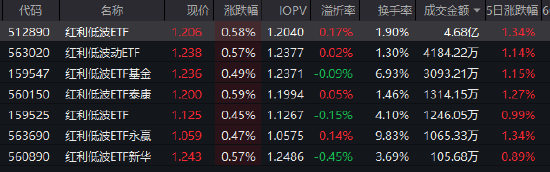
Core Insights - The Reducing Volatility ETF (512890) has shown significant capital inflow, with net inflows of 10.6 billion over the last 5 trading days and a total circulation scale reaching 245.39 billion as of October 22, 2025 [1][2] - Several A-share listed companies have announced third-quarter dividend plans, enhancing market focus on dividend assets, with expectations for the fourth quarter to be a key time for bottom-fishing in dividend stocks [1] - The banking sector is projected to maintain positive revenue and profit growth, with a year-on-year increase of 0.4% in revenue and 1.1% in net profit for the first three quarters of 2025 [1] Fund Performance - The Huatai-PineBridge Reducing Volatility ETF (512890) has achieved a cumulative return of 139.60% as of October 22, 2025, ranking 70th among 502 similar products [2] - The fund has consistently delivered positive returns for six consecutive years from 2019 to 2024, marking it as one of the few A-share ETFs to achieve "annual positive return full marks" [2] - Investors are encouraged to consider the ETF as a core component for stable returns in their asset allocation, especially through systematic investment plans to mitigate short-term volatility [2] Market Activity - On October 23, A-share major indices experienced fluctuations, with the Reducing Volatility ETF (512890) closing up 0.58% at 1.206 yuan, leading in trading volume among similar ETFs with a turnover rate of 1.90% and a transaction amount of 4.68 billion [3]