Wen Hua Cai Jing

Search documents
海关:智利12月铜出口量为146,401吨
Wen Hua Cai Jing· 2026-01-13 01:33
Core Insights - Chile's copper exports in December reached 146,401 tons, with 42,984 tons exported to China [2] - The total export volume of copper ore and concentrate from Chile in December was 1,170,302 tons, with 751,238 tons sent to China [2] Industry Challenges - China's copper industry faces three main challenges: increasing reliance on foreign resources in the upstream sector, overcapacity in the midstream processing segment, and suppressed downstream demand due to high copper prices [2] - To assist the industry in navigating these changes, a bilingual version of the "2026 China Copper Industry Chain Distribution Map" has been compiled in collaboration with copper industry chain enterprises [2]


期铜逼近纪录高位,受需求乐观预期及AI数据中心带动【1月12日LME收盘】
Wen Hua Cai Jing· 2026-01-13 00:55
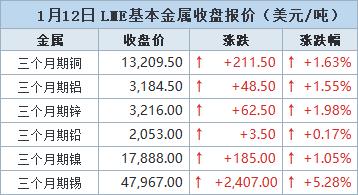
1月12日(周一),伦敦金属交易所(LME)期铜上涨并逼近纪录高位,市场情绪受益于对最大消费国 强劲需求的乐观预期,以及人工智能所需数据中心的拉动。 伦敦时间1月12日17:00(北京时间1月13日01:00),LME三个月期铜上涨211.5美元,或1.63%,收报每吨 13,209.5美元。 此外,伦敦金属交易所(LME)周一发布的按产地划分的金属库存月度报告显示,2025年12月,中国 产的铜在LME库存中的占比下降,原因是位于亚洲的LME注册仓库中的铜库存流出。 | | 1月12日 LIE基本金属收盘报价(美元/吨) | | | | --- | --- | --- | --- | | 金属 | 收盘价 | 张跃 | 张跌幅 | | 三个月期铜 | 13,209.50 ↑ | +211.50 ↑ +1.63% | | | 三个月期铝 | 3,184.50 ↑ | +48.50 ↑ +1.55% | | | 三个月期锌 | 3,216.00 ↑ | +62.50 ↑ +1.98% | | | 三个月期铅 | 2,053.00 1 | +3.50 ↑ +0.17% | | | 三个月期镇 | 17,888.0 ...
1月9日LME金属库存及注销仓单数据
Wen Hua Cai Jing· 2026-01-12 09:30
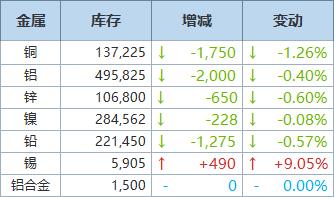
Group 1 - The overall inventory levels for various metals have shown fluctuations, with copper decreasing by 1,750 tons (-1.26%) to 137,225 tons, while aluminum decreased by 2,000 tons (-0.40%) to 495,825 tons [1][4] - Tin inventory increased significantly by 490 tons (+9.05%) to 5,905 tons, indicating a positive trend in this metal's stock [1][11] - The registered warehouse stocks for copper are at 115,150 tons, with a decrease of 0.17%, while the canceled warehouse stocks decreased by 6.56% to 22,075 tons, resulting in a cancellation ratio of 16.09% [2][4] Group 2 - Aluminum registered warehouse stocks are at 446,050 tons, remaining unchanged, while canceled stocks decreased by 3.86% to 49,775 tons, leading to a cancellation ratio of 10.04% [2][5] - Zinc inventory decreased by 650 tons to 106,800 tons, with registered stocks at 98,750 tons and canceled stocks at 8,050 tons, resulting in a cancellation ratio of 7.54% [9] - The tin inventory's registered stocks increased by 9.45% to 5,790 tons, while canceled stocks decreased by 8.00% to 115 tons, leading to a cancellation ratio of 1.95% [2][11]
乐观情绪重燃 沪铜出现反弹【1月12日SHFE市场收盘评论】
Wen Hua Cai Jing· 2026-01-12 08:34
Group 1 - The core viewpoint of the articles indicates that copper prices are experiencing upward momentum due to tight supply conditions and increased production pressures from smelters, despite weak domestic demand and rising social inventories [1][2] - Domestic copper concentrate processing fees are under pressure, and disruptions in overseas supply have exposed vulnerabilities in the mining sector, providing support for copper prices [1] - The recent cancellation of export tax rebates for photovoltaic products may temporarily boost metal demand, influencing copper price trends, although high prices continue to suppress actual demand [1] Group 2 - New Lake Futures suggests that after a decline in copper prices, previously suppressed domestic consumption may be released, potentially alleviating inventory pressure [2] - The global mining and smelting sector faces significant production reduction pressures by 2026, indicating a challenging mid-term fundamental outlook [2] - The demand side remains resilient, driven by growth in the renewable energy sector, AI data center construction, and global grid renovation cycles, contributing to strong global copper consumption [2]
沪铜库存增逾两成 刷新近九个月新高
Wen Hua Cai Jing· 2026-01-12 06:56
Group 1 - The London Metal Exchange (LME) reported that copper inventories initially increased and then decreased, with the latest inventory level at 138,975 tons, marking a near two-month low [2] - The Shanghai Futures Exchange (SHFE) indicated a significant accumulation of copper inventory, with a weekly increase of 24.22% to 180,543 tons, reaching a near nine-month high [2] - International copper inventory remained stable at 10,746 tons, while New York copper inventory continued to rise, reaching 517,999 tons, a new phase high [2] Group 2 - The data from the three major exchanges shows a consistent trend in copper inventory levels, with specific figures for January 9, 2026, indicating 517,999 tons at COMEX, 138,975 tons at LME, and 180,543 tons at SHFE [5] - A comparison of copper inventory levels since the beginning of 2023 highlights fluctuations across the three exchanges, reflecting market dynamics [4]
乐观情绪带动 沪铜早间走强【盘中快讯】
Wen Hua Cai Jing· 2026-01-12 01:10
Group 1 - The core viewpoint of the article indicates that both domestic and international copper prices have surged by over 3%, following the upward trend in precious metals [1] - The recent changes in the copper market's supply and demand dynamics have been limited, with high prices continuing to restrict domestic demand [1] - The rise in precious metals has generated a more optimistic sentiment in the market, leading to fluctuations in copper prices [1]
智利国家铜业公司11月铜产量下降3% 埃斯康迪达矿区产量下降12.8%
Wen Hua Cai Jing· 2026-01-10 11:48
Group 1 - The Chilean Copper Commission (Cochilco) reported that Codelco's copper production in November decreased by 3% year-on-year to 130,900 tons [2] - Production at the Escondida mine, owned by BHP, fell by 12.8% to 94,400 tons [2] - The Collahuasi mine, operated by Glencore and Anglo American, saw a production increase of 2.7% to 37,700 tons [2] Group 2 - China, as the world's largest copper consumer, faces three major challenges: increasing dependence on foreign upstream resources, overcapacity in the midstream processing sector, and downstream demand being suppressed by high copper prices [2] - To assist the industry in addressing these challenges, Shanghai Nonferrous Metals Network has collaborated with copper industry chain enterprises to compile the "2026 China Copper Industry Chain Distribution Map" in both Chinese and English [2]


随着电气化的加速,到2040年铜供应缺口将扩大至1000万吨
Wen Hua Cai Jing· 2026-01-10 11:43
Core Insights - A new study by S&P Global Energy and S&P Global Market Intelligence indicates that by 2040, the copper supply shortage could reach 10 million tons, posing "systemic risks" to global industries due to unprecedented consumption driven by artificial intelligence, defense spending, and electrification [2] - The report titled "Copper in the Age of AI: Challenges of Electrification" highlights that even if recycled copper supply doubles to 10 million tons, the shortfall will still be approximately 4.2 million tons, representing 23.8% of the projected demand [2] - The study emphasizes that the increasing importance of copper in AI data centers, electric vehicles, renewable energy infrastructure, and defense systems could limit technological advancement and economic growth [2] Supply and Demand Dynamics - Global copper production is expected to peak at 33 million tons by 2030 and then decline, while demand is projected to surge by 50% due to accelerated electrification across multiple industries [2][4] - The report identifies four key demand areas driving copper consumption: core economic demand from construction, appliances, and traditional industries is expected to reach 23 million tons by 2040, accounting for 53% of global demand [4] - Energy transition demand from electric vehicles, battery storage, and renewable energy is anticipated to increase by over 7.1 million tons, reaching 15.6 million tons by 2040 [4] Emerging Demand Categories - Two emerging demand categories present additional challenges to supply adequacy: demand from AI and data centers is expected to double, reaching a total installed capacity of 550 GW, more than five times the 2022 level [5] - Defense spending may double to $6 trillion by 2040, contributing an additional 4 million tons of copper demand [5] - Humanoid robots are identified as a potential fifth demand area, with 1 billion operational robots requiring approximately 1.6 million tons of copper annually by 2040, equivalent to 6% of current demand [6] Supply Chain Challenges - The report outlines multiple challenges limiting copper supply, including declining ore grades, rising energy and labor costs, complex mining conditions, and lengthy permitting processes [6] - The average time from discovery to production is 17 years, with environmental disputes and judicial reviews further delaying project progress [6] - The concentration of supply chains poses additional risks, as six countries account for two-thirds of mine production, making global supply vulnerable to policy shocks and trade barriers [6] - The study estimates that in addition to increasing recycling, an extra 10 million tons of primary supply will be needed by 2040; however, without significant investment, global primary production may only reach 22 million tons, 1 million tons lower than current levels [6]
力拓与嘉能可合并后将主导全球铜供应
Wen Hua Cai Jing· 2026-01-10 11:43
Core Viewpoint - Rio Tinto and Glencore are in preliminary talks for a potential mega-merger, aiming to create a diversified mining giant amid rising demand for key minerals [2] Group 1: Company Overview - Rio Tinto confirmed the possibility of merging part or all of its business with Glencore, with a deadline to submit a formal offer by February 5 [2] - Rio Tinto is a major iron ore producer, expected to produce 298.1 million tons in 2024, accounting for 12% of global supply [3] - Rio Tinto ranks seventh in global copper production with an output of 649,720 tons in 2024 [4] - Glencore is the fourth-largest copper producer, with an estimated production of around 1 million tons in 2024 [6] - Glencore is also a significant producer of cobalt, ranking second globally with a production of 32,712 tons in 2024 [7] Group 2: Market Position and Synergies - The merger would position the combined entity as a leader in the global copper market, with a total copper output of approximately 1.7 million tons in 2024, surpassing BHP and Codelco [9] - Rio Tinto holds a 30% stake in the Escondida mine, the largest copper mine globally, which is expected to produce 5.5% of the world's copper in 2024 [9] - Glencore owns 44% of the Collahuasi mine, the third-largest copper mine in 2024 [9] Group 3: Copper Market Outlook - The potential merger coincides with a growing global demand for copper, projected to reach a supply gap of 10 million tons by 2040, with demand increasing by 50% to 42 million tons [10] - The copper market is experiencing tight conditions, as indicated by the recent surge in copper prices, with LME copper reaching a high of $13,240.98 per ton on January 6 [12]

泛太平洋铜业上调2026年日本铜升水至创纪录的330美元/吨
Wen Hua Cai Jing· 2026-01-10 11:38
Group 1 - Pan-Pacific Copper (PPC) proposed a record-high copper premium of $330 per ton for domestic customers in Japan for 2026, more than three times the $88 premium in 2025, reflecting supply-demand fundamentals [2] - The current price increase is attributed to a significant decline in processing and refining fees (TC/RC), which has raised raw material procurement costs, prompting PPC to pass these costs onto customers [2] - Concerns about potential U.S. tariffs on copper ingots later this year have tightened Asian supply, impacting the market dynamics [2] Group 2 - China's copper industry faces three major challenges: increasing reliance on foreign upstream resources, overcapacity in the midstream processing sector, and suppressed downstream demand due to high copper prices [3] - Shanghai Nonferrous Metals Network (SMM) collaborated with copper industry enterprises to compile a bilingual distribution map of the Chinese copper industry chain for 2026 [3]