华尔街见闻

Search documents
科技股、币圈、黄金“三杀”,美股跌破关键支撑位,美国市场遭遇“全面抛售”
华尔街见闻· 2025-11-18 00:45
Core Viewpoint - A significant sell-off has swept through the U.S. financial markets, affecting nearly all asset classes, driven by concerns over the sustainability of the AI boom and economic outlook [1][2]. Market Performance - Major stock indices, including the S&P 500 and Nasdaq, closed below their 50-day moving averages for the first time in 138 trading days, breaking the longest consecutive rise since May [2][3]. - The Dow Jones Industrial Average experienced its worst three-day performance since April, closing down 1.2% or 557 points [3]. - The S&P 500 index fell below the critical level of 6725 points, raising concerns of a potential 10% market correction [13][16]. Sector Analysis - Technology stocks were heavily impacted, with most of the "Big Tech" companies, including Nvidia and Meta, seeing declines. Despite Berkshire Hathaway increasing its stake in Alphabet, it did not uplift the overall sector sentiment [12]. - The "most shorted stocks" index has dropped to a two-month low, indicating waning confidence in previously popular stocks [15]. Credit Market Concerns - The widening credit spreads for investment-grade and high-yield corporate bonds reflect increasing investor concerns over default risks [19]. - Amazon's $15 billion bond issuance faced higher risk premiums despite strong demand, signaling caution in the credit market [21]. - Credit default swap spreads for AI-related companies, including Oracle and CoreWeave, have widened, indicating rising credit concerns [22][24]. Cryptocurrency and Gold Market - Bitcoin's price fell below $92,000, erasing its gains for the year and forming a "death cross" technical pattern [8][26]. - Gold prices dropped to around $4,000 per ounce, losing its status as a safe-haven asset, with silver also declining below $50 [6][27]. Macroeconomic Environment - The current market pessimism is rooted in high uncertainty regarding macroeconomic conditions and monetary policy, with the Federal Reserve's path remaining unclear [31][32]. - Concerns over the private credit market have emerged, with warnings about potential "junk loans" reminiscent of the pre-2008 financial crisis [35].



对冲基金CIO:每个人都在准备2026年,特朗普"不惜一切"赢中选,"人们觉得一季度暴涨,然后5月卖掉"
华尔街见闻· 2025-11-17 10:43
周一,One River Asset Management分析师Eric Peters在最新专栏中引述对冲基金经理的观点指出,投资者正在押注2026年的政治周期将主导市场节奏。 这些资深交易员预期一季度将出现强劲反弹,但5月新任美联储主席上任后市场将面临考验,而特朗普为赢得中期选举将采取所有可能手段。 据Peters文章,多策略对冲基金经理Alpha表示,市场将上调全球增长预期,美国名义GDP增速可能升至5%甚至更高。财政刺激将提振需求,提前报税者将获 得大额退税,对消费形成显著推动。 华尔街策略师:2025年底无需冲刺 某大型华尔街机构全球首席策略师Biggie Too表示,2025年初市场最大的担忧是10年期美债收益率触及6%,而收益率回落至4%为今年市场提供了重要支撑。 Biggie表示,尽管有人认为2027年将是灾难性的一年,但投资者需要关注的是2026年的赚钱机会。当前没有人需要年底冲刺,今年已经表现出色,交易员正在 清理账簿为明年布局。 政治周期主导交易逻辑 这种需求驱动的增长将迫使美联储重新考虑利率政策。当总需求超过总供给时,无论谁领导美联储都将被迫加息而非降息。短期国债面临40-50个基点的抛 ...

Peter Thiel,也清仓了英伟达
华尔街见闻· 2025-11-17 10:43
Core Viewpoint - The recent sell-offs by prominent investors, including Peter Thiel, signal a cautious stance towards the AI market, despite its current strong performance [2][12]. Group 1: Thiel's Investment Actions - Thiel Macro LLC completely exited its investment in Nvidia during Q3, a notable move as Nvidia's market cap surpassed $5 trillion [3][4]. - The fund's total holdings shrank dramatically from approximately $212 million to $74.4 million, indicating a strategic reduction rather than a mild rebalancing [5][10]. - Thiel sold all 537,700 shares of Nvidia, which constituted 40% of his previous portfolio, and also divested from Vistra Energy, which accounted for 19% [4][5]. Group 2: Shift in Investment Focus - The fund established new positions in Microsoft and Apple, buying 49,000 shares of Microsoft and 79,181 shares of Apple [6][7]. - Tesla remains the largest holding at approximately 38.8% of the portfolio, despite a significant reduction of 76% in its shares [8]. - The shift indicates a preference for companies with diversified revenue streams and robust cloud and software services, contrasting with high-valuation chip manufacturers [9][13]. Group 3: Market Sentiment and Comparisons - Thiel has previously warned that the AI hype cycle is outpacing its actual economic benefits, likening it to the 1999 internet bubble [12]. - Other notable figures, such as Jeff Bezos and David Solomon, have echoed concerns about a potential AI bubble and market corrections [14].

今年一度达30%涨幅“全部抹去”,比特币陷入熊市
华尔街见闻· 2025-11-17 10:43
Core Viewpoint - Bitcoin's price has dropped below $93,714, erasing over 30% of its annual gains earlier this year, following a record high of $126,251 on October 6, triggered by market turmoil after comments from President Trump [1][3]. Group 1: Market Dynamics - The decline in Bitcoin's price is attributed to reduced institutional participation, with over $25 billion flowing into Bitcoin ETFs this year, raising total assets under management to approximately $169 billion [1]. - The exit of large buyers, including ETF allocators and corporate finance departments, has weakened the narrative of Bitcoin as a "hedging asset" [1]. - The overall market is in a risk-off mode, with cryptocurrencies reacting first to macroeconomic changes, as noted by Bitwise Asset Management's CIO [3]. Group 2: Investor Sentiment - There is a prevailing negative sentiment among retail investors in the cryptocurrency market, leading many to exit early to avoid significant losses [5]. - This pessimism is particularly pronounced in the altcoin market, with a MarketVector index tracking the bottom 50 of the top 100 digital assets down approximately 60% this year [6][7]. - The lack of natural bullish catalysts has led to skepticism regarding capital deployment in the market [8].

华尔街共识浮现?摩根大通刚划出“关键防线”,高盛也警告标普6725点为多空分水岭
华尔街见闻· 2025-11-17 10:43
Core Viewpoint - Wall Street's top investment banks are establishing a new "bull-bear divide" as market sentiment becomes increasingly cautious [1] Group 1: Market Trends and Technical Levels - Goldman Sachs identifies 6725 points as a critical technical inflection point for the S&P 500 index; a breach could signal the end of a positive market trend that has persisted since February [2] - JPMorgan warns that the S&P 500 index faces key support levels at 6700, 6631, and 6525 points; breaking these levels could confirm a downward trend, potentially lasting until early 2026 [3][9] - The report highlights that the Nasdaq 100 and Russell 2000 indices have also breached short-term momentum thresholds, indicating a potential for significant selling pressure from algorithm-driven commodity trading advisors (CTAs) [7] Group 2: Upcoming Market Events - The market is preparing for significant events, including Nvidia's earnings report, which could lead to a market capitalization fluctuation of up to $300 billion, and the first U.S. government employment report in two and a half months [4] Group 3: Defensive Rotation and Sector Performance - There is a notable shift of funds from growth sectors to defensive sectors, with the VIX index rising above 23 for the fourth time since April, indicating increased market anxiety [11] - In the technology, media, and telecommunications (TMT) sectors, short selling has outpaced long buying, while defensive sectors like healthcare and consumer staples have seen stronger demand [11] - Despite the defensive shift, overall stock exposure has not significantly decreased, suggesting persistent market volatility [11] Group 4: Momentum Factor and Market Risks - A sharp decline in the momentum factor has been observed, with Goldman Sachs' momentum index experiencing one of its worst trading periods in a decade, raising concerns about potential instability [13] - The report indicates that despite the poor performance of the momentum factor, investor exposure remains high, which could lead to larger-scale deleveraging and asset repricing if selling continues [13]



一周重磅日程:最重要的财报和数据,都来了
华尔街见闻· 2025-11-16 12:05
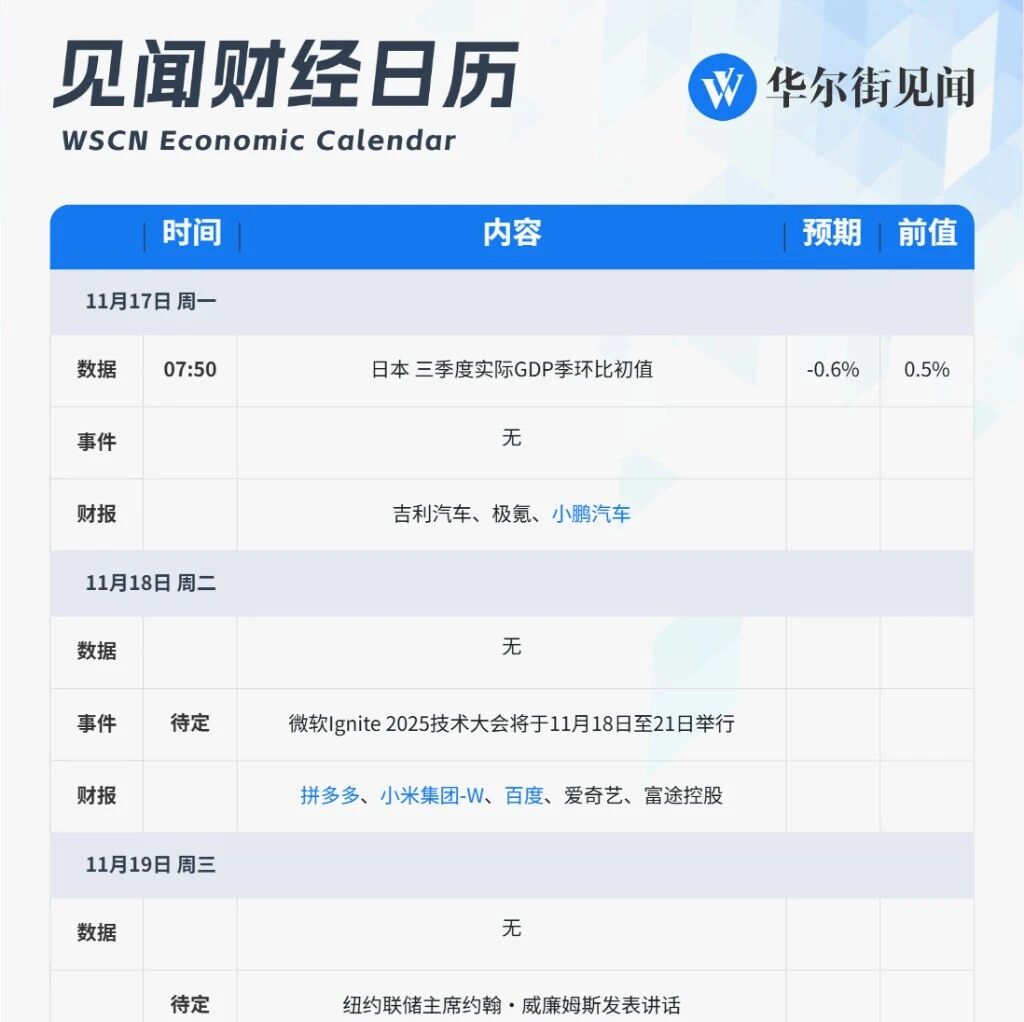
Core Viewpoint - The article highlights significant upcoming financial events and earnings reports from major companies, including Nvidia, Baidu, Xiaomi, and Pinduoduo, which are expected to influence market trends and investor sentiment in the tech and automotive sectors [6][7][9]. Financial Reports - Nvidia is set to release its Q3 2025 earnings report on November 19, with analysts expecting an adjusted EPS of $1.25 and revenue of $54.8 billion, reflecting year-over-year increases of 54% and 56% respectively [7][8]. - Other companies scheduled to report earnings include Baidu, Pinduoduo, Kuaishou, NetEase, and Xpeng Motors, following reports from Tencent and JD.com [9][10]. Economic Indicators - The U.S. government has resumed the release of economic data, with the non-farm payroll report for September scheduled for November 20 and the third-quarter GDP revision on November 26 [12][13][14]. - China's one-year and five-year Loan Prime Rates (LPR) are expected to remain unchanged when announced on November 20 [15]. Key Events - The Federal Reserve will release the minutes from its October FOMC meeting on November 20, which may indicate a more hawkish stance on interest rate cuts [16]. - The Microsoft Ignite 2025 conference will take place from November 18 to 21, focusing on AI and cloud computing innovations [19]. - Japan's Ministry of Finance will auction 800 billion yen of 20-year bonds, amid indications of a shift towards expansionary fiscal policy [20]. Industry Conferences - The 2025 Data Storage Industry Conference will be held in Guangzhou on November 19, focusing on AI and storage ecosystems [21]. - The Dubai Airshow will run from November 17 to 21, showcasing over 1,500 exhibitors, including the Chinese C919 aircraft [22]. - The 2025 China International Photovoltaic and Energy Storage Industry Conference will take place from November 17 to 20, featuring new products and technologies in the solar storage sector [23].
烧光155亿,超级独角兽要破产了
华尔街见闻· 2025-11-16 12:05
Core Viewpoint - The bankruptcy of Pine Gate, a leading solar developer in the U.S., signifies a severe downturn in the solar industry, marking a potential end to the renewable energy boom that began in 2022 [4][5][19]. Group 1: Company Overview - Pine Gate, founded in 2016, was a vertically integrated solar developer, handling the entire process from development to operation [8][9]. - The company underwent a significant restructuring in 2021, shifting to a lighter asset model focused on financing and development, which increased its capital appeal [9][10]. Group 2: Financing and Growth - Between 2022 and 2025, Pine Gate raised over $2.18 billion (approximately 15.5 billion RMB) in public financing, becoming the top solar company in terms of venture capital in 2024 [10][11]. - The company had a total project financing and capital investment of $10 billion (approximately 71 billion RMB) by August 2025, operating over 2 GW of solar projects and developing over 30 GW across more than 30 states [11][12]. Group 3: Market Challenges and Bankruptcy - The introduction of the OBBBA Act in July 2024 significantly reduced subsidies for the solar industry and increased tariffs on photovoltaic products, undermining Pine Gate's business model [13][14]. - Following the policy changes, the financing for solar companies in the U.S. dropped by 39% in 2025, leading to severe cash flow issues for Pine Gate, which had already been struggling due to rising interest rates [16][18]. - Pine Gate officially filed for bankruptcy on November 6, 2024, with debts totaling $4.4 billion (approximately 31.2 billion RMB) and only $850,000 in cash remaining [18][19]. Group 4: Industry Impact - The bankruptcy of Pine Gate is part of a broader trend, with dozens of solar companies in the U.S. declaring bankruptcy since 2025, indicating a systemic failure in the solar market [20][21]. - The rapid transition from a booming market to a crisis reflects a collective failure of over-leveraged business models reliant on cheap capital and policy support, leading to significant losses for top investors [21][22].

差异化特色鲜明,风险边际改善 这家银行价值成色更足
华尔街见闻· 2025-11-16 12:05
Core Viewpoint - The article discusses the resilience and long-term investment value of bank stocks, particularly focusing on Industrial Bank's recent performance amidst external challenges, highlighting its differentiated operations and strong core competitiveness [1]. Group 1: Operating Performance - Industrial Bank reported a revenue of 161.23 billion yuan for the first three quarters, a year-on-year decrease of 1.82%, but achieved a net profit of 63.08 billion yuan, indicating positive growth in net profit despite a challenging environment [2]. - The bank's net interest margin stood at 1.72%, maintaining a relatively leading position among joint-stock banks, and it aims to implement effective strategies to stabilize net interest income [3]. Group 2: Differentiated Competitive Advantage - Industrial Bank continues to enhance its "green bank," "wealth bank," and "investment bank" identities, with green finance financing balance reaching 2.47 trillion yuan, a 12.8% increase from the beginning of the year [4]. - The bank's asset management scale reached 3.51 trillion yuan, growing by 20.62% year-on-year, with retail wealth AUM at 3.95 trillion yuan, reflecting its strong market position [5]. Group 3: Risk Management and Asset Quality - The bank has seen a decrease in new non-performing loans and non-performing loan ratios, with the non-performing loan rate at 1.08%, indicating stable asset quality [6]. - The bank has established agile teams for risk management in key areas, enhancing its ability to address potential risks effectively [7]. Group 4: Shareholder Returns and Valuation - Industrial Bank has a history of significant shareholder returns, with cumulative dividends of 216.1 billion yuan since its listing, and recently announced a mid-term dividend of 5.65 yuan per 10 shares [8]. - The bank's static dividend yield is 5.29%, and its price-to-book ratio is 0.53, positioning it as a high-quality dividend stock for long-term investors [9].


高盛交易员:过去两周对市场的“核心牛市逻辑”构成了挑战
华尔街见闻· 2025-11-16 12:05
Core Viewpoint - Recent concerns have emerged regarding the sustainability of the three core bull market narratives, leading to significant market pullbacks, particularly in high-beta momentum stocks [1][2][5] Market Sentiment and Economic Concerns - The market's confidence in the Federal Reserve's interest rate cuts in December and a dovish policy through 2026 has weakened due to conflicting statements from multiple Fed officials [3] - Economic activity is under scrutiny, with deteriorating conditions for low-income consumers and weak employment trends raising concerns about a K-shaped recovery and the outlook for 2026 [4][17] Market Positioning and Investor Behavior - Overly optimistic market positioning and retail investor enthusiasm have created crowded trades in aggressive market sectors, with hedge fund exposure to momentum factors reaching a five-year high [5] - The week before Nvidia's earnings report, high-beta momentum stocks experienced their largest decline since the DeepSeek event, as the market began to focus on year-end performance [6][8] AI Investment Outlook - Signals from upcoming spending reports are expected to drive AI stocks higher, although concerns about power supply issues in Western countries may pose significant challenges to AI development [9] - Historical comparisons of the current AI boom to past tech cycles have limitations, with some suggesting that the current AI investment trend resembles the tech boom of 1997-1998 rather than the bubble of 1999-2000 [10][11] Economic Data and Fed Policy - Ongoing debates about the broader economic situation complicate market visibility, especially with the end of government reopening and quantitative tightening [13] - Despite rising layoffs, earnings sentiment has rebounded strongly post-Q3 earnings reports, partly due to cost control measures [15][14]

下周四开始,美国“数据狂潮”来了,对市场至关重要
华尔街见闻· 2025-11-16 12:05
Core Viewpoint - The end of the longest government shutdown in U.S. history will lead to a dense release of delayed economic data, which is crucial for the market and the Federal Reserve to assess the economic situation [1][5]. Data Release Schedule - The U.S. Department of Commerce and the Department of Labor have announced a detailed schedule for the release of delayed economic data starting next Thursday. Over 30 important economic reports, including employment, inflation, and GDP, were postponed or canceled during the shutdown [2]. - Key data releases include the September non-farm payroll report on November 20 and the September real wage data on November 21. The third-quarter GDP revision will be published on November 26, along with personal income, spending, and PCE price index for October [3][4]. Impact on Federal Reserve Decision-Making - The unprecedented data void caused by the 43-day government shutdown has clouded the Federal Reserve's judgment regarding the economic situation [5]. - Apollo's chief economist noted that the market was in a "very dark and foggy" state during the shutdown, and while the fog is dissipating, it will not clear completely in the short term [6]. - Federal Reserve Chairman Powell emphasized that a rate cut in December is not a "foregone conclusion," and the lack of data may influence the committee's decision. Barclays economists pointed out significant disagreements within the Federal Open Market Committee regarding the timing and pace of rate cuts due to the absence of new data [7]. Challenges in Key Economic Indicators - Although the September employment data is expected to be released on time, the October data faces challenges. The White House press secretary warned that October inflation and employment data "may never be published," and any released data will be "permanently flawed" [8]. - The Director of the National Economic Council indicated that only half of the employment report will be available, lacking the unemployment rate for that month [9]. - The collection of consumer price data is particularly problematic, as about two-thirds of the price data requires in-person visits to stores, which cannot be retroactively gathered [10]. Broader Economic Implications - The data void will affect social security payments tied to inflation and influence corporate hiring and inventory decisions ahead of the holiday season. Economists suggest that it may take months for data to return to normalcy as businesses navigate uncertainties related to trade policies and consumer spending [10].