汽车琰究

Search documents
数据解放生产力——琰究摩托车数据系列(2025年9月)【民生汽车 崔琰团队】
汽车琰究· 2025-10-22 14:14
Core Viewpoint - The motorcycle industry is experiencing growth, particularly in the sales of larger displacement motorcycles, with a notable increase in sales figures for September 2025 compared to the previous year and month [2][3]. Sales Data Summary - For motorcycles with displacement over 250cc, September 2025 sales reached 87,000 units, marking a year-on-year increase of 13.1% and a month-on-month increase of 2.5%. Cumulative sales from January to September totaled 761,000 units, reflecting a year-on-year growth of 32.9% [2]. - In the 250ml to 400ml displacement category, September sales were 53,000 units, up 3.8% year-on-year and 11.9% month-on-month, with cumulative sales of 409,000 units for the first nine months, a 31.2% increase year-on-year [3]. - For the 400ml to 500ml category, September sales were 16,000 units, down 24.1% year-on-year and 8.8% month-on-month, with cumulative sales of 186,000 units, a slight decline of 1.9% year-on-year [3]. - In the 500ml to 800ml category, September sales were 17,000 units, a significant increase of 351.5% year-on-year, though down 12.4% month-on-month, with cumulative sales of 148,000 units, up 143.7% year-on-year [3]. - For motorcycles over 800cc, September sales were 2,000 units, up 7.4% year-on-year and 32.6% month-on-month, with cumulative sales of 18,000 units, reflecting a year-on-year increase of 68.3% [3]. Market Share Insights - Chuanfeng Power sold 13,000 units in September, down 3.2% year-on-year, with a market share of 15.3%, a decrease of 2.1 percentage points month-on-month. Cumulative market share for the first nine months stands at 20.3%, an increase of 0.5 percentage points compared to the full year of 2024 [4]. - Longxin General sold 13,000 units in September, a year-on-year increase of 84.8%, with a market share of 15.0%, up 4.8 percentage points month-on-month. Cumulative market share for the first nine months is 13.3%, down 3.5 percentage points compared to the full year of 2024 [4]. - Qianjiang Motorcycle sold 12,000 units in September, up 30.3% year-on-year, with a market share of 13.9%, down 3.0 percentage points month-on-month. Cumulative market share for the first nine months is 14.2%, unchanged from the full year of 2024 [4]. Industry Outlook - The industry is advised to focus on key companies such as Chuanfeng Power, Longxin General, and Qianjiang Motorcycle, which are showing significant sales growth and market share dynamics [5][10].


摩托车行业系列点评二十一 | 中大排出海提速 自主高端化突围
汽车琰究· 2025-10-22 14:14
Core Viewpoint - The motorcycle industry is experiencing steady growth in the mid-to-large displacement segment, with significant export acceleration and a focus on high-end domestic production [5][18]. Sales Performance - In September 2025, sales of motorcycles above 250cc reached 87,000 units, representing a year-on-year increase of 13.1% and a month-on-month increase of 2.5%. Cumulative sales from January to September totaled 761,000 units, up 32.9% year-on-year [2]. - The export of motorcycles above 250cc in September was 53,000 units, a year-on-year increase of 39.0% and a month-on-month increase of 13.6%. Cumulative exports for the first nine months reached 412,000 units, up 65.4% year-on-year [3]. - Domestic sales for September were 33,000 units, down 12.7% year-on-year and 11.2% month-on-month, with cumulative domestic sales of 350,000 units, up 8.0% year-on-year [4]. Market Structure - The growth of motorcycles with a displacement of 500cc and above is strong, with leading companies like Chuanfeng Power, Longxin General, and Qianjiang Motorcycle enhancing their export capabilities [5]. - The top three companies in the 250cc+ segment in September were Chuanfeng Power, Qianjiang Motorcycle, and Longxin General, with a combined market share of 44.2% [6]. Company Insights - Chuanfeng Power's total two-wheeler sales in September were 49,000 units, up 41.5% year-on-year, while cumulative sales for the first nine months reached 423,000 units, up 86.4% year-on-year [6]. - Qianjiang Motorcycle's sales in September were 38,000 units, down 20.9% year-on-year, with cumulative sales of 305,000 units, down 13.2% year-on-year [12]. - Longxin General's motorcycle sales in September were 130,000 units, down 22.7% year-on-year, with cumulative sales of 1.282 million units, down 3.6% year-on-year [15]. Future Outlook - The motorcycle market is expected to continue expanding, driven by new models and brands from leading companies, with a focus on high-end products and international market penetration [18]. - Chuanfeng Power plans to launch new models in the 450cc and 650cc categories, which are anticipated to boost sales [11]. - Qianjiang Motorcycle is enhancing its product definition capabilities and aims to introduce new models to stimulate growth [14].



隆盛科技 | 2025Q3:归母高增 机器人布局全面推进【民生汽车 崔琰团队】
汽车琰究· 2025-10-21 14:59
Event Overview - The company released its Q3 2025 report, showing revenue of 1.81 billion yuan for the first three quarters, a year-on-year increase of 10.13%. The net profit attributable to shareholders was 210 million yuan, up 36.89% year-on-year, while the non-recurring profit was 130 million yuan, down 13.53% year-on-year. In Q3 2025, revenue was 586 million yuan, a year-on-year increase of 0.48% but a quarter-on-quarter decrease of 5.28%. The net profit attributable to shareholders was 106 million yuan, up 109.83% year-on-year and 129.13% quarter-on-quarter, while the non-recurring profit was 30 million yuan, down 45.11% year-on-year and 32.51% quarter-on-quarter [2]. Revenue and Profit Analysis - Revenue remained stable with Q3 2025 revenue at 586 million yuan, showing a year-on-year increase of 0.48% and a quarter-on-quarter decrease of 5.28% [3] - The net profit attributable to shareholders for Q3 2025 was 106 million yuan, reflecting a significant year-on-year increase of 109.83% and a quarter-on-quarter increase of 129.13%. The non-recurring profit was 30 million yuan, down 45.11% year-on-year and 32.51% quarter-on-quarter. The gross margin for Q3 2025 was 15.23%, a decrease of 2.68 percentage points year-on-year and 2.78 percentage points quarter-on-quarter [3] - The increase in net profit and net profit margin year-on-year was primarily driven by non-recurring gains, with fair value changes contributing 87 million yuan [3] Strategic Collaborations - The company is collaborating closely with Nidec to develop a new blueprint for the new energy and humanoid robot industries, focusing on "technology empowerment + capacity collaboration + market resonance." This partnership aims to analyze technological iteration trends and global market demand changes in key components of new energy vehicles [4] - In the field of humanoid robot harmonic reducers, the company and Nidec have engaged in in-depth discussions on technology development, capacity expansion, and processing business collaboration, aiming for further cooperation to meet growth demands in humanoid, collaborative, and industrial robots [4] Investment in Technology - In July 2025, the company made a strategic investment in Shenzhen Diedong Technology Co., Ltd., which has a core team from prestigious universities. Diedong Technology has developed the world's first high-performance visual tactile sensor using MEMS technology. This collaboration is expected to create a synergistic effect between hardware and perception, enhancing applications in robotic end-effectors and dexterous hands [5] Financial Projections - The company maintains a solid position as a leader in EGR, forming a three-dimensional driving pattern of "traditional business + new energy business + international layout." Revenue projections for 2025-2027 are 3.23 billion, 4.08 billion, and 5.07 billion yuan, with net profits of 303 million, 381 million, and 529 million yuan respectively. The expected EPS for these years is 1.33, 1.67, and 2.32 yuan, corresponding to PE ratios of 40, 32, and 23 times based on the closing price of 53.66 yuan per share on October 20, 2025 [6][8]
周专题 | 2025Q3前瞻:销量环比提升 成本端向好【民生汽车 崔琰团队】
汽车琰究· 2025-10-19 15:06
Core Viewpoints - The automotive sector is experiencing a mixed performance, with passenger car sales showing a slight year-on-year increase while the overall market sentiment remains weak [3][4][5]. Passenger Cars - In the week of September 22-28, 2025, passenger car sales reached 653,000 units, a year-on-year increase of 1.5% and a month-on-month increase of 26.6% [2]. - For Q3 2025, wholesale passenger car sales are projected to be 7.686 million units, representing a year-on-year growth of 14.7% and a month-on-month growth of 8.1% [5][58]. - The penetration rate of new energy vehicles (NEVs) in Q3 2025 is expected to be 52.4%, with NEV wholesale sales reaching 4.024 million units, a year-on-year increase of 24.2% [5][19]. - The export of passenger cars in Q3 2025 is anticipated to be 1.592 million units, a year-on-year increase of 23.1% [19][62]. Market Performance - The automotive sector underperformed the broader market, with the A-share automotive sector declining by 6.1% during the week of October 13-17, 2025 [3]. - The performance of various sub-sectors varied, with commercial passenger vehicles increasing by 3.7%, while other segments like passenger cars and automotive parts saw declines ranging from 2.9% to 8.0% [3]. Investment Recommendations - Key companies to watch include Geely, Xpeng, Li Auto, BYD, and Xiaomi, among others, focusing on those with strong performance in the NEV sector [4][8][58]. - In the parts sector, companies involved in intelligent driving and smart cockpit technologies are recommended, such as Berteli and Jifeng [8]. Heavy Trucks - The heavy truck market is experiencing significant growth, with Q3 2025 wholesale sales reaching 282,000 units, a year-on-year increase of 58.1% [40][62]. - New energy heavy trucks are particularly strong, with sales of 58,000 units in Q3 2025, reflecting a year-on-year increase of 181.5% [45][62]. Motorcycles - The market for large-displacement motorcycles (over 250cc) is projected to see wholesale sales of 258,000 units in Q3 2025, a year-on-year increase of 18.9% [56][63]. - Exports of large-displacement motorcycles are expected to grow significantly, with a year-on-year increase of 50.5% [52][63]. Component Sector - The component sector is benefiting from a decrease in raw material costs and shipping fees, which is expected to alleviate cost pressures for companies [34][35][62]. - Companies in the supply chain for leading manufacturers like Xiaomi, Xpeng, and NIO are expected to perform well in terms of revenue [38][62].





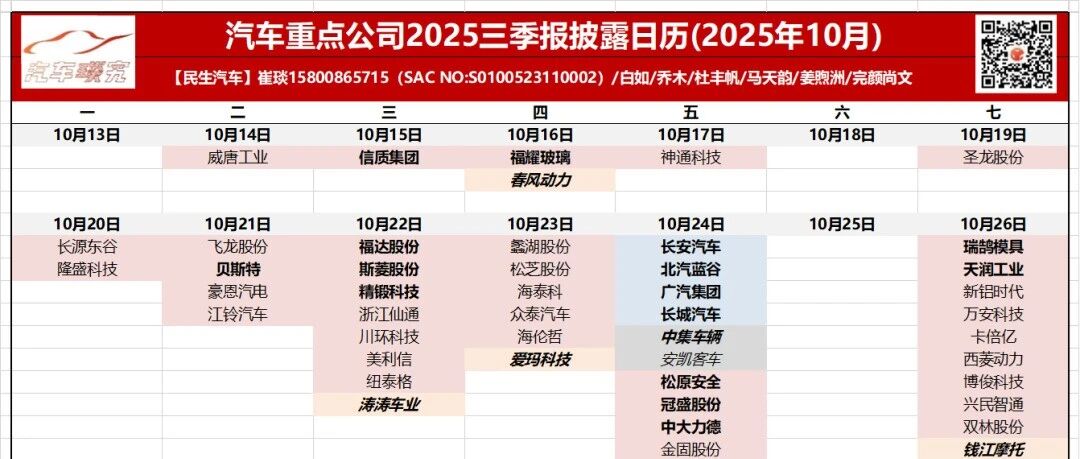
2025三季报来袭:汽车及零部件行业披露日历【民生汽车 崔琰团队】
汽车琰究· 2025-10-17 13:58
Core Viewpoint - The article provides a detailed calendar for the disclosure of third-quarter reports for key automotive companies in October 2025, highlighting the importance of these disclosures for investors and industry stakeholders [1]. Summary by Sections Disclosure Calendar - The calendar lists various automotive companies scheduled to release their third-quarter reports from October 13 to October 30, 2025, including notable firms such as Weitang Dingye, Xinzhi Group, and Chang'an Automobile [1]. - The final disclosure dates are subject to the actual release by the companies, indicating the dynamic nature of financial reporting in the automotive sector [2]. Industry Focus - The article emphasizes the ongoing transformation in the automotive industry, particularly focusing on the four key trends: intelligence, electrification, globalization, and high-end development [6]. - It highlights the potential investment opportunities arising from these trends, suggesting a significant shift in the automotive landscape that could reshape industry dynamics over the next decade [16].





春风动力 | 2025Q3:业绩符合预期 经营韧性持续验证【民生汽车 崔琰团队】
汽车琰究· 2025-10-17 13:58
Core Viewpoint - The company reported strong revenue growth driven by increased exports of two-wheeled vehicles and significant sales growth in electric motorcycles, despite facing challenges from tariffs and currency fluctuations [2][3]. Group 1: Financial Performance - For the first three quarters of 2025, the company achieved revenue of 14.9 billion yuan, a year-on-year increase of 30.1%, and a net profit attributable to shareholders of 1.42 billion yuan, up 30.9% year-on-year [2]. - In Q3 2025, the company reported revenue of 5.04 billion yuan, a year-on-year increase of 29.6% but a quarter-on-quarter decrease of 10.0%. The net profit for the same quarter was 410 million yuan, reflecting a year-on-year increase of 10.8% and a quarter-on-quarter decrease of 30.5% [2][3]. Group 2: Revenue Drivers - The revenue growth in Q3 2025 was primarily attributed to the increase in two-wheeled vehicle exports, with sales of 21,000 units in July-August, representing a year-on-year increase of 55.1%, and a significant rise in electric motorcycle sales, which reached 70,000 units, up 430.9% year-on-year [3]. - The company’s net profit margin in Q3 2025 was 8.8%, showing a decline due to the impact of tariffs on all-terrain vehicles in the U.S. and foreign exchange effects [3]. Group 3: Product Performance - The sales of mid-to-large displacement motorcycles (over 250cc) reached 142,000 units from January to August 2025, marking a year-on-year increase of 41.6%, with market share rising to 21.0% [4]. - The company’s electric motorcycle brand, "极核," saw sales of 193,000 units from January to August 2025, with rapid channel expansion domestically and internationally [4]. Group 4: Market Outlook - The company sold 122,000 all-terrain vehicles in the U.S. market from January to August 2025, reflecting a year-on-year increase of 6.7%. The company is optimistic about its high-end product line expansion and market share growth [5]. - Long-term projections estimate revenues of 19.91 billion yuan in 2025, 24.51 billion yuan in 2026, and 29.50 billion yuan in 2027, with net profits expected to reach 1.86 billion yuan, 2.38 billion yuan, and 2.93 billion yuan respectively [7].
隆鑫通用 | 2025Q3:业绩超预期 无极品牌量利共振【民生汽车 崔琰团队】
汽车琰究· 2025-10-17 13:58
Core Viewpoint - The company is expected to achieve significant growth in net profit and operating income in the first three quarters of 2025, driven by strong performance in various business segments and the expansion of the Wujie brand [2][3][6]. Financial Performance - The company forecasts a net profit attributable to shareholders of 1.52 to 1.62 billion yuan for the first three quarters of 2025, representing a year-on-year increase of 69.1% to 80.3% [2]. - The expected non-net profit is projected to be between 1.48 to 1.58 billion yuan, with a year-on-year growth of 75.7% to 87.5% [2]. - For Q3 2025, the net profit is estimated at 500 million yuan, a year-on-year increase of 60.5% but a quarter-on-quarter decrease of 12.5% [3]. Business Growth Drivers - The growth is primarily driven by the Wujie brand, which saw a 22.1% increase in sales of large-displacement motorcycles (over 250cc) in July and August, totaling 28,000 units [3]. - The all-terrain vehicle segment also contributed positively, with sales of 6,000 units in the same period, marking a 40.7% increase [3]. - The three-wheeler and general machinery businesses are also experiencing growth, alongside continuous optimization of the Wujie product lineup [3]. Brand and Market Expansion - The Wujie brand achieved a revenue of 1.98 billion yuan in the first half of 2025, reflecting a year-on-year growth of 30.2%, with exports accounting for 1.19 billion yuan, a significant increase of 83.3% [4]. - The number of domestic sales outlets for the Wujie brand reached 1,053, while overseas outlets totaled 1,292, with a notable increase in Europe [4]. - The brand's visibility in overseas markets has improved, with a total exposure of 9.27 million times, up 70.85% year-on-year [4]. Global Market Performance - Sales of large-displacement motorcycles for the Wujie brand reached 108,000 units in 2024 and 68,000 units in the first half of 2025, with year-on-year increases of 43.1% and 32.8%, respectively [5]. - Export sales for these motorcycles were 51,000 units in 2024 and 48,000 units in the first half of 2025, showing increases of 24.8% and 69.4% [5]. - The Wujie brand has made significant inroads in the European market, with sales in Spain reaching 12,000 units, a year-on-year increase of 83.9%, and in Italy, sales increased by 69.4% [5]. Future Projections - The company anticipates revenues of 20.16 billion yuan in 2025, 23.41 billion yuan in 2026, and 27.05 billion yuan in 2027, with corresponding net profits of 1.98 billion yuan, 2.32 billion yuan, and 2.71 billion yuan [6][8]. - The earnings per share (EPS) are projected to be 0.96 yuan in 2025, 1.13 yuan in 2026, and 1.32 yuan in 2027, with price-to-earnings (PE) ratios of 14, 12, and 11, respectively [6][8].
周观点 | 新能源免税门槛提高 Q4乘用车旺季来临【民生汽车 崔琰团队】
汽车琰究· 2025-10-12 16:17
Group 1: Weekly Data and Market Performance - Passenger car sales for the week of September 22-28, 2025, reached 653,000 units, up 1.5% year-on-year and up 26.6% month-on-month [2] - New energy vehicle sales for the same week were 371,000 units, up 13.8% year-on-year and up 23.6% month-on-month, with a penetration rate of 56.9%, down 1.4 percentage points from the previous month [2][48] - The A-share automotive sector declined by 0.9% during the week of October 9-10, 2025, underperforming the CSI 300 index, which rose by 0.2% [3] Group 2: Investment Recommendations - Recommended companies include Geely Automobile, Xpeng Motors, Li Auto, BYD, Xiaomi Group, Berteli, Top Group, New Spring Co., Hu Guang Co., and Chuanfeng Power [4][14] - Focus on quality autonomous brands that are accelerating in intelligence and globalization [16] Group 3: Policy and Regulatory Updates - The Ministry of Industry and Information Technology announced adjustments to the technical requirements for the exemption of purchase tax for new energy vehicles from 2026 to 2027, which is expected to enhance average selling prices (ASP) and drive technological upgrades [5] - The new standards for pure electric vehicles set stricter energy consumption limits, while plug-in hybrid vehicles must now meet a minimum electric range of 100 kilometers [5] Group 4: Robotics and Automation - Tesla is expected to release the Optimus V3 robot in Q4 2025, with a production target of hundreds of prototype units within the year and a goal of reaching a million units in five years [6][15] - The focus is on hardware segments with significant potential for change, including dexterous hand configurations and lightweight materials [7][20] Group 5: Market Trends in Motorcycles and Heavy Trucks - The motorcycle market saw a significant increase in sales for large displacement models, with 84,000 units sold in August 2025, up 23.6% year-on-year [27] - Heavy truck sales reached 92,000 units in August 2025, a year-on-year increase of 46.6%, driven by expanded subsidies for replacing older vehicles [30][31] Group 6: Tire Industry Insights - The tire industry is experiencing strong demand, with domestic PCR operating rates at 67.47%, indicating high production levels [33][54] - The global tire market is expected to benefit from the ongoing expansion of Chinese tire manufacturers into overseas markets [32]

上汽集团 | 9月:销量同环比亮眼 尚界 H5 上市即热销【民生汽车 崔琰团队】
汽车琰究· 2025-10-10 01:16
Core Viewpoint - The article highlights the strong sales performance of SAIC Motor Corporation in September 2025, driven by domestic brands and exports, alongside the successful launch of the Huawei-powered SUV, the Shangjie H5, and ongoing reforms within the company [2][4][5][6]. Sales Performance - In September 2025, SAIC Motor's wholesale sales reached 440,000 units, with a year-to-date total of 3.193 million units, reflecting a year-on-year increase of 20.5% [2]. - Breakdown of sales by brand for September 2025 includes: - SAIC Volkswagen: 94,000 units, year-to-date 772,000 units, down 2.5% year-on-year - SAIC General Motors: 49,000 units, year-to-date 278,000 units, up 36.7% year-on-year - SAIC Passenger Vehicles: 94,000 units, year-to-date 481,000 units, up 23.8% year-on-year - SAIC-GM-Wuling: 158,000 units, year-to-date 840,000 units, up 37.8% year-on-year - SAIC New Energy: 189,000 units, year-to-date 1.083 million units, up 44.8% year-on-year - SAIC Overseas: 101,000 units, year-to-date 765,000 units, up 3.5% year-on-year [3][4]. Growth Drivers - The growth in sales is attributed to the innovation of domestic brands and resilient export performance, with a notable increase in new energy vehicle sales, which reached 189,000 units in September, up 46.5% year-on-year [4]. - The launch of new models such as the next-generation Zhiji LS6, the all-new MG4, and the Roewe DMH has significantly boosted sales of domestic brands, which accounted for 64% of total sales, up 4.3 percentage points year-on-year [4]. Strategic Partnerships - The collaboration with Huawei has led to the successful launch of the Shangjie H5 SUV, which sold over 10,000 units within the first hour of its release. This model features advanced technology such as the HarmonyOS cockpit and Huawei's ADS 4 driving assistance system [5]. Management Changes - The company is undergoing significant management changes as part of its state-owned enterprise reform, focusing on domestic market and new energy vehicle development. The new management team is younger and emphasizes resource integration and collaboration [6]. Financial Projections - Revenue projections for 2025-2027 are estimated at 687.76 billion, 722.06 billion, and 776.21 billion yuan respectively, with net profits of 12.27 billion, 14.07 billion, and 16.67 billion yuan. The corresponding EPS is projected to be 1.06, 1.22, and 1.44 yuan [7][8].

新势力 | 9月:车市保持增长 新势力高端亮眼【民生汽车 崔琰团队】
汽车琰究· 2025-10-08 14:44
Group 1 - The core viewpoint of the article highlights the growth in the new energy vehicle market, with significant delivery increases among key players in September 2025, indicating a robust market performance and competitive dynamics [2][3][4][5][6][7]. - The overall retail market for narrow passenger vehicles in September is estimated at approximately 2.15 million units, showing a year-on-year increase of 2.0% and a month-on-month increase of 6.5%, with new energy vehicles expected to reach 1.25 million units, achieving a penetration rate of about 58.1% [3]. - The six sampled new energy vehicle companies (excluding Xiaomi) delivered a total of 224,308 units in September, reflecting a year-on-year increase of 19.9% and a month-on-month increase of 12.6% [3]. Group 2 - Leap Motor maintained the top position with deliveries of 66,657 units in September, a year-on-year increase of 97.4% and a month-on-month increase of 16.8%, driven by strong product offerings in the under 200,000 yuan segment [4]. - XPeng delivered 41,581 units in September, marking a year-on-year increase of 94.7% and a month-on-month increase of 10.3%, with significant contributions from the MONA M03 model [5]. - NIO reported deliveries of 34,749 units, a year-on-year increase of 64.1% and a month-on-month increase of 11.0%, with the ET5T and ES6 models contributing significantly to the sales [6]. - Li Auto's deliveries were 33,951 units, showing a year-on-year decrease of 36.8% but a month-on-month increase of 19.0%, with the L6 model being a key contributor [7]. - Aion delivered 29,113 units, reflecting a year-on-year decrease of 18.6% but a month-on-month increase of 7.7% [7]. - Zeekr's deliveries were 18,257 units, with a year-on-year decrease of 14.4% and a month-on-month increase of 3.6% [7]. - Xiaomi reported over 40,000 units delivered in September, with the YU7 SUV being a notable product launch [7]. Group 3 - The article discusses the acceleration of end-to-end technology applications, marking the beginning of an era of equal access to intelligent driving capabilities, with companies like XPeng and Huawei leading the charge [8]. - The article anticipates that advancements in intelligent driving technology will lower hardware barriers and expand applications in the mainstream market, particularly for vehicles priced under 200,000 yuan [8]. - The article emphasizes the importance of intelligent capabilities as a competitive factor among automakers, predicting a significant shift in user acceptance and business models in the intelligent driving sector [8]. Group 4 - The article highlights the ongoing growth in the automotive parts sector, particularly in the context of new energy vehicles and intelligent electric frameworks, suggesting a favorable outlook for the industry [9][10]. - Recommendations include focusing on intelligent driving components and the new energy vehicle supply chain, with specific companies identified for potential investment opportunities [9][10].