国泰海通证券研究

Search documents
国泰海通 · 晨报0813|海外科技、国别研究
国泰海通证券研究· 2025-08-12 14:20
Group 1: AI Industry Trends - The AI industry is accelerating due to the resonance between hardware and application sides, with significant investments in computing infrastructure and talent acquisition by major players like Meta [4] - Meta is investing several hundred billion dollars to build large data centers, including the Prometheus supercomputer cluster in Ohio with a power of 1 GW, set to be operational by 2026, and the Hyperion supercomputer cluster in Louisiana targeting 5 GW by the end of 2027 [4] - Nvidia is resuming sales of the H20 GPU in China, which is expected to eliminate uncertainties in domestic CSP major's Capex and drive the upward trend in computing infrastructure construction [5] Group 2: Economic Trends in Southeast Asia - Vietnam's production growth rate was 8.5% in July, with an average of 11% over the past six months, largely driven by continuous high export growth of 17.7% [11] - Indonesia's GDP growth rate for Q2 was 5.1%, reflecting improvements from investments and foreign trade, while Thailand's CPI fell to -0.7%, indicating a deflationary trend [11] - The U.S. has signed trade agreements with several Southeast Asian countries, reducing tariffs significantly, which may enhance trade relations and economic growth in the region [11] Group 3: Industry Policies - Indonesia is accelerating local production of electric vehicles and adjusting cryptocurrency transaction tax rates, while Thailand is strengthening green manufacturing standards [12] - Vietnam is decentralizing some economic management approval powers and increasing tax incentives for key sectors [12]

国泰海通|全球视野掘金科技牛市·海外市场研究
国泰海通证券研究· 2025-08-12 07:00
Core Viewpoint - The article emphasizes the significance of technology in the Hong Kong stock market for the second half of the year, suggesting that it will be a decisive factor in market performance [6]. Group 1: Market Insights - The Hong Kong stock market is identified as the main battleground for the current bull market, with specific focus on the importance of marginal factors and top picks [6]. - Historical trends indicate that the performance of the Hong Kong stock market is driven by various factors, including the impact of U.S.-China trade tensions and global industrial upgrades [6][7]. Group 2: Sector Analysis - The series of lectures includes discussions on the evolution of technology in the semiconductor industry, particularly the transition from 14nm to N2 processes, which is expected to drive innovation in Electronic Design Automation (EDA) [6][7]. - The analysis of the pricing power in the Hong Kong market highlights the influence of different types of capital and the restructuring of industries following significant mergers, such as Synopsys and Ansys [6][7]. Group 3: Investment Opportunities - The research series explores the growth potential of companies like Tencent Music Entertainment (TME) and NetEase Cloud Music, drawing parallels with Spotify's success [7]. - The focus on AI applications and new consumer trends in the Hong Kong market suggests that companies like Kuaishou and Bilibili are positioned for significant growth, driven by their unique content ecosystems [7].

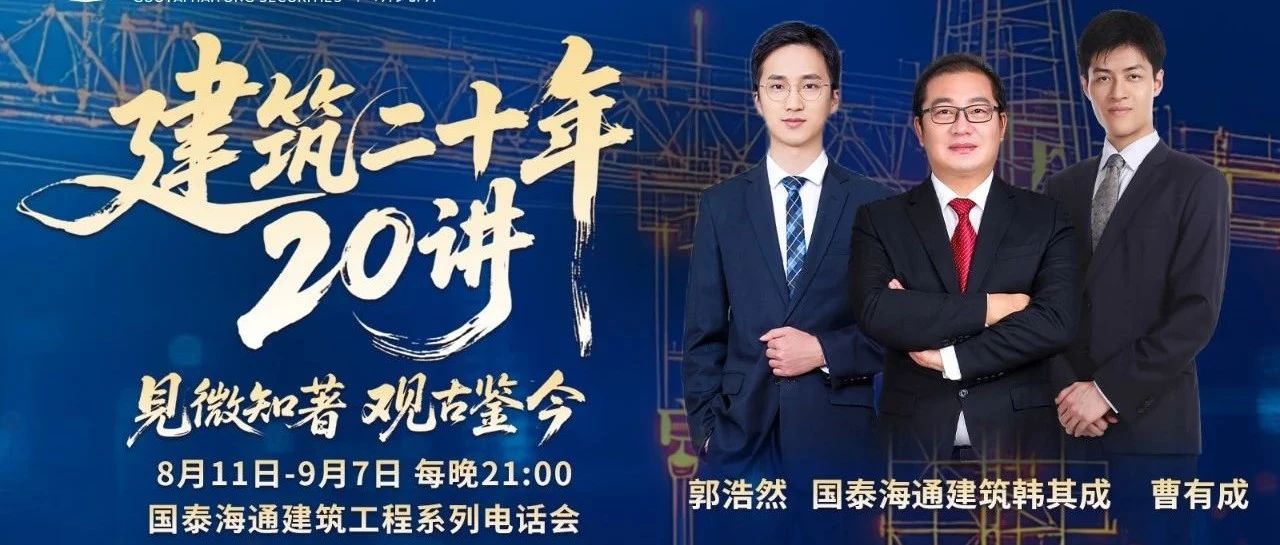
国泰海通|建筑二十年20讲-深度研究系列电话会
国泰海通证券研究· 2025-08-12 03:26
Group 1: Macro Overview - The article discusses the importance of market trends and historical analysis in identifying investment opportunities, emphasizing the role of leading companies in shaping market dynamics [4]. - It highlights a comprehensive review of historical market cycles, providing insights into potential upward trends and key stock selections [4]. - The analysis includes a focus on fiscal policies and their impact on infrastructure trends and profit patterns in the stock market [4]. Group 2: Industry Insights - The article provides an in-depth analysis of major infrastructure projects in Central and Western China, including regions like Xinjiang, Tibet, and Sichuan, indicating significant investment opportunities [4]. - It discusses the reevaluation of mineral resources such as copper, cobalt, nickel, gold, and coal, suggesting a potential shift in market valuations for these commodities [4]. - The article also covers the performance and valuation trends of leading companies in the decoration and landscaping sectors, offering insights into optimal buying and selling points [4]. Group 3: Company Analysis - The article features a detailed examination of China Huadian Corporation, highlighting its leadership in the marine economy and hydrogen energy business [4]. - It analyzes China State Construction Engineering Corporation, noting its undervaluation and high dividend yield in the context of the real estate market's seasonal trends [4]. - The report discusses China National Chemical Corporation's ongoing breakthroughs and global expansion strategies, indicating growth potential in its business operations [4]. Group 4: Technological Transformation - The article outlines the advancements in sectors such as renewable energy storage, controlled nuclear fusion, and deep-sea industries, emphasizing the transformative impact on related companies [4]. - It summarizes the progress in data center operations, robotics, and quantum technologies, indicating significant developments in these high-tech industries [4]. - The analysis includes a review of the low-altitude economy, AI applications, and smart transportation systems, highlighting their performance and business implications [4].



国泰海通计算机 | 周观点第14期:GPT5 发布,成本大幅下降,长期利好AI应用
国泰海通证券研究· 2025-08-11 14:15
Core Viewpoints - The recent issuance of guidelines by the Ministry of Industry and Information Technology (MIIT) aims to promote the development of the brain-computer interface (BCI) industry, with a target to achieve breakthroughs in key technologies by 2027 and establish a reliable industrial system by 2030 [6][4] - The release of GPT-5 on August 8, 2025, marks a significant advancement in AI applications, with a notable reduction in costs and improvements in reliability, efficiency, and usability, which will accelerate the adoption of AI technologies across various sectors [7][4] - The 2025 World Robot Conference, held from August 8 to 12 in Beijing, showcases advancements in robotics and intelligent applications across multiple industries, highlighting the growing importance of robotics in industrial manufacturing and healthcare [8][4] Summary by Sections Brain-Computer Interface Industry - The MIIT and seven other departments have issued an implementation opinion to drive high-quality development in the BCI industry, aiming to form a new production capacity and support the modernization of the industrial system [6] - By 2027, the goal is to achieve breakthroughs in key BCI technologies and establish an advanced technical, industrial, and standard system, with products reaching international standards in performance [6] - By 2030, the aim is to cultivate 2 to 3 globally influential leading enterprises and a number of specialized small and medium-sized enterprises, creating a competitive industrial ecosystem [6] AI Applications and GPT-5 - GPT-5 has shown limited state-of-the-art (SOTA) performance, with improvements in user experience, reliability, and programming capabilities, significantly reducing hallucination rates and enhancing text generation [7] - The cost of API calls for GPT-5 is significantly lower than competitors, making it a competitive option for software development and content production [7] - The advancements in GPT-5 support the large-scale implementation of AI technologies across various industries, enhancing productivity and efficiency [7] Robotics and Industry Trends - The 2025 World Robot Conference features over 200 domestic and international companies, showcasing more than 1,500 exhibits and 100 new products, emphasizing the integration of robotics in various applications [8] - The conference includes forums focusing on industrial development, innovative applications, and technology integration, facilitating discussions among experts and entrepreneurs on cutting-edge technologies and industry trends [8]

国泰海通|机械:上海助推具身智能产业集群发展,多款机器人产品亮相2025世界机器人大会
国泰海通证券研究· 2025-08-11 14:15
报告导读: 上周( 2025/8/4-2025/8/8 )机器人领域动态:大疆首款旗舰扫地机器人 发布,上海市人民政府办公厅印发《上海市具身智能产业发展实施方案》, 2025 世界机 器人大会于北京正式开幕。 投资建议: 重点关注机器人整机厂商及机器人核心零部件供应商 , 包括 : 1 )执行器和电机; 2 )减速器; 3 )丝杠类; 4 )丝杠设备类; 5 )轴承; 6 )传感器; 7 )整机。 报告来源 以上内容节选自国泰海通证券已发布的证券研究报告。 报告名称: 上海助推具身智能产业集群发展,多款机器人产品亮相2025世界机器人大会;报告日期: 2025.08.10 报告作者: 肖群稀(分析师),登记编号:S0880522120001 黄龙(分析师),登记编号:S0880525070027 李启文(分析师),登记编号:S0880524060001 重要提醒 本订阅号所载内容仅面向国泰海通证券研究服务签约客户。因本资料暂时无法设置访问限制,根据《证 券期货投资者适当性管理办法》的要求,若您并非国泰海通证券研究服务签约客户,为保证服务质量、 控制投资风险,还请取消关注,请勿订阅、接收或使用本订阅号中的任何信 ...

国泰海通|策略:风险偏好改善支撑全球权益配置价值
国泰海通证券研究· 2025-08-11 14:15
Core Viewpoint - The article maintains a tactical overweight view on A-shares and US stocks for August, driven by improving market risk appetite and expectations of economic growth [1][2]. Group 1: Market Conditions - Recent improvements in market risk appetite have led to risk assets significantly outperforming safe-haven assets, with equities outperforming commodities and bonds [1]. - The expectation of continued economic growth and government support for capital markets is leading to a highly optimistic outlook for A-shares [1]. - The US stock market is viewed positively due to a reduced probability of recession and increasing chances of interest rate cuts [1]. Group 2: Asset Allocation Strategy - The current low-interest-rate environment necessitates higher demands for asset allocation research, with a long-term trend of increased institutional investment in capital markets [1]. - A strategic asset allocation (SAA) plan has been constructed based on macro factors, achieving an annualized return of 9.1% and a Sharpe ratio of 1.57 as of the end of July [1]. - The proposed strategic benchmark allocation is set at 45% for equities, 45% for bonds, and 10% for commodities, with a deviation limit of 10% [1]. Group 3: Tactical Asset Allocation (TAA) - The improvement in risk appetite is identified as a core factor influencing the current tactical asset allocation, with multiple factors expected to support continued strong performance in equity assets [2]. - The TAA plan projects an annualized return of 55% by 2025, with a high Sharpe ratio of 1.65 based on full sample backtesting [2]. Group 4: Specific Allocation Recommendations - For August, the recommended allocation is 55% in equities, 40% in bonds, and 5% in commodities [3]. - A positive outlook is maintained for A-shares and Hong Kong stocks due to stable economic growth expectations and government support [3]. - Caution is advised regarding government bonds due to pressures from market risk appetite and capital redemption [3]. - The outlook for commodities, particularly oil, remains cautious due to supply and demand pressures [3].

国泰海通|电子:全面升级推理能力,GPT-5将实现复利式增长
国泰海通证券研究· 2025-08-11 14:15
报告导读: GPT-5 发布会展现了 OpenAI 在模型智能性、推理效率与产品体系上的全面 进化,标志着大模型从"强大"走向"可控、高效、可用"的关键拐点。 OpenAI 正式发布其新一 代通用人工智能模型 GPT-5 ,相较此前各代模型在智能水平上实现了实质性飞跃。看好后续 AI 应用层爆发,间接反哺底层硬件, 维持行业"增持"评级。 GPT-5 的一个大的升级是 GPT-5 被设计为一个统一的多模型系统 。具体而言,系统由三大核心组成:一是主模型,负责处理大多数日常查询,具备高效响 应能力;二是" GPT-5 思考"( GPT-5 Think )模块,专为复杂问题设计,具备更强的推理与逻辑能力;三是实时模型路由器,能够根据任务的类型、难 度、工具调用需求及用户的显式提示判断并分配最合适的模型执行任务。 GPT-5 实现"复利型体验"提升,用户短期感知不一定强烈,但长时间使用相信会觉得顺滑、稳定、准确度都在提升。 GPT-5 在多项核心能力上实现显著提 升,体现出其作为下一代通用大模型的全面进化。首先,在编程能力方面, GPT-5 在多个权威评测中超越同代模型,如在 SWE-bench Verified ...

国泰海通|中小与股权研究:AI眼镜爆发有望推动智能眼镜加速迈向千亿市场
国泰海通证券研究· 2025-08-11 14:15
Core Viewpoint - The AI glasses market is poised for explosive growth, driven by lightweight design, essential use cases, and consumer pricing, with a projected 188% increase in sales in China by 2025, potentially creating a trillion-yuan market space [1][2]. Market Dynamics - The evolution of AI glasses is transitioning from separate functional devices to integrated computing solutions, with three main product categories: audio devices, audio + camera devices, and AR integration devices [2]. - Major brands like Meta and Xiaomi are leading the consumer market, while domestic players are catching up in technology and application expansion [2]. Value Chain and Market Estimation - The cost structure of AI glasses shows that the main chip accounts for approximately 33% of total costs, with optical display and computing units making up 43% and 31% respectively [3]. - The global market for AI glasses is expected to exceed 190 billion RMB by 2030, with the Chinese market projected to surpass 50 billion RMB, reflecting a CAGR of over 80% over five years [3]. Industry Structure - The AI glasses industry value chain includes upstream manufacturers of optical modules, chips, and frames; midstream ODM/OEM manufacturers and software suppliers; and downstream brand manufacturers and distributors [3].

国泰海通|机械研究框架培训·深度研究系列电话会
国泰海通证券研究· 2025-08-11 14:15
Core Viewpoint - The article outlines a series of in-depth research calls focused on various aspects of robotics and related technologies, highlighting investment opportunities and industry trends in the mechanical sector [4][5]. Group 1: Robotics and Technology - The research series includes discussions on humanoid robots, their cognitive capabilities, and sensory technologies such as 3D vision and tactile sensors [4]. - Key topics also cover the mechanical components of robots, including efficient motors, precision reducers, and bearings, which are essential for enhancing robotic functionality [4]. - The series emphasizes the growing market for exoskeleton robots and companion robots, indicating a shift towards advanced wearable technology and AI companionship [4]. Group 2: Industrial Applications - The research addresses the logistics sector, focusing on how robotics can enhance supply chain efficiency and the demand for specialized robots in safety and unique operational scenarios [5]. - The article discusses the commercial aerospace sector, highlighting the benefits of high-density rocket launches and the interdependence of rocket and satellite supply chains [5]. - It also explores the potential of controlled nuclear fusion and its impact on capital expenditure in upstream sectors driven by downstream demand [5]. Group 3: Equipment and Machinery - The article reviews the recovery expectations in the tool industry, suggesting a resilient market outlook [5]. - It analyzes the engineering machinery sector, discussing the evolution of domestic sales over the past thirty years and the future trends in electric and unmanned applications [5]. - The research highlights the upcoming boom in mining automation, indicating a shift from technical feasibility to commercial viability [5].

国泰海通 · 晨报0812|策略、建筑工程、航空航天
国泰海通证券研究· 2025-08-11 14:15
Group 1: Market Strategy and Asset Allocation - The core viewpoint emphasizes an improvement in risk appetite supporting global equity allocation value, with a tactical overweight on A-shares and US stocks as of August [3] - The current low interest rate environment necessitates higher demands for asset allocation research, with a strategic asset allocation (SAA) plan yielding an annualized return of 9.1% and a Sharpe ratio of 1.57 as of the end of July [3] - The proposed strategic benchmark allocation is set at 45% for equities, 45% for bonds, and 10% for commodities, with a deviation limit of 10% [3] Group 2: Tactical Asset Allocation Insights - The enhancement of risk appetite is identified as a key factor influencing current tactical asset allocation, with expectations of continued strong performance in equity assets supported by various factors including technological breakthroughs and government support for capital markets [4] - The tactical asset allocation (TAA) plan anticipates a 55% weight in equities, 40% in bonds, and 5% in commodities, reflecting optimism for A-shares and Hong Kong stocks, as well as marginal optimism for US and Japanese stocks [4] - Caution is advised regarding government bonds due to market risk appetite adjustments and redemption pressures, while commodity prices, particularly oil, may face dual pressures from supply and demand [4] Group 3: Infrastructure Opportunities in Xinjiang - Historical reviews of three central work conferences on Xinjiang indicate significant stock price increases for key construction companies following these meetings, with notable gains such as 45.6% for Beixin Road and Bridge after the first conference [10] - Fixed asset investment in Xinjiang increased by 16.2% in the first five months of the year, with industrial investment rising by 22.8%, particularly in wind and solar energy projects [11] - The establishment of the Xinjiang Tibet Railway Company with a registered capital of 950 billion yuan highlights ongoing infrastructure investment, with plans for 500 key projects totaling 3.47 trillion yuan by 2025 [12] Group 4: Coal Chemical Industry Development - The coal chemical sector in Xinjiang is projected to experience a construction peak, with planned projects exceeding 800 billion yuan, driven by policy support [13] - Companies like China Chemical and Donghua Technology are positioned to capitalize on traditional coal chemical market opportunities, with significant new orders reported [13] Group 5: Aerospace and Satellite Deployment - The acceleration of low Earth orbit (LEO) satellite deployment is identified as a critical area, with a projected need for 2.3 million satellites by 2030, necessitating enhanced rocket launch capabilities [18] - Current rocket launch capacity is insufficient to meet the demand for satellite deployment, with an annual requirement of 1,500-2,000 tons compared to the current capacity of approximately 200 tons [19] - Reusable rocket technology is highlighted as a key factor in reducing launch costs, with liquid fuel rockets becoming the mainstream choice for new generation reusable rockets [20]