老徐抓AI趋势

Search documents
盈米小帮投顾团队-第15次信号发车
老徐抓AI趋势· 2025-10-24 08:41
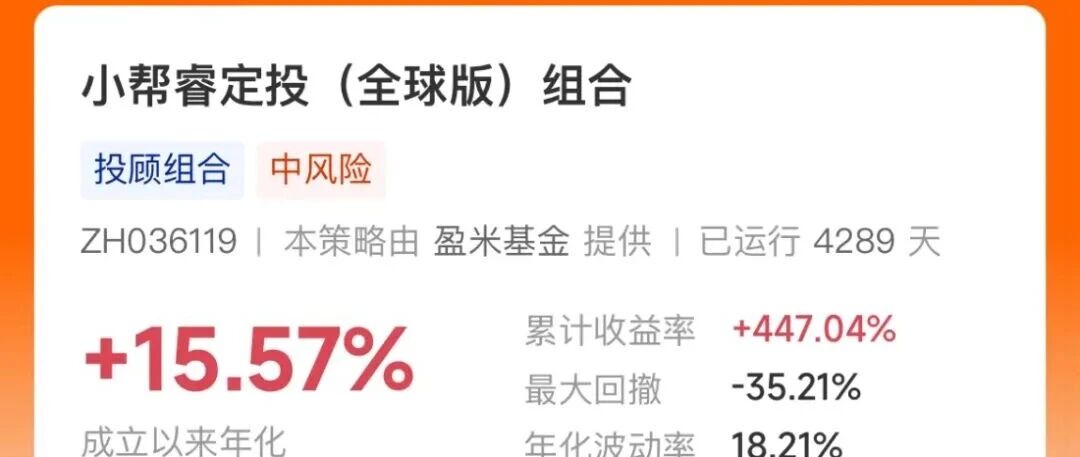
Global Market Performance - The global market shows increasing divergence, with US stocks and Indian markets leading the performance [1][3] - The A-share market has shown a decline of 1.21%, while the Indian Sensex30 has increased by 2.47% [1] - Vietnam's stock market experienced a significant drop of 7.29%, which was proactively avoided in asset allocation [1] Investment Strategies - The "Rui Ding Tou Global Version" portfolio achieved a return of 0.87% last week, bringing its total return since 2025 to 18.57% [6] - The portfolio's consistent positive returns over three years highlight the robustness and foresight of the global allocation strategy [6] - The strategy capitalizes on structural opportunities in AI-related assets, demonstrating a diversified global approach [6] Performance of Investment Combinations - The "Lazy Balanced Combination" recorded a return of 0.92% last week, with a year-to-date return of 12.87%, marking a historical high [11] - The "Rui Ding Tou Global Version" is designed for investors seeking higher returns with a tolerance for volatility, while the "Lazy Balanced Combination" is aimed at those preferring stability [12][15] - The difference in returns between the two combinations is approximately 18% versus 12%, catering to different investor profiles [12] Market Trends and Future Outlook - The overall market logic is characterized by a liquidity-driven structural differentiation [2] - The US stock market continues to show resilience despite geopolitical tensions and economic uncertainties [17] - The upcoming "Fourteenth Five-Year Plan" is expected to introduce measures to consolidate economic growth, which may positively impact the A-share market [17]

特斯拉FSD 14.1.2的“疯狂模式”,到底意味着什么?(内含双十一会员优惠!)
老徐抓AI趋势· 2025-10-22 01:04
Core Insights - The article emphasizes Tesla's confidence in its AI driving capabilities, particularly with the release of the FSD version 14.1.2, which introduces a more aggressive driving mode known as "Mad Max" [2][3] - This update marks a significant shift from conservative driving strategies to a more human-like decision-making process in complex driving environments [2][3] Technological Breakthroughs - The FSD V14 version features a tenfold increase in model parameters compared to the previous version, indicating a substantial enhancement in AI intelligence [4] - Tesla's HW4 chip enables this advanced model to operate directly on the vehicle, signifying a move towards "local intelligence" rather than relying on cloud computing [4] Evolution of FSD - The FSD system is evolving rapidly, with plans for iterative updates every few weeks, leading to stable commercial versions in the near future [7] - This approach transforms the vehicle manufacturing process into one akin to software development, allowing for faster improvements and adaptations [7] Upcoming Events - Key upcoming events for Tesla include the Q3 earnings report on October 22, which will address the timeline for the Robotaxi plan and the commercialization of FSD [8] - The shareholder meeting on November 6 will focus on Musk's compensation plan and potential investments in xAI, which could enhance Tesla's AI capabilities [8] AI Investment Implications - The advancements in FSD are seen as a significant indicator of AI's potential, as it represents a mature integration of AI perception, decision-making, and execution [9][11] - The self-reinforcing growth model of Tesla's AI capabilities—where data improves models, which in turn enhance driving and generate new data—creates a "flywheel effect" in AI development [12] Future Vision - The ultimate goal for Tesla is to integrate AI across various domains, with Robotaxi and humanoid robots (Optimus) forming a comprehensive AI ecosystem [16][18] - This vision aims to redefine productivity by combining energy control, computational power, and labor through AI [18]

AI全面开战!OpenAI刚放的三个大招
老徐抓AI趋势· 2025-10-18 15:28
Core Insights - OpenAI is entering a new phase of AI development characterized by a competition for computing power, a revolution in video technology, and the implementation of intelligent agents [2][3] Group 1: Computing Power and Infrastructure - OpenAI has announced a partnership with AMD to build a 6GW computing center, which is equivalent to the annual electricity consumption of a large city, indicating a significant investment in AI infrastructure [3] - The collaboration with AMD, Nvidia, and Broadcom highlights the strategic importance of a diversified supply chain in AI development, as reliance on a single chip manufacturer could hinder progress [3] - OpenAI's agreements with Samsung and SK Hynix for storage solutions are substantial, amounting to double the current global demand, reflecting the explosive need for data storage in AI model training and operation [5] Group 2: AI Video Revolution - The launch of Sora 2 marks a pivotal moment in AI, transitioning from a demo to a usable but costly product, indicating that AI capabilities are improving and becoming more accessible [6] - Sora 2 signifies a shift in content creation, allowing anyone to generate high-quality videos without the need for traditional production resources, thus democratizing content creation [6] Group 3: Intelligent Agents and Organizational Change - OpenAI's introduction of an enterprise-level AI platform at the developer conference represents a shift from AI as a tool to AI as a part of organizational structure, enabling businesses to deploy various intelligent agents for different roles [7] - This transition suggests that future companies will be restructured around human-AI collaboration, emphasizing the need for adaptation in business models [7] Group 4: Investment and Future Trends - OpenAI's significant investments in computing power are viewed as a rational strategy to secure future capabilities, as the demand for AI continues to grow [8] - The ongoing competition for computing resources is not just an industry issue but a national-level resource contest, as evidenced by investments from major corporations and governments [8] - Individuals are encouraged to understand, utilize, and invest in AI, as the future wealth divide will be influenced by one's relationship with AI technology [9]
阿里提出的“超级公司”,正在重写职场规则
老徐抓AI趋势· 2025-10-18 14:44
Core Concept - The article introduces the concept of "Super Company," a new organizational form driven by artificial intelligence (AI) and focused on human-machine collaboration, emphasizing that AI should be deeply integrated into every aspect of a business rather than merely serving as a tool [5][12]. Group 1: Definition and Importance of Super Companies - "Super Company" is defined as an organization where AI acts as the backbone and humans serve as the brain, enhancing efficiency and precision across all operations [5][12]. - The competition in the next decade will shift from cloud adoption to the depth of AI utilization within organizations [5][12]. Group 2: AI's Impact on Sales Processes - Traditional sales methods involve repetitive tasks with low efficiency, while AI can prioritize leads and generate tailored communication strategies, significantly improving conversion rates [7][8]. - AI can automate various tasks, such as drafting personalized messages for potential customers, which enhances customer engagement and saves time [10][11]. Group 3: Transformation of Human Roles - The role of sales personnel is evolving from mere executors of tasks to supervisors who assess AI-generated strategies and refine them based on human judgment [11]. - This shift signifies a move towards high-efficiency collaboration where AI handles calculations and execution, while humans focus on strategy and optimization [11]. Group 4: Implementation Challenges and Solutions - Transitioning to a "Super Company" requires more than just a conceptual understanding; practical implementation is crucial [13]. - The current landscape allows businesses to leverage AI infrastructure without needing to build it from scratch, as cloud providers offer accessible AI capabilities [13][16]. Group 5: Future of AI in Business - The future of competition will hinge on how quickly and effectively companies can adopt and integrate AI into their operations [16][18]. - Organizations that embrace AI will gain significant advantages, while those that do not will find themselves managed by those who do understand and utilize AI [18][19]. Group 6: Educational Initiatives - Companies are encouraged to explore training programs that facilitate the integration of AI into their workflows, promoting a collaborative environment between humans and AI [19].
【红杉:AI至少是每年10万亿的机会】AI的五大趋势与人类的新分工
老徐抓AI趋势· 2025-10-18 13:24
Core Insights - Sequoia Capital emphasizes that AI is not merely a software revolution but a labor revolution, targeting the $10 trillion labor market rather than the $650 billion software market [2][8] - The historical context of software development shows that AI is creating new markets similar to how SaaS transformed the software industry [5][7] AI as a Labor Revolution - AI aims to replace certain labor functions rather than just enhance software capabilities, with a focus on sectors like customer service, administration, sales, financial analysis, and education [8] - The current automation level of AI in the U.S. service industry is less than 0.2%, indicating significant potential for growth [8] Comparison with Historical Innovations - The AI revolution is likened to the Industrial Revolution, where the true impact came from the establishment of factory systems rather than the invention of steam engines [10][11] - The development of AI infrastructure, akin to the assembly line in manufacturing, is crucial for widespread adoption and efficiency [12] Future Trends in AI - Sequoia identifies five key trends for AI: enhancing efficiency while accepting uncertainty, the rise of reinforcement learning, the integration of AI into the physical world, the shift in productivity metrics towards computational power, and the need for companies to adapt to these changes [13][14] - The demand for computational power is expected to increase dramatically, creating new opportunities for infrastructure providers [14] Implications for Businesses and Individuals - Companies that can effectively utilize AI will have a competitive edge, while those that do not adapt may face obsolescence [14] - The future workforce will be smaller and more efficient, with a focus on collaboration with AI rather than traditional labor roles [12][14]
盈米小帮投顾团队-第14次信号发车
老徐抓AI趋势· 2025-10-17 05:27
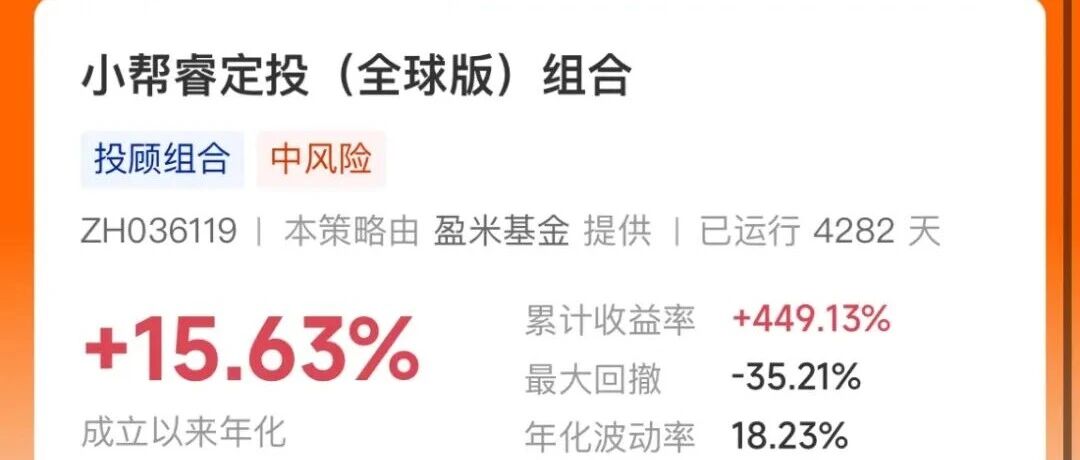
Core Viewpoint - The global market remains resilient despite recent fluctuations, with structural differentiation evident, particularly in the performance of gold and U.S. stocks, while bonds face slight pressure [1]. Market Overview - In September, the global market continued its strong performance, with most indices rising, except for the dividend sector, Germany, and Vietnam, which saw slight declines. Gold was the standout performer, surging approximately 11% for the month, while Chinese bonds fell about 0.6% [2]. Investment Strategies - The "Rui Ding Tou Global Version" portfolio achieved a monthly return of 4.41% in September, with a cumulative return of 15.98% year-to-date. Despite a minor decline of 0.17% during a recent market adjustment, the portfolio maintains a strong upward trend. Over the past three years, it has consistently delivered positive returns, averaging over 10% annually, ranking in the top 9% among similar public funds [6]. - The "Lazy Balanced Portfolio" aims to reduce volatility by increasing the proportion of bonds and cash. In September, it recorded a monthly return of 2.84%, with a projected annual return of 5.13% for 2024. Although its returns are slightly lower than the Rui Ding Tou Global Version, it exhibits significantly lower volatility, making it suitable for risk-averse investors [10]. Performance Metrics - The Rui Ding Tou portfolio has a maximum drawdown of -35.21% and an annualized volatility of 18.23%, with a Sharpe ratio of 0.77, indicating a balanced risk-return profile [12]. - The Lazy Balanced Portfolio has a maximum drawdown of -27.45% and an annualized volatility of 11.01%, with a Sharpe ratio of 0.02, reflecting its stability in turbulent market conditions [14]. Market Sentiment - Recent U.S.-China trade tensions are viewed as a temporary shock rather than a trend reversal, with expectations for supportive measures from the upcoming "Fourteenth Five-Year Plan" meeting. The overall market resilience suggests potential for further investment opportunities despite short-term volatility [13][22].
黄仁勋最新访谈:AI芯片还有10倍空间,华尔街严重低估了这个时代
老徐抓AI趋势· 2025-10-17 01:04
Group 1 - The core viewpoint of the article emphasizes the transformative potential of AI and the strategic investment by Nvidia in OpenAI, betting on AI becoming a new utility akin to electricity [3][5][13] - Nvidia plans to invest $100 billion in OpenAI to build a 10GW computing power cluster, which could generate $400 billion in revenue for Nvidia if powered by its chips [5][13] - The article argues that AI chip market has not reached its peak, with a significant shift from CPU to GPU for applications like search and recommendation systems, indicating a major industry upgrade [14][16] Group 2 - Nvidia's CEO highlights that the global GDP is approximately $100 trillion, and investing $10 trillion in AI could significantly enhance productivity, with a substantial portion directed towards AI infrastructure [16][19] - The article discusses the misconception among Wall Street analysts regarding Nvidia's growth potential, suggesting that they fail to recognize the exponential growth pattern of AI technology [20][21] - The competition from ASIC chips is acknowledged, but Nvidia's focus on efficiency over price is emphasized, as energy consumption is the real cost driver in computing power [24][25] Group 3 - The article addresses concerns about AI leading to job losses, arguing instead that AI will create new job opportunities and enhance human capabilities rather than replace them [28][29] - It stresses the importance of understanding the transformative power of AI and the need for investors to remain open-minded and informed about the evolving landscape [29][30] - The article concludes that the current era represents a pivotal moment for investment in AI and hard technology, with the potential for significant returns [30]

喜大普奔!我的视频号粉丝突破 100 万啦!感谢大家一路陪伴~
老徐抓AI趋势· 2025-10-15 12:59
Core Insights - The article emphasizes the importance of making the right choices over mere hard work, highlighting that strategic decisions significantly impact success [4][10] - The author reflects on their journey, noting that despite hard work, they initially struggled to gain traction until they pivoted towards AI, which led to substantial growth in followers [11][15] - The narrative suggests that the future will be dominated by AI, indicating a shift in wealth creation and opportunities, similar to the past two decades of real estate [13][17] Summary by Sections Introduction - The company celebrates surpassing 1 million followers on its video platform, expressing gratitude for the support received [2] Personal Reflection - The author shares insights from their entrepreneurial journey, emphasizing that the right choices are crucial for success [4] - The company has experienced both highs and lows over the past eight years, marking significant milestones [6] Challenges and Realizations - Despite hard work and expertise, initial efforts in content creation did not yield expected results until a strategic shift towards AI was made [10][11] - The realization that tactical efforts cannot compensate for strategic misdirection is highlighted, stressing the importance of choosing the right direction [10] AI as a Turning Point - The author identifies the arrival of the AI era as a structural wave, leading to a rapid increase in followers from 200,000 to 1.05 million within a year [11] - The company has fully embraced AI across all aspects, marking a transformative phase in its operations [15] Future Outlook - The article posits that the next decade will favor those who understand and leverage AI, positioning it as a critical factor for future success [17] - The milestone of 1 million followers is viewed as a starting point for deeper engagement with the AI landscape [17] Upcoming Initiatives - The company announces a promotional event coinciding with the celebration, offering membership benefits and AI-related courses [18]

海外黑天鹅带来的“新机遇”
老徐抓AI趋势· 2025-10-15 06:08
Core Viewpoint - The article discusses the recent downturn in the US stock market and its impact on various markets, particularly highlighting the potential investment opportunities in Southeast Asia's technology sector amidst global uncertainties [1][3]. Market Reaction - The US stock market experienced a significant drop, leading to a total liquidation amount of $19.133 billion in the cryptocurrency market within 24 hours, indicating a severe market reaction [1][2]. Southeast Asia Investment Thesis - Southeast Asia is projected to be a focal point for global capital over the next 3-5 years, driven by the ongoing US-China tariff conflicts and the region's economic resilience [3][4]. Macroeconomic Foundations - The average real GDP growth rate for ASEAN-6 countries is expected to remain around 4.5% from 2024 to 2029, significantly higher than the global average of 3.0% and developed economies' 2.2% [8]. - The region benefits from a demographic dividend, with a labor force participation rate of 65%-70% and an average age of 28-31 years by 2025, indicating a young and growing workforce [11]. Digital Economy Potential - Southeast Asia is one of the fastest-growing digital markets globally, with a digital economy projected to exceed $260 billion by 2024, yet with an e-commerce penetration rate of only about 15%, indicating substantial growth potential [12][14]. Industry Dynamics - The region is experiencing a shift in the global supply chain, attracting significant international investment in technology sectors, particularly in semiconductors and AI, with Southeast Asia contributing approximately 20% of global semiconductor exports [17][19]. - The monetary policy environment is becoming more favorable, allowing for lower financing costs for technology companies, with expected EPS growth rates of 7% and 9% for 2025 and 2026, respectively [19][23]. Key Companies Performance - Leading technology companies in Southeast Asia are transitioning from scale expansion to profitability improvement, with notable performances from Sea Group, Grab, and GoTo, indicating a shift towards high-quality development [20][21]. Foreign Investment Trends - Investment flows into Southeast Asia are showing a stable upward trend, with EPS growth rates for Vietnamese and Thai companies expected to reach 19% and 15% in 2025, respectively [22][23]. Valuation Opportunities - The Southeast Asia technology index presents a favorable valuation compared to high-flying US tech stocks, with a projected P/E ratio of 18.5, providing a safety margin for investors [24][27].

马斯克没说谎,特斯拉的电动车真的“活了”
老徐抓AI趋势· 2025-10-11 13:11
Core Insights - Tesla has made significant advancements in its Full Self-Driving (FSD) system, particularly with the recent upgrade to version 14, which enhances the vehicle's ability to understand and predict human intentions, leading to a more intuitive driving experience [4][5][7] - The company is strategically navigating current market challenges, including a potential decline in demand, by introducing lower-cost versions of its vehicles while maintaining a focus on AI development and profitability [10][11] - Tesla's long-term vision positions it not merely as an automotive manufacturer but as an AI platform, leveraging data from vehicle operations to enhance its autonomous driving capabilities and robotics [11][12][15] FSD v14 Upgrade - The FSD v14 upgrade allows vehicles to recognize and respond to contextual human behaviors, such as understanding when to stop at a drive-thru, indicating a leap towards more advanced AI capabilities [4][6] - The integration of a shared AI model between FSD and Tesla's humanoid robot, Optimus, suggests a future where both systems can learn and adapt from each other, enhancing their operational intelligence [5][15] Market Strategy and Sales - In Q3 2025, Tesla delivered 497,000 vehicles, a record high, but market concerns arose regarding potential demand depletion in Q4 due to aggressive pricing strategies for new models [8][10] - The introduction of lower-priced Model 3 and Model Y vehicles, while seemingly beneficial, has faced criticism for reduced features and lack of substantial consumer appeal [10][11] Long-term Vision - Tesla's approach is not focused on traditional automotive competition but rather on establishing itself as a leader in AI technology, with the ultimate goal of creating fully autonomous vehicles that can operate independently as Robotaxis [11][12][17] - The anticipated advancements in AI, including the potential emergence of superintelligent systems, indicate that the company is positioned to capitalize on ongoing technological revolutions in the coming years [17][19] Future Developments - The next iterations of FSD, including v14.2, are expected to significantly enhance the algorithm's capabilities, marking a step towards machines with a form of awareness [13][15] - The expansion of Robotaxi services and the development of the third-generation Optimus robot are critical components of Tesla's strategy to transition from a manufacturing company to a self-evolving ecosystem [15][17]