TENCENT(00700)

Search documents
智通港股沽空统计|2月27日
智通财经网· 2026-02-27 00:28
Group 1 - BYD Company Limited (81211), Anta Sports Products Limited (82020), and Great Wall Motor Company Limited (82333) have the highest short-selling ratios at 100.00% each [1][2] - Alibaba Group Holding Limited (09988), Ping An Insurance (Group) Company of China, Ltd. (02318), and Tencent Holdings Limited (00700) lead in short-selling amounts, with 1.503 billion, 1.32 billion, and 892 million respectively [1][2] - The highest deviation values are recorded for BYD Company Limited (43.16%), Geely Automobile Holdings Limited (80175) (40.22%), and Standard Chartered PLC (02888) (36.96%) [1][2] Group 2 - The top ten short-selling ratios include BYD Company Limited (100.00%), Anta Sports Products Limited (100.00%), and Great Wall Motor Company Limited (100.00%) [2] - The top ten short-selling amounts show Alibaba Group Holding Limited leading with 1.503 billion, followed by Ping An Insurance with 1.32 billion, and Tencent Holdings with 892 million [2] - The top ten deviation values highlight BYD Company Limited (43.16%), Geely Automobile Holdings Limited (40.22%), and Standard Chartered PLC (36.96%) [2][3]

无人“通赢”!80亿AI红包战转场
Shen Zhen Shang Bao· 2026-02-26 22:55
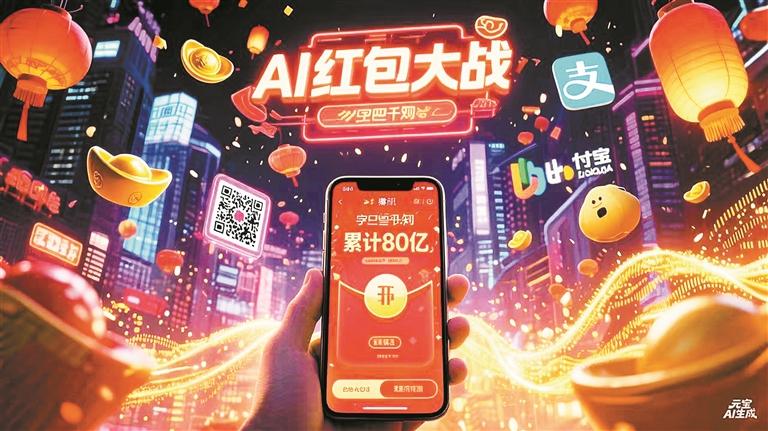
Core Insights - The AI Spring Festival "Red Packet War" involved major industry players, with over 8 billion yuan invested in promotional activities, marking a significant marketing push for AI applications [2][3][11] - The competition is not just about short-term marketing but also about establishing AI as a key entry point in consumer decision-making and daily life [6][9] Group 1: Investment and Participation - Tencent initiated the campaign with a 1 billion yuan cash red packet, followed by Alibaba's 3 billion yuan "free meal" initiative, and ByteDance's distribution of tech products during the Spring Festival [3][4] - The total investment from various internet companies exceeded 8 billion yuan, indicating a strong commitment to capturing market share in the AI sector [2][11] Group 2: User Engagement and Growth Metrics - During the promotional period, DAU for Yuanbao surged to over 50 million, while Qianwen's DAU increased by 727.7% to reach 5.848 million [4][5] - The promotional activities led to significant user engagement, with Yuanbao users completing over 10 billion AI creations and Qianwen facilitating nearly 2 billion orders [4][5] Group 3: Market Dynamics and Competition - The initial surge in user numbers is expected to decline as subsidies fade, leading to a more stable competitive landscape focused on user retention and ecosystem integration [7][10] - The competition is shifting from attracting users to maintaining them, with a focus on the long-term value of AI applications rather than just short-term gains [11] Group 4: Strategic Implications - The investments signal a transition from technology development to large-scale competition in the AI space, with companies vying for strategic positioning in the market [11] - The differing strategies among companies highlight various approaches to integrating AI into existing ecosystems, whether as standalone applications or embedded capabilities [9][10]


智通ADR统计 | 2月27日





Xin Lang Cai Jing· 2026-02-26 22:27
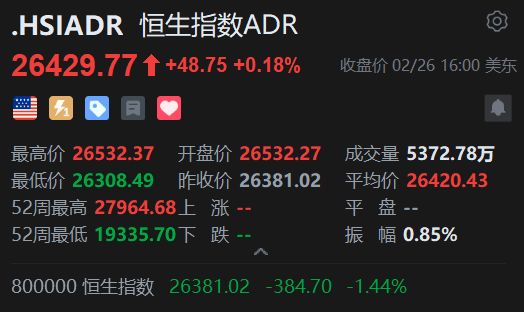
Market Overview - On Thursday, the three major U.S. stock indices showed mixed performance, while the Hang Seng Index ADR rose, closing at 26,429.77 points, an increase of 48.75 points or 0.18% compared to the Hong Kong market close [1]. Company Performance - Major blue-chip stocks exhibited varied performance: HSBC Holdings closed at HKD 147.859, up 1.97% from the Hong Kong market close; Tencent Holdings closed at HKD 513.204, up 0.24% [3]. - Tencent Holdings reported a price of HKD 512.000, with a decline of 2.01%, while its ADR price was 513.204, reflecting a 0.24% increase [4]. - Alibaba Group's stock price was HKD 143.000, down 3.57%, with its ADR at 144.779, showing an increase of 1.779% [4]. - HSBC's stock price was HKD 145.000, up 1.61%, with its ADR at 147.859, reflecting a 1.97% increase [4]. - China Ping An's stock price decreased by 4.64% to HKD 67.850, while its ADR showed a slight increase of 0.49% [4]. - Meituan's stock price fell by 2.72% to HKD 80.450, with its ADR showing a minimal change of -0.03% [4].
微信有新功能!网友:好用
Xin Lang Cai Jing· 2026-02-26 15:34
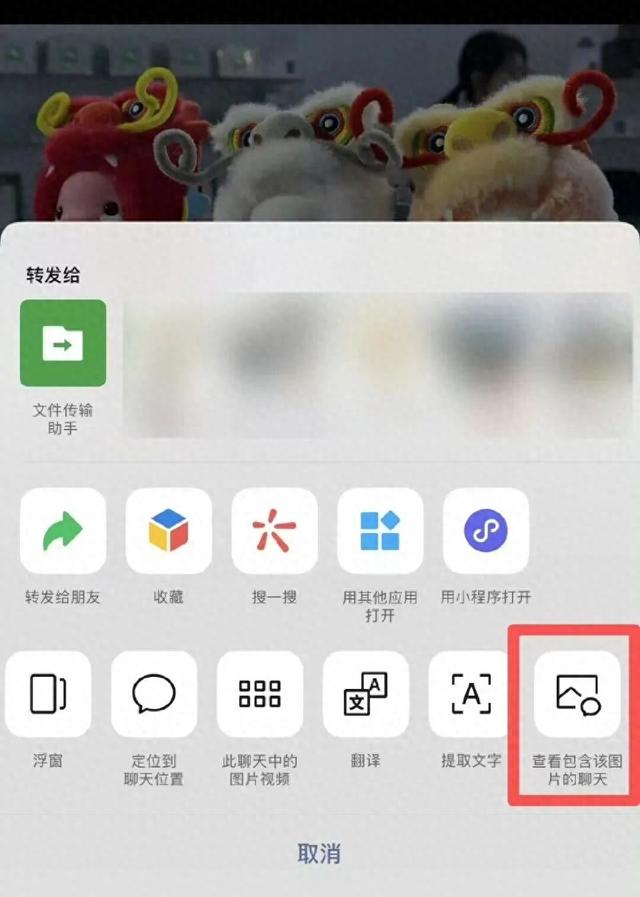
Core Viewpoint - WeChat has introduced a new feature that allows users to see how many chats a particular image, video, or file has been used in, addressing concerns about storage space usage [1][5]. Group 1: New Feature Introduction - The new feature enables users to long-press on any image, video, or file in a chat to view the option "View the chats that contain this image/video/file" [1]. - Users can see the number of chats that have used the same content, which helps them understand that multiple uses do not increase storage space [5]. Group 2: User Interface and Experience - The interface will display a message indicating that the same image, video, or file used in multiple chats does not occupy additional storage space [3]. - This feature aims to reassure users that forwarding content does not lead to increased file storage, as it merely increases the reference count [5]. Group 3: Storage Management Tips - Users can manage their storage by checking the total usage and specific sections in the WeChat settings under "Storage Space" [6]. - Temporary data generated by various functions can be safely cleared, and users can selectively clear high-resolution images and videos to save space [6]. - The chat record management page allows sorting by file size, enabling users to quickly identify and delete large files [6].
英伟达财报亮眼黄仁勋称AI达拐点,腾讯元宝出错暴露盲点
Bei Jing Shang Bao· 2026-02-26 14:00
【#AI拐点也有盲点#】#英伟达#又交出了一份让行业咂舌的财报,第四财季营收利润涨幅双双超过 70%。站在聚光灯下,英伟达CEO黄仁勋颇为笃定:代理AI(Agentic AI)已达到拐点,企业对智能体 的采用率正在飙升,算力直接转化为收入。#元宝# 从大模型到智能体,从对话互动到系统级操作,Agentic AI或者智能体的跃进,意味着AI从会聊天到会 干活、从消费端的社交娱乐到企业级的商业渗透。黄仁勋无疑是最乐观的那个人,但越来越多的人也开 始意识到,AI似乎真的要完成从"嘴替"到"手替"的关键一跃。 值得注意的是,就在同一时间,在春节AI大战中赚足眼球的腾讯元宝,却在忙着为用户生成的内容差 错而致歉。一位用户使用元宝制作拜年海报时,呈现的是一句脏话。元宝官方:模型在多轮对话中输出 了异常结果。这不是大模型产品第一次"情绪失控",年初元宝就曾对要求改代码的用户"辱骂+乱回"。 宏大愿景撞上琐碎情绪,一边是黄仁勋口中的指数级增长,一边是消费级场景里的失误频出——画面放 在一起,构成了AI叙事里最真实的割裂。 无论从技术上还是商业上,AI拐点是存在的,甚至无法被预测被计划。英伟达的业绩是结果,黄仁勋 得以对形势总 ...


春节AI红包大战收官:“烧”了45亿,谁抢到了“超级入口”?
3 6 Ke· 2026-02-26 12:53
Core Insights - The 2026 Spring Festival marked a historic collective appearance of AI companies on a major platform, indicating a significant shift in the commercial landscape towards AI [2][3] - The competition among AI firms during the Spring Festival involved a massive cash giveaway totaling 45 billion yuan, reflecting a strategic shift from user acquisition to direct commercial conversion [3][5] Group 1: AI Product Promotion Strategies - Major AI companies adopted aggressive cash distribution strategies to promote their products, with Baidu distributing 5 billion yuan, Tencent 10 billion yuan, and Alibaba's Qianwen 30 billion yuan [3][6][7] - The promotional tactics varied among companies, with Baidu focusing on activating existing users, Tencent leveraging social media for rapid user acquisition, and Qianwen binding subsidies to specific transactions to drive engagement [6][7][8] Group 2: Impact and Results of the Cash Giveaways - Following the cash giveaways, Baidu's Wenxin assistant saw a fourfold increase in monthly active users (MAU), while Tencent's Yuanbao achieved over 50 million daily active users (DAU) [10][11] - Qianwen reported significant user engagement, with 50 billion interactions during the Spring Festival and a 66-fold increase in movie ticket purchases through its platform [11] Group 3: Industry Challenges and Future Outlook - Despite the initial success in user engagement, the long-term sustainability of user retention and product experience remains uncertain, with concerns about high costs and regulatory pressures [11][12] - The total expenditure by AI companies during the Spring Festival exceeded 80 billion yuan, raising questions about the profitability and effectiveness of such large-scale promotional efforts [12]
豪掷80亿后发现,AI大战的胜负不靠红包
3 6 Ke· 2026-02-26 12:50
Core Insights - The AI red envelope battle during the Spring Festival saw over 8 billion yuan invested, making AI and large models accessible beyond first-tier cities, reaching elderly users and lower-tier markets [1][11] - Major tech giants like ByteDance, Alibaba, Tencent, and Baidu engaged in a strategic competition, each with distinct approaches to integrate AI into everyday life [2][4][11] Group 1: Industry Dynamics - The AI applications experienced a surge in user engagement during the Spring Festival, with ByteDance's Doubao achieving 1.9 billion interactions on New Year's Eve, while Alibaba's Qianwen attracted over 130 million first-time AI shoppers [4][11] - Despite the initial success, post-festival user retention rates dropped significantly, with average 30-day retention at only 12.8%, indicating challenges in maintaining user engagement after promotional activities ended [6][10] Group 2: Company Strategies - Doubao replicated WeChat's successful model by partnering with CCTV for the Spring Festival, integrating AI features like avatar generation and greeting videos into user interactions [3][4] - Alibaba's strategy focused on leveraging its ecosystem, converting 3 billion yuan in subsidies into practical AI experiences across various consumer scenarios, enhancing user engagement through familiar platforms [4][13] - Tencent utilized social engagement tactics, offering cash rewards through its Yuanbao app to encourage users to interact with AI features, aiming to create habitual usage patterns [4][12] Group 3: User Experience and Retention - The initial excitement from the red envelope promotions led to a significant influx of users, but many were driven by short-term incentives, resulting in a high churn rate post-festival [6][10][12] - Users expressed dissatisfaction with the complexity of tasks and low perceived value of rewards, leading to a rapid decline in app usage after the promotional period [6][10] - The effectiveness of AI applications in retaining users is closely tied to their integration into daily activities, as seen with Alibaba and ByteDance's strategies of embedding AI into existing services [13][14]
元宝、千问、豆包:烧完40亿后,留下了什么?
Sou Hu Cai Jing· 2026-02-26 12:41
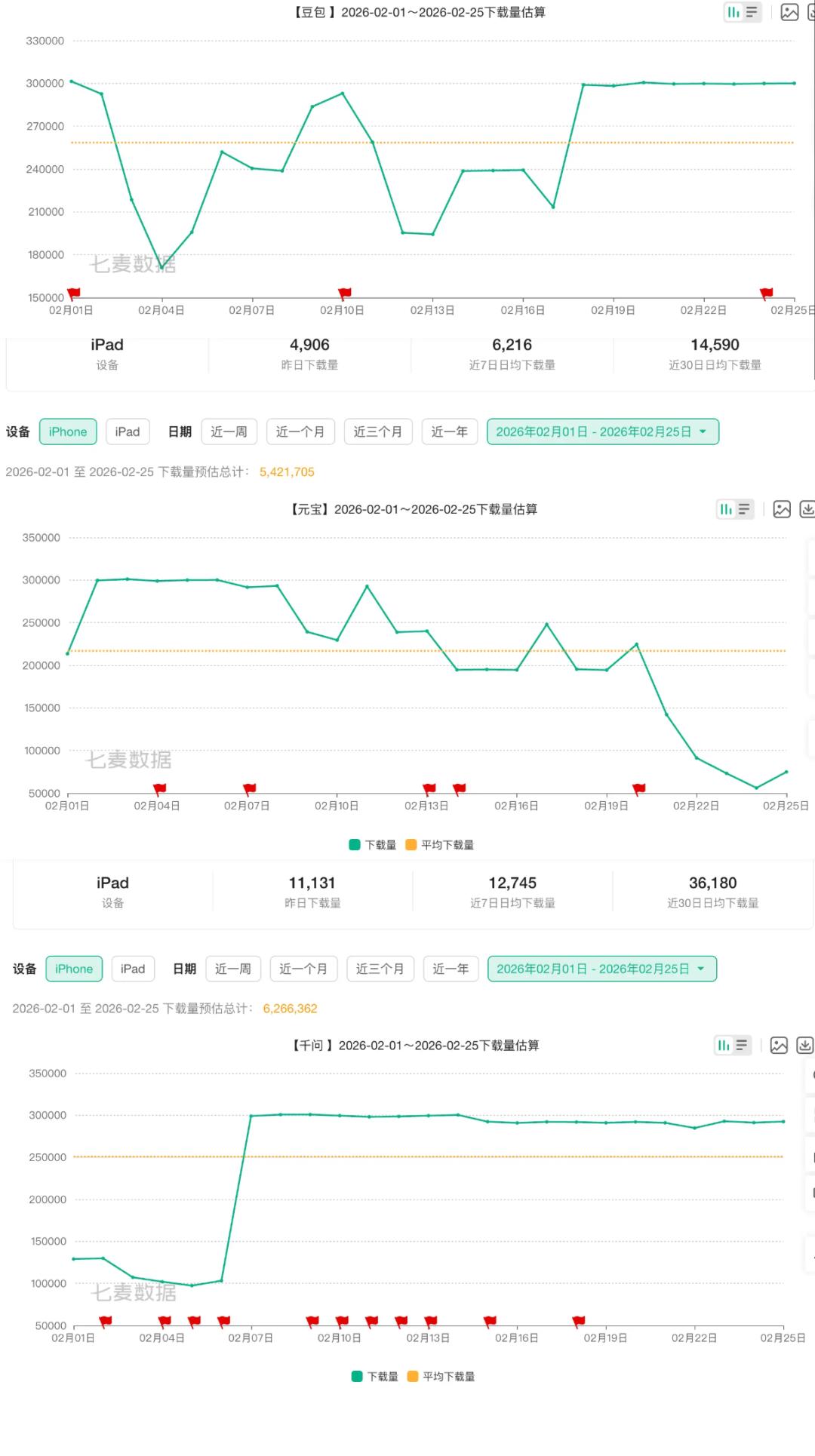
Core Insights - The Chinese internet industry has re-entered a "burning money" phase, particularly in the AI sector, with major players like Tencent, Alibaba, and ByteDance investing heavily in user acquisition through cash incentives [3][6][7] - Despite initial success in user engagement, the long-term retention of users remains uncertain, as evidenced by the rapid decline in rankings on the App Store after the promotional activities ended [5][10] Group 1: Investment and User Engagement - Tencent's Yuanbao launched a campaign with a cash incentive of 1 billion yuan, achieving over 50 million daily active users (DAU) and 114 million monthly active users (MAU) shortly after the campaign [6][8] - Alibaba's Qianwen invested 3 billion yuan in a "Spring Festival Treat Plan," integrating AI capabilities into real-life consumer scenarios, resulting in over 130 million first-time AI shopping experiences [7][8] - ByteDance's Doubao capitalized on the Spring Festival's peak viewership, achieving a peak processing capacity of 633 billion tokens per minute during the event [4][9] Group 2: User Retention Challenges - Post-campaign analysis revealed that while Doubao and Qianwen maintained high rankings, Yuanbao dropped significantly, indicating that cash incentives do not guarantee user retention [5][10] - Analysts emphasize that user retention is more closely tied to the product's ability to meet high-frequency needs rather than the amount of cash incentives offered [11][13] - The competition is not solely about user acquisition through cash but also about integrating AI into daily life, which will determine long-term success [13][14]
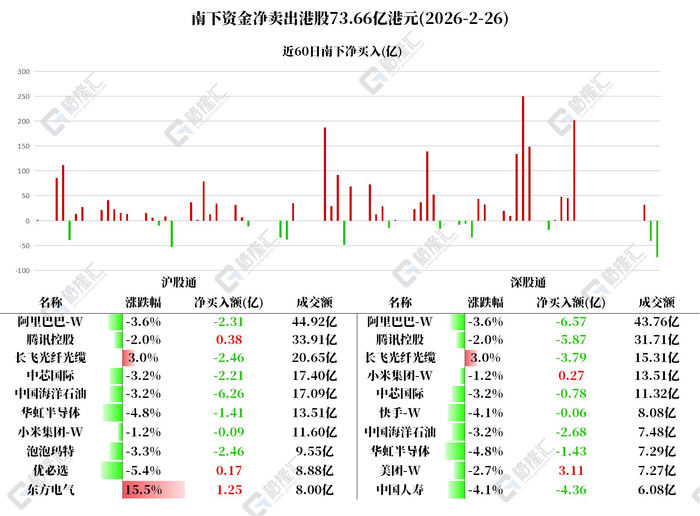
智通港股通活跃成交|2月26日
智通财经网· 2026-02-26 11:01
Core Insights - On February 26, 2026, Alibaba-W (09988), Tencent Holdings (00700), and Yangtze Optical Fibre and Cable (06869) were the top three companies by trading volume in the Southbound Stock Connect, with trading amounts of 4.492 billion, 3.391 billion, and 2.065 billion respectively [1] - The same companies also led in trading volume in the Shenzhen-Hong Kong Stock Connect, with trading amounts of 4.376 billion, 3.171 billion, and 1.531 billion respectively [1] Southbound Stock Connect Trading Activity - **Top Active Companies**: - Alibaba-W (09988): Trading amount of 4.492 billion, net buy of -0.231 billion [2] - Tencent Holdings (00700): Trading amount of 3.391 billion, net buy of +37.9726 million [2] - Yangtze Optical Fibre and Cable (06869): Trading amount of 2.065 billion, net buy of -0.246 billion [2] - SMIC (00981): Trading amount of 1.740 billion, net buy of -0.221 billion [2] - CNOOC (00883): Trading amount of 1.709 billion, net buy of -0.626 billion [2] Shenzhen-Hong Kong Stock Connect Trading Activity - **Top Active Companies**: - Alibaba-W (09988): Trading amount of 4.376 billion, net buy of -0.657 billion [2] - Tencent Holdings (00700): Trading amount of 3.171 billion, net buy of -0.587 billion [2] - Yangtze Optical Fibre and Cable (06869): Trading amount of 1.531 billion, net buy of -0.379 billion [2] - Xiaomi Group-W (01810): Trading amount of 1.351 billion, net buy of +27.0028 million [2] - Kuaishou-W (01024): Trading amount of 0.808 billion, net buy of -0.06332 billion [2]


图解丨南下资金连续第2日净卖出港股,抛中海油、阿里



Ge Long Hui A P P· 2026-02-26 10:29
净卖出中国海洋石油8.93亿、阿里巴巴-W 8.88亿、长飞光纤光缆6.24亿、腾讯控股5.48亿、中国人寿 4.36亿、中芯国际2.98亿、华虹半导体2.84亿、泡泡玛特2.45亿。 据统计,南下资金已连续7日净买入美团,共计36.1242亿港元;连续5日净买入小米,共计32.2538亿港 元;连续4日净卖出中海油,共计12.2479亿港元。 格隆汇2月26日|南下资金今日净卖出港股73.66亿港元,为连续第2日净卖出。其中: 净买入美团-W 3.11亿、东方电气1.25亿; ...