
HAIDILAO(06862)

Search documents
“吃海底捞发现门店挂着狮子和海蛇族徽”,「传销式家族制」才是这个火锅帝国最大的商业机密?
3 6 Ke· 2025-09-24 08:03
Core Viewpoint - Haidilao has adopted a family-based management system that combines traditional elements with modern practices, creating a unique corporate culture that emphasizes mentorship and internal growth [10][21][23]. Group 1: Family System and Management - The family system at Haidilao consists of various "families" represented by animal-themed badges, with each family comprising 5 to 18 stores led by a "master store manager" [3][5][10]. - This system is rooted in a mentorship model where experienced store managers train their apprentices, who in turn can establish their own families once they reach a certain scale [10][21]. - The family structure allows for significant decision-making power, including store expansion and management evaluations, fostering a sense of ownership among the family leaders [10][23]. Group 2: Employee Training and Retention - Haidilao's mentorship model is designed to ensure consistent service quality across its locations, as all management personnel are internally trained [13][29]. - The rigorous training process includes multiple assessments and a clear path for advancement, which helps reduce employee turnover and enhances motivation [29][30]. - The emotional connection fostered by the family system encourages employees to view Haidilao as a home, contributing to a strong corporate culture [32][34]. Group 3: Financial Incentives and Performance - The financial structure of the mentorship system includes performance-based incentives, where store managers receive a percentage of profits from their stores and those of their apprentices [23][25]. - This "multi-level" incentive system encourages managers to actively develop their teams, as their earnings are directly tied to the success of their apprentices [25][27]. - Despite the potential for high earnings, there are strict performance evaluations, and poor performance can lead to penalties for both the manager and their apprentices [27][30]. Group 4: Challenges and Evolution - The rapid expansion of Haidilao led to challenges, particularly during the pandemic, resulting in significant store closures and a reevaluation of the family management system [30][32]. - In response to operational difficulties, Haidilao has experimented with different management structures, including a shift to regional managers, but has reverted to the family system due to its deep-rooted connections with store operations [32][33]. - The company is now attempting to balance its traditional family culture with a more rational and transparent management approach to attract a new generation of employees [33][34].



深圳市烹饪协会会长刘永忠:建立稳定的供应链,是全球化的前提条件
Sou Hu Cai Jing· 2025-09-24 07:06
Group 1 - The core viewpoint emphasizes the essential preparations for Chinese restaurant brands to successfully expand globally, highlighting three critical factors [1] Group 2 - Establishing a stable and standardized supply chain system is crucial. For instance, Haidilao entered the Singapore market in 2012 and spent several years developing a mature supply chain, which not only supports its brand but also provides assistance to smaller domestic brands, creating additional revenue channels [3] Group 3 - Cultural resonance is vital for restaurant brands going abroad. Brands should not impose their culture excessively, especially elements that may be difficult for the target country to accept. Instead, they should extract the essence of Chinese culture and integrate it with the local cultural context to avoid conflicts and foster familiarity [3] Group 4 - Localized operational management is necessary after entering foreign markets. Companies should gradually train local employees to enhance their understanding of the local market and reduce labor and management costs. For example, Japan's labor laws require foreign employees to undergo language training, which, despite initial costs, contributes to sustainable brand development in the long run [3]

让宠物和人一起吃饭,海底捞拼了
Xin Lang Cai Jing· 2025-09-24 04:33
Core Viewpoint - Haidilao has opened its first pet-friendly restaurant in Shenzhen, tapping into the growing pet economy and allowing customers to dine with their pets [1][3]. Group 1: Pet-Friendly Restaurant - The pet-friendly restaurant features a dedicated area for pets, with separate entrances for pet owners and non-pet customers [3]. - On its opening day, nearly 40 tables were occupied by pet owners, and over 150 tables were filled during the first weekend [1][3]. - The restaurant offers a "cute pet exclusive package" with daily specials like chicken breast and duck meat dishes, priced around 23 to 46 yuan [3][4]. Group 2: Industry Trends - Many restaurants in major cities like Beijing, Shanghai, and Chengdu are also embracing the pet dining trend [4]. - Other brands, such as Xiaobuxiang and Coucou Hotpot, have opened pet-friendly locations, although they do not yet offer pet-specific meals [5]. Group 3: Business Strategy - Haidilao has diversified its offerings by launching various themed restaurants, including night snack and community stores, and has introduced 14 sub-brands in recent years [6][7]. - The company aims to meet diverse consumer needs and increase revenue by exploring new market segments [7][9]. - The "Red Pomegranate Plan" encourages internal entrepreneurship, allowing employees to innovate and test new concepts [8][11]. Group 4: Financial Performance - Haidilao's revenue and net profit growth have slowed, with a 3.7% decline in revenue to 20.7 billion yuan and a 13.7% drop in profit to 1.755 billion yuan in the first half of 2025 [9][10]. - The decline in the hotpot segment is attributed to increased competition and changing consumer preferences [9][10]. Group 5: Challenges and Opportunities - Despite the challenges, Haidilao has sufficient cash reserves of 6.407 billion yuan to support new ventures and employee projects [11][12]. - The company has seen mixed results with its sub-brands, with nearly half of the 26 launched by March 2025 having closed, indicating the risks associated with rapid expansion [12].
建银国际:内地国庆黄金周将推动短期零售销售增长
智通财经网· 2025-09-23 02:38
Core Viewpoint - The report from Jianyin International highlights that the upcoming National Day Golden Week in China will significantly boost short-term consumption, particularly benefiting sectors such as tourism, dining, beverages, outdoor sports, and gold-related businesses [1] Group 1: Impact on Sectors - The Golden Week is expected to drive retail sales growth, with a notable increase during the overlapping period of the Mid-Autumn Festival and National Day in 2025, from October 1 to 8 [1] - Key sectors poised to benefit from the consumption surge include tourism, hospitality, retail, dining, jewelry, ready-to-drink beverages, and outdoor sports, driven by rising demand for services, cultural experiences, and leisure activities [1] Group 2: Policy Support - Recent national service consumption boosting policies and regional initiatives are anticipated to extend the consumption growth during the holiday period, creating short-term investment opportunities in the market [1]


预制菜风波背后:西贝与海底捞们的副牌焦虑
3 6 Ke· 2025-09-22 11:34
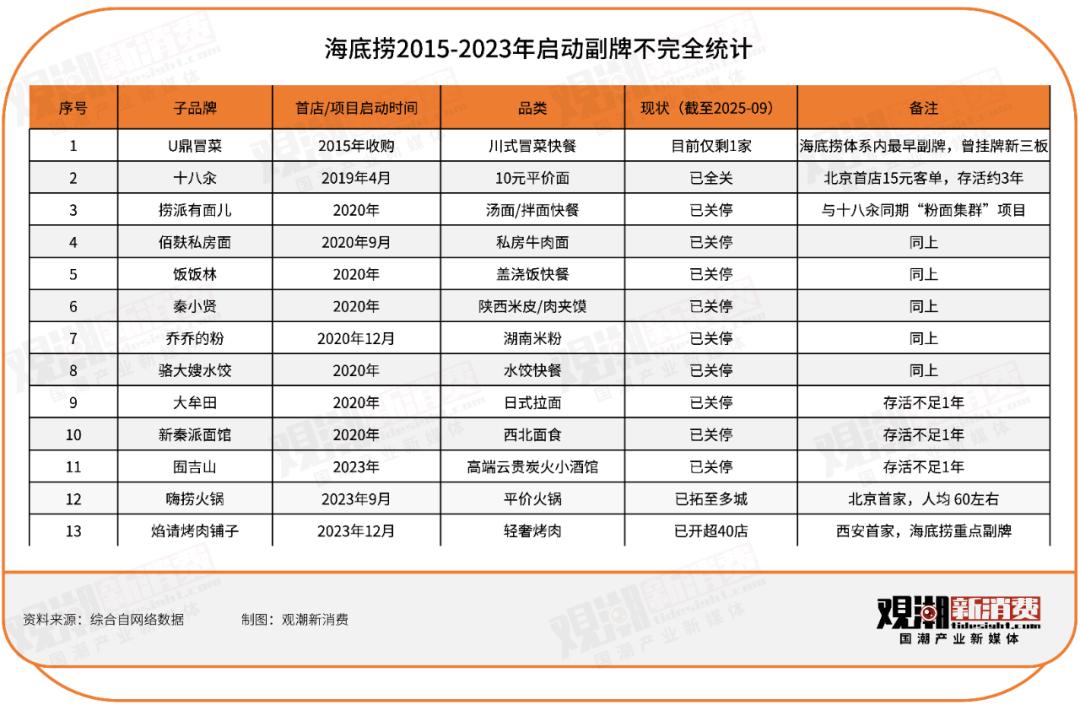
Core Viewpoint - The restaurant industry is shifting from a "many brands, many blessings" strategy to a focus on "quality over quantity" in brand development, particularly in the context of a low-margin environment [1][27]. Group 1: Brand Strategy - Leading restaurant companies are adopting a "main brand holds the fort, sub-brands charge forward" strategy, but the success of sub-brands depends on strategic consistency and resource synergy [2][27]. - Haidilao, despite being a hotpot giant, is aggressively exploring sub-brands, having launched over 20 sub-brands across various categories, including baking and barbecue [1][3]. Group 2: Performance and Challenges - Haidilao's rapid expansion led to a significant increase in store count to 1,205 by 2020, resulting in operational challenges and a record loss of 4.2 billion yuan in 2021 [3][4]. - The company has since reassessed its sub-brand strategy, focusing on fewer launches and prioritizing its main brand, with only three sub-brands introduced in 2023 [3][4]. Group 3: Sub-Brand Development - The "Red Pomegranate Plan" encourages internal entrepreneurship among employees, allowing for quicker market adjustments and reducing trial costs for new sub-brands [5][27]. - By the end of 2024, Haidilao's other restaurant revenues reached 483 million yuan, showing a year-on-year growth of 39.6%, indicating initial success from its sub-brands [6]. Group 4: Pricing Strategy - The restaurant market is experiencing a structural shift towards lower price points, with average hotpot spending dropping from 86.7 yuan in 2022 to 77.1 yuan in 2025, a decline of 11% [13][16]. - Haidilao's sub-brands are strategically priced to attract a broader consumer base, with offerings like "Little Hi Hotpot" and "High High Self-Service Hotpot" focusing on affordability [14][15]. Group 5: Industry Trends - The competitive landscape is forcing companies to refine their sub-brand strategies, with many opting to consolidate resources and focus on core brands rather than spreading themselves too thin [23][26]. - West B's sub-brand exploration has resulted in cumulative losses of 700-800 million yuan over 7-8 years, leading to a strategic retreat to focus on its main brand [26][27].
海底捞、杨国福纷纷入局小火锅,年轻人为何愿为“一人食”买单?
Xin Lang Cai Jing· 2025-09-22 11:17
Group 1 - The core viewpoint of the article highlights the emergence of a new trend in the hot pot industry, driven by the rise of the "one-person economy" and changing consumer preferences, particularly among young people who prefer individual dining experiences [2][4] - The article notes that by 2030, the number of people living alone in China is expected to reach between 150 million to 200 million, with the highest proportion being young adults aged 20-39, indicating a significant shift in consumer demand [2] - Major restaurant chains are entering the self-service hot pot market due to three main factors: the evolution of consumer demographics, growth anxiety among companies, and the attractive market potential [2][3] Group 2 - The article discusses the competitive landscape of the hot pot market, which has formed distinct price segments: below 30 yuan is dominated by regional brands, while the mid-range market is led by giants like Haidilao and Yang Guofu, priced at 59.9 yuan [3][4] - The rise of self-service hot pot addresses modern social issues, particularly the discomfort associated with dining alone, by providing features such as independent cooking stations and transparent partitions that enhance the dining experience [2][4] - The article emphasizes that the popularity of self-service hot pot is not merely a product innovation but a response to demographic changes, with the need for personal dignity in consumption becoming a key driver for both low-end and mid-range offerings [4]
海底捞(06862) - 2025 - 中期财报
2025-09-22 08:32
Financial Performance - Haidilao reported a revenue of HK$3.5 billion for the first half of 2025, representing a year-on-year increase of 15%[4]. - The company achieved a net profit of HK$500 million, up 20% compared to the same period last year[4]. - The Group achieved operating revenue of RMB20,703.3 million for the first half of 2025, a decrease of 3.7% compared to the same period in 2024[21]. - Core operating profit (non-IFRS measure) was RMB2,408.1 million, representing a decrease of 14.0% year-over-year[21]. - Profit for the period was RMB1,754.6 million, down 13.7% from the previous year[21]. - The revenue for the six months ended June 30, 2025, decreased by 3.7% to RMB20,703.3 million from RMB21,490.9 million in the same period of 2024[42][43]. - Revenue from Haidilao restaurant operations accounted for 89.8% of total revenue, decreasing by 9.0% to RMB18,580.2 million due to a decline in table turnover rate, which averaged 3.8 times per day[47]. - Same store sales for Haidilao restaurants decreased to RMB17,016.2 million for the six months ended June 30, 2025, from RMB18,884.9 million in the same period of 2024, representing a decline of approximately 9.9%[56]. Customer Engagement and Expansion - User data indicated that the total number of customers served increased by 12% to 15 million during the reporting period[4]. - Haidilao plans to open 50 new restaurants in 2025, expanding its footprint in both domestic and international markets[4]. - The overall market expansion strategy includes targeting key cities in Southeast Asia, with plans to enter two new countries by 2026[4]. - As of June 30, 2025, Haidilao operated a total of 1,363 restaurants, including 1,299 self-operated in mainland China and 41 franchised restaurants[23]. - The company opened 25 new self-operated restaurants and 3 franchised restaurants in the first half of 2025, while closing a total of 33 under-performing restaurants[23]. Product Development and Innovation - Haidilao is focusing on developing a new line of vegetarian dishes, aiming to attract health-conscious consumers[4]. - Haidilao is actively exploring and innovating hot pot scenarios and developing distinctive products to optimize offerings[20]. - Revenue from other restaurant operations surged by 227.0% to RMB596.5 million, attributed to the launch of innovative dining brands under the "Pomegranate plan" and various dining scenarios[49]. - The company plans to integrate multi-brand and multi-category resources to build a Haidilao Delivery Super Kitchen and explore a new satellite restaurant model[31]. Operational Efficiency and Cost Management - The company is investing HK$200 million in new technology for kitchen automation to enhance operational efficiency[4]. - The implementation of the "Woodpecker plan" aims to improve performance by shutting down under-performing restaurants and adjusting organizational structure[24]. - The average table turnover rate for Haidilao restaurants was 3.8 times per day for the six months ended June 30, 2025, down from 4.2 times per day in the same period of 2024[53]. - Staff costs decreased by 2.3% from RMB7,155.7 million for the six months ended June 30, 2024, to RMB6,988.0 million for the corresponding period in 2025, with the percentage of revenue rising from 33.3% to 33.8%[65]. Financial Position and Liquidity - Total assets as of June 30, 2025, were RMB21,115.1 million, down from RMB22,781.3 million at the end of 2024[18]. - Cash and cash equivalents decreased from RMB6,406.9 million as of December 31, 2024, to RMB4,756.1 million as of June 30, 2025, a reduction of approximately 25.7%[100]. - The Group's debt-to-equity ratio as of June 30, 2025, was 22.4%[119]. - The company funded its operations and expansion primarily through cash generated from operations, maintaining optimum liquidity to support business growth[99]. Shareholder Information and Corporate Governance - The Board has declared an interim dividend of HK$0.338 (equivalent to RMB0.309) per Share for the six months ended June 30, 2025[180]. - The company declared an interim dividend of HKD 0.338 per share for the six months ended June 30, 2025[183]. - The company has complied with the Corporate Governance Code during the six months ended June 30, 2025[165]. - As of June 30, 2025, the total number of issued shares is 5,574,000,000[140].
复盘西贝风波:连锁餐饮的规模陷阱
远川研究所· 2025-09-21 13:06
Core Viewpoint - The article discusses the ongoing challenges and transformations in the prepared food industry, particularly focusing on the case of Xibei, highlighting the tension between consumer expectations and operational realities in the restaurant sector [4][6][14]. Group 1: Prepared Food Industry Dynamics - The prepared food and central kitchen models are seen as inevitable products of the expansion of chain restaurants [6]. - Despite facing backlash, the sales of prepared foods continue to rise, indicating a complex consumer relationship with these products [5][6]. - The central kitchen model simplifies supply chain management by unifying raw material procurement and pre-processing, allowing restaurants to focus on final cooking [13][14]. Group 2: Xibei's Business Model and Challenges - Xibei's journey reflects a search for the optimal single-store model suitable for expansion, influenced by the success of Haidilao [10][13]. - The company has undergone multiple rebranding efforts to find a focused identity, ultimately adopting a central kitchen approach to enhance efficiency [10][14]. - Xibei's pricing strategy has faced criticism, particularly regarding the perceived value of its prepared dishes compared to fresh ones, leading to consumer backlash [24][28]. Group 3: Market Trends and Consumer Behavior - The article notes a significant increase in investment activity in the restaurant sector post-2015, driven by the central kitchen model's promise of standardization and rapid expansion [14][18]. - Xibei's pricing strategies, including the introduction of children's meals, have aimed to enhance profitability but have also led to public scrutiny over perceived value [20][22]. - The challenges faced by Xibei reflect broader structural issues in the chain restaurant industry, particularly concerning single-store efficiency and consumer expectations [28][34].
餐饮商家,集体上演“擦边餐”
虎嗅APP· 2025-09-19 11:10
Core Viewpoint - The article discusses the emerging trend of combining dining with performance in the restaurant industry, highlighting how this "borderline economy" is being rapidly adopted to attract younger consumers and drive foot traffic in a challenging market environment [4][10]. Group 1: Dining and Performance Integration - The integration of dining and performance is becoming a popular trend, with restaurants like Haidilao introducing themed night venues featuring DJs and interactive performances to enhance customer experience [6][8]. - The "night snack" theme introduced by Haidilao has generated significant social media buzz, with over 10 million views on Xiaohongshu and 9 million on Douyin, indicating strong consumer interest [7][10]. - Other restaurants are also adopting similar strategies, such as introducing live performances and themed service staff to create a unique dining atmosphere [4][8]. Group 2: Market Challenges and Consumer Behavior - The restaurant industry is facing significant challenges, with major brands like Nayuki and Xiaobawang reporting substantial losses in 2024, highlighting the need for innovative customer engagement strategies [10][12]. - Younger consumers, particularly those born in the 1990s and 2000s, are seeking more than just food; they desire social interaction and entertainment, which has led to the rise of "borderline" performances in dining settings [10][11]. - The perception of value has shifted, with consumers willing to pay for experiences that combine dining with entertainment, as seen in the popularity of Haidilao's new offerings [10][11]. Group 3: Risks and Sustainability - The article warns that while "borderline" dining can generate short-term interest, it may not be sustainable in the long run, as evidenced by the closure of restaurants like Staneemeehoi and Hooters due to changing consumer preferences and societal values [13][14]. - The reliance on provocative marketing strategies can backfire, as seen in the backlash against establishments that objectify staff, indicating a need for restaurants to balance entertainment with respect for social norms [14][15]. - Ultimately, the success of performance dining hinges on maintaining food quality and service standards, as consumers prioritize taste and value over mere spectacle [21][22].
解锁夜宵“新玩法”,蹦迪、二次元助力餐饮“破圈”
Bei Ke Cai Jing· 2025-09-19 10:13
Group 1 - The core idea of the articles is that Haidilao is actively expanding its night economy by introducing innovative dining experiences, such as "hot pot + disco" and themed night markets, to attract younger customers and increase sales during nighttime hours [1][2] - Haidilao's average daily table turnover for night snacks increased by over 11% from April-May to July-August, with some themed stores experiencing a 15% increase in customer traffic [1] - The company launched a comprehensive night snack menu this summer, including a variety of dishes suitable for late-night dining, and opened nearly 30 night snack-themed stores nationwide by the end of June [1] Group 2 - The collaboration with popular anime "Time Agent" has significantly increased the number of "two-dimensional" customers, accounting for nearly 50% of patrons, and improved table turnover rates by nearly 30% compared to the same period last year [2] - The "Dimensional Night Market" events have been introduced in 10 stores across four cities, leading to a notable increase in sales, with some stores experiencing a growth of 10%-15% during the promotional period [2] - The night snack segment's revenue has increased by 11%-15%, enhancing the brand's connection with younger consumers and encouraging them to actively participate in brand promotion [2]