POP MART(09992)

Search documents
港股通(沪)净买入11.52亿港元
Zheng Quan Shi Bao Wang· 2025-11-10 13:50
Market Overview - On November 10, the Hang Seng Index rose by 1.55%, closing at 26,649.06 points, with a total net inflow of HKD 6.654 billion through the southbound trading channel [1] - The total trading volume for the southbound trading was HKD 103.941 billion, with a net buying amount of HKD 6.654 billion [1] Southbound Trading Details - The Shanghai Stock Exchange's southbound trading had a total transaction amount of HKD 63.035 billion, with a net buying of HKD 1.152 billion [1] - The Shenzhen Stock Exchange's southbound trading recorded a transaction amount of HKD 40.906 billion, with a net buying of HKD 5.502 billion [1] Active Stocks - In the Shanghai Stock Exchange's southbound trading, Alibaba-W had the highest transaction amount of HKD 30.14 billion, followed by SMIC and Tencent Holdings with transaction amounts of HKD 25.38 billion and HKD 23.94 billion, respectively [1] - In terms of net buying, China National Offshore Oil Corporation (CNOOC) led with a net buying amount of HKD 564 million, with its stock price increasing by 5.95% [1] - Alibaba-W recorded the highest net selling amount of HKD 748 million, while its stock price rose by 2.06% [1] Shenzhen Stock Exchange Active Stocks - In the Shenzhen Stock Exchange's southbound trading, Alibaba-W also topped the transaction amount with HKD 22.88 billion, followed by SMIC and CNOOC with transaction amounts of HKD 17.66 billion and HKD 16.28 billion, respectively [2] - CNOOC had the highest net buying amount of HKD 750 million, with its stock price increasing by 5.95% [2] - SMIC recorded the highest net selling amount of HKD 12.6 million, with its stock price declining by 0.99% [2]

南向资金丨中国海洋石油获净买入13.13亿港元



Di Yi Cai Jing· 2025-11-10 13:13
Group 1 - Southbound funds recorded a net purchase of 6.654 billion HKD [1] - China National Offshore Oil Corporation (CNOOC) received a net purchase of 1.313 billion HKD [1] - Pop Mart and Xiaomi Group-W saw net purchases of 519 million HKD and 173 million HKD respectively [1] Group 2 - Alibaba-W experienced the highest net sell-off, amounting to 653 million HKD [1]
智通港股通活跃成交|11月10日


智通财经网· 2025-11-10 11:04
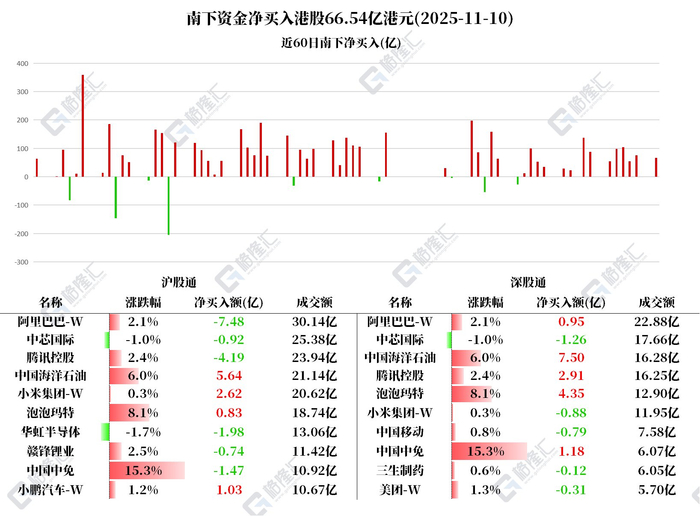
Core Insights - On November 10, 2025, Alibaba-W (09988), SMIC (00981), and Tencent Holdings (00700) were the top three companies by trading volume in the Southbound Stock Connect, with trading amounts of 30.14 billion, 25.38 billion, and 23.94 billion respectively [1][2] - In the Shenzhen-Hong Kong Stock Connect, Alibaba-W (09988), SMIC (00981), and China National Offshore Oil Corporation (00883) also ranked as the top three, with trading amounts of 22.88 billion, 17.66 billion, and 16.28 billion respectively [1][2] Southbound Stock Connect - Top Active Companies - Alibaba-W (09988) had a trading amount of 30.14 billion with a net buy of -7.48 billion [2] - SMIC (00981) recorded a trading amount of 25.38 billion with a net buy of -91.6453 million [2] - Tencent Holdings (00700) had a trading amount of 23.94 billion with a net buy of -4.19 billion [2] - China National Offshore Oil Corporation (00883) achieved a trading amount of 21.14 billion with a net buy of +5.64 billion [2] - Xiaomi Group-W (01810) had a trading amount of 20.62 billion with a net buy of +2.62 billion [2] - Pop Mart (09992) recorded a trading amount of 18.74 billion with a net buy of +834.075 million [2] - Hua Hong Semiconductor (01347) had a trading amount of 13.06 billion with a net buy of -1.98 billion [2] - Ganfeng Lithium (01772) recorded a trading amount of 11.42 billion with a net buy of -743.079 million [2] - China Duty Free Group (01880) had a trading amount of 10.92 billion with a net buy of -1.47 billion [2] - Xpeng Motors-W (09868) achieved a trading amount of 10.67 billion with a net buy of +1.03 billion [2] Shenzhen-Hong Kong Stock Connect - Top Active Companies - Alibaba-W (09988) had a trading amount of 22.88 billion with a net buy of +952.690 million [2] - SMIC (00981) recorded a trading amount of 17.66 billion with a net buy of -1.26 billion [2] - China National Offshore Oil Corporation (00883) achieved a trading amount of 16.28 billion with a net buy of +7.50 billion [2] - Tencent Holdings (00700) had a trading amount of 16.25 billion with a net buy of +2.91 billion [2] - Pop Mart (09992) recorded a trading amount of 12.90 billion with a net buy of +4.35 billion [2] - Xiaomi Group-W (01810) had a trading amount of 11.95 billion with a net buy of -883.856 million [2] - China Mobile (00941) achieved a trading amount of 7.58 billion with a net buy of -789.845 million [2] - China Duty Free Group (01880) recorded a trading amount of 6.07 billion with a net buy of +1.18 billion [2] - 3SBio (01530) had a trading amount of 6.05 billion with a net buy of -11.6094 million [2] - Meituan-W (03690) achieved a trading amount of 5.70 billion with a net buy of -306.287 million [2]
前瞻全球产业早报:马斯克计划建造特斯拉超大型AI芯片工厂
Qian Zhan Wang· 2025-11-10 10:48
Trade and Economic Data - ASEAN has become China's largest trading partner in the first ten months of the year, with a total trade value of 6.18 trillion yuan, an increase of 9.1%, accounting for 16.6% of China's total foreign trade [2] - The EU is the second-largest trading partner, with a trade value of 4.88 trillion yuan, growing by 4.9%, representing 13.1% of total foreign trade [2] - The US ranks third, with a trade value of 3.38 trillion yuan, a decrease of 15.9%, making up 9% of total foreign trade [2] - China's total imports and exports with Belt and Road countries reached 19.28 trillion yuan, an increase of 5.9% [2] Digital Economy and Technology - Beijing's digital economy increased by 9% in the first three quarters, with core digital economy industries growing by 10.7% [3] - The city has released implementation opinions to build a data factor comprehensive experimental zone, focusing on market-oriented data allocation reform [3] - The State Council has issued opinions to promote the integration of new-generation information technologies, including big data and IoT, in medical applications [4] Robotics and AI Developments - Predictions indicate that there may be ten times the number of robots compared to humans working in the future, with a global robot count potentially exceeding 70 billion [5] - Tesla's full self-driving software is expected to receive full approval in China by early 2026 [5] - Ant Group has upgraded its organizational structure, establishing a health business group to accelerate its healthcare strategy [5] - Lens Technology is set to supply key components for Xiaopeng Robotics, although mass production plans are not yet finalized [6] AI and Chip Technology - Google is set to launch its most powerful AI chip, Ironwood, in the coming weeks [7] - Tesla is considering building a large AI chip factory and may collaborate with Intel for chip production [7] - Tesla's humanoid robots are expected to have a production cost of under $20,000 each [8] Funding and Investments - Thunderbird Innovation has completed a Series C financing round, led by CITIC Jinshi, to accelerate AI+AR glasses development [13] - Simple AI, a new player in the embodied AI robotics sector, has raised a total of 200 million yuan in seed funding within three months [13] - Companies like Zhongwei New Materials are pursuing dual listings in Hong Kong and A-shares [14]




图解丨南下资金净买入中海油、泡泡玛特,净卖出阿里
Ge Long Hui A P P· 2025-11-10 10:23
Group 1 - Southbound funds net bought Hong Kong stocks worth 6.654 billion HKD today [1] - The top net purchases included China National Offshore Oil Corporation (CNOOC) at 1.313 billion HKD, Pop Mart at 518 million HKD, Xiaomi Group-W at 173 million HKD, and Xpeng Motors-W at 103 million HKD [1] - The top net sales included Alibaba-W at 653 million HKD, SMIC at 217 million HKD, Hua Hong Semiconductor at 197 million HKD, and Tencent Holdings at 127 million HKD [1] Group 2 - Southbound funds have net bought Xiaomi for 9 consecutive days, totaling 5.36835 billion HKD [1] - Southbound funds have net bought Xpeng Motors for 3 consecutive days, totaling 1.68038 billion HKD [1] - Southbound funds have net sold Alibaba for 3 consecutive days, totaling 1.32284 billion HKD [1]
南向资金今日净买入超66亿港元 中国海洋石油获净买入居前
Mei Ri Jing Ji Xin Wen· 2025-11-10 09:48
Group 1 - Southbound funds recorded a net purchase of approximately 66.54 billion HKD today [1] - China National Offshore Oil Corporation (CNOOC) and Pop Mart received net purchases of about 13.13 billion HKD and 5.19 billion HKD respectively [1] - Alibaba-W experienced a net sell-off of 6.53 billion HKD [1] Group 2 - Southbound funds have maintained a net inflow for 14 consecutive trading days, with a cumulative purchase of 927.72 billion HKD during this period [1]
港股主要指数高开高走 恒指涨1.55% 科指涨1.34%



Xin Hua Cai Jing· 2025-11-10 09:35
Group 1 - The Hong Kong stock market saw significant gains on November 10, with the Hang Seng Index rising by 1.55% to close at 26,649.06 points, the Hang Seng Tech Index increasing by 1.34% to 5,915.56 points, and the National Enterprises Index up by 1.90% to 9,443.24 points [1] - The Hang Seng Index opened at 26,319.40 points, fluctuated around this level in the morning, and surged in the afternoon, ultimately gaining 407.23 points with a total turnover exceeding 214.7 billion HKD [1] - The southbound trading under the Stock Connect saw a net inflow of over 6.6 billion HKD on the same day [1] Group 2 - Most sectors experienced upward movement, including biopharmaceuticals, technology, real estate, gold, banking, insurance, brokerage, and new consumption, while sectors like coal, lithium batteries, and building materials showed mixed results, and chips and electricity sectors mostly declined [1] - Notable individual stock performances included Pop Mart rising by 8.11%, China Resources Land increasing by 4.45%, BYD gaining 3.98%, and Ideal Auto up by 2.39%, while SMIC fell by 0.99% [1] - Among the top three stocks by trading volume, Tencent Holdings rose by 2.44% with a turnover exceeding 9.3 billion HKD, Alibaba increased by 2.06% also with over 9.3 billion HKD in turnover, and Xiaomi Group saw a slight increase of 0.28% with a turnover exceeding 6.9 billion HKD [2]
港股新消费概念走强,泡泡玛特涨超6%,机构看好四大主线
2 1 Shi Ji Jing Ji Bao Dao· 2025-11-10 06:43
Group 1 - The core viewpoint of the news highlights a strong performance in the new consumption sector in Hong Kong and A-shares, driven by multiple favorable policies and market dynamics [2] - Key stocks in the Hong Kong market, such as "沪上阿姨" (Hushang Auntie) and "泡泡玛特" (Pop Mart), saw significant gains, with increases of over 16% and 6% respectively, indicating robust investor interest [2] - In the A-share market, the consumer sector also experienced a strong rally, with stocks like "欢乐家" (Huanle Jia) and "会稽山" (Kuaijishan) hitting the daily limit, reflecting a broad-based enthusiasm for consumer goods [2] Group 2 - Guojin Securities identifies four main themes in the new consumption sector: 1) Brand expansion into emerging markets, 2) Growth in emotional value sectors such as toys and pet products, 3) Functional value driven by AI applications in e-commerce and education, and 4) Channel transformation focusing on instant retail and cost-effective dining [3] - According to Everbright Securities, the market is likely in a bull phase but may enter a period of wide fluctuations, with a focus on defensive and consumer sectors in the short term, while maintaining interest in TMT and advanced manufacturing sectors for the medium term [3]

泡泡玛特大涨
Xin Lang Cai Jing· 2025-11-10 06:15
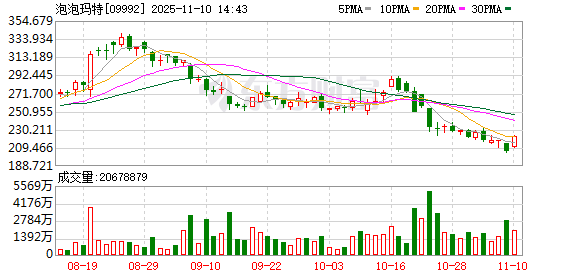
Core Viewpoint - Despite facing public scrutiny over the pricing of its products, the company's stock price remains strong, reflecting robust sales performance and growth potential in the collectible toy market [2][3]. Sales Performance - The company’s stock rose over 8% on November 10, closing at 221.2 HKD per share, with a total market capitalization of approximately 297 billion HKD [2]. - The DIMOO "New Diary" series blind box, priced at 79 RMB, sold out immediately after its release, with the hidden variant "Safety Sense" reaching a resale price of 819 RMB, a 7.3 times premium [2]. - Other recent product launches, such as the CRYBABY "Vacation Mode On" series and the "Delicious Moments" series, also saw significant demand, with resale prices increasing dramatically [3]. Revenue Growth - The company announced a projected revenue increase of 245%-250% for Q3 2025 compared to Q3 2024, with domestic revenue (including Hong Kong, Macau, and Taiwan) expected to grow by 185%-190% and overseas revenue by 365%-370% [3]. - Online sales are anticipated to grow by 300%-305%, while offline sales are expected to increase by 130%-135% [3]. Market Expansion and Strategy - Analysts from Huachuang Securities noted the company's strong growth reflects the long-term potential of its global expansion and IP ecosystem, with a diverse product matrix meeting market demand [4]. - Morgan Stanley expressed a positive outlook on the company's sales growth through 2026, highlighting the effective management of product lifecycle and customer retention strategies [4].
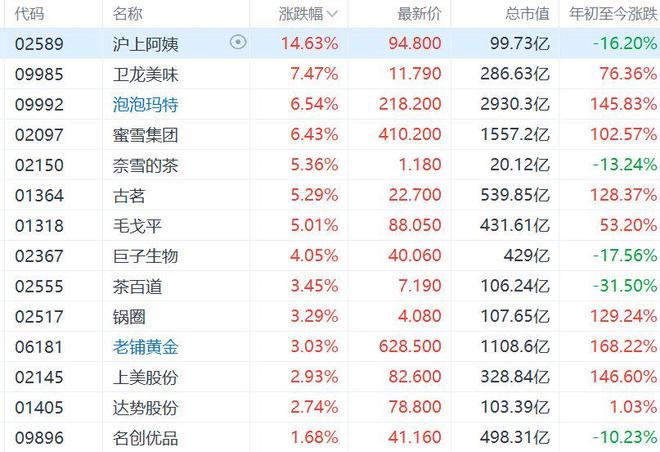
港股异动丨新消费概念股集体走强,卫龙美味涨超7%,蜜雪集团涨超6%
Ge Long Hui· 2025-11-10 04:11
Core Insights - The A-share market's consumer stocks have surged, positively impacting Hong Kong's new consumer concept stocks, with notable increases in various companies' stock prices [1] Group 1: Market Performance - Stocks such as "沪上阿姨" rose over 14%, "卫龙美味" increased over 7%, and "泡泡玛特" and "蜜雪集团" both saw gains exceeding 6% [1] - Other companies like "奈雪的茶," "古茗," and "毛戈平" experienced increases of over 5%, while "茶百道," "锅圈," and "老铺黄金" rose over 3% [1] Group 2: Economic Indicators - The National Bureau of Statistics released positive inflation data for October, indicating a 0.2% month-on-month and year-on-year increase in the Consumer Price Index (CPI), marking a shift from decline to growth [1] - The core CPI, excluding food and energy prices, rose by 1.2% year-on-year, with the growth rate expanding for the sixth consecutive month [1] Group 3: Government Policy - The Ministry of Finance plans to continue implementing measures to boost consumption, including providing financial subsidies for personal consumption loans in key sectors [1]