
Baosteel(600019)

Search documents
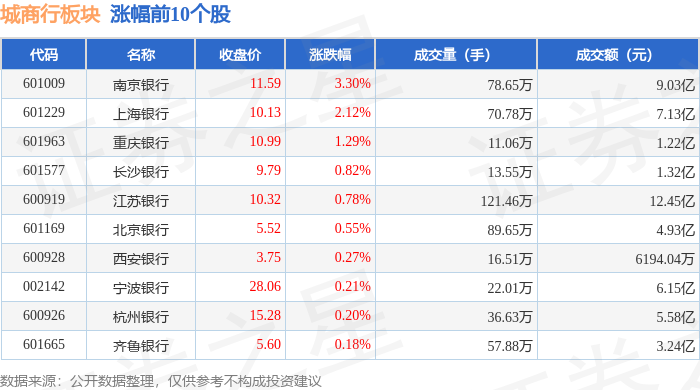
城商行板块12月29日涨0.79%,南京银行领涨,主力资金净流入7889.42万元
Zheng Xing Xing Ye Ri Bao· 2025-12-29 09:06
证券之星消息,12月29日城商行板块较上一交易日上涨0.79%,南京银行领涨。当日上证指数报收于 3965.28,上涨0.04%。深证成指报收于13537.1,下跌0.49%。城商行板块个股涨跌见下表: | 代码 | 名称 | 收盘价 | 涨跌幅 | 成交量(手) | 成交额(元) | | | --- | --- | --- | --- | --- | --- | --- | | 6000109 | 南京银行 | 11.59 | 3.30% | 78.65万 | | 9.03亿 | | 601229 | 上海银行 | 10.13 | 2.12% | 70.78万 | | 7.13亿 | | 601963 | 重庆银行 | 10.99 | 1.29% | 11.06万 | | 1.22亿 | | 601577 | 长沙银行 | 9.79 | 0.82% | 13.55万 | | 1.32亿 | | 616009 | 江苏银行 | 10.32 | 0.78% | 121.46万 | | 12.45 Z | | 601169 | 北京银行 | 5.52 | 0.55% | 89.65万 | | 4.93亿 | | ...







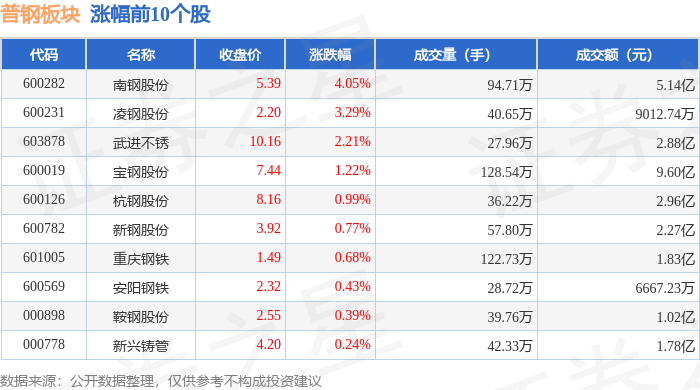
普钢板块12月29日涨0.61%,南钢股份领涨,主力资金净流出1.25亿元
Zheng Xing Xing Ye Ri Bao· 2025-12-29 08:58
Market Performance - The steel sector saw an increase of 0.61% on December 29, with Nanjing Steel leading the gains [1] - The Shanghai Composite Index closed at 3965.28, up 0.04%, while the Shenzhen Component Index closed at 13537.1, down 0.49% [1] Individual Stock Performance - Nanjing Steel (600282) closed at 5.39, up 4.05% with a trading volume of 947,100 shares and a transaction value of 514 million [1] - Ling Steel (600231) closed at 2.20, up 3.29% with a trading volume of 406,500 shares [1] - Wujin Stainless Steel (603878) closed at 10.16, up 2.21% with a trading volume of 279,600 shares [1] - Baosteel (600019) closed at 7.44, up 1.22% with a trading volume of 1,285,400 shares [1] - Other notable performances include Hangang (600126) up 0.99% and Xinguang Steel (600782) up 0.77% [1] Capital Flow Analysis - The steel sector experienced a net outflow of 125 million from main funds, while retail investors saw a net inflow of 102 million [2] - Speculative funds had a net inflow of 22.98 million [2] Detailed Capital Flow for Selected Stocks - Nanjing Steel (600282) had a main fund net outflow of 31.31 million, with retail investors contributing a net outflow of 41.04 million [3] - Shougang (000959) saw a main fund net inflow of 14.06 million, while retail investors had a net outflow of 11.25 million [3] - New Steel Pipe (000778) had a main fund net inflow of 7.50 million, with a retail net outflow of 8.54 million [3] - Ansteel (000898) reported a main fund net inflow of 5.83 million, while retail investors had a net outflow of 6.39 million [3]


钢铁行业点评:粗钢产量管控明确,行业利润预期改善
Shenwan Hongyuan Securities· 2025-12-28 13:29
Investment Rating - The report rates the steel industry as "Overweight," indicating a positive outlook for the sector compared to the overall market performance [2]. Core Insights - The report highlights that the Chinese government is committed to controlling crude steel production, which is expected to improve the supply-demand dynamics in the steel industry. The Ministry of Industry and Information Technology has emphasized the need to curb low-quality competition and regulate production capacity [2]. - In the first eleven months of 2025, China's crude steel production was 892 million tons, a decrease of 4.0% year-on-year, while steel product output increased by 4.0% to 1.333 billion tons. This suggests a shift in production focus and an anticipated improvement in the supply side of the market [2]. - The report notes that the commissioning of the Simandou iron ore mine is expected to contribute significantly to iron ore supply, which may lead to a decline in iron ore prices and reduce cost pressures on steel companies [2]. - Demand is expected to show structural differentiation, with resilient demand in the manufacturing sector supporting the profitability of plate and special steel segments, while the construction sector remains weak [2]. - The report suggests that as the steel consumption structure shifts from construction to manufacturing, investors should focus on undervalued, high-dividend stocks in the plate sector, such as Baosteel, Nanjing Steel, and Hualing Steel, as well as high-end stainless steel and special steel companies like Jiuli Special Materials and CITIC Special Steel [2]. Summary by Sections Production Control - The government has announced ongoing measures to control crude steel production and prevent the addition of new capacity, which is expected to optimize the supply side of the steel market [2]. Raw Material Supply - The Simandou iron ore mine has commenced production, with an expected annual capacity of 12 million tons, contributing to a more favorable pricing environment for iron ore [2]. Demand Dynamics - The report anticipates a divergence in demand, with manufacturing-related sectors showing resilience, while construction demand remains weak [2]. Investment Recommendations - The report recommends focusing on low-valuation, high-dividend stocks in the manufacturing-oriented steel sector and highlights the importance of special steel in emerging sectors like energy and defense [2].


——金属&新材料行业周报20251222-20251226:金属价格强势突破,看好春季行情-20251228
Shenwan Hongyuan Securities· 2025-12-28 07:50
信任命 2025 年 12 月 28 日 相关研究 证券分析师 郭中伟 A0230524120004 quozw@swsresearch.com 马焰明 A0230523090003 maym@swsresearch.com 陈松涛 A0230523090002 chenst@swsresearch.com 马昕晔 A0230511090002 maxy@swsresearch.com 联系人 郭中耀 A0230124070003 quozy@swsresearch.com 会属价格强势突破,看好春季行情 金属&新材料行业周报 20251222-20251226 本期投资提示: 我研究报 请务必仔细阅读正文之后的各项信息披露与声明 波段人分出品 申万宏源研究微信服务号 o 一周行情回顾:据 ifind,环比上周 1)上证指数上涨 1.88%,深证成指上涨 3.53%,沪深 300 上涨 1.95%,有色金属(申 万) 指数上涨 6.43%,跑赢沪深 300 指数 4.48 个百分点。2)分子板块看,环比上周,贵金属上涨 4.06%,铝上涨 6.33%, 能源金属上涨 6.66%,小金属上涨 6.16%,铜上涨 ...



2025上市公司碳排放排行榜暨双碳领导力榜
Cai Jing Wang· 2025-12-26 14:51
Core Insights - The total carbon emissions of the top 100 listed companies in China for 2024 are projected to be 5.134 billion tons, a decrease of 2.7 million tons compared to 2023, indicating a potential peak in emissions [1][6][11] - The disclosure rate of carbon emissions among these companies has increased from 43% in 2021 to an expected 80% by 2025, reflecting a growing awareness and commitment to carbon reduction [1][5][23] Group 1: Carbon Emissions Overview - The carbon emissions of the top 100 listed companies in 2024 are 5.134 billion tons, which is a 0.52% decrease from 5.161 billion tons in 2023 [6][11] - The top ten companies account for approximately 38% of the total emissions, highlighting the concentration of emissions among a few major players [2][6] - The threshold for inclusion in the carbon emissions ranking has decreased to 10.3128 million tons in 2024, down from 11.5329 million tons in 2023, indicating a reduction in emissions intensity among leading high-carbon companies [6][11] Group 2: Industry Emission Trends - The power industry remains the largest contributor to carbon emissions, accounting for approximately 2.29 billion tons in 2024, maintaining a significant share of the total emissions [15] - The cement industry follows with emissions of about 770 million tons, continuing a downward trend for four consecutive years [15] - The steel industry has seen a notable decrease in emissions, returning to levels close to those of 2022, with emissions around 580 million tons [15][18] Group 3: Carbon Efficiency Metrics - The average carbon efficiency of the top 100 companies in 2024 is 0.399 million yuan per ton, remaining stable compared to 0.40 million yuan per ton in 2023 [20][21] - The carbon efficiency has improved by 10.83% from 2021 to 2024, indicating a positive trend in decoupling economic output from carbon emissions [20] - Seven industries have shown improvements in carbon efficiency, with the chemical industry achieving the most significant increase, reaching 0.39 million yuan per ton, the highest in three years [20][21] Group 4: Disclosure and Transparency - In 2024, 80 companies disclosed their carbon emissions data, an increase from 65 in 2023, achieving the highest disclosure rate in four years [23] - The disclosure rate for the power industry is 77.42%, while the cement industry leads with 85.71%, consistently above the average [26] - A-share companies have seen a significant rise in disclosure rates, from 16.67% in 2021 to 70.97% in 2024, indicating improved transparency in carbon reporting [26][27]




钢铁行业今日涨1.34%,主力资金净流入1.86亿元
Zheng Quan Shi Bao Wang· 2025-12-26 09:11
Market Overview - The Shanghai Composite Index rose by 0.10% on December 26, with 19 out of the 28 sectors experiencing gains. The top-performing sectors were non-ferrous metals and electric equipment, with increases of 3.69% and 1.40% respectively. The steel sector ranked third in terms of gains [1] - The main funds in the two markets saw a net outflow of 23.284 billion yuan, with 8 sectors experiencing net inflows. The electric equipment sector led with a net inflow of 8.560 billion yuan, followed by the non-ferrous metals sector with a net inflow of 3.814 billion yuan [1] Steel Industry Performance - The steel sector increased by 1.34% today, with a net inflow of 186 million yuan. Out of 44 stocks in this sector, 34 rose, including one that hit the daily limit, while 8 declined [2] - The top stocks in terms of net inflow included Hainan Mining with 343 million yuan, Baosteel with 101 million yuan, and Dazhong Mining with 92.2 million yuan. Conversely, the stocks with the highest net outflows included Maanshan Steel, Taiyuan Iron & Steel, and Hesteel, with outflows of 76.525 million yuan, 75.162 million yuan, and 60.016 million yuan respectively [2][3] Steel Industry Fund Flow - The steel industry fund flow rankings showed Hainan Mining leading with a daily increase of 10.02% and a turnover rate of 4.56%, followed by Baosteel with a 2.37% increase and a turnover rate of 0.44% [2] - Other notable performers included Dazhong Mining with an 8.12% increase and a turnover rate of 2.84%, while stocks like Maanshan Steel and Taiyuan Iron & Steel experienced significant net outflows [3]

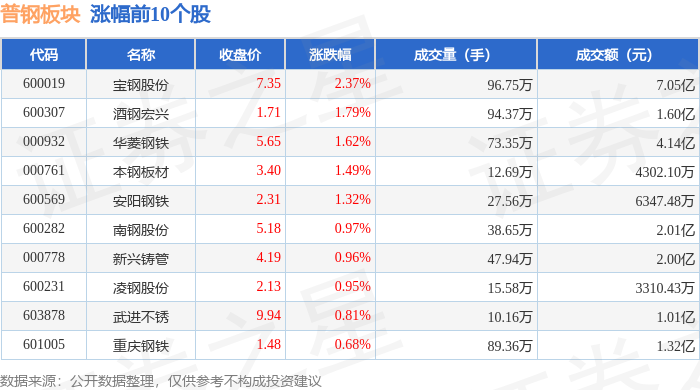
普钢板块12月26日涨1.07%,宝钢股份领涨,主力资金净流出1.56亿元
Zheng Xing Xing Ye Ri Bao· 2025-12-26 09:07
Market Performance - The steel sector saw an increase of 1.07% on December 26, with Baosteel leading the gains [1] - The Shanghai Composite Index closed at 3963.68, up 0.1%, while the Shenzhen Component Index closed at 13603.89, up 0.54% [1] Individual Stock Performance - Baosteel shares closed at 7.35, up 2.37%, with a trading volume of 967,500 shares and a transaction value of 705 million yuan [1] - Other notable performers included Jiugang Hongxing, which rose by 1.79% to 1.71, and Hualing Steel, which increased by 1.62% to 5.65 [1] - Conversely, Maanshan Steel saw a decline of 0.71% to 4.22, with a trading volume of 792,500 shares [2] Capital Flow Analysis - The steel sector experienced a net outflow of 156 million yuan from institutional investors and retail investors, while retail investors saw a net inflow of 312 million yuan [2] - Baosteel had a net inflow of 10 million yuan from institutional investors, but a net outflow of 48.7 million yuan from speculative funds [3] - The overall capital flow indicates a mixed sentiment among different investor types within the steel sector [2][3]



政策精准调控防内卷,龙头提质增效赢先机 | 投研报告
Sou Hu Cai Jing· 2025-12-26 02:55
Core Viewpoint - The steel industry is experiencing a tightening supply trend, with a projected decrease in crude steel production and an increase in exports, indicating a shift towards quality and structural improvements in production policies [1][2]. Supply Side - As of November 2025, the cumulative crude steel production in China reached 890 million tons, a year-on-year decrease of 4.04%, with a reduction of 3.8 million tons compared to the same period in 2025 [1]. - The current round of regulatory policies emphasizes innovative capacity governance, focusing on quality and structure rather than merely eliminating ineffective capacity or controlling production levels [1]. Demand Side - By October 2025, China's cumulative steel exports amounted to approximately 110 million tons, an increase of 13.29 million tons year-on-year, with net steel exports accounting for about 13% of crude steel production, nearing the pre-reform high of 15% in 2015 [2]. - Although the demand for construction steel is still declining, the rate of decline is narrowing, indicating that demand is approaching its bottom [2]. - Manufacturing steel demand is expected to remain stable, driven by sectors such as automotive, home appliances, and shipbuilding, along with increased demand from new infrastructure projects like wind power and photovoltaics [2]. Cost Side - Global iron ore demand is expected to decline, with China's industrial structure upgrades leading to reduced steel demand, while growth in other emerging markets is insufficient to offset this decline [3]. - In the first half of 2025, supply looseness has put downward pressure on coking coal prices, with price movements primarily driven by supply adjustments rather than strong demand growth [3]. - The price of scrap steel is expected to remain stable with limited fluctuations, continuing to exert pressure on upstream and downstream profits [3]. Investment Recommendations - The combination of supply-side production controls and more proactive fiscal policies is likely to enhance sector valuations [4]. - Demand for construction steel is stabilizing, while manufacturing steel demand is showing positive trends, with exports shifting towards higher quality and indirect models [4]. - The elimination of outdated capacity is expected to increase the concentration of leading enterprises, with a necessary trend towards high-quality product development [4]. - Recommended companies include industry leaders with product structure advantages such as Baosteel (600019.SH), Nanjing Steel (600282.SH), and Hualing Steel (000932.SZ), as well as special steel companies with high barriers and added value like CITIC Special Steel (000708.SZ), Jiuli Special Materials (002318.SZ), and Yongjin Co., Ltd. (603995.SH) [4].

视频丨近零碳钢铁是怎样炼成的?独家探访绿色钢铁“梦工厂”
Xin Lang Cai Jing· 2025-12-25 13:18
Core Viewpoint - The establishment of China's first million-ton near-zero carbon steel production line in Zhanjiang marks a significant breakthrough in the green and low-carbon development of the steel industry [1][3]. Group 1: Technological Advancements - The production line utilizes advanced hydrogen metallurgy and electric melting technology, replacing traditional coke with hydrogen, significantly reducing carbon emissions [3]. - Compared to traditional processes, this production line can achieve a carbon reduction of 50% to 80% [3]. - The hydrogen-based steelmaking technology transforms the high-energy consumption and pollution of traditional steelmaking methods into a greener and low-carbon process [3][6]. Group 2: Environmental Impact - The million-ton near-zero carbon steel production line can reduce carbon emissions by over 3.14 million tons annually, equivalent to creating 2,000 square kilometers of forest [5]. - The production process can eliminate 2,500 tons of CO2 emissions per day, making it the most environmentally friendly and lowest carbon steelmaking process currently available [6]. - The electric furnace used in the production can smelt 220 tons of steel at once, producing 80,000 amperes of current and reaching temperatures of up to 5,000°C, while reducing carbon emissions by over 80% compared to traditional methods [8]. Group 3: Industry Development - The "14th Five-Year Plan" is a critical period for the steel industry to achieve high-quality development, with green transformation becoming a prominent theme [11]. - The number of new green factories in the steel industry is increasing annually, with a total of 126 new green factories expected from 2021 to 2024 [13]. - Key enterprises in the steel industry have significantly reduced pollutant emissions, with SO2, particulate matter, and NOx emissions decreasing by 28%, 26.7%, and 36.5% respectively by the end of Q3 2025 compared to the end of 2021 [13]. Group 4: Resource Efficiency - Water resource utilization efficiency in the steel industry has improved, with the water consumption per ton of steel decreasing from 2.50 cubic meters in 2021 to 2.33 cubic meters in 2024, a reduction of 6.8% [15]. - The steel industry is expected to achieve a total energy saving of approximately 10.5 million tons of standard coal and a carbon reduction of about 27.5 million tons by 2024 [16].
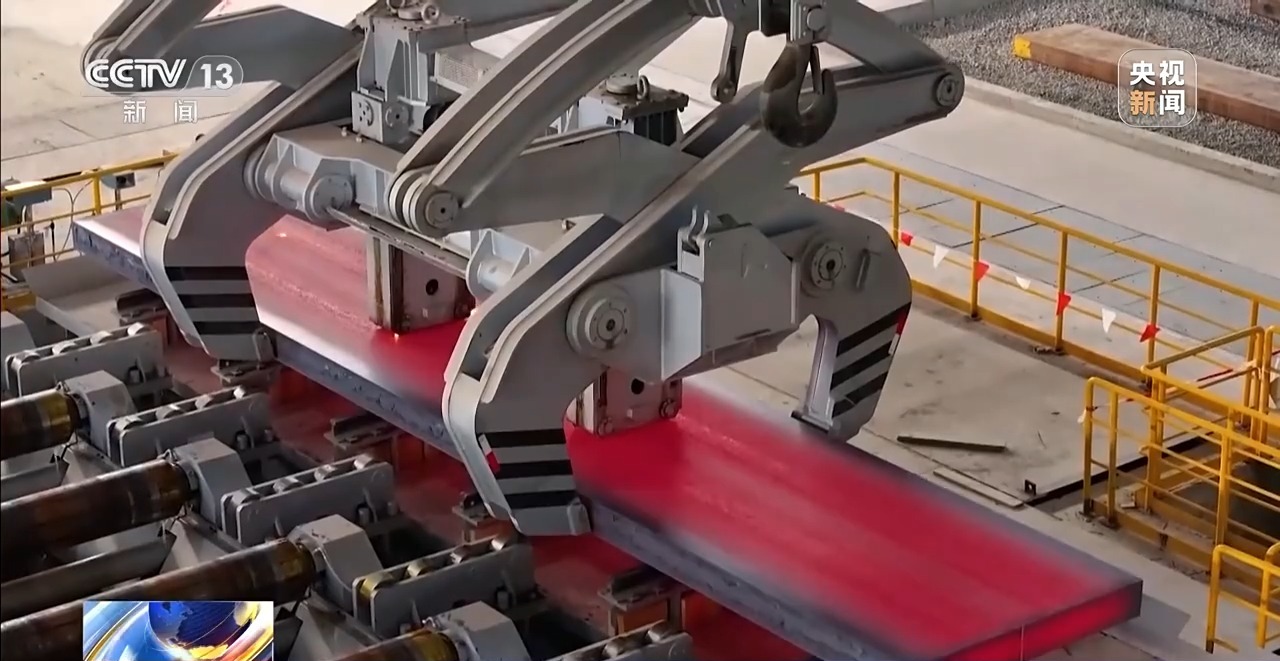
马钢股份:公司已完成钢铁主业资产权属变更并收到宝钢股份第二笔股权转让款
Zheng Quan Ri Bao Zhi Sheng· 2025-12-25 12:49
证券日报网讯 12月25日,马钢股份在互动平台回答投资者提问时表示,公司已完成将相关钢铁主业资 产增资注入至马钢有限涉及的经营资质转移、承接工作,基本完成资产权属变更转移手续。目前公司已 收到宝钢股份受让马钢有限股权的第二笔股权转让款。 (编辑 丛可心 袁冠琳) ...
