
Baosteel(600019)

Search documents
钢铁周报 20260104:铁矿补库预期增强,钢材出口短期承压-20260104
Minsheng Securities· 2026-01-04 05:35
Investment Rating - The report maintains a "Buy" rating for several key companies in the steel industry, including Hualing Steel, Baosteel, Nanjing Steel, and others, indicating a positive outlook for their performance in the coming years [2][4]. Core Insights - The expectation for iron ore replenishment has increased, while short-term steel exports are under pressure due to new regulations on low-value-added steel exports [8][30]. - Steel prices have seen a slight increase, with the price of 20mm HRB400 rebar reaching 3,320 CNY/ton, up 40 CNY/ton from the previous week [14][15]. - The overall steel production has slightly increased, with a total output of 8.15 million tons for major steel products, reflecting a week-on-week increase [8][30]. - The report highlights a decrease in steel profits, with average margins for rebar, hot-rolled, and cold-rolled steel showing a decline compared to the previous week [8][30]. Summary by Sections Domestic Steel Market - Domestic steel prices have risen, with specific increases noted in rebar and high-line steel prices [14][15]. - The report indicates stable prices for hot-rolled and cold-rolled steel, while medium plates have remained unchanged [14][15]. International Steel Market - U.S. and European steel prices have remained stable, with no significant changes reported in the last week [25][27]. Raw Materials and Shipping Market - Domestic iron ore prices are stable to slightly rising, while scrap steel prices have decreased [30][35]. - The report notes that the shipping market has seen a decline, impacting overall raw material costs [30]. Production Situation of Domestic Steel Mills - The production of major steel products has increased, with specific gains in rebar and plate production [8][30]. - Inventory levels have decreased, indicating a tightening supply in the market [8][30]. Profit Situation - The steel industry reported a profit of 1,115 billion CNY from January to November, showing a significant year-on-year increase [12][30]. - Monthly profits have shown a decreasing trend, indicating potential challenges ahead [12][30]. Key Steel Companies Valuation and Stock Performance - The report provides detailed earnings forecasts and valuations for key companies, all rated as "Buy" [2][4].


宝钢股份:拟对1900名员工进行股权激励!
Xin Lang Cai Jing· 2026-01-04 01:29
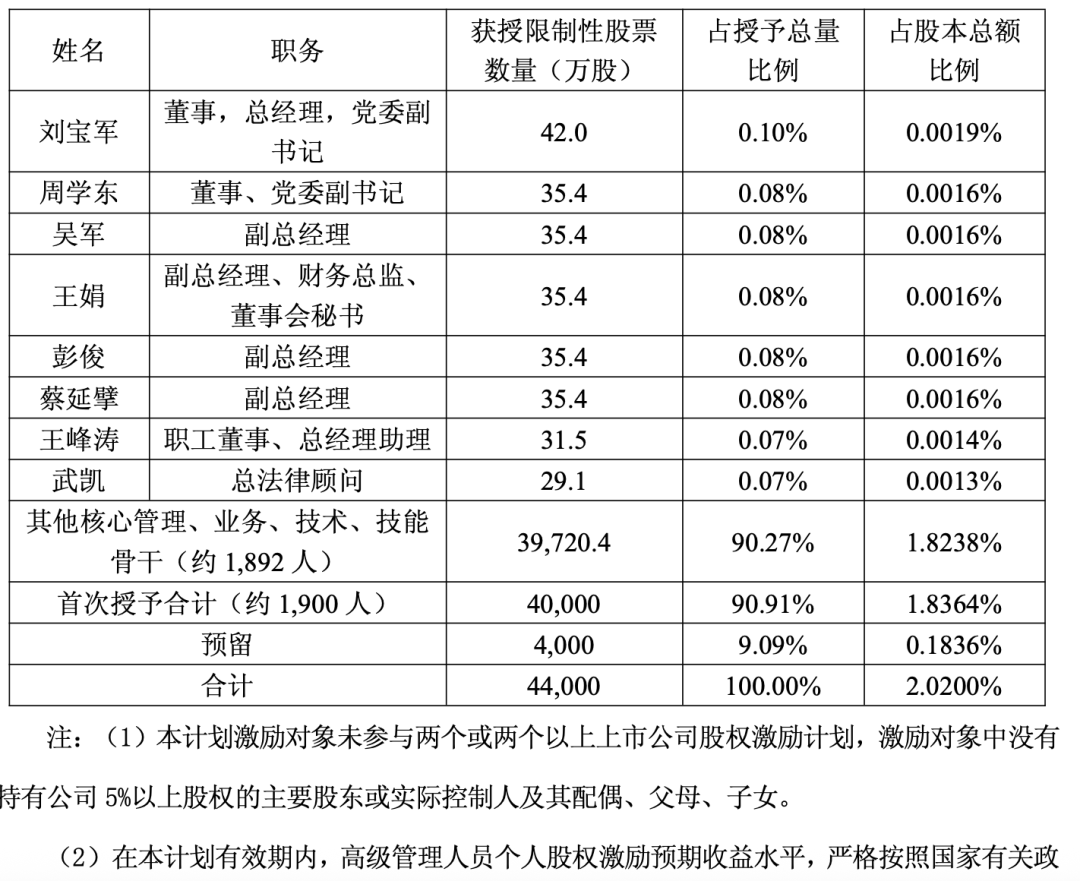
近日,宝钢股份公布第四期A股限制性股票计划,本计划拟授予的限制性股票总量不超过44,000万股,约占本计划草案公告时公司股本总额2,178,208.4749 万股的2.02%。本计划涉及的首次激励对象不超过1,900人,限制性股票的标的股票来源为公司从二级市场回购的宝钢股份A股普通股。依据本计划授予的 限制性股票(含预留)的授予价格为每股4.49元。 制定本激励计划的目的: 1.进一步完善公司治理结构, 建立健全持续、 稳定的激励约束机制, 为股东带来持续的回报; 2.构建股东、公司与员工之间的利益共同体,为股东带来持续的回报; 激励对象获授权益的分配情况: | 姓名 | 眼多 | 获授限制性股票 | 占授予总量 | 占股本总额 | | --- | --- | --- | --- | --- | | | | 数量(万股) | 比例 | 比例 | | 刘宝军 | 董事,总经理,党委副 | 42.0 | 0.10% | 0.0019% | | 书记 | | | | | | 周学东 | 董事、党委副书记 | 35.4 | 0.08% | 0.0016% | | 吴军 | 副总经理 | 35.4 | 0.08% | ...

钢铁行业:行业盈利修复提速,龙头优势凸显
Yin He Zheng Quan· 2025-12-30 13:13
Investment Rating - The report maintains a "Recommend" rating for the steel industry [1] Core Insights - The overall profitability of the steel industry is recovering rapidly, with effective cost control measures leading to significant improvements in profit margins [5][6] - In Q3 2025, the steel sector achieved record profits, with net profit margins increasing quarterly, indicating a sustainable recovery in profitability [7][10] - The recovery in profitability is broadening, with leading companies showing faster recovery rates compared to their peers, highlighting the advantages of scale and cost management [19][24] - Investment recommendations focus on companies with stable high dividends, those with high technical barriers, and upstream resource companies benefiting from improved supply dynamics [27] Summary by Sections 1. Industry Profitability Recovery and Cost Control - The profitability of the steel industry has shown significant improvement, with a total profit of 111.5 billion yuan from January to November 2025, a year-on-year increase of 1,752.2% [5] - The SW steel sector reported a net profit of 20.147 billion yuan in the first three quarters of 2025, marking a turnaround from losses in the previous year [5][6] 2. Record Profits in Q3 2025 - In Q3 2025, the steel sector generated revenue of 480.123 billion yuan, a slight year-on-year increase of 0.07%, while costs decreased by 4.42% [7][8] - The net profit for Q3 2025 reached 8.716 billion yuan, reflecting a 12.16% increase from the previous quarter and a significant recovery from losses in the same period last year [7][10] 3. Broadening Profit Recovery and Leading Companies - Leading steel companies like Baosteel and Shougang have demonstrated strong profit recovery, with Shougang's net profit increasing by 368.13% year-on-year [19][20] - The recovery in profitability is not limited to top firms; several smaller companies have also turned losses into profits, indicating a broad improvement across the sector [24] 4. Investment Recommendations - The report suggests focusing on companies with stable high dividends, such as CITIC Special Steel and Hualing Steel, as well as those with high technical barriers like Fangda Special Steel [27] - Upstream resource companies like Baotou Steel and Hainan Mining are also recommended due to expected improvements in supply dynamics [27]


普钢板块12月30日跌0.72%,武进不锈领跌,主力资金净流出1.19亿元
Zheng Xing Xing Ye Ri Bao· 2025-12-30 08:56
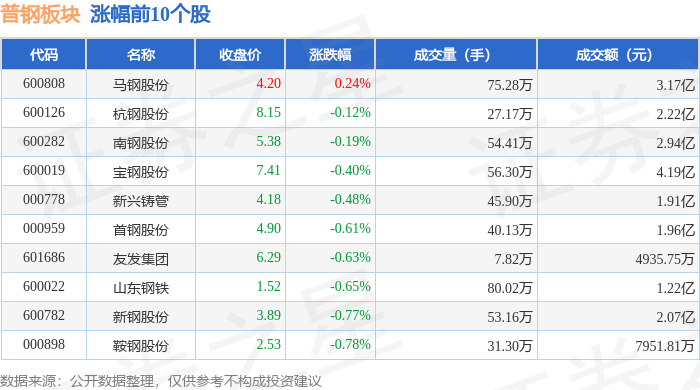
Market Overview - The steel sector experienced a decline of 0.72% on December 30, with Wujin Stainless Steel leading the drop [1] - The Shanghai Composite Index closed at 3965.12, showing no change, while the Shenzhen Component Index rose by 0.49% to 13604.07 [1] Individual Stock Performance - Major steel stocks showed varied performance, with Maanshan Iron & Steel slightly up by 0.24% at a closing price of 4.20, while Wujin Stainless Steel fell significantly by 8.86% to 9.26 [2] - Other notable declines included Angang Steel down by 0.78% to 2.53 and Shougang Corporation down by 0.61% to 4.90 [1][2] Trading Volume and Value - Maanshan Iron & Steel had a trading volume of 752,800 shares with a transaction value of 317 million yuan, while Wujin Stainless Steel had a volume of 339,700 shares and a value of 326 million yuan [1][2] - The overall steel sector saw a net outflow of 119 million yuan from main funds, while retail investors contributed a net inflow of 135 million yuan [2][3] Fund Flow Analysis - Key stocks like Hebei Steel and Baotou Steel saw net inflows from main funds of 16.26 million yuan and 12.10 million yuan respectively, while Wujin Stainless Steel experienced a net outflow of 22.06 million yuan from speculative funds [3] - Retail investors showed a preference for stocks like Baotou Steel, which had a net inflow of 24.11 million yuan, indicating a mixed sentiment in the market [3]


碳市场系列研究报告之六:转型金融助力高碳企业低碳发展
Shenwan Hongyuan Securities· 2025-12-30 05:30
Investment Rating - The report does not explicitly state an investment rating for the industry. Core Insights - Transition finance and green finance form an effective complementary structure, with transition finance targeting high carbon-emitting enterprises for their low-carbon transformation through technological upgrades, while green finance focuses on pure green projects [2][9]. - The international development of transition finance is driven by the EU carbon tax policy, entering a rapid development phase since 2023, with a historical progression through three stages: global consensus (2015-2019), framework establishment (2020-2022), and rapid development (2023-present) [2][14]. - China officially proposed the concept of "low-carbon transition" in 2024, with a series of supportive policies following, including the revision of the "Green Industry Guidance Catalog" to focus on low-carbon transition industries [2][17]. - The 14th Five-Year Plan shifts China's energy management from "dual control of energy consumption" to "dual control of carbon emissions," with an estimated demand for green low-carbon investment reaching 487 trillion yuan over the next 30 years, of which 60% is related to low-carbon transition [2][20]. - Mainstream international transition finance products include Sustainable Linked Loans (SLL), Sustainable Linked Bonds (SLB), and transition bonds, with SLL and SLB directly linking financing costs to sustainability goals [2][25]. Summary by Sections Transition Finance vs Green Finance - Transition finance supports high carbon-emitting projects for low-carbon transformation, while green finance supports energy-saving and emission-reducing projects [9][8]. International Development of Transition Finance - The development of international transition finance has progressed through three stages: consensus (2015-2019), framework establishment (2020-2022), and rapid development (2023-present) [14][10]. China's Transition Finance Development - China's transition bonds include transition bonds and low-carbon transition-linked bonds, with the latter dominating in issuance and financing amounts [3][50]. - The issuance of low-carbon transition-linked bonds reached 104, with a net financing amount of 572 billion yuan, while transition bonds totaled 32 with approximately 207 billion yuan [3][50]. - The main issuers of transition bonds have shifted from state-owned enterprises to local state-owned enterprises, with a corresponding decline in credit ratings from AAA to AA [3][72]. Mainstream Products in Transition Finance - The report identifies three main products in transition finance: transition bonds, SLL, and SLB, with specific characteristics and restrictions on fund usage [25][27]. - Transition bonds are specifically allocated for low-carbon transition projects, while SLL and SLB link financing costs to sustainability targets [25][27]. Advantages and Challenges of Transition Bonds - Despite higher costs, transition bonds offer advantages such as expedited review processes, potential government interest subsidies, and flexible interest rate adjustments linked to ESG goals [3][96][94]. - Transition bonds face challenges including higher issuance costs and a shift in issuer credit ratings, impacting their attractiveness compared to traditional corporate bonds [3][84][89].
宝钢股份(600019.SH):拟推第四期A股限制性股票计划
Ge Long Hui A P P· 2025-12-29 10:55
格隆汇12月29日丨宝钢股份(600019.SH)公布第四期A股限制性股票计划,本计划拟授予的限制性股票总 量不超过44,000万股,约占本计划草案公告时公司股本总额2,178,208.4749万股的2.02%。本计划涉及的 首次激励对象不超过1,900人,限制性股票的标的股票来源为公司从二级市场回购的宝钢股份A股普通 股。依据本计划授予的限制性股票(含预留)的授予价格为每股4.49元。 ...
宝钢股份:12月29日召开董事会会议
Mei Ri Jing Ji Xin Wen· 2025-12-29 10:28
每经AI快讯,宝钢股份(SH 600019,收盘价:7.44元)12月29日晚间发布公告称,公司第九届董事会 临时会议于2025年12月29日在上海召开。会议审议了《关于 <宝山钢铁股份有限公司第四期a股限制性 股票计划 草案="草案" 及其摘要="及其摘要"> 的议案》等文件。 (记者 王晓波) 截至发稿,宝钢股份市值为1621亿元。 每经头条(nbdtoutiao)——绕开光刻机"卡脖子",中国新型芯片问世!专访北大孙仲:支撑AI训练和 具身智能,可在28纳米及以上成熟工艺量产 2025年1至6月份,宝钢股份的营业收入构成为:加工配送占比100.99%,钢铁占比77.31%,其他行业占 比6.75%,内部抵销占比-85.04%。 ...
宝钢股份(600019) - 宝钢股份第四期A股限制性股票计划实施考核管理办法
2025-12-29 10:16
宝山钢铁股份有限公司 第四期 A 股限制性股票计划实施考核管理办法 一、考核目的 进一步完善公司法人治理结构,建立和完善公司激励约束机制,保证本计划 的顺利实施,并在最大程度上发挥股权激励的作用,进而保障公司发展战略和经 营目标的实现。 二、考核原则 (一)战略导向,目标分解。结合专业和业务管理逐级分解企业战略目标和 年度重点工作任务,并贯穿于专业管理和业务流程全过程,促进企业各项业务高 效运转,确保战略目标有效落实。 (二)注重实绩,科学量化。合理设置考核指标和评价标准,以实际工作业 绩为依据,按照规范的程序和科学的方法,公开、公平、公正地对绩效指标进行 量化评价。 (三)以人为本,强化激励。坚持公司利益与个人激励相结合、个人工作绩 效与公司组织绩效相结合。 三、考核范围 为保证宝山钢铁股份有限公司(以下简称"公司")第四期 A 股限制性股票 计划(以下简称"本计划")的顺利进行,进一步完善公司法人治理结构,形成 良好均衡的价值分配体系,激励公司核心员工诚信勤勉地开展工作,保障公司业 绩稳步提升,实现公司发展战略和经营目标,根据有关政策规定和公司实际,特 制定本办法。 本办法适用于公司本计划所确定的所有激励 ...
宝钢股份(600019) - 宝钢股份第四期A股限制性股票计划(草案)摘要公告
2025-12-29 10:15
证券代码:600019 证券简称:宝钢股份 公告编号:临 2025-063 宝山钢铁股份有限公司 第四期 A 股限制性股票计划(草案)摘要公告 本公司董事会及全体董事保证本公告内容不存在任何虚假记载、误导性陈述 或者重大遗漏,并对其内容的真实性、准确性和完整性承担法律责任。 重要内容提示: 股权激励方式 ☑ 第一类限制性股票 □股票期权 股份来源 □发行股份 ☑ 回购股份 □其他 本次股权激励计划有效期 72个月 本次股权激励计划拟授予的权益数量 440,000,000股(份) 本次股权激励计划拟授予的权益数量 占公司总股本比例 2.02% 本次股权激励计划是否有预留 ☑ 是,预留数量40,000,000股(份); 占本股权激励拟授予权益比例9.09% □否 本次股权激励计划拟首次授予的权益 数量 400,000,000股(份) 激励对象数量 1,900人 激励对象数量占员工总数比例 4.13% 激励对象范围 ☑ 董事 ☑ 高级管理人员 ☑ 核心技术或业务人员 ☑ 外籍员工 | | ☑ 其他,_核心技能人员_ | | --- | --- | | 授予价格/行权价格 | 4.49/股 | 一、公司基本情况 (一 ...
宝钢股份(600019) - 宝钢股份第四期A股限制性股票计划(草案)
2025-12-29 10:15
证券简称:宝钢股份 证券代码:600019 宝山钢铁股份有限公司 第四期 A 股限制性股票计划 (草案) 二零二五年十二月 声 明 本公司董事会及全体董事保证本公告内容不存在任何虚假记载、误导性陈 述或者重大遗漏,并对其内容的真实性、准确性和完整性依法承担法律责任。 特别提示 1.宝山钢铁股份有限公司(以下简称"宝钢股份"或"公司")第四期A股限制 性股票计划(以下简称"本计划")依据《中华人民共和国公司法》(以下简称"《公 司法》")、《中华人民共和国证券法》、《上市公司股权激励管理办法》(以 下简称"《管理办法》")、《国有控股上市公司(境内)实施股权激励试行办 法》(国资发分配〔2006〕175号)、《关于规范国有控股上市公司实施股权激 励制度有关问题的通知》(国资发分配〔2008〕171号)、《中央企业控股上市 公司实施股权激励工作指引》(国资考分〔2020〕178号)(以下简称"《指引》") 和《宝山钢铁股份有限公司章程》以及其他有关法律、法规、规章和规范性文 件的规定制定。 2.公司不存在《管理办法》第七条及《指引》规定的不得实行股权激励的 情形。 3.本计划激励对象不存在《管理办法》第八条及《指 ...