
Hisense V.T.(600060)

Search documents
AI电视大战,谁抢先吃到了红利?
创业邦· 2025-05-01 10:05
Core Viewpoint - The television industry, traditionally a mature market, is experiencing a resurgence driven by AI integration, with major players like Hisense and TCL leveraging AI to enhance user experience and operational efficiency [6][7]. Group 1: Industry Overview - The television industry has evolved from price wars in hardware to a focus on software and content monetization, and now to AI-driven value creation [7]. - Major companies are reporting positive financial results for 2024, with Hisense achieving over 46.6 billion yuan in TV revenue and TCL's revenue reaching 99.32 billion HKD, a 25.7% year-on-year increase [8]. - The recovery in performance is attributed to a shift towards high-end and large-screen products, moving away from price competition to enhance product value [9]. Group 2: AI Integration and Impact - AI is reshaping the television landscape, with companies like Coolpad transitioning to AI-native enterprises and expanding into various sectors beyond traditional TV [10][13]. - The AI wave has enabled new business models for system service providers, shifting from software sales to service-oriented offerings, enhancing user engagement and ecosystem development [14]. - Traditional TV manufacturers are focusing on AI to improve user interaction and increase TV usage rates, as daily active users have significantly declined [15][16]. Group 3: Technological Advancements - Current AI applications in the television sector focus on three main areas: display quality, user interaction, and connectivity [17]. - In the display domain, advancements include AI-driven enhancements in picture and sound quality, with companies like Samsung and Hisense leading the charge with new AI chips [18][19]. - The competition in user interaction is characterized by different strategies, with some companies adopting a centralized approach while others emphasize integration with smart home ecosystems [20].

买过百吋电视的人都在喊“后悔买晚”?用过才知道多香!
Sou Hu Wang· 2025-04-30 07:06
Core Viewpoint - The recent popularity of large-screen televisions, particularly 100-inch models, is driven by their immersive viewing experience and advanced technology, making them a preferred choice for both entertainment and gaming. Group 1: Market Trends - The Haier TV brand has become synonymous with large-screen televisions, with one in every two 100-inch TVs sold globally being a Haier product, indicating its market leadership [9][10]. - The trend towards larger screens is supported by consumer testimonials on social media platforms, emphasizing the regret of not purchasing larger models sooner [1][3]. Group 2: Technological Advancements - The integration of AI quality chips in 100-inch TVs enhances image clarity and depth, comparable to IMAX screens, while also providing features that protect users' eyes [3][8]. - High refresh rates of up to 330Hz in gaming TVs eliminate lag and tearing, significantly improving the gaming experience for users [5]. Group 3: Consumer Experience - Families with children report that large screens reduce eye strain compared to smaller devices, making them a safer option for viewing content [3][7]. - The smart features of 100-inch TVs allow for voice-activated commands, making them user-friendly for all age groups, including children and the elderly [7][8]. Group 4: Product Offerings - Haier offers a diverse range of over 50 models of 100-inch TVs, catering to various consumer preferences and needs, from aesthetics to performance [9][10]. - Current promotional activities include significant discounts and incentives, such as government subsidies and extended service options, encouraging consumers to invest in large-screen TVs [10].

2025年全球电视出货量预估1.96亿台,年减0.7%
WitsView睿智显示· 2025-04-30 06:34
以下文章来源于TrendForce集邦 ,作者TrendForce TrendForce集邦 . TrendForce集邦咨询是一家全球高科技产业研究机构,研究领域横跨存储器、AI服务器、集成电路与半 导体、晶圆代工、显示面板、LED、AR/VR、新能源(含太阳能光伏、储能和电池)、AI机器人及汽车 科技等,提供前瞻性行业研究报告、产业分析 根据TrendForce集邦咨询最新调查,受美国对等关税政策影响,电视品牌业者2025年下半年可能间 接转嫁上涨的成本至零售价,从而抑制消费动能。此外,2024年下半年中国市场的以旧换新政策 提前释放部分需求,预估2025年全球电视出货量将年减0.7%,仅剩1亿9,644万台。 品牌提前备货,1Q25电视出货量年增6.1% 观察三星电子、LG电子、TCL、海信等四大电视品牌出货动态,因应对美国计划提高商品进口关 税,且最初拟针对墨西哥提高至25%,品牌业者于2024年底开始提高北美地区出货量,进入2025 年第一季淡季力道仍然强劲,出货量达4,559万台,年增6.1%,四大品牌在美国渠道商的库存水位 也较平均增加三至四周。 关税带动1H25出货,下半年旺季面临不确定性 2 ...

面向中国的Mini LED电视出货量增至2倍
日经中文网· 2025-04-30 06:10
Core Viewpoint - The demand for Mini LED TVs is rapidly increasing in China, driven by government subsidy policies and a significant rise in shipments, which are expected to impact global pricing and market dynamics [2][6][9]. Group 1: Market Dynamics - Mini LED TVs have a global market share of 3% as of 2024, while traditional LCD TVs dominate at 94% [6]. - The average price of a 55-inch Mini LED TV is $901, positioned between LCD TVs at $501 and OLED TVs at $1,317 [6]. - In the last quarter of 2024, shipments of Mini LED TVs to China reached 2.02 million units, a 2.3-fold increase compared to the previous quarter, accounting for 65% of global shipments [6][9]. Group 2: Government Policies and Consumer Behavior - China's subsidy policy for replacing old appliances has significantly boosted the sales of Mini LED TVs, with subsidies ranging from 15% to 20% of the purchase price [6][9]. - Larger screen sizes, such as 85-inch and 98-inch TVs, receive higher subsidies, leading to increased sales and potential supply shortages for certain components [7]. Group 3: Competitive Landscape - Prior to 2023, the Mini LED TV market was largely dominated by Samsung, but Chinese companies like TCL and Hisense have rapidly gained market share, reaching 25% and 24% respectively in 2024, surpassing Samsung's 20% [9]. - Sony is increasing its supply of Mini LED TVs in Japan, with plans to boost production significantly, while reducing OLED TV supply [13]. Group 4: Pricing Trends - The price of 98-inch Mini LED TVs has decreased by 49% year-on-year, dropping to $3,374 in the last quarter of 2024, indicating a trend of declining prices in the segment [11][12]. - The shift towards larger TVs is leading to a commoditization of the market, with expectations of continued price reductions [12].
AI电视大战,谁抢先吃到了红利?
3 6 Ke· 2025-04-30 03:24
Core Viewpoint - The television industry, traditionally a mature market, is experiencing a resurgence due to the integration of AI technologies, with major players like Hisense and TCL leveraging AI to enhance their product offerings and financial performance [2][3][4]. Group 1: AI's Impact on Financial Performance - Major television manufacturers have reported positive financial results for 2024, with Hisense achieving over 46.6 billion yuan in television revenue and TCL's revenue reaching 99.32 billion HKD, a year-on-year increase of 25.7% [2][3]. - The recovery in performance is attributed more to strategic shifts towards high-end and large-screen products rather than AI alone, as companies focus on upgrading product structures to avoid price wars [3][4]. Group 2: Role of System Service Providers - System service providers, such as Coocaa, have capitalized on the AI trend, quickly commercializing AI applications across various sectors, including telecommunications and automotive [6][8]. - Coocaa's transition to an "AI-native enterprise" has allowed it to develop new products and services, leveraging its extensive data accumulated from diverse verticals [6][7]. Group 3: AI Television Development - The integration of AI in televisions is not a new concept, but the industry faces challenges such as declining daily active users, prompting manufacturers to enhance user interaction through AI [9][10]. - Key areas of focus for AI television include improvements in display quality, user interaction, and connectivity with smart home devices [10][11]. Group 4: Competitive Landscape - The competition in AI television is intensifying, with companies like Samsung and Hisense adopting different strategies; Samsung emphasizes integration with its IoT ecosystem, while Hisense focuses on developing centralized AI assistants [13][14]. - The competition is still in its early stages, and success will depend on how well companies can articulate their AI narratives and engage users [15].
银河证券晨会报告-20250430
Yin He Zheng Quan· 2025-04-30 02:40
Key Insights on Fixed Income Market - The bond market experienced a significant decline followed by a period of consolidation, with the 10-year government bond yield decreasing by 15 basis points to 1.66% in April [2][3] - The supply of government bonds is expected to peak in May, with net supply projected to reach around 1.9 trillion yuan, comparable to levels seen in August of the previous year [3][4] - The central bank is likely to maintain a supportive stance on liquidity, with potential reverse repos and MLF net injections to counterbalance the impact of increased bond issuance [4][7] Key Insights on Artificial Intelligence Industry - The Central Political Bureau emphasized the importance of self-reliance and application-driven development in AI, marking a shift towards a focus on ecological construction and rule-setting in AI development [9][10] - The AI industry is expected to enter a golden window for commercialization from 2025 to 2030, with significant opportunities in various applications such as AIoT and embodied intelligence [10][11] - Key areas of focus include enhancing basic research, fostering collaboration between academia and industry, and strengthening the regulatory framework to prevent blind development in the AI sector [11] Key Insights on Pharmaceutical Industry - The pharmaceutical sector is witnessing a recovery in holdings, with public fund allocations increasing as the market stabilizes, particularly in innovative drugs and medical devices [16][19] - The introduction of a new insurance payment model is expected to stimulate the development of innovative drugs, with the first version of the Class B drug list focusing on high-innovation products [17][19] - The medical device procurement market is experiencing significant growth, with a year-on-year increase of 67.49% in Q1 2025, driven by domestic demand and the rise of local brands [18][19] Key Insights on Semiconductor Industry - The company reported a record high in revenue and net profit for 2024, with a 27.69% year-on-year increase in revenue to 7.356 billion yuan and a staggering 584.21% increase in net profit [22][23] - The growth is attributed to the strong performance of storage chips, with a gross margin of 40.27% and a focus on expanding into high-growth markets such as AI terminals and automotive electronics [23][24] - The company is strategically positioned to benefit from the acceleration of AI applications, with plans to enhance its product offerings in the storage chip sector [25] Key Insights on Food Industry - The company demonstrated resilience with a 10.3% year-on-year increase in revenue to 600 million yuan in Q1 2025, despite a challenging market environment [28][29] - The strong performance of major product lines, particularly fish and bean products, contributed to revenue growth, supported by improved channel partnerships [28][30] - The company is focusing on brand development and product innovation to enhance its market position and drive long-term growth [30]




海信视像(600060):一季报业绩表现亮眼,全球化布局优势凸显
CMS· 2025-04-29 08:34
Investment Rating - The report maintains a "Strong Buy" investment rating for Hisense Visual Technology [4] Core Views - The company's Q1 2025 performance is impressive, with revenue of 13.4 billion yuan, a year-on-year increase of 5%, and a net profit attributable to shareholders of 554 million yuan, up 19% year-on-year [1] - Hisense's global layout advantages are highlighted, particularly its production capacity in Mexico, which exceeds 8 million units, effectively covering U.S. demand [8] - The report forecasts revenue growth for 2025-2027 at 14%, 11%, and 10% respectively, with net profit growth of 12%, 10%, and 9% [8] Financial Data and Valuation - Total revenue is projected to reach 66.784 billion yuan in 2025, with a year-on-year growth of 14% [3] - The estimated net profit for 2025 is 2.512 billion yuan, reflecting a 12% increase year-on-year [3] - The report indicates a PE ratio of 12 times for 2025, decreasing to 10.1 times by 2027 [3] Market Position and Competitive Advantage - Hisense's market share in the domestic TV market has improved, with a 28.2% online sales market share and over 32% in offline sales [8] - The company benefits from government subsidies that enhance the sales of energy-efficient products, with significant improvements in market share for these products [8] - The report emphasizes Hisense's ability to mitigate risks from U.S. tariffs due to its diversified manufacturing locations [8]
海信视像(600060):一季度稳步增长 全球供应链应对关税风险
Xin Lang Cai Jing· 2025-04-29 06:28
Core Viewpoint - The company reported a steady growth in its Q1 2025 financial results, with revenue and net profit showing positive year-on-year changes, despite a slowdown in growth rates compared to the previous quarter [1][2]. Financial Performance - Q1 2025 revenue reached 13.375 billion yuan, an increase of 5.31% year-on-year [1]. - The net profit attributable to shareholders was 554 million yuan, reflecting an 18.61% increase year-on-year [1]. - Gross margin for Q1 2025 was 15.9%, showing a slight improvement [2]. - The net profit margin for Q1 2025 was 4.7%, up 0.2 percentage points year-on-year, indicating a strong historical performance [2]. - Operating cash flow was 1.214 billion yuan, with cash collections exceeding profits [2]. - The company's cash and trading financial assets totaled 15.9 billion yuan, approximately 50% of its market capitalization [2]. Market Dynamics - The domestic market for televisions has seen improved competition, with a decrease in demand elasticity due to the long-term continuation of the old-for-new subsidy [1]. - In Q1 2025, the retail sales volume of televisions in China was 6.91 million units, a decrease of 2.2% year-on-year, while retail sales revenue was 26.4 billion yuan, an increase of 3.4% [1]. - The company's strategic partnerships, such as with XREAL for AI glasses, indicate a focus on technological advancements [1]. Global Market Position - Chinese television brands, including Hisense and TCL, have been increasing their global market share since 2016, with Hisense holding a 13.95% market share in 2024, up 0.99 percentage points year-on-year [3]. - Despite uncertainties from U.S. tariff policies, the overall industry trend remains positive, with opportunities arising from competitors' focus on OLED technology [3]. Investment Outlook - The company’s performance aligns with expectations, with revenue forecasts for 2025-2027 projected at 63.968 billion, 69.674 billion, and 75.944 billion yuan, respectively [3]. - Expected net profits for the same period are 2.576 billion, 2.990 billion, and 3.424 billion yuan, with corresponding earnings per share (EPS) of 1.97, 2.29, and 2.62 yuan [3]. - The price-to-earnings (PE) ratios are projected to be 12.5, 10.8, and 9.4 times for the years 2025, 2026, and 2027, respectively, maintaining a "recommended" rating [3].
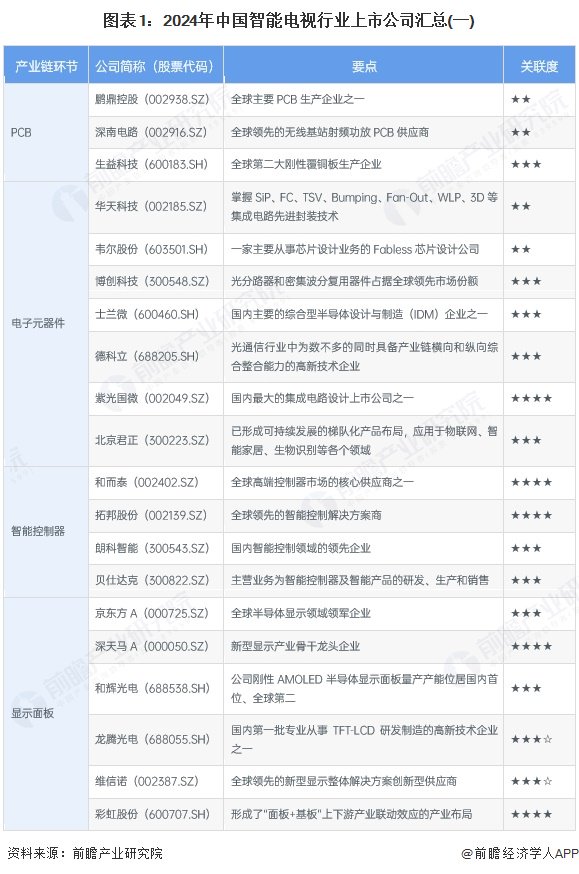
【最全】2025年智能电视行业上市公司全方位对比(附业务布局汇总、业绩对比、业务规划等)
Qian Zhan Wang· 2025-04-29 06:08
Industry Overview - The rise of smart TVs has revitalized the television market, integrating traditional functions with internet connectivity for multimedia playback, app downloads, and online interaction, making smart TVs a crucial link between home entertainment and the internet [1] - The number of listed companies in China's smart TV industry is significant, primarily distributed across the upstream and midstream of the industry chain [1] Company Summaries - Major listed companies in the smart TV sector include TCL Technology (000100.SZ), Hisense Visual (600060.SH), Haier Smart Home (600690.SH), Skyworth Digital (000810.SZ), Shenzhen Konka (000016.SZ), Sichuan Changhong (600839.SH), and Xiaomi Group (1810.HK) [1][2] - TCL Technology and Xiaomi Group reported substantial revenues from their smart TV businesses, with TCL generating 498.77 billion and Xiaomi 471.34 billion in the first half of 2024 [17] - Haier Smart Home leads in gross margin for smart TV business at 30.61% in the first half of 2024 [17] Financial Performance - The financial performance of listed companies in the smart TV industry shows a diverse range of revenues, with TCL Technology leading in revenue generation [4][5] - The revenue figures for the first half of 2024 for key companies include: - TCL Technology: 498.77 billion - Hisense Visual: 201.46 billion - Haier Smart Home: 1356.23 billion - Xiaomi Group: 1643.95 billion [17] Business Layout and Strategy - Most companies have a high proportion of their business focused on smart TVs, with Hisense Visual and Skyworth Digital exceeding 70% [15] - Companies are expanding their overseas markets, with Hisense Visual, Haier Smart Home, and Xiaomi Group having over 45% of their business from international markets [15] - Companies are focusing on consolidating their existing product advantages, increasing R&D investment, and embracing artificial intelligence in their business strategies [18] Competitive Landscape - The competitive landscape shows that TCL Technology and Xiaomi Group are significant players in terms of revenue, while Haier Smart Home has the highest gross margin [17] - Companies are leveraging technological innovations and market expansion strategies to enhance their competitive positions [18] Key Metrics and Rankings - TCL Technology has the highest registered capital among listed companies at approximately 1.88 billion [9] - Haier Smart Home has the largest employee count at 112,458 [11] - The number of bidding information is highest for Hisense Visual and Sichuan Changhong, each exceeding 1,000 entries [8]



海信视像(600060):业绩符合预期,盈利改善逻辑持续
ZHESHANG SECURITIES· 2025-04-29 04:32
Investment Rating - The report maintains a "Buy" rating for Hisense Visual Technology [5] Core Views - The company's Q1 2025 performance met expectations, with revenue of 13.375 billion yuan, a year-on-year increase of 5.31%, and a net profit of 554 million yuan, up 18.61% year-on-year [1] - The continuation of national subsidies and the growth of the TV industry, particularly in the MiniLED segment, is expected to drive further growth [2] - The company's profit growth is significantly outpacing revenue growth, indicating improved profit elasticity due to product structure upgrades [3] - Hisense has accelerated new product launches in 2025, which are anticipated to enhance sales during peak seasons [4] Financial Summary - Revenue projections for 2025-2027 are 63.932 billion yuan, 69.907 billion yuan, and 76.940 billion yuan, with corresponding growth rates of 9%, 9%, and 10% [5] - Expected net profits for the same period are 2.583 billion yuan, 2.876 billion yuan, and 3.167 billion yuan, with growth rates of 15%, 11%, and 10% [5] - The report provides a detailed financial forecast, including earnings per share (EPS) estimates of 1.98 yuan, 2.20 yuan, and 2.43 yuan for 2025, 2026, and 2027 respectively [7]