CNRE(600111)

Search documents
宏观预期转暖,战略金属领衔金属全面上行
Changjiang Securities· 2025-07-27 14:38
Investment Rating - The industry investment rating is "Positive" and maintained [8] Core Views - The macroeconomic outlook is improving, leading to a comprehensive rise in metal prices, particularly strategic metals [2][4] - The report emphasizes the importance of strategic metals and bottom energy metal allocation opportunities, highlighting the revaluation of rare earths and tungsten [4] - The report suggests that the domestic growth stabilization and anti-involution policies are enhancing expectations, which is driving up domestic commodity prices [5][6] Summary by Sections Strategic Metals - Strategic metals such as rare earths and tungsten are experiencing a revaluation, with significant price increases expected due to government focus and international supply chain developments [4] - The price of rare earth concentrate has increased to 19,100 CNY/ton, reflecting a 1.5% increase [4] - Tungsten prices are also on the rise, supported by strong supply dynamics and improving company performance [4] Energy Metals - The report indicates a high probability of short-term price increases for cobalt, with a significant drop in imports noted [4] - Cobalt intermediate imports in June fell to 18,991 tons, a decrease of 61.6% month-on-month [4] - Nickel prices are expected to stabilize, with long-term price expectations likely to rise [4] Lithium - The report notes a bottoming out of lithium prices, with recent regulatory changes indicating stricter domestic mining controls [4] - The price of battery-grade lithium carbonate has rebounded by 15.2% to 76 CNY/kg [24] - The report suggests monitoring potential resource releases in the lithium sector [4] Precious Metals - Gold prices are fluctuating due to improved risk appetite and easing trade tensions, with a recommendation to increase allocation to precious metal stocks [4][6] - The report highlights that gold stocks have underperformed, suggesting a strategic buying opportunity [4] - Silver is noted for its potential upside, with a recommendation to consider silver stocks for recovery [4] Industrial Metals - The report indicates that industrial metals are experiencing mixed performance, with domestic prices leading international trends [5][6] - Copper prices on the SHFE increased by 1.1%, while aluminum prices rose by 1.2% [5] - The report emphasizes the importance of monitoring macroeconomic policies and their impact on metal demand [6]





供给收缩预期叠加反内卷催化,碳酸锂波动率放大
Tianfeng Securities· 2025-07-27 11:15
Investment Rating - Industry rating: Outperform the market (maintained rating) [8] Core Views - The significant increase in lithium carbonate prices is primarily driven by supply contraction expectations and a rapid price correction due to regulatory actions against non-compliant mining practices [1] - Copper prices have shown a mixed performance, with market sentiment supporting price increases, but demand remains weak, limiting upward momentum [2][15] - Aluminum prices have risen due to external market influences and domestic production adjustments, although concerns about future demand in the photovoltaic sector persist [3][24] - Precious metals, particularly gold and silver, have seen price increases driven by heightened risk aversion amid global trade uncertainties [4][30] - Tungsten prices have increased across the board, supported by resource scarcity and cautious market activity [5][63] - The rare earth sector is experiencing a recovery in fundamentals, with significant price increases for light and heavy rare earth elements [6][41] Summary by Sections Base Metals & Precious Metals - Copper: Prices have fluctuated, with a recent increase to 78,710 CNY/ton, but market demand remains weak, leading to cautious trading [2][15] - Aluminum: Prices rose to 20,630 CNY/ton, driven by external market trends and domestic production recovery, despite concerns in the photovoltaic sector [3][24] - Precious Metals: Gold averaged 780.69 CNY/gram, up 0.83%, and silver at 9,291 CNY/kg, up 2.02%, influenced by global trade tensions [4][30] Minor Metals - Lithium: Prices for lithium carbonate have stabilized, with market sentiment remaining cautious amid steady production [41][42] - Cobalt: Prices have increased slightly, but demand remains weak, leading to limited trading activity [43][44] - Tin: Prices have risen to 34,750 USD/ton, supported by supply-side reforms and low inventory levels [53][54] - Tungsten: Prices have increased due to resource scarcity, with black tungsten averaging 186,500 CNY/ton [5][63] - Molybdenum: Prices have shown a mixed trend, with recent increases due to supply disruptions and market optimism [68][69] Rare Earths - The rare earth market is witnessing a significant recovery, with prices for light rare earths like praseodymium-neodymium oxide rising to 514,000 CNY/ton [6][41]



有色钢铁行业周思考(2025年第29周):战略金属板块的行情还能延续吗
Orient Securities· 2025-07-27 01:45
Investment Rating - The report maintains a "Positive" investment rating for the non-ferrous and steel industry [5] Core Viewpoints - The report argues that the value reassessment of the strategic metals sector has just begun, contrary to some investors' belief that the recent rapid price increases indicate an impending peak [8][14] - It highlights three dimensions supporting this view: policy measures against strategic mineral smuggling, a tight supply-demand balance driving product prices up, and an increase in risk appetite due to political policy risk premiums [8][14][17] Summary by Sections Strategic Metals - Some investors believe the recent surge in strategic metals prices is unsustainable and may soon peak [8][13] - The report counters this by stating that the value reassessment of strategic metals is just beginning, driven by macroeconomic inflation, tight supply-demand dynamics, and political risk premiums [14][17] - Policy measures to combat strategic mineral smuggling are expected to be reinforced, particularly for rare earths and other strategic metals [15] - The supply-demand balance remains tight, with increasing demand from sectors like new energy vehicles and offshore wind power, leading to rising prices for rare earths [16] - Political policy risk premiums are expected to rise, enhancing the attractiveness of the strategic metals sector [17] Steel Industry - Steel prices are anticipated to continue rising due to production cut expectations [18] - Steel demand and production have decreased, but a dynamic balance in supply and demand is expected [18][25] - Inventory levels are showing differentiation among various steel products, with total inventory likely to decline further [25] - Cost increases in raw materials are pushing steel prices up, with profits for steel mills expected to recover [28] - The overall steel price index has seen a slight increase, with specific products like hot-rolled steel showing notable price rises [35] New Energy Metals - Lithium production in June 2025 saw a significant year-on-year increase of 20.95%, indicating strong supply growth [40] - The demand for new energy vehicles remains robust, with production and sales in June 2025 showing substantial growth [44] - Prices for lithium and cobalt have generally risen, while nickel prices have seen a decline [49][50] Industrial Metals - Global refined copper production has increased, with supply slightly better than expected [57] - The demand outlook is improving, with manufacturing activity expected to continue recovering [69]
融资客出手!12股获大手笔净买入
Sou Hu Cai Jing· 2025-07-25 23:38
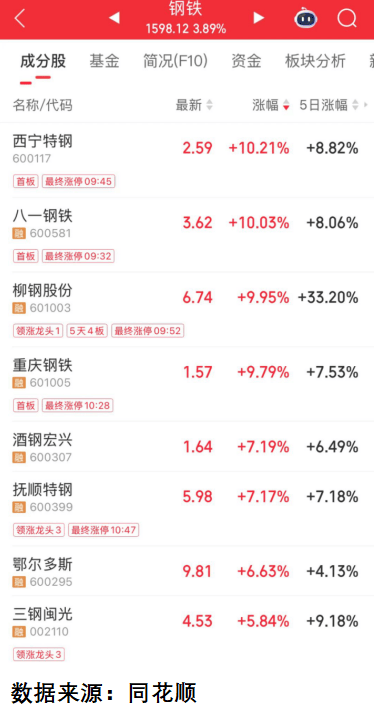
Market Overview - The A-share market is experiencing a surge, with sectors like robotics and steel showing significant performance, highlighted by 12 stocks receiving over 100 million yuan in net purchases from financing clients, led by Northern Rare Earth with 380 million yuan [1][4] - The Shanghai Composite Index has surpassed 3400 points, with a trading volume increase and a stock rise-to-fall ratio of 2.57:1, although less than 50% of stocks have risen over 6% [3] Market Illusions - Four major illusions in the bull market are identified: 1. The "waiting for a rise" illusion, where investors believe their stocks will soon increase in value 2. The "hot and cold" illusion, where rapid rotation of hot stocks leads to losses for those who chase them 3. The "rise and fall" illusion, where the index rises but individual stocks do not 4. The "high and low" illusion, where low-priced stocks are perceived as safe while high-priced stocks are seen as risky [5][10] Fund Dynamics - The 12 stocks favored by financing clients include Northern Rare Earth (380 million yuan), New Yi Sheng (281 million yuan), and Hainan Huate (163 million yuan), indicating significant fund dynamics at play [4][10] - The concept of "funding competition" is discussed, where aggressive buying often leads to subsequent adjustments, creating opportunities for informed investors [7][9] Institutional Research - A total of 194 companies were subject to institutional research, with New Yi Sheng attracting the most attention; however, not all intensive research leads to positive outcomes [10] - The distinction between "genuine research" and "fake research" is crucial, as some companies are investigated due to stock price fluctuations rather than genuine interest from institutions [10] Data Utilization - The importance of using quantitative data to navigate the market is emphasized, as it can reveal underlying trends and intentions that are not immediately apparent to average investors [11][12]


主力动向:7月25日特大单净流出291.93亿元
Zheng Quan Shi Bao Wang· 2025-07-25 09:04
Market Overview - The two markets experienced a significant net outflow of 29.193 billion yuan, with 1,766 stocks seeing net inflows and 3,075 stocks experiencing net outflows [1] - The Shanghai Composite Index closed down by 0.33% [1] Industry Performance - Four industries saw net inflows from large orders, with the computer industry leading at a net inflow of 3.266 billion yuan and an index increase of 1.26% [1] - The electronics sector followed with a net inflow of 2.556 billion yuan and an increase of 1.37% [1] - Other industries with net inflows included media and real estate [1] - In contrast, 27 industries experienced net outflows, with the non-ferrous metals sector seeing the largest outflow of 5.087 billion yuan [1] - The power equipment sector had a net outflow of 3.628 billion yuan, followed by construction decoration and machinery equipment [1] Individual Stock Performance - 23 stocks had net inflows exceeding 200 million yuan, with Cambricon Technologies leading at 886 million yuan [2] - Zhangjiang Hi-Tech had a net inflow of 824 million yuan, ranking second [2] - Other notable stocks with significant inflows included Yanshan Technology, Haiguang Information, and Western Securities [2] - On the outflow side, Northern Rare Earth saw the largest net outflow of 1.974 billion yuan, followed by China Power Construction and Baosteel with outflows of 1.767 billion yuan and 1.634 billion yuan respectively [2] Stock Price Movements - Stocks with net inflows exceeding 200 million yuan averaged a rise of 7.01%, outperforming the Shanghai Composite Index [2] - Notable stocks that hit the daily limit up included Ashi Innovation and InnoCare [2] - The sectors with the highest concentration of stocks with significant net inflows were electronics, computers, and media, with 6, 6, and 3 stocks respectively [2] Detailed Stock Data Top Net Inflows | Code | Name | Closing Price (Yuan) | Change (%) | Net Inflow (Billion Yuan) | Industry | | --- | --- | --- | --- | --- | --- | | 688256 | Cambricon Technologies | 673.30 | 12.17 | 0.886 | Electronics | | 600895 | Zhangjiang Hi-Tech | 30.58 | 10.00 | 0.824 | Real Estate | | 002195 | Yanshan Technology | 5.88 | 4.44 | 0.462 | Computer | | 688041 | Haiguang Information | 141.49 | 3.50 | 0.439 | Electronics | | 002673 | Western Securities | 8.78 | 6.04 | 0.420 | Non-Banking Finance | [2][3] Top Net Outflows | Code | Name | Closing Price (Yuan) | Change (%) | Net Outflow (Billion Yuan) | Industry | | --- | --- | --- | --- | --- | --- | | 600111 | Northern Rare Earth | 38.25 | 0.29 | -1.974 | Non-Ferrous Metals | | 601669 | China Power Construction | 7.22 | -3.09 | -1.767 | Construction Decoration | | 600010 | Baosteel | 2.47 | -1.98 | -1.634 | Steel | | 600326 | Tibet Tianlu | 15.43 | 9.98 | -1.205 | Building Materials | | 002594 | BYD | 337.93 | -1.40 | -1.047 | Automotive | [4]


7月25日主力资金流向日报
Zheng Quan Shi Bao Wang· 2025-07-25 08:55
Market Overview - On July 25, the Shanghai Composite Index fell by 0.33%, the Shenzhen Component Index decreased by 0.22%, the ChiNext Index dropped by 0.23%, and the CSI 300 Index declined by 0.53% [1] - Among the tradable A-shares, 2,533 stocks rose, accounting for 46.85%, while 2,726 stocks fell [1] Capital Flow - The main capital saw a net outflow of 49.376 billion yuan throughout the day [1] - The ChiNext experienced a net outflow of 10.343 billion yuan, while the STAR Market had a net outflow of 0.819 billion yuan [1] - The CSI 300 constituent stocks faced a net outflow of 17.168 billion yuan [1] Industry Performance - Among the 1st-level industries classified by Shenwan, 9 sectors rose, with the electronics and computer sectors leading with increases of 1.37% and 1.26%, respectively [1] - The construction decoration and building materials sectors had the largest declines, with decreases of 2.06% and 1.69% [1] Industry Capital Inflow and Outflow - Four industries saw net inflows, with the computer sector leading at a net inflow of 2.924 billion yuan and a rise of 1.26% [1] - The electronics sector followed with a net inflow of 2.348 billion yuan and a rise of 1.37% [1] - The non-ferrous metals sector had the largest net outflow, with a decrease of 0.23% and a net outflow of 6.911 billion yuan [1] - The power equipment sector also faced significant outflows, with a decline of 0.84% and a net outflow of 5.773 billion yuan [1] Individual Stock Performance - A total of 1,816 stocks experienced net inflows, with 675 stocks having inflows exceeding 10 million yuan [2] - The stock with the highest net inflow was Cambrian, which rose by 12.17% with a net inflow of 836 million yuan [2] - The stocks with the largest net outflows included China Power Construction, Tibet Tianlu, and Northern Rare Earth, with net outflows of 2.377 billion yuan, 2.112 billion yuan, and 1.917 billion yuan, respectively [2]


个股上涨、下跌家数基本相当
第一财经· 2025-07-25 08:29
Core Viewpoint - The A-share market experienced a collective pullback on July 25, with the Shanghai Composite Index down by 0.33%, the Shenzhen Component down by 0.22%, and the ChiNext Index down by 0.23%. However, the Sci-Tech Innovation 50 Index saw an increase of over 2% in the afternoon session [1]. Market Performance - The Shanghai Composite Index closed at 3593.66, down by 12.07 points or 0.33% [2]. - The Shenzhen Component closed at 11168.14, down by 24.92 points or 0.22% [2]. - The ChiNext Index closed at 2340.06, down by 5.31 points or 0.23% [2]. - The total trading volume in the Shanghai and Shenzhen markets was 1.79 trillion, a decrease of 574 billion compared to the previous trading day [2]. Sector Performance - The Hainan Free Trade Zone sector experienced a pullback, while major infrastructure, diversified finance, liquor, and coal sectors weakened [4]. - The semiconductor sector showed strength in the afternoon, with stocks like Aishi Chuang hitting the daily limit, and companies such as Cambrian, Saiwei Microelectronics, and Aojie Technology rising over 10% [5]. - Water conservancy concept stocks collectively adjusted, with several stocks like Deep Water Planning Institute and Huaxin Cement hitting the daily limit down [6]. Capital Flow - Main capital saw a net inflow into sectors such as semiconductors, media, and biomedicine, while there was a net outflow from shipbuilding and paper printing sectors [8]. - Specific stocks with net inflows included Cambrian (8.27 billion), Zhangjiang Hi-Tech (6.88 billion), and Haiguang Information (5.22 billion) [9]. - Stocks facing net outflows included China Power Construction (24.24 billion), Northern Rare Earth (18.83 billion), and Tibet Tianlu (16.21 billion) [10]. Institutional Perspectives - Shenwan Hongyuan noted that the market's upward trend remains intact without any changes [12]. - Guojin Securities highlighted that recent index movements showed a clear rise in both price and volume, with a focus on individual stocks rather than indices [12]. - Dexun Securities pointed out that while the A-share index has been steadily rising, it faces significant technical resistance above 3600 points, indicating potential short-term volatility [13].

沪深两市今日成交额合计17873.37亿元,北方稀土成交额居首
news flash· 2025-07-25 07:03
Summary of Key Points Market Overview - The total trading volume of the Shanghai and Shenzhen stock markets on July 25 was 17,873.37 billion yuan, a decrease of 573.69 billion yuan compared to the previous day [1] - The Shanghai Stock Exchange had a trading volume of 8,216.1 billion yuan, down from 8,522.4 billion yuan on the previous trading day [1] - The Shenzhen Stock Exchange recorded a trading volume of 9,657.27 billion yuan, compared to 9,924.66 billion yuan the day before [1] Trading Volume Details - The trading volume for the Shanghai market was 697 million shares, a decline from 773 million shares in the previous session [1] - The Shenzhen market's trading volume was 724 million shares, slightly down from 742 million shares the previous day [1] Top Performing Stocks - Northern Rare Earth had the highest trading volume at 15.606 billion yuan [1] - China Power Construction, Dongfang Wealth, Tibet Tianlu, and Baogang Group followed with trading volumes of 15.576 billion yuan, 11.391 billion yuan, 9.337 billion yuan, and 8.386 billion yuan respectively [1]
主力资金监控:张江高科净买入超5亿
news flash· 2025-07-25 06:22
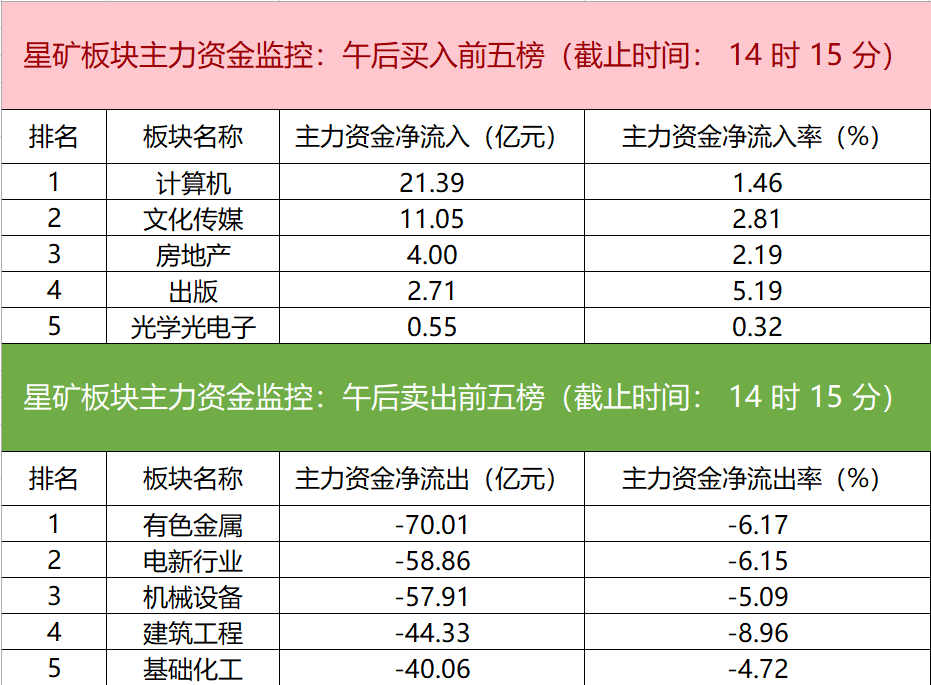
Group 1: Market Overview - Main capital inflow was observed in the computer, cultural media, and real estate sectors, while significant outflows occurred in the non-ferrous metals, electric new energy, and machinery equipment sectors [1] - The non-ferrous metals sector experienced a net outflow exceeding 7 billion [1] Group 2: Capital Inflow by Sector - The computer sector led with a net inflow of 21.39 billion, representing a 1.46% inflow rate [2] - Cultural media followed with a net inflow of 11.05 billion, with an inflow rate of 2.81% [2] - Real estate sector recorded a net inflow of 4 billion, with a 2.19% inflow rate [2] Group 3: Capital Outflow by Sector - The non-ferrous metals sector had the highest net outflow of 70.01 billion, with a -6.17% outflow rate [3] - The electric new energy sector saw a net outflow of 58.86 billion, with a -6.15% outflow rate [3] - Machinery equipment sector experienced a net outflow of 57.91 billion, with a -5.09% outflow rate [3] Group 4: Top Stocks by Capital Inflow - Zhangjiang Hi-Tech topped the list with a net inflow of 5.73 billion, reflecting a 15.70% inflow rate [4] - Cambricon Technologies-U followed closely with a net inflow of 5.37 billion, at an 11.94% inflow rate [4] - Western Securities recorded a net inflow of 5.08 billion, with a 15.14% inflow rate [4] Group 5: Top Stocks by Capital Outflow - China Power Construction faced the largest net outflow of 22.34 billion, with a -16.55% outflow rate [5] - Tibet Tianlu had a net outflow of 19.07 billion, reflecting a -22.08% outflow rate [5] - Northern Rare Earth experienced a net outflow of 17.50 billion, with a -13.21% outflow rate [5]


近4天获得连续资金净流入,稀土ETF嘉实(516150)规模创近1年新高!
Xin Lang Cai Jing· 2025-07-25 05:58
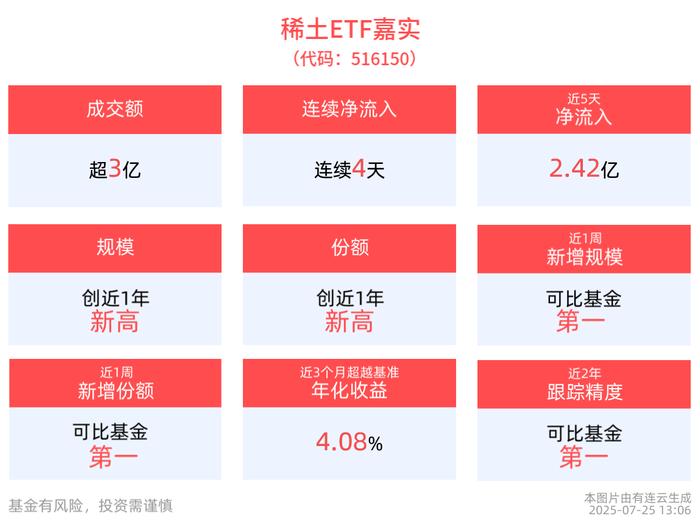
Core Viewpoint - The rare earth industry is experiencing fluctuations in stock performance, with notable gains in some companies while others face declines. The rare earth ETF has shown significant growth over the past week and year, indicating strong investor interest and market dynamics [1][4]. Group 1: Market Performance - As of July 25, 2025, the China Rare Earth Industry Index fell by 1.02%, with component stocks showing mixed results. Zhenghai Magnetic Materials led with a 5.39% increase, while Huahong Technology saw the largest decline [1]. - The rare earth ETF, Jiashi (516150), has adjusted and solidified, with a 13.43% increase over the past week as of July 24, 2025 [1]. - The Jiashi rare earth ETF recorded a turnover of 8.36% and a transaction volume of 305 million yuan, leading comparable funds in both metrics [4]. Group 2: Fund Performance - The Jiashi rare earth ETF reached a new high in scale at 3.657 billion yuan and in shares at 2.545 billion, ranking first among comparable funds [4]. - The fund has seen continuous net inflows over the past four days, with a peak single-day net inflow of 151 million yuan, totaling 401 million yuan [4]. - Over the past year, the Jiashi rare earth ETF's net value increased by 79.96%, ranking 75th out of 2940 index stock funds, placing it in the top 2.55% [4]. Group 3: Company Performance - Several companies in the rare earth sector have released mid-year performance forecasts, with North Rare Earth expecting a 1882.54% year-on-year increase in net profit to 2.01471 billion yuan [5]. - China Rare Earth anticipates a net profit of 136 to 176 million yuan, marking a turnaround from losses [5]. - Ningbo Yunsheng expects a 133.55% increase in net profit, while Jinli Permanent Magnet forecasts a 151% to 180% year-on-year increase [5]. Group 4: Industry Demand - The demand for rare earth magnetic materials is growing, particularly in emerging applications such as low-altitude economy and intelligent manufacturing, which are driving the need for high-end permanent magnet materials [6]. - The electric vehicle sector remains a major demand area for permanent magnet motors, with the Ministry of Commerce accelerating the approval of export applications for rare earth magnetic material companies, potentially expanding downstream demand [6].