Hengrui Pharma(600276)

Search documents
港股概念追踪 | 医保商保“双目录”出炉!多款创新药获纳入 行业望延续强劲发展势头(附概念股)
智通财经网· 2025-12-07 23:24
Core Insights - The National Healthcare Security Administration (NHSA) has officially announced the latest version of the National Basic Medical Insurance, Maternity Insurance, and Work Injury Insurance Drug Catalog, which includes 114 new drugs and 19 drugs in the first version of the Commercial Health Insurance Innovative Drug Catalog, effective from January 1, 2026 [1][2][3] Industry Summary - The NHSA has adjusted the drug catalog for the eighth time since its establishment, with a total of 949 new drugs added over the years, and the medical insurance fund has spent over 4.6 trillion RMB on negotiated drugs, driving sales exceeding 6 trillion RMB [1][2] - The new catalog includes 50 first-class innovative drugs, with an overall success rate of 88%, significantly higher than the 76% in 2024 [3] - The inclusion of drugs for major diseases such as triple-negative breast cancer, pancreatic cancer, and lung cancer, as well as rare diseases and chronic conditions, addresses gaps in basic medical insurance coverage [2][3] Company-Specific Updates - Green Leaf Pharmaceutical has successfully included five new products in the NHSA's drug catalog, including MiMeiXin® and ZhanBiJia® [4] - Fuhong Hanlin announced that its product Fuzhuoning® has been included in the NHSA's drug catalog for specific indications [5] - Junshi Biosciences reported that its products Tuoyi® and Junshida® have been successfully included in the NHSA's drug catalog [6] - Innovent Biologics has successfully added seven innovative products to the new NHSA drug catalog, including Daboru® and Xindimian® [6]

重磅利好!15家A股公司,集体公告
Zheng Quan Shi Bao· 2025-12-07 22:47
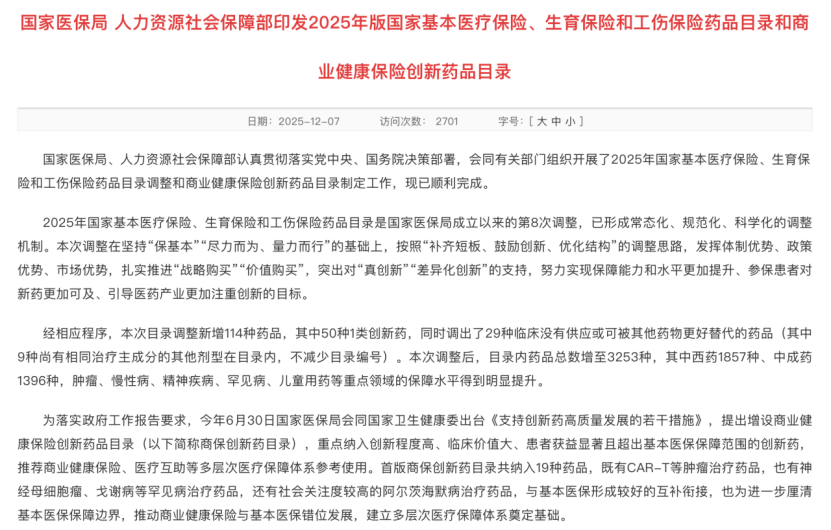
Core Points - The National Healthcare Security Administration announced the 2025 National Medical Insurance Drug List, which will take effect on January 1, 2026, adding 114 new drugs, including 50 innovative drugs, while removing 29 drugs that are either unavailable or can be replaced by better alternatives [2][4] Group 1: Drug List Adjustments - The total number of drugs in the directory has increased to 3,253, comprising 1,857 Western medicines and 1,396 traditional Chinese medicines, with significant improvements in coverage for key areas such as cancer, chronic diseases, mental illnesses, rare diseases, and pediatric medications [2][4] - The 2025 adjustment marks the 8th update since the establishment of the National Healthcare Security Administration [7] Group 2: Company Announcements - 15 A-share pharmaceutical companies announced that their products have been included in the new directory, with many innovative drug companies benefiting from this inclusion [4] - Zai Lab's drug, Jikaxitinib, has been included in the directory, which is expected to enhance sales and improve patient accessibility [4] - Junshi Biosciences reported that its products, including Toripalimab and an additional indication for another drug, have been successfully included in the directory [4] - Innovent Biologics' drug, IBI301, has also been added to the new directory, marking a significant milestone for the company [5] - Leading A-share pharmaceutical companies like Fosun Pharma, East China Pharmaceutical, and Heng Rui Medicine have also had several products included, with Heng Rui reporting a combined sales figure of approximately 8.66 billion yuan for the newly added drugs in 2024 [6][7]



江苏恒瑞医药股份有限公司 关于公司药品纳入国家医保目录的公告
Zhong Guo Zheng Quan Bao - Zhong Zheng Wang· 2025-12-07 22:40
Core Points - The company has successfully included several of its products in the National Medical Insurance Catalog for 2025, which is expected to enhance sales and improve operational performance [1] - The total estimated sales for the included drugs in 2024 is approximately 8.66 billion yuan, and for the first three quarters of 2025, it is about 7.55 billion yuan [1] Drug Inclusion in National Medical Insurance Catalog - The following drugs have been newly included: - Injection of Rukang Qutuzumab - Apixaban Famitinib Capsules - Injection of Funaqi Zhumab - Sulfate of Amatuximab Tablets - Injection of Phosphorola Pitant Palonosetron - Injection of Ruikasi Zhumab - Acetate of Abiraterone Tablets (II) - Lipid Injection of Irinotecan Hydrochloride (II) - Regaglitin Metformin Tablets (I)/(II) - Perfluorohexyl Octane Eye Drops [1] - The following drugs have successfully added new indications: - Injection of Karelizumab - Fluorazepam Capsules - Injection of Fumaric Acid Tegafur [1] - The following drugs have been renewed and retained in the National Medical Insurance Catalog: - Maleate of Pyrotinib Tablets - Hecorapam Ethanolamine Tablets - Phosphate of Regaglitin Tablets - Injection of Methylsulfonylmethane Remazolam - Sulfate of Pevonedistat Injection [1] - The following drugs have new indications and have been adjusted to regular catalog management: - Mesylate of Apatinib Tablets - Lipid Injection of Bupivacaine [1] Impact on the Company - The inclusion of these drugs in the National Medical Insurance Catalog is expected to positively impact sales, although the exact effect on the company's operational performance is currently indeterminate [1] - The National Medical Insurance Catalog will officially take effect on January 1, 2026, with further details on payment standards and reimbursement rules to be announced by relevant government departments [1]
江苏恒瑞医药股份有限公司关于公司药品纳入国家医保目录的公告
Shang Hai Zheng Quan Bao· 2025-12-07 18:39
Core Viewpoint - Jiangsu Hengrui Medicine Co., Ltd. has announced that several of its products have been included in the National Medical Insurance Directory, which is expected to positively impact sales and overall business performance in the future [1][2]. Group 1: Inclusion of Products in National Medical Insurance Directory - The following products have been newly included in the National Medical Insurance Directory: injection of Rukang Qutuzumab, Apixaban Famitinib capsules, injection of Funaqi Qutuzumab, Sulfate Amamxetine tablets, injection of Phosphororapitant Palonosetron, injection of Ruikasi monoclonal antibody, Acetate Abiraterone tablets (II), Liposomal Irinotecan injection (II), and Regaglitin Metformin tablets (I)/(II), as well as Perfluorohexyl Octane eye drops [2]. - Additional indications for injection of Karilizumab, Fluorouracil capsules, and injection of Fumagillin have successfully been added to the National Medical Insurance Directory [2]. - The renewal of the following products has been successfully retained in the National Medical Insurance Directory: Maleate Pyrrolidine tablets, Hecorapam Ethanolamine tablets, Phosphate Regaglitin tablets, injection of Toluene Sulfonate Remazolam, and Sulfate Pevotizumab injection [2]. Group 2: Financial Impact - The total sales of the aforementioned products for the year 2024 are estimated to be approximately 8.66 billion yuan, while the sales for the first three quarters of 2025 are projected to be around 7.55 billion yuan [2]. - The inclusion of these products in the National Medical Insurance Directory is expected to facilitate sales, although the exact impact on the company's operating performance cannot be estimated at this time [2].
利好!15家A股公司,集体公告!
证券时报· 2025-12-07 14:35
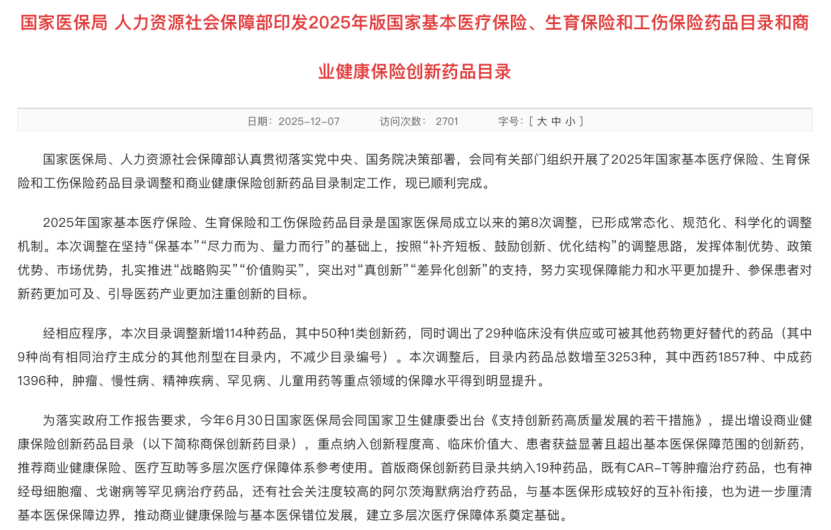
Core Viewpoint - The 2025 National Medical Insurance Drug List has been announced, including 114 new drugs, with a focus on innovative drugs and significant improvements in coverage for key areas such as oncology and chronic diseases [4][9]. Group 1: Drug List Adjustments - The 2025 National Medical Insurance Drug List will be implemented on January 1, 2026, with a total of 3,253 drugs, including 1,857 Western medicines and 1,396 traditional Chinese medicines [4]. - The list includes 50 first-class innovative drugs and removes 29 drugs that are either not clinically available or can be replaced by better alternatives [4]. Group 2: Impact on A-Share Companies - 15 A-share pharmaceutical companies announced that their products were included in the new drug list, particularly benefiting innovative drug companies [6]. - Zai Lab's drug, Jikaxitinib, was included, which is used for treating specific types of myelofibrosis, enhancing its market accessibility and sales potential [6]. - Junshi Biosciences reported that its products, including Toripalimab and Oncorine, were added to the list, with all four of its commercialized products now covered [6]. Group 3: Major Pharmaceutical Companies - Leading A-share pharmaceutical companies like Fosun Pharma, Hengrui Medicine, and others have also had products included in the new list, with Hengrui having 10 drugs added and several others with new indications [7]. - Hengrui's drugs are projected to generate approximately 8.66 billion yuan in sales for 2024 and about 7.55 billion yuan for the first three quarters of 2025 [8]. Group 4: Complementary Innovations - In addition to the basic medical insurance list, 19 drugs have been added to the first version of the commercial insurance innovative drug list, including treatments for rare diseases and Alzheimer's, providing a complementary framework to the basic insurance [9].



A股利好!15家公司,集体公告
Zhong Guo Ji Jin Bao· 2025-12-07 14:32
Core Viewpoint - The 2025 National Medical Insurance Drug List has been released, adding 114 new drugs, including 50 innovative drugs, while removing 29 drugs that are no longer clinically available or can be replaced by better alternatives [2][5]. Group 1: New Additions to the Drug List - A total of 15 A-share pharmaceutical companies announced that their products have been included in the new drug list, particularly benefiting many innovative drug companies [5]. - Zai Lab's drug, Jikaxitinib, has been included in the National Medical Insurance Drug List, which is expected to enhance sales and improve patient accessibility [5][6]. - Junshi Biosciences has added two new indications for its drug, Toripalimab, and successfully included another drug, Oncorine, in the Class B category of the National Medical Insurance List [5]. Group 2: Impact on Major Pharmaceutical Companies - Leading A-share pharmaceutical companies such as Fosun Pharma, East China Pharmaceutical, and Hengrui Medicine have also had products included in the National Medical Insurance List [7]. - Hengrui Medicine has 10 drugs newly added to the list, with a total sales revenue of approximately 8.66 billion yuan in 2024 and about 7.55 billion yuan in the first three quarters of 2025 [8]. - The inclusion of these drugs in the National Medical Insurance List is expected to positively impact sales, although the exact effect on operating performance is currently uncertain [8]. Group 3: Overall Changes in the Drug List - The total number of drugs in the National Medical Insurance Drug List has increased to 3,253, with significant improvements in coverage for key areas such as cancer, chronic diseases, mental illnesses, rare diseases, and pediatric medications [2]. - This adjustment marks the 8th update since the establishment of the National Medical Insurance Bureau, indicating ongoing efforts to enhance drug accessibility and affordability [8].
A股利好!15家公司,集体公告
中国基金报· 2025-12-07 14:22
Core Viewpoint - The 2025 National Medical Insurance Drug List has been released, including 114 new drugs, with a focus on innovative drugs and significant improvements in coverage for key areas such as cancer, chronic diseases, and rare diseases [4][5][10]. Group 1: New Drug Inclusion - A total of 15 A-share pharmaceutical companies announced that their products have been included in the new drug list, particularly benefiting innovative drug companies [7]. - Zai Lab's drug, Jikaxitinib, has been included in the list, which is expected to enhance sales and market accessibility for patients [7]. - Junshi Biosciences has multiple products included, with two new indications for its drug Toripalimab and another drug successfully included in the Class B category [7]. Group 2: Impact on Major Pharmaceutical Companies - Leading companies like Hengrui Medicine have had 10 products included in the new list, with an estimated combined sales of approximately 8.66 billion yuan for 2024 and about 7.55 billion yuan for the first three quarters of 2025 [9]. - Other major players such as Fosun Pharma and Huadong Medicine also have products included, indicating a broad impact across the industry [8]. Group 3: Overall Drug List Changes - The total number of drugs in the directory has increased to 3,253, with 1,857 Western medicines and 1,396 traditional Chinese medicines [5]. - The adjustment marks the eighth update since the establishment of the National Medical Insurance Bureau, reflecting ongoing efforts to enhance drug accessibility and affordability [10].

今日晚间重要公告抢先看——恒瑞医药9款药品首次纳入国家医保目录,11款药品新增或续约成功 天赐材料控股股东承诺不减持公司股份
Sou Hu Cai Jing· 2025-12-07 12:56
Group 1 - Heng Rui Pharmaceutical has 9 drugs included in the national medical insurance directory for the first time, with an estimated total sales of approximately 8.66 billion yuan for 2024 and 7.55 billion yuan for the first three quarters of 2025 [5] - Junshi Biosciences' products Tuoyi® and Junshida® have been added to the national medical insurance directory, enhancing patient affordability and market promotion [6] - Huadong Medicine's subsidiary has products included in the national medical insurance and commercial insurance innovative drug directories, expected to aid in market promotion [7] Group 2 - Aidi Pharmaceutical's two innovative HIV drugs have successfully renewed their inclusion in the national medical insurance directory, with specific reimbursement prices set [8] - Fuxing Pharmaceutical has multiple products newly included in the national medical insurance directory, which is anticipated to positively impact future performance [9] - Weichuang Biotechnology's product has been included in the national medical insurance directory, which is expected to enhance market promotion and sales [10] Group 3 - Muxi Co., Ltd. announced a final online issuance rate of 0.03348913% after the mechanism was activated, with a total of 22.83 million shares issued [2] - Doushan New Materials reached a consensus on production reduction in the BOPET industry, although the sustainability of long-term price increases remains uncertain [2] - Guanglian Aviation's controlling shareholder has had the detention lifted, allowing normal operations to resume [3] Group 4 - Jiangjian Co., Ltd. clarified that it bears no obligations for any overdue financial products related to its controlling shareholder, confirming normal operations [4] - Tian Ci Materials' controlling shareholder has committed not to reduce holdings, holding 34.35% of the shares [13] - Annie Co., Ltd. is planning a change in control, with stock resuming trading on December 8 [14]


恒瑞11款肿瘤药物纳入2025年新版国家医保目录
Huan Qiu Wang· 2025-12-07 12:51
Core Insights - The National Medical Insurance Drug List for 2025 includes 11 anti-tumor products from Heng Rui Medicine, with 5 innovative drugs newly added to the national insurance directory, enhancing accessibility for patients [1] - Heng Rui's oncology division has developed a differentiated product matrix covering various high-incidence tumors, including immunotherapy and targeted therapy [1][5] Group 1: New Drug Inclusion - Five innovative drugs newly included in the insurance directory are: - Injection of Rukang Trastuzumab (Aivida®) - Injection of Phronolapitan Palonosetron (Ruitanning®) - Malic Acid Famitinib Capsules (Aibite®) - Acetate Abiraterone Tablets (II) (Airiji®) - Liposomal Irinotecan Injection (II) (Yueyouli®) [1][2] - These drugs address long-standing treatment gaps in various cancers, providing improved accessibility and efficacy for patients [1][2] Group 2: Expanded Indications - Three existing drugs in the insurance directory have expanded indications: - Fluorouracil Capsules (Airiyi®) now includes treatment options for breast cancer patients with specific genetic markers - Apatinib Tablets (Aitan®) have new indications for combination therapy - Injection of Carrelizumab (Airika®) is now indicated for recurrent/metastatic cervical cancer [3][4] Group 3: Long-term Drug Continuity - Three key products have successfully renewed their insurance coverage, ensuring continuous access for patients: - Pyrotinib Tablets (Airini®) for HER2-positive breast cancer - Hecoriparib Ethanolamine Tablets (Hengqu®) for immune thrombocytopenia and severe aplastic anemia - Sulfapeginterferon Injection (Aido®) for reducing infection risk in chemotherapy patients [4][5] Group 4: Overall Coverage - Out of 16 innovative drugs launched by Heng Rui, 14 have been included in the national insurance directory, achieving near-complete coverage of innovative results [5] - The company aims to continue focusing on patient needs while expanding its technological platforms and diverse pipeline to meet unmet clinical demands [5]
2025国谈结果公布:“药王”进医保 5款百万抗癌药进商保
经济观察报· 2025-12-07 12:13
Core Viewpoint - The recent adjustments to the national basic medical insurance directory and the introduction of the commercial insurance innovative drug directory mark significant steps towards enhancing access to innovative treatments in China, particularly for high-cost therapies like CAR-T drugs [2][6]. Summary by Sections National Basic Medical Insurance Directory Adjustments - A total of 114 new drugs were added to the basic medical insurance directory, including 50 first-class innovative drugs [2]. - The total number of drugs in the basic medical insurance directory has increased to 3,253, comprising 1,857 Western medicines and 1,396 traditional Chinese medicines [3]. - New inclusions cover various fields such as oncology, chronic diseases, mental health, and pediatric medications, with several rare disease treatments also added [3]. Commercial Insurance Innovative Drug Directory - The commercial insurance innovative drug directory aims to include high-innovation drugs that exceed the basic insurance scope but offer significant clinical value and patient benefits [6]. - A total of 121 drugs underwent formal review for the commercial insurance directory, with 24 entering price negotiation, ultimately resulting in 19 drugs from 18 companies being included [6]. - Notable inclusions are five CAR-T therapies, which previously cost over one million yuan per injection, making them unaffordable for many patients [6]. Performance of Pharmaceutical Companies - Several leading pharmaceutical companies have reported their successes in the 2025 national medical insurance negotiations, with Heng Rui Pharmaceutical having 20 drugs included, contributing 7.554 billion yuan to their total revenue [5]. - Innovent Biologics announced that 7 of its new drugs were included in the updated national medical insurance directory, with 12 of its 17 innovative drugs now covered [5]. Specific Drug Inclusions - The directory includes drugs for Alzheimer's disease, such as the monoclonal antibodies from Eisai and Eli Lilly, and several rare disease treatments [7]. - Some high-profile drugs, like Novo Nordisk's semaglutide and Bristol-Myers Squibb's nivolumab, were not included despite passing the formal review [8]. Implementation Timeline - The new directory is set to be officially implemented nationwide on January 1, 2026 [9].