Nisco(600282)

Search documents
11月PMI回暖,红利资产稳健配置价值凸显,国企红利ETF(159515)盘中涨0.53%
Sou Hu Cai Jing· 2025-12-15 02:51
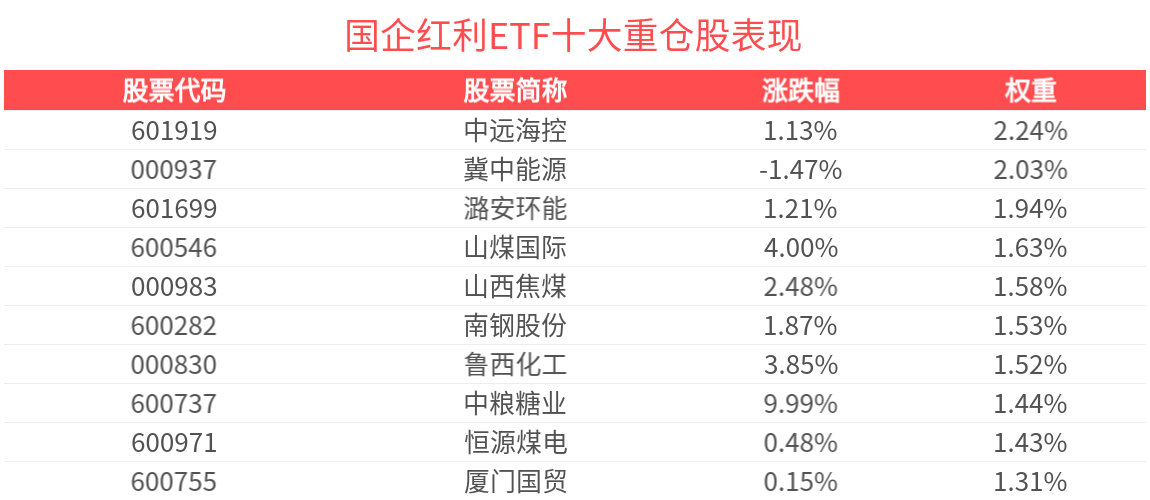
Group 1 - The core viewpoint of the news is that the State-owned Enterprise Dividend Index has shown positive performance, with significant increases in specific constituent stocks, indicating a favorable environment for dividend-paying stocks [1][2]. - As of December 15, 2025, the State-owned Enterprise Dividend Index rose by 0.56%, with notable stock performances including COFCO Sugar rising by 9.99% and Shanxi Coal International by 4.00% [1]. - The State-owned Enterprise Dividend ETF (159515) also experienced an increase of 0.53%, reflecting strong investor interest in dividend-paying assets [1][2]. Group 2 - The liquidity of the State-owned Enterprise Dividend ETF has improved, with an average daily transaction volume of 2.7164 million yuan over the past month and a weekly scale growth of 2.3717 million yuan [1]. - The ETF's share count increased by 3 million shares in the past week, indicating a significant uptick in investor participation [1]. - The State-owned Enterprise Dividend Index is designed to reflect the performance of 100 listed companies with high cash dividend yields and stable dividend policies, which are selected from state-owned enterprises [2]. Group 3 - The report highlights that dividend assets are attractive in a low-interest-rate environment, appealing to risk-averse investors seeking stable returns [2]. - The manufacturing PMI showed a slight recovery to 49.2% in November, indicating improvements in both production and demand, which supports the overall economic stability [2]. - The top ten weighted stocks in the State-owned Enterprise Dividend Index account for 16.99% of the index, with companies like COSCO Shipping and Jizhong Energy among the leaders [2][4].





部分钢铁产品纳入出口许可证管理,行业产能结构或迎优化
Orient Securities· 2025-12-14 12:29
Investment Rating - The industry investment rating is maintained as "Buy" for specific companies within the steel sector, indicating a strong potential for returns exceeding 15% relative to market benchmarks [3][12]. Core Insights - The introduction of export license management for certain steel products is expected to optimize the export structure, encouraging companies to shift towards high-value products and enhancing domestic profitability [8]. - The domestic steel demand is declining due to the downturn in the real estate sector, with crude steel apparent consumption expected to decrease by 4.4% in 2024, while net exports are projected to rise by over 30% [8]. - The anticipated stabilization of steel profitability is supported by a balance in supply and demand, alongside a downward trend in costs, suggesting a shift towards high-quality and high-return development in the industry [8]. Summary by Sections Steel Sector Investment Recommendations - Recommended companies include: - Nanjing Steel (600282, Buy) for its strong pricing power and stable profitability - CITIC Special Steel (000708, Buy) for its continuous optimization of product structure - Shandong Steel (600022, Buy) for its significant profit improvement driven by operational synergies and cost reduction [3]. - Other companies mentioned include: - Hualing Steel (000932, Not Rated) - Sansteel Minguang (002110, Not Rated) [3]. Export License Management Impact - The implementation of export licenses for 300 steel products, including pig iron and steel plates, marks a new phase in domestic steel export management, aiming to guide companies towards higher-value exports [8]. - The management is expected to alleviate the pressure of overcapacity in the domestic market by regulating low-end product exports [8]. Market Dynamics and Profitability Outlook - The first shipment of high-grade iron ore from the Simandou project indicates a potential decrease in iron ore prices, which could positively impact steel profitability [8]. - The expectation of improved dividend capabilities for companies as capital expenditures for environmental upgrades peak and decline [8].


内外兼修
GOLDEN SUN SECURITIES· 2025-12-14 06:27
Investment Rating - The investment rating for the steel industry is "Buy" for several key companies including Hualing Steel, Nanjing Steel, Baosteel, and New Steel [8]. Core Insights - The market remains in a state of fluctuation, with non-ferrous metals outperforming ferrous metals. The focus is on the financial attributes of metals, particularly gold, silver, and copper [2]. - The Federal Reserve has lowered interest rates by 25 basis points to a range of 3.50%-3.75%, marking the third consecutive rate cut this year. This is expected to influence domestic policies towards a more proactive fiscal stance [2]. - The steel industry is expected to see a shift towards structural adjustments, with a focus on optimizing consumption patterns and enhancing service consumption [2]. - The report highlights a significant recovery in the valuation of the steel sector, moving from absolute undervaluation to a moderately low position, indicating potential for absolute returns [2]. Supply and Demand Analysis - Daily molten iron production has decreased by 32,000 tons to 2.291 million tons, with steel production continuing to decline, particularly in rebar [14]. - Total inventory of five major steel products has decreased by 3.8% week-on-week, while steel mill inventories have slightly increased by 0.9% [27]. - Apparent consumption of five major steel products has weakened, with a week-on-week decline of 2.8% [53]. - The average weekly transaction volume for construction steel has decreased by 0.8% [43]. Price and Profitability - The comprehensive steel price index has weakened, with a week-on-week decline of 1.1% [72]. - The current spot price for rebar in Beijing is 3,110 CNY/ton, down 2.2% week-on-week [72]. - The profit margins for long-process rebar and hot-rolled coils are negative, indicating a challenging profitability environment [74]. Industry News - The introduction of export license management for certain steel products is seen as a significant step towards promoting high-quality development in the steel industry [96]. - The Ministry of Industry and Information Technology has released a draft for the implementation of capacity replacement in the steel industry, which is expected to enhance supply-side adjustments [15].


钢铁周报 20251214:深入整治“内卷式”竞争,出口管理推动结构变革-20251214
Guolian Minsheng Securities· 2025-12-14 05:12
Investment Rating - The report maintains a "Buy" rating for several steel companies, including Hualing Steel, Baosteel, Nanjing Steel, and others, indicating a positive outlook for these stocks [3]. Core Viewpoints - The report emphasizes the need for deep reforms to address "involution" competition in the steel industry, with the central government advocating for a unified national market and stricter export management [2]. - The introduction of export licenses for certain steel products is expected to limit the export of low-value-added products, encouraging steel companies to upgrade to higher-end products [2]. - In the short term, low-value-added products may face adjustments, while the long-term trend will see an increase in the export proportion of high-end products, benefiting leading companies in the industry [2]. Summary by Sections Domestic Steel Market - As of December 12, 2025, steel prices have decreased, with HRB400 rebar priced at 3,250 CNY/ton, down 20 CNY from the previous week [7][16]. - The report notes a decline in production and inventory levels, with total steel production at 8.06 million tons, a decrease of 227,300 tons week-on-week [7][16]. International Steel Market - The report highlights stable price increases in the U.S. and European steel markets, with U.S. hot-rolled coil prices at 985 USD/ton, up 10 USD from the previous week [28][30]. Raw Materials and Shipping Market - Domestic iron ore prices have shown a mixed trend, with some prices remaining stable while others have decreased slightly [33]. - The report indicates a decline in scrap steel prices, with the current price at 2,080 CNY/ton, down 10 CNY from the previous week [33]. Company Valuations and Stock Performance - The report provides earnings per share (EPS) forecasts and price-to-earnings (PE) ratios for key companies, with Hualing Steel projected to have an EPS of 0.29 CNY in 2024 and a PE ratio of 18 [3].

钢铁2026年度策略:破内卷启新篇
Xinda Securities· 2025-12-12 03:25
Core Insights - The steel industry is experiencing a dual decline in supply and demand, with structural optimization and marginal profit improvement. Supply side: total contraction and structural differentiation, with capital expenditure continuing to show weak growth. The steel industry's capital expenditure has been slowing for four consecutive years, entering negative growth in 2025 due to multiple factors including "anti-involution" policies, a downturn in the real estate sector, and limited infrastructure support [2][10] - The domestic crude steel consumption has decreased significantly, with a 6.4% year-on-year decline in demand from January to October 2025, amounting to 710 million tons. The demand in traditional steel usage areas remains weak, particularly in real estate and infrastructure [2][32] - Exports have become a crucial support for the steel industry, with steel exports reaching 97.74 million tons from January to October 2025, a 6.4% increase year-on-year. The total annual export volume is expected to exceed 110 million tons, effectively offsetting the pressure from declining domestic demand [2][48] Group 1: Marginal Improvement in the Steel Industry - The average steel price has continued to decline, with the comprehensive price index for ordinary steel dropping to 3,447 yuan/ton as of November 24, 2025, down approximately 200 yuan from the year's peak [10][60] - The profit margin of the steel industry has shown significant improvement, with the gross profit margin reaching 6.4% in Q3 2025, marking a recovery from the low levels seen since 2022 [13][15] - The proportion of loss-making enterprises in the steel industry has slightly decreased but remains high at 37.18%, indicating ongoing challenges within the industry [17] Group 2: PPI Turnaround Expectations - The Producer Price Index (PPI) for the steel industry is expected to turn positive by Q2 2026, driven by improvements in supply structure and demand dynamics [53][60] - Historical data shows that the steel industry plays a significant role in PPI fluctuations, with past PPI turnarounds in 2016 and 2021 coinciding with significant steel industry performance [54][60] - The steel industry accounts for approximately 5.9% of the PPI, making its price movements critical for overall industrial price trends [53][54] Group 3: Investment Recommendations - The report suggests focusing on high-efficiency, low-emission regional leading enterprises such as Hualing Steel, Shougang, and Shandong Steel, as well as companies with strong growth potential like Baosteel and Nanjing Steel [4][60] - The steel sector is viewed as having strong "anti-involution" attributes and significant profit recovery potential, making it a strategic investment opportunity for the medium to long term [4][60] - The report emphasizes the importance of monitoring the performance of small and medium-sized steel companies, particularly those with strong earnings growth and valuation appeal [4][60]


钢铁行业2026年投资策略:减量提质,价利回稳
GF SECURITIES· 2025-12-11 09:08
Core Viewpoint - The steel industry is expected to experience a reduction in production capacity and an improvement in quality, leading to stabilization in prices and profits in 2026 [1] Group 1: Supply - A new capacity replacement policy is set to be implemented, which is expected to continue reducing crude steel production in 2026 [6] - The capacity replacement policy will increase the reduction ratio in non-key areas to at least 1.5:1, enhancing long-term capacity constraints [14][18] - The overall crude steel production is anticipated to decrease year-on-year due to differentiated production restrictions and proactive production control by enterprises [6][28] Group 2: Demand - Investment stability and domestic demand expansion are expected to lead to a recovery in steel demand in 2026 [6] - The construction sector is projected to see a recovery in fixed asset investment, supported by policies aimed at stabilizing the real estate market [36] - Manufacturing sectors such as automotive, machinery, and home appliances are expected to maintain growth in steel demand due to supportive policies [6][57] Group 3: Costs - Steel cost pressures are expected to continue easing in 2026, with iron ore supply slightly increasing and demand stabilizing [6][61] - The global iron ore supply is projected to see a slight increase, with the four major mining companies expected to have a production growth rate of about 1.8% in 2026 [66] - The overall balance between iron ore supply and demand is expected to remain weak, with prices anticipated to fluctuate downward [6][61] Group 4: Prices and Profits - The reduction in production and improvement in quality are expected to help stabilize steel prices and profits in 2026 [6] - Demand for flat steel is expected to remain stronger than for long steel, with policies aimed at further tapping into consumption potential [6] - The anticipated decline in crude steel production, primarily driven by loss-making enterprises and policy-induced reductions, will contribute to a mild improvement in the steel supply-demand landscape [6] Group 5: Investment Recommendations - The report suggests focusing on leading companies in the ordinary steel sector and those involved in restructuring and integration, such as Baosteel, Hualing Steel, and Nanjing Steel [6] - In the special steel sector, high-performance steel products are encouraged, with companies like Jiuli Special Materials and Yongjin Co. expected to benefit from policy support [6][7]

中国金属学会特板数智分会在宁成立,南钢系支撑单位与发起者——
Nan Jing Ri Bao· 2025-12-11 02:54
特种板材是国家高端装备、绿色能源、海洋工程等战略领域的"核心基石",其发展水平直接关乎我 国重大工程自主安全与高端制造核心竞争力。12月10日,中国金属学会特板数智分会成立大会暨技术 交流会在南京举行,为特种板材产业数智化转型提供新助力。 作为分会支撑单位与核心发起者,我市制造业标杆企业南京钢铁集团有限公司(以下简称南钢)全 程主导筹备工作,并以自身数智化转型实践为行业高质量发展树立典范。 "分会的成立是行业发展的必然选择,更是南钢践行产业责任的具体体现。"南钢相关负责人表示, 企业始终以"产业智慧化、智慧产业化"为目标,凭借在特种板材领域的技术积累与数智化转型经验,为 分会搭建提供了坚实支撑。据了解,南钢已入选国家首批领航级智能工厂培育名单,连续3年斩获冶金 科学技术奖特等奖,拥有45个高端研发平台,211项产品(技术)达到国际先进以上水平,这些成果都 成为分会引领行业发展的重要底气。 为何在南京成立? 从自我革新到行业标杆,"南钢模式"赋能行业发展 上月底,2025世界智能制造大会在宁举行,南钢入选国家首批领航级智能工厂培育名单,同时凭 借"钢铁企业全要素资源优化与智慧运营中心"成功入选2025中国智能制 ...
26家银行派息落地,险资有望加码红利板块,国企红利ETF(159515)调整蓄势
Xin Lang Cai Jing· 2025-12-10 02:42
Group 1 - The core viewpoint of the news is that the China Securities State-Owned Enterprises Dividend Index has experienced a slight decline, while the dividend distribution from major banks is expected to attract long-term capital into the market [1][2] - As of December 10, 2025, the China Securities State-Owned Enterprises Dividend Index fell by 0.15%, with Xiamen International Trade leading the gains and China Merchants Bank leading the losses [1] - The China Securities State-Owned Enterprises Dividend ETF (159515) saw a scale increase of 2.33 million yuan and a share increase of 2.7 million shares over the past week [1][2] Group 2 - On December 8, Industrial and Commercial Bank of China and Agricultural Bank of China announced their mid-term dividend distributions, totaling 50.396 billion yuan and 41.823 billion yuan, respectively [1] - By December 9, 2025, 26 A-share listed banks had disclosed mid-term or quarterly dividend plans, with a total proposed payout exceeding 260 billion yuan [1] - China Galaxy Securities noted that the mid-term dividend distribution from listed banks remains strong and is occurring earlier than expected, enhancing the attractiveness of dividend stocks [1][2] Group 3 - The China Insurance Regulatory Commission announced a reduction in stock risk factors, which lowers the capital requirements for insurance companies investing in high-quality equity assets [2] - Recent policies focus on capital markets and consumer policies, with a goal for large state-owned insurance companies to allocate 30% of new premiums to A-shares [2] - The China Securities State-Owned Enterprises Dividend Index includes 100 listed companies with high cash dividend yields, reflecting the overall performance of high-dividend securities among state-owned enterprises [2]






钢铁行业资金流出榜:包钢股份、华菱钢铁等净流出资金居前
Zheng Quan Shi Bao Wang· 2025-12-09 09:32
Market Overview - The Shanghai Composite Index fell by 0.37% on December 9, with five industries experiencing gains, led by the comprehensive and communication sectors, which rose by 3.45% and 2.23% respectively [1] - The metal and steel industries faced the largest declines, with losses of 3.03% and 2.47% respectively, placing the steel industry second in terms of decline [1] Capital Flow - The main capital outflow from the two markets totaled 52.992 billion yuan, with only three industries seeing net inflows: retail trade (1.143 billion yuan), comprehensive (432 million yuan), and banking (70.578 million yuan) [1] - The non-ferrous metals industry had the highest net outflow, totaling 7.937 billion yuan, followed by the computer industry with a net outflow of 5.616 billion yuan [1] Steel Industry Performance - The steel industry saw a decline of 2.47%, with a total net outflow of 704 million yuan, and only one of the 44 stocks in this sector rose in value [2] - Among the steel stocks, Baosteel had the highest net inflow of 25.986 million yuan, followed by Shagang and Jiugang Hongxing with inflows of 8.877 million yuan and 5.087 million yuan respectively [2] - Six steel stocks experienced net outflows exceeding 30 million yuan, with Baogang, Hesteel, and Nanjing Steel leading the outflows at 190 million yuan, 64.883 million yuan, and 49.797 million yuan respectively [2] Steel Stock Flow Data - The following table summarizes the performance of key steel stocks: - Baogang: -1.63%, -189.6372 million yuan - Hesteel: -3.45%, -64.8827 million yuan - Nanjing Steel: -4.61%, -49.797 million yuan - Other notable declines include Fangda Carbon (-2.79%, -39.6426 million yuan) and Vanadium Titanium (-3.55%, -38.6316 million yuan) [2][3]


2025年中国钢铁行业绿电消费的进程、挑战与建议报告
Sou Hu Cai Jing· 2025-12-08 08:19
Core Insights - The report discusses the acceleration of green electricity consumption in China's steel industry, highlighting its significance in the sector's low-carbon transition and the challenges it faces [1][11]. Group 1: Acceleration of Green Electricity Consumption - The steel industry, being a high energy-consuming and high carbon-emitting sector, is focusing on green electricity consumption as a core pathway for low-carbon transformation [1]. - The acceleration is driven by multiple factors, including policy shifts from energy consumption control to carbon emission control, clear compliance directions for green electricity consumption, and increasing demand for low-carbon steel from downstream industries like automotive and construction [1][12]. - Major steel companies are integrating green electricity consumption into their long-term strategies, responding to both regulatory requirements and market demands [1][12]. Group 2: Consumption Models - Three mainstream models of green electricity consumption have emerged: green electricity trading, green certificate trading, and self-built/invested renewable energy projects [2][14]. - Green electricity trading requires no initial investment and can lock in power supply and environmental value, with companies like Baowu Steel and Hebei Steel engaging in large-scale transactions [2]. - Self-built renewable energy projects, while having higher initial costs, can optimize long-term energy costs, as seen with companies like Ansteel and Jiugang [2][14]. Group 3: Long-term Value and Challenges - Green electricity consumption brings multiple long-term benefits, including enhanced green competitiveness, compliance with domestic and international regulations, and the development of the green certificate market [2][12]. - Challenges include mismatches between steel industry locations and renewable energy-rich areas, unclear cost-sharing mechanisms for green electricity premiums, and the need for clearer policy connections and compliance details [2][12]. Group 4: Policy and Corporate Recommendations - To promote sustainable development in green electricity consumption, the report suggests improving incentive mechanisms, fostering industry collaboration, and enhancing energy management levels within companies [3][15]. - Companies are encouraged to set green electricity consumption targets, develop diversified consumption strategies, and advance technology integration with core production processes [3][15]. Group 5: Market Dynamics and Downstream Demand - The demand for low-carbon steel from key downstream sectors, such as construction and automotive, is increasing, influencing steel companies' energy consumption decisions [2][41]. - Major automotive manufacturers are setting carbon reduction targets that directly impact their steel suppliers, creating a supply chain responsibility that drives steel companies to enhance their green electricity consumption [2][41]. Group 6: Future Outlook - The report anticipates that the synergy between renewable energy development and the steel industry will expand, with green electricity consumption facilitating deeper decarbonization and structural transformation in the steel sector [1][17]. - The ongoing evolution of policies and market mechanisms will provide robust support for the steel industry's transition to green electricity consumption [20][31].