
Shanxi Xinghuacun Fen Wine Factory (600809)

Search documents
张坤2025四季报发声:强大内需不仅是“消费引擎”,更是“科技创新的燃料”
Xin Lang Cai Jing· 2026-01-22 03:34
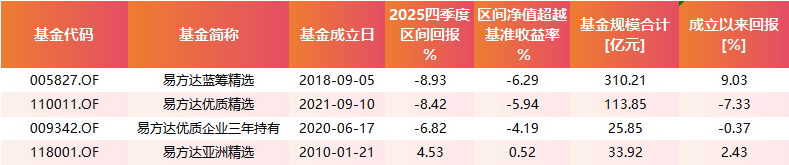
Core Viewpoint - The report highlights the investment strategies of top fund managers, particularly focusing on Zhang Kun from E Fund, who has made adjustments in his portfolio amidst market fluctuations, maintaining a long-term optimistic outlook on China's economic transformation and the growth of the domestic market [1][10]. Fund Performance - As of the end of Q4 2025, Zhang Kun managed a total fund size of 48.383 billion yuan, which reflects adjustments from the previous quarter [1]. - Three of the funds primarily investing in A-shares reported negative quarterly returns, failing to outperform their benchmarks, while the E Fund Asia Select, which focuses on overseas Chinese stocks, achieved a positive return of 4.53%, significantly exceeding its benchmark [2][10]. Portfolio Adjustments - In Q4 2025, there was a reduction in holdings of key stocks such as Kweichow Moutai, Wuliangye, Shanxi Fenjiu, and Luzhou Laojiao, while maintaining a stable stock position overall [3][13]. - The adjustments focused on reallocating investments in sectors such as pharmaceuticals, consumer goods, and technology [3][13]. Economic Outlook - Zhang Kun expressed a long-term optimistic view on the macroeconomic environment, predicting significant improvements in living standards and social security in China over the next decade, narrowing the gap with developed countries [4][14]. - He emphasized the unique advantages of the Chinese market in the context of the global AI wave, noting that a strong domestic demand market is a crucial driver for technological innovation [4][14]. Investment Philosophy - The report addresses concerns regarding the long-term value of core assets, with Zhang Kun asserting that the underlying value remains intact and that current market pessimism has created attractive valuations for quality companies [5][15]. - He believes that the current low valuation of quality assets presents a rare opportunity for long-term investors [5][15]. Policy Context - The Central Economic Work Conference in December emphasized the importance of boosting consumption and expanding domestic demand as a key task for 2026, highlighting the government's commitment to enhancing consumer spending [6][16]. - The report notes that recent indicators show domestic consumption has been weak, particularly for companies focused on domestic demand compared to those reliant on exports [6][16]. GDP Growth Projections - According to the "14th Five-Year Plan," China aims to achieve a per capita GDP level comparable to that of middle-income developed countries by 2035, requiring a compound annual growth rate of 5.27% [7][17]. - The report suggests that the decline in housing prices over the past five years has negatively impacted consumer wealth and spending, but this trend may be reversing due to potential policy support and lower interest rates [7][17].





机构看好零食乳业弹性,白酒估值修复可期,消费ETF嘉实(512600)布局消费复苏行情
Xin Lang Cai Jing· 2026-01-22 03:32
Group 1 - The core viewpoint of the articles highlights the performance of the consumer sector in China, particularly the growth of brand value for Kweichow Moutai, which increased by 2.2% to reach $59.63 billion, ranking first in the global liquor industry [1] - The China Securities Index shows that the major consumer index has risen by 0.20%, with significant gains from stocks such as Hainan Rubber (+2.15%), Yanjing Beer (+1.64%), and Dongpeng Beverage (+1.53%) [1] - The market is currently favoring sectors like snacks and dairy, which are experiencing clear growth and higher elasticity, driven by policy support and improving monthly data, while the liquor sector is in a "bottoming out" phase [1] Group 2 - The major consumer index includes leading A-share consumer stocks across various categories, with liquor being the largest sector, accounting for over 38% of the index [2] - The top ten weighted stocks in the major consumer index, which include Yili, Kweichow Moutai, and Wuliangye, collectively account for 68.63% of the index [1] - Investors can also access the consumer recovery trend through the Consumption ETF linked fund (009180) [3]



易方达基金张坤Q4持仓出炉:前十大重仓包括腾讯控股、贵州茅台等
Zhong Guo Zheng Quan Bao· 2026-01-22 02:35
Group 1 - The core viewpoint of the news is that E Fund's Blue Chip Select Fund, managed by Zhang Kun, has maintained a stable stock position while adjusting its sector allocations in pharmaceuticals, consumer goods, and technology as of Q4 2025 [1] - The top ten holdings of the fund as of the end of Q4 2025 include Tencent Holdings, Kweichow Moutai, Wuliangye, Alibaba-W, Shanxi Fenjiu, Luzhou Laojiao, Yum China, CNOOC, JD Health, and Focus Media, showing no changes from Q3 2025 [1] - Zhang Kun expresses confidence that both the actual living standards and social security levels in China will significantly improve over the next decade, narrowing the gap with developed countries [1] Group 2 - The current AI wave highlights the importance of a strong domestic demand market in promoting technological innovation, as it attracts global resources, talent, and capital [2] - Subscription revenues, such as the approximately $200 annual fee for C-end users of leading AI models like GPT and Gemini, are crucial for companies' financing and ongoing investment confidence amid debates about an "AI bubble" [2] - A domestic company with leading foundational model capabilities could benefit from a stronger consumer environment, enhancing subscription income and model investment interactions, which may help it catch up with global leaders [2]
酒价内参1月22日价格发布 习酒君品下跌13元
Xin Lang Cai Jing· 2026-01-22 01:23
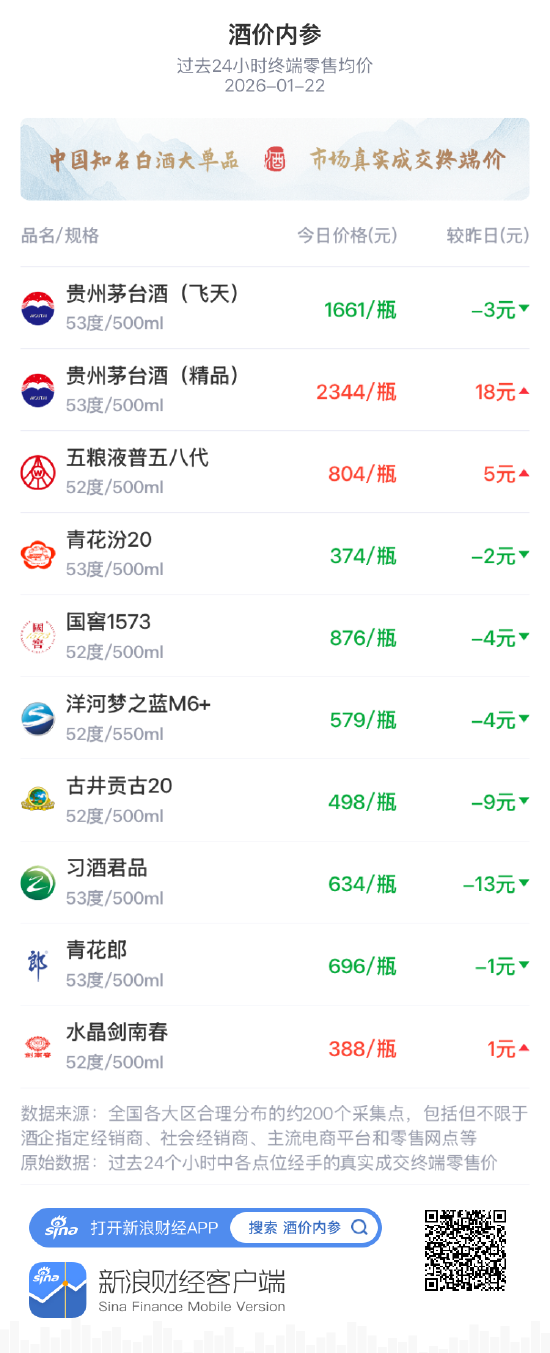
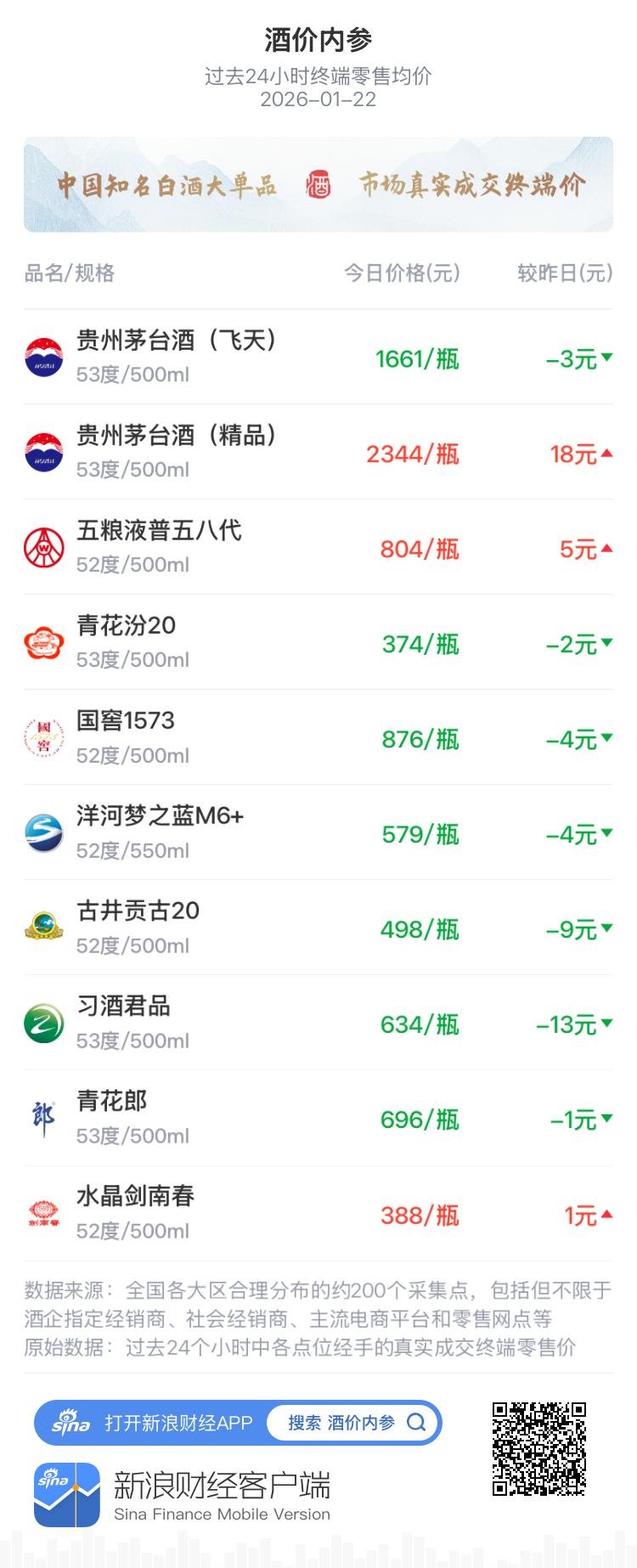
新浪财经"酒价内参"重磅上线 知名白酒真实市场价尽在掌握 新浪财经"酒价内参"过去24小时收集的数据显示,中国白酒市场十大单品的终端零售均价在1月22日迎 来普遍下跌。如果十大单品各取一瓶整体打包售卖,今日总售价为8854元,较昨日下跌12元。市场价格 第五次创下近两个月的新低,高端酒价格中枢持续下移,行业短期调整态势未改。 今日市场普跌特征凸显,十大单品七跌三涨,头部酒品走势分化,仅少数单品显露止跌回暖迹象。下跌 产品中,习酒君品领跌,环比降低13元/瓶;古井贡古紧随其后,环比下跌9元/瓶;国窖1573与洋河梦 之蓝M6+均环比下跌4元/瓶;飞天茅台环比下跌3元/瓶,i茅台平价货源持续投放,终端价格支撑进一步 弱化;青花汾20与青花郎跌幅较小,分别下跌2元/瓶与1元/瓶。上涨产品中,精品茅台领涨,环比大幅 上涨18元/瓶,渠道货源阶段性收紧,叠加部分终端补货需求释放;五粮液普五八代上涨5元/瓶;水晶 剑南春微涨1元/瓶。 "酒价内参"的每日数据源自全国各大区均有合理分布的约200个采集点,包括但不限于酒企的指定经销 商、社会经销商、电商平台和零售网点等,原始取样数据为过去24个小时各点位经手的真实成交终端零 ...


酒价内参1月22日价格发布 市场延续下跌五创两月价格新低
Xin Lang Cai Jing· 2026-01-22 00:59
新浪财经"酒价内参"过去24小时收集的数据显示,中国白酒市场十大单品的终端零售均价在1月22日迎来 普遍下跌。如果十大单品各取一瓶整体打包售卖,今日总售价为8854元,较昨日下跌12元。市场价格第五 次创下近两个月的新低,高端酒价格中枢持续下移,行业短期调整态势未改。今日市场普跌特征凸显,十 大单品七跌三涨,头部酒品走势分化,仅少数单品显露止跌回暖迹象。下跌产品中,习酒君品领跌,环比 降低13元/瓶;古井贡古紧随其后,环比下跌9元/瓶;国窖1573与洋河梦之蓝M6+均环比下跌4元/瓶;飞天 茅台环比下跌3元/瓶,i茅台平价货源持续投放,终端价格支撑进一步弱化;青花汾20与青花郎跌幅较小, 分别下跌2元/瓶与1元/瓶。上涨产品中,精品茅台领涨,环比大幅上涨18元/瓶,渠道货源阶段性收紧,叠 加部分终端补货需求释放;五粮液普五八代上涨5元/瓶;水晶剑南春微涨1元/瓶。 数据来源:全国各大区合理分布的约200个采集点,包括但不限于 酒企指定经销商、社会经销商、主流电商平台和零售网点等 原始数据: 过去24个小时中各点位经手的真实成交终端零售价 sma 打开新浪财经APP 搜索 酒价内参 Q 新浪财经客户端 Sina ...
食品饮料行业今日跌1.53%,主力资金净流出24.16亿元
Zheng Quan Shi Bao Wang· 2026-01-21 09:20
Market Overview - The Shanghai Composite Index rose by 0.08% on January 21, with 18 out of the 28 sectors experiencing gains. The top-performing sectors were non-ferrous metals and electronics, with increases of 2.79% and 2.62% respectively [1] - The banking and coal sectors saw the largest declines, with drops of 1.58% and 1.57% respectively [1] Capital Flow Analysis - The net inflow of capital in the two markets was 11.983 billion yuan, with 14 sectors receiving net inflows. The electronics sector led with a net inflow of 16.369 billion yuan, while the non-ferrous metals sector followed with a net inflow of 7.289 billion yuan [1] - Conversely, 17 sectors experienced net outflows, with the power equipment sector seeing the largest outflow of 6.688 billion yuan, followed by the defense and military sector with an outflow of 2.906 billion yuan [1] Food and Beverage Sector Performance - The food and beverage sector declined by 1.53%, with a net outflow of 2.416 billion yuan. Out of 124 stocks in this sector, 23 rose while 97 fell, including one stock that hit the daily limit down [2] - The top three stocks with the highest net inflows in the food and beverage sector were "Hao Xiang Ni" with 61.106 million yuan, "*ST Chun Tian" with 12.8997 million yuan, and "Wei Zhi Xiang" with 12.7381 million yuan [2] - Major stocks with significant net outflows included Kweichow Moutai with 9.52 billion yuan, Wuliangye with 3.66 billion yuan, and Shanxi Fenjiu with 1.33 billion yuan [2][4] Food and Beverage Sector Capital Inflow and Outflow - The capital inflow leaderboard in the food and beverage sector included "Hao Xiang Ni" (+8.11%), "*ST Chun Tian" (+4.85%), and "Wei Zhi Xiang" (+1.43%) [2] - The capital outflow leaderboard featured Kweichow Moutai (-1.64%), Wuliangye (-1.77%), and Shanxi Fenjiu (-2.34%) [4]


白酒板块1月21日跌1.83%,*ST岩石领跌,主力资金净流出26.42亿元
Zheng Xing Xing Ye Ri Bao· 2026-01-21 08:53
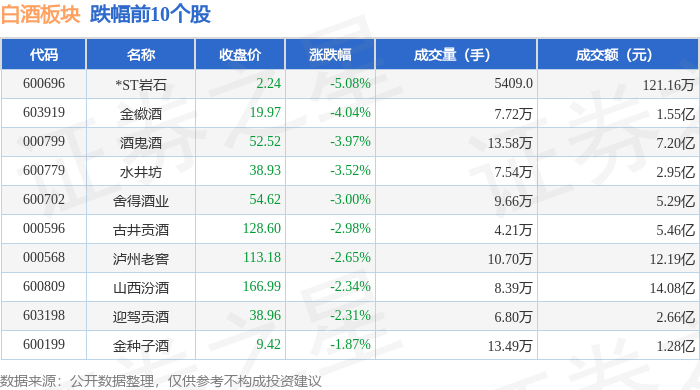
Core Viewpoint - The liquor sector experienced a decline of 1.83% on January 21, with *ST Rock leading the drop, while the overall market indices showed slight increases [1] Group 1: Market Performance - The Shanghai Composite Index closed at 4116.94, up 0.08% [1] - The Shenzhen Component Index closed at 14255.12, up 0.7% [1] - The liquor sector saw a net outflow of 2.642 billion yuan from main funds, while retail investors contributed a net inflow of 858 million yuan [1] Group 2: Individual Stock Performance - *ST Rock closed at 2.24 yuan, down 5.08% with a trading volume of 5409 lots [1] - Other notable declines included Quan Wei Jiu down 4.04%, Zhi Si Li down 3.97%, and Shui Jing Fang down 3.52% [1] - The highest closing price was for Shanxi Fen Jiu at 166.99 yuan, down 2.34% [1] Group 3: Fund Flow Analysis - Main funds showed a significant outflow from several stocks, including Lao Bai Gan Jiu with a net outflow of 18.7589 million yuan [2] - Retail investors had a net inflow in stocks like Jin Shi Zi Jiu, which saw a net inflow of 12.814 million yuan [2] - The overall trend indicates a mixed sentiment among different types of investors within the liquor sector [2]


酒价内参1月21日价格发布 五粮液普五八代下跌4元
Xin Lang Cai Jing· 2026-01-21 01:20
Core Insights - The core viewpoint of the news is that the retail prices of major Chinese liquor brands have generally declined, indicating a downward adjustment in the market, particularly for high-end products, with the overall price reaching a new low in two months [1][6]. Price Trends - The average retail price of the top ten liquor products dropped to 8866 yuan, a decrease of 49 yuan from the previous day [1][6]. - Eight out of the ten major products experienced price declines, while only two saw slight increases, highlighting the pressure on the industry for short-term adjustments [7]. Specific Product Price Changes - Moutai's premium product saw the largest drop, decreasing by 13 yuan per bottle due to increased supply and dealer discounts [7]. - Other notable declines included Qinghua Lang and Xijiu Junpin, which fell by 11 yuan and 9 yuan respectively, while Feitian Moutai decreased by 8 yuan [7]. - The only products that increased in price were Yanghe Dream Blue M6+ and Qinghua Fen 20, both rising by 1 yuan [7]. Data Collection Methodology - The "Liquor Price Reference" collects data from approximately 200 sampling points across various regions, including designated distributors, social distributors, e-commerce platforms, and retail outlets, ensuring a comprehensive and objective representation of market prices [2][8]. - The pricing data is based on real transaction prices from the past 24 hours, aiming to provide a scientifically traceable dataset for the liquor market [2][8]. Industry Concerns - Recent reports indicate issues with counterfeit authorization letters for products like the 52-degree Crystal Jian Nan Chun, raising concerns about the integrity of online sales and the potential impact on brand pricing structures [3][8]. - The online low-price sales phenomenon may stem from distributors using e-commerce to clear inventory, which could disrupt the established pricing order in the industry [3][8].
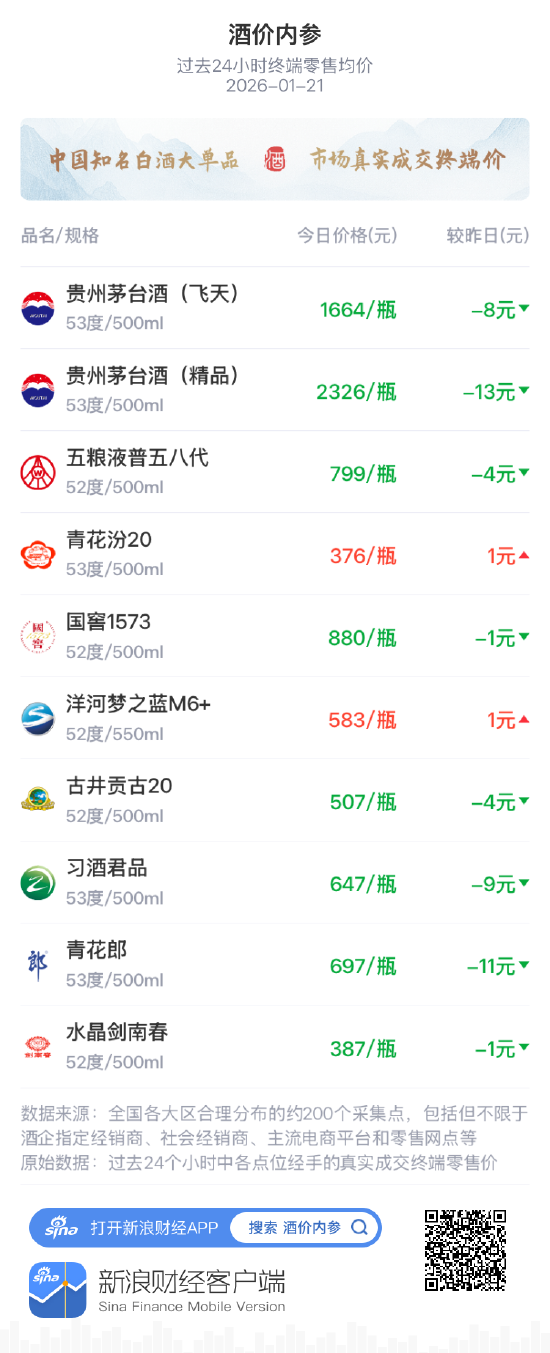
酒价内参1月21日价格发布 习酒君品下跌9元
Xin Lang Cai Jing· 2026-01-21 01:20
新浪财经"酒价内参"重磅上线 知名白酒真实市场价尽在掌握 新浪财经"酒价内参"过去24小时收集的数据显示,中国白酒市场十大单品的终端零售均价在1月21日迎 来普遍下跌。如果十大单品各取一瓶整体打包售卖,今日总售价为8866元,较昨日下跌49元。市场价格 第四次创下近两个月来新低,高端酒价格支撑力度减弱,行业下行调整节奏有所加快。 今日市场呈普跌态势,十大单品八跌两涨,行业短期调整压力凸显。下跌产品中,精品茅台领跌,环比 降低13元/瓶,主因系其终端货源补给增加,经销商适度让利促流通;青花郎与习酒君品紧随其后,分 别环比下跌11元/瓶与9元/瓶;飞天茅台环比下跌8元/瓶,"i茅台"平台平价货源持续入市分流需求,终端 零售价承压下行;古井贡古20与五粮液普五八代同步下跌4元/瓶;国窖1573与水晶剑南春微跌1元/瓶。 上涨产品中,洋河梦之蓝M6+与青花汾20涨势微弱,均环比上升1元/瓶。 "酒价内参"的每日数据源自全国各大区均有合理分布的约200个采集点,包括但不限于酒企的指定经销 商、社会经销商、电商平台和零售网点等,原始取样数据为过去24个小时各点位经手的真实成交终端零 售价格,力求为社会各界提供一份关于知名 ...
2026年第3周:酒行业周度市场观察
艾瑞咨询· 2026-01-21 00:07
Industry Environment - After a year and a half, Australian wine is reshaping the Chinese imported wine market as China terminates anti-dumping and countervailing duties on Australian imported wine starting March 29, 2024, leading to an initial surge in imports, followed by a significant decline in sales due to inventory buildup and economic pressures, with declines ranging from 20% to 70% [2][3] - Despite challenges, Australian wine is seen as having product strength, prompting the industry to streamline brands and enhance promotions to reshape market dynamics [3] Low-Alcohol Beverage Market - The low-alcohol beverage market has rapidly grown, increasing from 20 billion yuan in 2020 to an expected 57 billion yuan by 2024, with global market projections surpassing 740 billion yuan by 2025, driven by young consumers and a trend towards "tipsy enjoyment" [4] - Traditional liquor companies and retail brands are entering the low-alcohol space, but the market faces challenges such as brand homogenization and declining repurchase rates, indicating a need for innovation to establish long-term competitiveness [4] New Product Innovations in Alcohol Industry - In 2025, leading liquor companies are leveraging product innovation to navigate challenges, with notable new products like Moutai's 1935 premium version and Wuliangye's youth-oriented design gaining market traction [5] - The industry is witnessing a trend towards low-alcohol and youth-oriented products, with a focus on value reconstruction across all price ranges, indicating a shift in consumer preferences and competitive dynamics [5] Changing Landscape of Baijiu Industry - The baijiu industry is undergoing significant changes, with Shanxi Fenjiu surpassing Luzhou Laojiao and Yanghe in revenue, marking a competitive shift among leading brands [6] - The overall industry is under pressure, with many mid-sized companies experiencing declines, while top brands like Moutai and Fenjiu show slight growth, indicating a potential gradual recovery in 2026 [6] New Beverage Trends - The new beverage sector is experiencing growth, with brands like Xiaojinjiu and Guolifang successfully filling market gaps through innovative products that cater to younger consumers and diverse consumption scenarios [7] - The success of these new products is attributed to their ability to meet specific consumer needs and drive emotional consumption, positioning them as mainstream options in the market [7] Marketing Strategies of Leading Brands - Major liquor companies are optimizing inventory and enhancing marketing strategies to adapt to the current industry adjustment period, focusing on consumer-centric approaches and diversified consumption scenarios [9] - Companies are employing a pyramid product structure to solidify core offerings while exploring niche markets, indicating a shift from scale expansion to refined operations [9] Brand Dynamics - Guizhou Zhenjiu is upgrading its "Dazhen" product to enhance quality and packaging, aiming to establish it as a classic product in the market [10] - Wuliangchun is deepening emotional connections with consumers through its 30th-anniversary marketing activities, showcasing a shift towards more profound brand engagement [11] Value Competition in Baijiu Industry - The baijiu industry is entering a phase of value competition, with brands like Xifengjiu focusing on quality and cultural empowerment to drive their revival [12][13] - The emphasis on quality and innovation is seen as essential for long-term success in a competitive market [12][13] Retail Innovations - Sam's Club is restructuring its display of aged baijiu by grouping products by production year, aiming to enhance value perception and broaden consumption scenarios [23] - This adjustment reflects a collaborative effort between distributors and retailers to address market challenges and improve product value expression [23]
