Shanxi Xinghuacun Fen Wine Factory (600809)

Search documents
张坤在管基金披露2025年四季报:减持白酒股 加仓阿里巴巴(09988)
Zhi Tong Cai Jing· 2026-01-23 12:24
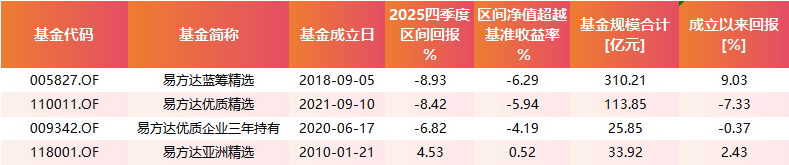
Core Viewpoint - E Fund's Zhang Kun reported a decline in total assets under management to 48.383 billion yuan as of December 2025, with three A-share focused funds underperforming their benchmarks, while the E Fund Asia Select fund achieved positive returns, significantly exceeding its benchmark [1][2]. Group 1: Fund Performance - As of December 2025, the largest fund, E Fund Blue Chip Select, had a net asset value of 1.8623 yuan, with a report period net asset value growth rate of -8.93%, compared to a benchmark return of -2.63% [1]. - Three main A-share focused funds reported negative quarterly returns and failed to outperform their performance benchmarks [1]. Group 2: Portfolio Adjustments - Zhang Kun reduced holdings in major stocks such as Kweichow Moutai, Wuliangye, Luzhou Laojiao, and Shanxi Fenjiu, while also significantly reducing positions in Focus Media and China Merchants Bank [1]. - The top ten holdings of E Fund Blue Chip Select remained unchanged, including Tencent, Kweichow Moutai, and Alibaba, with notable reductions in Focus Media and increases in Alibaba [2]. Group 3: Market Outlook - Zhang Kun expressed a long-term optimistic view on the macro economy and market, predicting significant improvements in living standards and social security in China over the next decade [2]. - He emphasized the importance of a strong domestic demand market in promoting technological innovation, suggesting that improved consumer environments could enhance subscription revenues and model capabilities [3]. Group 4: Confidence in Business Models - Zhang Kun maintained confidence in the business models, competitive barriers, and cash flow generation capabilities of the companies in the portfolio, asserting that the market's perception of quality companies presents good opportunities for long-term investors [3].





白酒板块1月23日跌0.24%,*ST岩石领跌,主力资金净流出4.56亿元
Zheng Xing Xing Ye Ri Bao· 2026-01-23 09:04
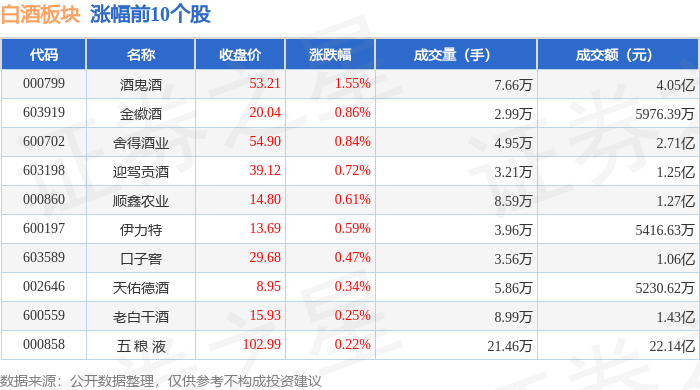
证券之星消息,1月23日白酒板块较上一交易日下跌0.24%,*ST岩石领跌。当日上证指数报收于 4136.16,上涨0.33%。深证成指报收于14439.66,上涨0.79%。白酒板块个股涨跌见下表: | 代码 | 名称 | 收盘价 | 涨跌幅 | 成交量(手) | 成交额(元) | | | --- | --- | --- | --- | --- | --- | --- | | 000799 | 劑思興 | 53.21 | 1.55% | 7.66万 | | 4.05亿 | | 616809 | 全徽酒 | 20.04 | 0.86% | 2.99万 | | 5976.39万 | | 600702 | 舍得漫业 | 54.90 | 0.84% | 4.95万 | | 2.71亿 | | 603198 | 迎驾贡酒 | 39.12 | 0.72% | ﻛ 3.21万 | | 1.25亿 | | 000860 | 顺鑫农业 | 14.80 | 0.61% | 8.59万 | | 1.27亿 | | 600197 | 伊力特 | 13.69 | 0.59% | 3.96万 | | 5416.63万 | | 6855 ...


白酒基金最新持仓披露:加仓“茅五洋”,茅台重回第一重仓
Mei Ri Jing Ji Xin Wen· 2026-01-23 07:43
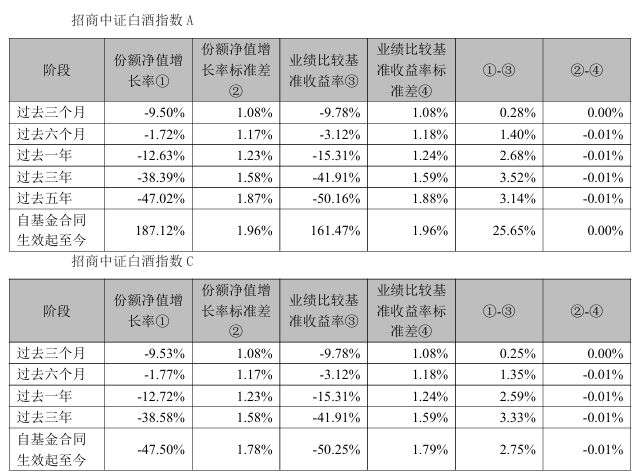
公募基金2025年四季报披露收官,唯一跟踪白酒指数的招商中证白酒指数基金(以下简称白酒基金)也交出了一份"亏损却跑赢"的成绩单——该基金去年四 季度A类份额、C类份额净值均下跌约9.5%,不过跑赢了同期业绩比较基准。 从重仓配置来看,贵州茅台重回该基金第一大重仓股。此外,申赎情况方面,基金投资者对白酒基金的态度则呈现A类被赎回、C类获加仓的鲜明分化。 这份充满反差的四季报背后,是白酒行业消费复苏不及预期的现实压力,还是头部企业的长期投资价值仍被看好? 贵州茅台重回白酒基金第一大重仓股 白酒基金2025年四季报显示,报告期内,基金A类份额净值增长率为-9.50%,C类为-9.53%,同期业绩比较基准收益率为-9.78%,两者分别跑赢基准0.28个百 分点、0.25个百分点,跟踪误差控制在基金合同约定范围内。 拉长时间看,过去一年基金A类份额、C类份额净值增长率分别为-12.63%、-12.72%,依次跑赢基准2.68个百分点、2.59个百分点。 | 阶段 | 份额净值增 | 份额净值增 | 业绩比较基 | 业绩比较基 | 1-3 | 2-4 | | --- | --- | --- | --- | --- | - ...


白酒基金最新持仓披露:加仓“茅五洋”,茅台重回第一重仓!投资者操作现分化
Mei Ri Jing Ji Xin Wen· 2026-01-23 07:39
Core Viewpoint - The report highlights the performance of the China Securities White Wine Index Fund, which experienced a decline in net value but outperformed its benchmark during the fourth quarter of 2025, indicating a complex market environment for the white wine industry [1][9]. Fund Performance - The A-class and C-class shares of the white wine fund both saw a net value decrease of approximately 9.5% in Q4 2025, while the benchmark's return was -9.78%, resulting in a slight outperformance of 0.28 and 0.25 percentage points respectively [1][10]. - Over the past year, the A-class and C-class shares recorded net value growth rates of -12.63% and -12.72%, outperforming the benchmark by 2.68 and 2.59 percentage points respectively [1][10]. Fund Holdings - The fund's top holdings include Kweichow Moutai, which regained its position as the largest holding with a 15.38% share, valued at approximately 6.642 billion yuan [3][12]. - The top ten holdings accounted for 84.79% of the fund's net asset value, indicating a significant concentration in leading companies within the white wine sector [3][12]. Market Conditions - The white wine sector faced challenges in Q4 2025 due to slower-than-expected consumer recovery and pressure on terminal sales, leading to an overall downward trend in stock prices [3][11]. - The fund manager noted that the industry is experiencing a phase of adjustment, with head companies exerting pressure on mid-tier firms, complicating the balance of price and volume for wine producers [5][13]. Investor Behavior - There was a notable divergence in investor behavior, with A-class shares experiencing a net redemption of 10.54 billion shares, while C-class shares increased by 15.71 billion shares during the same period [5][16]. - The growth in C-class shares may reflect investor strategies favoring short-term gains, while the redemption of A-class shares suggests a cautious outlook on the industry's recovery [5][16].


酒价内参1月23日价格发布 价格小幅回暖分化格局延续
Xin Lang Cai Jing· 2026-01-23 01:21
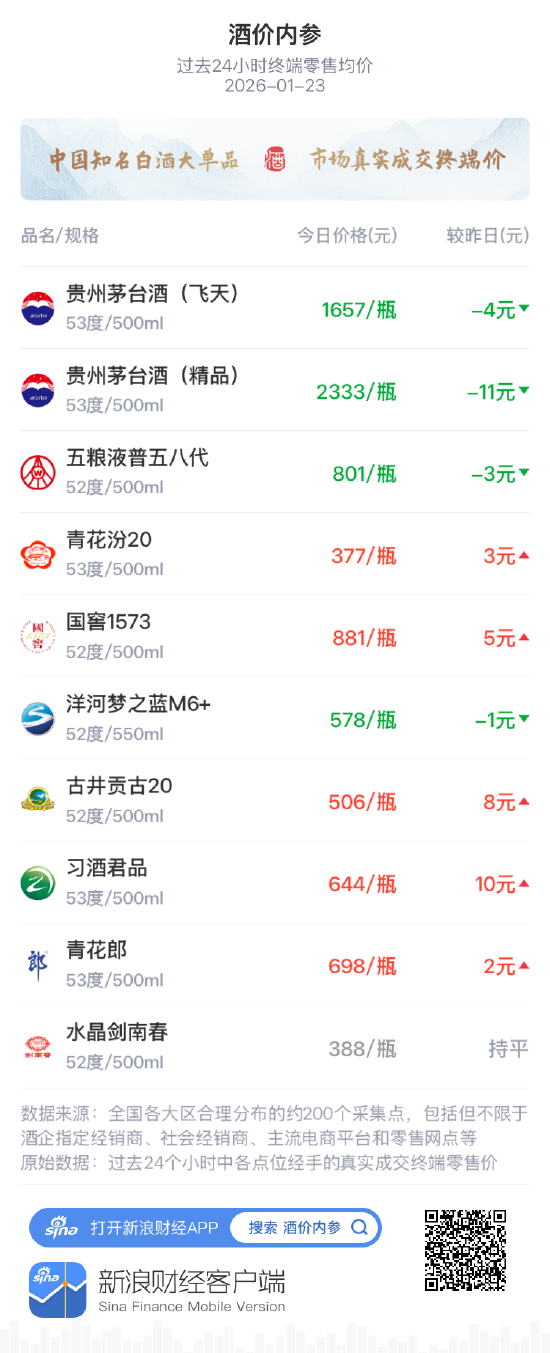
Core Insights - The core viewpoint of the article highlights a slight recovery in the retail prices of China's top ten liquor products, indicating a temporary alleviation of downward pressure in the industry [1][7]. Price Trends - The average retail price of the top ten liquor products reached 8,863 yuan on January 23, an increase of 9 yuan from the previous day [1][7]. - The market displayed a mixed performance with five products increasing in price, four decreasing, and one remaining stable [1][8]. - Notable price increases included Xijiu Junpin and Gujing Gonggu 20, which rose by 10 yuan and 8 yuan per bottle, respectively [1][8]. - Conversely, the premium Moutai led the declines with a drop of 11 yuan per bottle, followed by Feitian Moutai, which fell by 4 yuan [1][8]. Market Analysis - The data for "Wine Price Reference" is sourced from approximately 200 collection points across various regions, aiming to provide an objective and traceable overview of liquor market prices [2][9]. - The introduction of new sales channels for Moutai products has begun to influence market prices significantly [2][9]. - Fund managers are showing a mixed approach towards the liquor sector, with some increasing their holdings in leading brands, indicating a potential recovery phase for the industry [3][9]. - The liquor sector is perceived to be at a historical valuation low, with expectations of demand recovery driven by consumption policies under the "14th Five-Year Plan" [3][9].
张坤在管基金披露2025年四季报:减持白酒股 加仓阿里巴巴
Zhi Tong Cai Jing· 2026-01-22 23:43
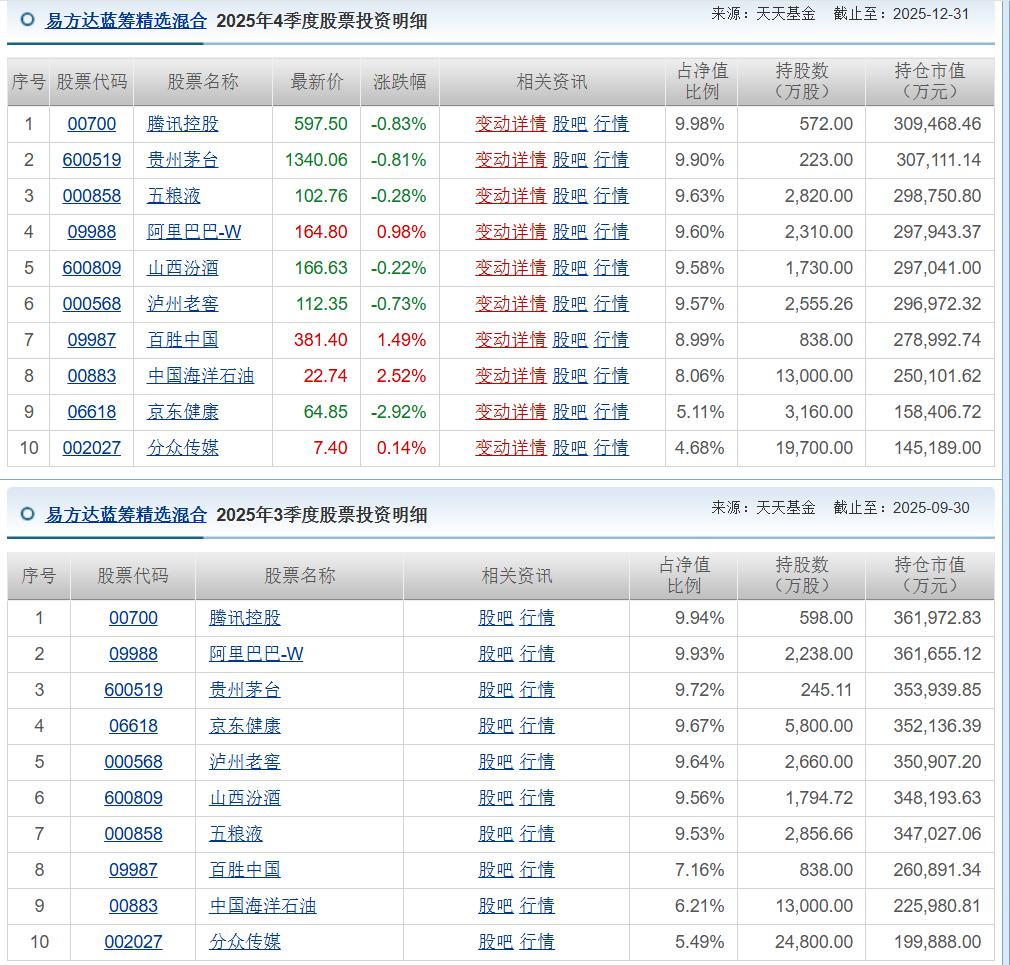
易方达蓝筹精选的前十大重仓股并未发生变更,依次为:腾讯控股(00700)、贵州茅台(600519.SH)、五粮液(000858.SZ)、阿里巴巴(09988)、山西 汾酒(600809.SH)、泸州老窖(000568.SZ)、百胜中国(09987)、中国海洋石油(00883)、京东健康(06618)、分众传媒(002027.SZ)。其中,张坤较大 幅度地减持了分众传媒,还减持了泸州老窖、山西汾酒、五粮液;加仓了阿里巴巴。 | 序号 | 股票代码 | 股票名称 | 相关资讯 | 占浄值 | 持股数 | 持仓市值 | | --- | --- | --- | --- | --- | --- | --- | | | | | | 比例 | (万股) | (万元) | | 1 | 00700 | 腾讯控股 | 股吧 行情 | 9.94% | 598.00 | 361,972.83 | | 2 | 09988 | 阿里巴巴-W | 股吧 行情 | 9.93% | 2.238.00 | 361.655.12 | | 3 | 600519 | 贵州茅台 | 股吧 行情 | 9.72% | 245.11 | 353.939.85 ...
公募基金去年如何对待白酒?张坤、刘彦春在减持
Nan Fang Du Shi Bao· 2026-01-22 09:41
Group 1 - Several public funds have reduced their holdings in liquor stocks, particularly in high-end brands like Kweichow Moutai and Shanxi Fenjiu, with reductions of 8.08% and 5.14% respectively [2] - The liquor sector experienced a cumulative decline of 11.5% in Q4 2025, contrasting with the overall bullish market, which has contributed to the decision of funds to decrease their positions [2] - The fundamental performance of the liquor industry is also underwhelming, with many companies issuing profit warnings for 2025 [3] Group 2 - Major liquor companies are forecasting significant declines in net profits, with Shui Jing Fang expected to see a 71% drop and Kuozi Jiao anticipating at least a 50% decrease [3] - The ongoing decline in the liquor sector is attributed to multiple factors, including supply-demand imbalances and changes in consumer behavior, indicating a shift from irrational exuberance to a focus on intrinsic value [3] - The consumer sector remains under pressure, with domestic demand facing challenges compared to export-oriented companies, as highlighted by Zhang Kun's analysis [4]

山西汾酒:致力于打破传统白酒刻板印象,以更轻松、更包容姿态融入多元化社交生活
Cai Jing Wang· 2026-01-22 08:18
Core Insights - The company is focusing on building a consumer-centric strategy to transform its brand heritage into market competitiveness, emphasizing product quality and enhancing consumer experience [1][2] - The company is actively integrating products with evolving drinking scenarios to break traditional perceptions of liquor, targeting younger consumers and promoting a modern lifestyle [1][2] Group 1 - The company aims to enhance market resilience and core competitiveness by optimizing communication mechanisms and strengthening service experiences [1] - The company is expanding into younger and fashionable market segments by creating innovative consumption scenarios that allow traditional liquor to blend into diverse social settings [1] - The company is committed to understanding consumer needs and emotional experiences, enriching the emotional value of its products in social interactions [1] Group 2 - The industry anticipates that 2026 will be a pivotal year for innovation in drinking scenarios and consumption methods, with new trends like casual drinking parties and modern drinking styles gaining popularity [2] - The industry must break traditional drinking scene boundaries and embrace changes to meet the personalized and fashionable experiences demanded by younger consumers [2] - The industry should focus on making traditional liquor accessible and understandable to younger generations, fostering a lively social atmosphere for consumption [2]

张坤等知名基金经理罕见发声!
天天基金网· 2026-01-22 05:20
Group 1 - The core viewpoint of the article highlights the strategic adjustments made by prominent fund managers at E Fund in their investment portfolios for Q4 2025, focusing on sectors like AI, healthcare, consumer goods, and technology [2][4][6][10] Group 2 - Zhang Kun adjusted the structure of investments in the healthcare, consumer, and technology sectors while maintaining a stable position in top holdings, which include Tencent Holdings, Kweichow Moutai, and Alibaba-W [4][5] - Zhang Kun expressed confidence in the improvement of living standards and social security in China over the next decade, suggesting a narrowing gap with developed countries [4] - The AI wave is seen as a significant driver for innovation, with strong domestic demand expected to attract global resources and talent [4][5] Group 3 - Chen Hao focused heavily on AI-related sectors, increasing allocations in power equipment, new energy, non-bank financials, and chemicals, which yielded positive returns [7][8] - Chen Hao anticipates a transition of the AI industry from an acceleration phase in 2025 to a stable growth phase in 2026, emphasizing the importance of structural opportunities and the integration of AI with local applications [7][8] Group 4 - Xiao Nan reduced allocations in high-end and sub-high-end liquor sectors while increasing investments in the livestock industry, anticipating inflation-driven cost increases over the next two years [10] - The top holdings in Xiao Nan's consumer sector fund remained unchanged, including Kweichow Moutai and Midea Group [10]






组合中企业“护城河还在,城在不在”?张坤在2025年四季报中给出了明确回答
Xin Lang Cai Jing· 2026-01-22 03:40
Core Viewpoint - The report highlights the investment strategies of top fund managers, particularly focusing on Zhang Kun from E Fund, who has made adjustments in his portfolio amidst market fluctuations, maintaining a long-term optimistic outlook on China's economic transformation and the growth of domestic demand [1][10]. Fund Performance - As of the end of Q4 2025, Zhang Kun managed funds totaling 48.383 billion yuan, with three A-share focused products underperforming against benchmarks, while the E Fund Asia Select, which invests in overseas Chinese stocks, achieved a positive return of 4.53% [1][2][10]. - The performance of the funds is as follows: - E Fund Blue Chip Select: -8.93% return, 31.021 billion yuan in size - E Fund Quality Select: -8.42% return, 11.385 billion yuan in size - E Fund Quality Enterprise Three-Year Holding: -6.82% return, 2.585 billion yuan in size - E Fund Asia Select: 4.53% return, 3.392 billion yuan in size [2][12]. Portfolio Adjustments - In Q4 2025, Zhang Kun reduced holdings in key stocks such as Kweichow Moutai, Wuliangye, Shanxi Fenjiu, and Luzhou Laojiao, while maintaining overall stock positions but adjusting sector allocations towards pharmaceuticals, consumer goods, and technology [3][13]. - The top holdings in the portfolio include Tencent Holdings (6.93%), Kweichow Moutai (6.87%), and Wuliangye (6.70%), with notable reductions in their respective weightings [3][13]. Economic Outlook - Zhang Kun expressed a long-term optimistic view on macroeconomic conditions, predicting significant improvements in living standards and social security in China over the next decade, narrowing the gap with developed countries [4][14]. - He emphasized the unique advantages of the Chinese market in the context of the global AI wave, suggesting that a strong domestic demand market is a crucial driver for technological innovation [4][14]. Investment Philosophy - The report indicates that despite current market pessimism regarding core assets, Zhang Kun believes that the intrinsic value of quality companies remains intact, presenting attractive investment opportunities for long-term investors [5][15]. - The central economic work conference highlighted the importance of boosting consumption and expanding domestic demand as key tasks for 2026, reinforcing the focus on consumer-driven growth [6][16]. GDP Growth Projections - According to the "14th Five-Year Plan," China aims to achieve a per capita GDP of $23,400 by 2035, requiring a compound annual growth rate of 5.27% from the current level of $13,300 [7][17]. - The report notes that the decline in housing prices over the past five years has negatively impacted consumer wealth and spending, but this trend may be reversing, potentially improving consumer sentiment and demand [8][18].