Shanxi Xinghuacun Fen Wine Factory (600809)

Search documents
食品饮料行业第三季报总结报告:酒类渠道包袱加速去化,大众品品类表现分化
Guoxin Securities· 2025-11-11 09:48
Core Insights - The leading companies in the mass-market segment are stabilizing, while the liquor industry is experiencing accelerated pressure release, reinforcing market share logic [4][10][19] - The food and beverage industry is expected to show stable overall volume with structural differentiation by 2025, with Q1/Q2/Q3 revenues growing by +2.5%/+2.4%/-4.77% year-on-year, and net profits declining by +0.3%/-2.1%/-14.6% [4][12] - The liquor sector is entering an adjustment phase, with a consensus on deceleration in 2024, as most companies face declining performance in Q3 [4][19][39] Liquor Sector - In Q3 2025, the liquor sector's revenue and net profit declines are widening, with total revenue of 3,202 billion yuan, down 5.8% year-on-year, and net profit of 1,126 billion yuan, down 6.9% year-on-year [19][35] - The Q3 revenue for the liquor sector dropped to 787.2 billion yuan, a year-on-year decline of 18.4%, with net profit at 280.1 billion yuan, down 22.2% [19][39] - Major liquor companies are experiencing cash flow pressures, with a significant drop in sales receipts, indicating a slowdown in operational pace [40] Mass-Market Segment - The mass-market segment is benefiting from proactive inventory reduction and macro policy support, leading to improved operations for leading companies in 2025 [4][12] - Specific high-demand categories such as sugar-free tea, functional beverages, and bulk snacks are showing strong growth, with leading companies like Nongfu Spring and Dongpeng Beverage achieving significant revenue increases [4][12] - The snack sector reported a Q3 revenue growth of 22.4% year-on-year, despite rising costs from raw materials [4][12] Investment Recommendations - The report suggests focusing on liquor and restaurant supply chains, particularly companies like Kweichow Moutai, Luzhou Laojiao, and Shanxi Fenjiu, which are expected to benefit from policy sensitivity [4][12] - Stronger companies in the mass-market segment, such as Nongfu Spring and Yanjing Beer, are also recommended for investment due to their robust performance [4][12] Financial Performance - The Q3 2025 financial performance of major liquor companies shows a significant decline in net profit margins, with only Kweichow Moutai recording a slight improvement in net profit margin due to better gross margin management [35][39] - The overall gross margin for the liquor sector has decreased, reflecting intensified competition and a shift in product mix towards lower-priced offerings [31][33]





白酒板块11月11日跌0.18%,水井坊领跌,主力资金净流出4.97亿元
Zheng Xing Xing Ye Ri Bao· 2025-11-11 08:37
Market Overview - The liquor sector experienced a decline of 0.18% on November 11, with Shui Jing Fang leading the drop [1] - The Shanghai Composite Index closed at 4002.76, down 0.39%, while the Shenzhen Component Index closed at 13289.0, down 1.03% [1] Individual Stock Performance - Shede Liquor (600702) rose by 2.56% to a closing price of 67.31, with a trading volume of 319,700 shares and a transaction value of 2.144 billion [1] - Gujing Gongjiu (000596) increased by 0.92% to 164.00, with a trading volume of 37,400 shares and a transaction value of 606 million [1] - Shui Jing Fang (600779) fell by 1.13% to 42.87, with a trading volume of 48,200 shares and a transaction value of 206 million [2] - Moutai (600519) decreased by 0.23% to 1458.99, with a trading volume of 26,700 shares and a transaction value of 3.883 billion [2] Capital Flow Analysis - The liquor sector saw a net outflow of 497 million from institutional investors, while retail investors contributed a net inflow of 244 million [2] - The main capital inflow and outflow for selected stocks showed varied trends, with Shanxi Fenjiu (600809) experiencing a net inflow of 1.06 billion from main capital [3] - Shede Liquor (600702) had a net inflow of 46.2 million from main capital, while it faced a net outflow of 90.1 million from speculative capital [3]





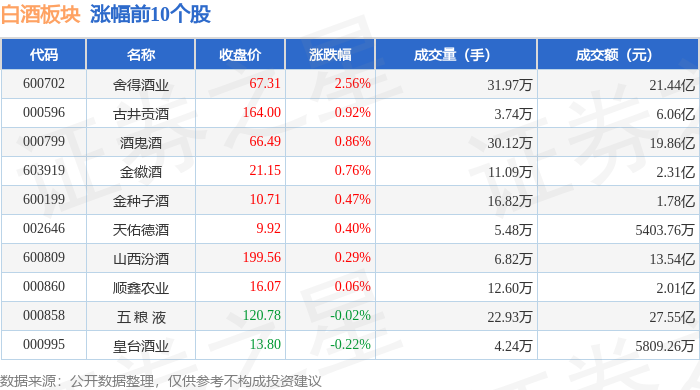
12只白酒股下跌 贵州茅台1458.99元/股收盘
Bei Jing Shang Bao· 2025-11-11 07:41
Core Viewpoint - The liquor sector showed mixed performance with a slight overall increase, while individual stocks experienced varied movements, indicating a potential recovery in the industry by 2026 according to CICC's forecast [1] Industry Summary - On November 11, the Shanghai Composite Index closed at 4002.76 points, down 0.39%, while the liquor sector index closed at 2359.06 points, up 0.39% [1] - CICC predicts that the liquor industry will see a gradual improvement starting in the first half of next year, with leading companies benefiting the most due to their strong fundamentals and market share logic [1] Company Summary - Kweichow Moutai closed at 1458.99 CNY per share, down 0.23% [1] - Wuliangye closed at 120.78 CNY per share, down 0.02% [1] - Shanxi Fenjiu closed at 199.56 CNY per share, up 0.29% [1] - Luzhou Laojiao closed at 141.64 CNY per share, down 0.60% [1] - Yanghe Brewery closed at 70.80 CNY per share, down 1.05% [1]
欧阳千里走进汾酒融媒体中心,开讲后真相时代的酒业舆情功守道
Sou Hu Cai Jing· 2025-11-11 04:39
Core Insights - The session led by Ouyang Qianli focused on the challenges and strategies for brand management in the "post-truth era" of the liquor industry, emphasizing the importance of understanding public sentiment and media dynamics [1][3] Group 1: Industry Challenges - In the "post-truth era," irrational factors such as personal emotions and cognitive biases often outweigh objective facts in influencing public opinion, posing unprecedented challenges for brand management in the liquor industry [3] - Many seemingly sudden public relations crises in the liquor sector have traceable internal logic and evolution patterns, highlighting the need for historical learning and understanding the essence of public sentiment [3] Group 2: Case Studies and Insights - Ouyang Qianli analyzed various public sentiment cases involving brands like Moutai, Tinghua Wine, Hongmao Medicine Wine, Jianshiyuan, and Xifeng Wine, identifying commonalities in brand communication and public sentiment management [3] - Key insights include that issues other than product quality can often be resolved, that public sentiment does not always reflect public opinion, and that influencing others requires addressing their irrationality rather than solely relying on rational arguments [3] Group 3: Strategies for Risk Management - To effectively manage public opinion risks, companies like Fenjiu must not only understand the situation but also the underlying reasons, establishing a real-time public sentiment monitoring system to clarify the sources of public opinion [4] - Ensuring corporate transparency should be a proactive strategy, focusing on preventive clarification rather than reactive denial [4] - Engaging allies, such as experts and industry partners, to provide accurate information is crucial for filling the public discourse with supportive narratives [4] Group 4: Brand Strengths and Communication - Fenjiu's exceptional quality and rich cultural heritage serve as a stabilizing force in navigating public sentiment challenges [4] - The communication team should leverage multimedia channels to transform these strengths into resonant and empathetic content while addressing potential public sentiment risks [4] - Mastery of new media tools, understanding platform algorithms, and comprehending user psychology are essential for maintaining focus and effectively utilizing the brand's cultural heritage in a complex public discourse environment [4]

中国白酒追踪 - 品牌对 2026 年春节仍持谨慎展望;聚焦持续严格的发货管控-China Spirits Tracker_ Brands still cautious outlook on 2026CNY; focus on continued stringent shipment control
2025-11-11 02:47
Summary of China Spirits Tracker Conference Call Industry Overview - The spirits industry is currently facing challenges due to weakening demand influenced by anti-extravagance policies and a shift in the Mid-Autumn festival calendar, leading to a tough quarter for many companies in Q3 2025 [1][1][1]. - Companies are adopting a cautious outlook for the upcoming Chinese New Year (CNY) sales and earnings performance, primarily due to a high base effect and lingering policy impacts, resulting in low visibility on demand recovery [1][1][1]. Company-Specific Insights Kweichow Moutai - Moutai is pursuing growth targets mainly through wholesale channels, reporting a 14% year-over-year increase in sales for Q3 2025, despite a 15% decline in direct sales [1][1][1]. - The company is likely to adjust its growth targets for 2026 to be more rational due to pressures on wholesale prices from competitors [1][1][1]. Wuliangye - Wuliangye anticipates back-ended growth in 2026, with the first half of the year facing headwinds from a high comparative base [1][1][1]. - The wholesale price of Common Wuliangye has remained relatively stable, with a slight decrease of RMB 5 to RMB 855 per bottle [2][2][2]. Luzhou Laojiao - Laojiao is also expected to maintain stringent shipment controls, focusing on channel health and pricing strategies into the first half of 2026 [1][1][1]. Feitian Moutai - The wholesale price of Original case Feitian Moutai has decreased by RMB 25 to RMB 1,675, while unpacked Feitian Moutai's price dropped by RMB 40 to RMB 1,640 [2][2][2]. - Various SKUs of Moutai have seen price reductions ranging from RMB 60 to RMB 120 per bottle [2][2][2]. Guojiao 1573 - The wholesale price for Guojiao 1573 has remained stable at RMB 850 per bottle, indicating a lack of significant price movement in the current market [2][2][2]. Market Dynamics - The spirits market is characterized by stringent shipment controls among leading premium brands, with a focus on maintaining channel health and pricing systems [1][1][1]. - The overall sentiment in the spirits industry remains cautious, with companies preparing for potential challenges in the upcoming quarters due to regulatory impacts and market conditions [1][1][1]. Performance Metrics - The stock performance of select spirits companies shows mixed results, with Kweichow Moutai and ZJLD being relatively better performers, while others like Jiangsu Yanghe and Jiugui Liquor have faced significant declines [35][35][35]. Key Risks - Potential risks include regulatory changes, such as consumption tax hikes, and a slower-than-expected macroeconomic recovery, which could impact the spirits market significantly [41][41][41]. This summary encapsulates the key points discussed in the conference call regarding the spirits industry and specific company performances, highlighting the cautious outlook and market dynamics as of Q3 2025.
11月以来91只股获机构高频评级 汽车行业最被看好
Zheng Quan Shi Bao Wang· 2025-11-11 01:19
Core Insights - The automotive industry is the most favored sector by institutions, with 11 stocks receiving ratings from 5 or more institutions [5] - A total of 91 stocks have received ratings from 5 or more institutions since November, with BYD, Shanxi Fenjiu, and Haier Zhijia leading the count [5][4] - The overall market sentiment is positive, with 59 institutions conducting 2150 "buy" ratings covering 1031 stocks [4] Company Summaries - BYD has received 13 ratings, with a total market value of 881.71 billion and a decline of 1.39% since November [3] - Shanxi Fenjiu has 12 ratings, a market value of 242.76 billion, and an increase of 4.46% [3] - Haier Zhijia has 11 ratings, a market value of 238.17 billion, and a rise of 2.10% [3] - The automotive sector shows strong performance, with production and sales in September reaching 3.276 million and 3.226 million units, respectively, marking year-on-year increases of 17.1% and 14.9% [5] Industry Trends - The automotive industry is expected to see significant growth, with projections indicating that total vehicle exports could exceed 6.5 million units in 2025, and cumulative sales of new energy vehicles may surpass 16 million units [5] - The food and beverage sector is also gaining attention, with a notable increase in the industry index by 3.22% as of November 10 [6] - Companies with growing profitability are attracting institutional interest, with 65.93% of the 91 stocks rated showing year-on-year profit growth [6][7]



白酒深度汇报:当下我们如何看待白酒行业
2025-11-11 01:01
Summary of the Baijiu Industry Conference Call Industry Overview - The Baijiu industry is expected to reach a turning point around the second quarter of 2026, with stock prices typically responding ahead of fundamentals, indicating a current bottoming expectation for the sector, which presents good absolute return potential [1][4] - The industry has undergone six quarters of adjustment, likely to bottom out by the second quarter of 2026, with a subsequent recovery in income and stock prices anticipated [1][13][16] Key Insights and Arguments - The current market structure for Baijiu has significantly changed compared to the 2013-2016 cycle, with increased industry concentration and improved market management capabilities among leading companies [1][3][14] - The wholesale price of Moutai has dropped to 1,650 RMB, which is equivalent to 34 bottles purchasable with the annual income of urban residents, indicating sufficient economic capacity for high-end Baijiu consumption [1][11] - The Baijiu sector is currently under pressure but is expected to enter a phase of recovery as new products and channels contribute to growth, creating a resonance effect between alpha and beta returns [1][5] Future Trends - The Baijiu industry is projected to see a recovery in revenue growth by the second quarter of 2026, with a potential for excess returns compared to the CSI 300 index [13][16] - The rise of sauce-flavored Baijiu and its increasing penetration rate are noted as significant trends, despite recent adjustments in this segment [14][15] Investment Recommendations - Companies are categorized into three main development lines: 1. Those that meet family demand and have competitive advantages in regional markets, such as Jinwei and Gujing [17] 2. Large enterprises with strong brand positions and operational capabilities, like Luzhou Laojiao and Moutai [17] 3. Companies that innovate in products and channels, such as Shede and Li Du, which are exploring new growth points [17] Challenges and Opportunities - Current challenges include inventory buildup and downward pricing pressures across the industry, but a recovery in demand and normalization of inventory levels are expected to lead to a turning point in revenue stabilization [20] - The valuation of Baijiu companies is at historical lows, suggesting significant upside potential once the market recovers, particularly for high-end products that remain in demand [19][21] Conclusion - The Baijiu industry is in a transitional phase, with expectations of recovery and growth in the coming years. The current low valuations present a favorable long-term investment opportunity as the market stabilizes and consumer demand rebounds [19][20]

消费赛道复苏预期升温 多只消费股估值具备优势
Zheng Quan Shi Bao· 2025-11-10 23:10
Core Viewpoint - The consumer sector is experiencing a collective rebound, driven by government policies aimed at boosting consumption and supporting key industries [1][3]. Group 1: Market Performance - As of November 10, 2023, various consumer indices, including food and beverage, beauty care, and retail, have shown less than 10% growth year-to-date, underperforming the Shanghai Composite Index [2]. - The food and beverage sector has been the weakest performer, with its index in a downward trend for the year [2]. Group 2: Institutional Outlook - Institutions are becoming increasingly optimistic about the future performance of the consumer sector, with several brokerages identifying potential investment opportunities [3]. - Open Source Securities notes that the food and beverage sector is nearing a bottom, with recovery expectations rising as negative factors have largely been released and policy impacts are slowing [3]. - Huachuang Securities highlights that service consumption is in a transformative phase, with strong policy support expected to make it a key investment theme [3]. - Galaxy Securities emphasizes the importance of enhancing consumer power and expanding quality consumption supply during the 14th Five-Year Plan period, as new consumption trends emerge [3]. Group 3: Valuation and Stock Performance - Many consumer stocks are currently seen as undervalued, with 123 stocks having a rolling P/E ratio below 30 and underperforming the Shanghai Composite Index year-to-date [4]. - Notable large-cap stocks include Kweichow Moutai, Midea Group, and Wuliangye, among others [4]. - 23 stocks have seen a cumulative decline of over 10% this year, with Ganyuan Food experiencing the largest drop at 33.79% [4]. Group 4: Future Growth Potential - From an institutional perspective, 43 of the 123 identified consumer stocks have an upside potential exceeding 20% based on consensus target prices [5]. - Proya Cosmetics leads with a projected upside of 49.05%, supported by its international expansion plans [5]. - Xueda Education follows with an expected upside of 48.6%, driven by its clear business expansion strategy in personalized education [5][6].

双11前夕白酒股集体“狂欢”!“最惨三季报”后现转机?
Nan Fang Du Shi Bao· 2025-11-10 13:28
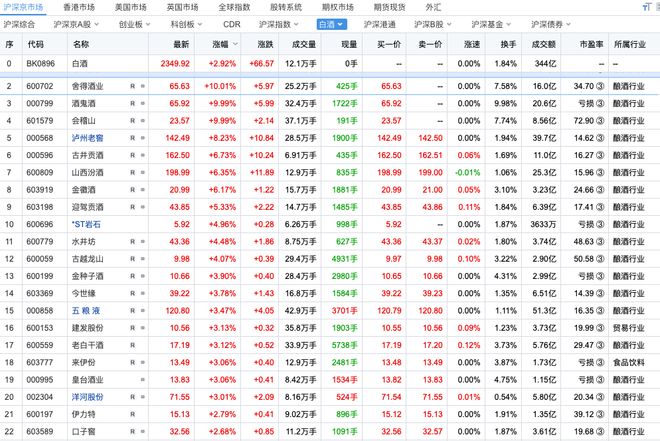
Core Viewpoint - The A-share liquor sector has experienced a significant rebound, driven by favorable policies, expectations of industry recovery, and positive macroeconomic data [1][3][9]. Group 1: Market Performance - As of November 10, the liquor sector index (BK0896) closed at 2349.92, with a rise of 2.92%, and several stocks, including Shede Liquor and Jiu Gui Jiu, reached their daily limit [1]. - Notable stocks such as Luzhou Laojiao and Gujing Gongjiu saw increases exceeding 6% [1]. - The overall market sentiment has improved, with the consumer sector also witnessing a collective rise, indicating a broader recovery trend [7]. Group 2: Policy and Industry Dynamics - A series of supportive policies have been introduced since late September, focusing on expanding domestic demand and promoting consumption, which has attracted capital to the liquor sector [3]. - The Ministry of Industry and Information Technology has included liquor in the "historical classic industries" category, emphasizing its cultural significance and potential for high-quality development [3]. - Recent policies from Guizhou province aim to shift the liquor industry from merely selling products to offering lifestyle services, indicating a strategic transformation in the sector [4]. Group 3: Financial Performance and Valuation - Despite a challenging third quarter for many liquor companies, the overall resilience of the sector has improved compared to previous downturns, with many companies showing better performance metrics [8][9]. - Analysts note that the valuation and sentiment in the sector are at low levels, which has contributed to the recent price increases [5]. - The presence of institutional investors in the market has been significant, with notable purchases in stocks like Jiu Gui Jiu, indicating renewed interest from larger players [5][6]. Group 4: Inventory and Sales Trends - The upcoming "Double 11" shopping festival is expected to help clear some inventory, although it is viewed as a short-term measure rather than a solution to the industry's deeper issues [10]. - Analysts suggest that while there is a limited recovery expected in the fourth quarter, the overall industry remains in a deep adjustment phase, with varying performance among different companies [14]. - The sales performance of premium products like Feitian Moutai has stabilized, contributing positively to market expectations [12][14].

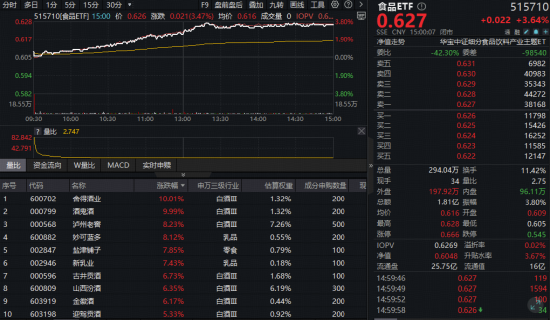
吃喝板块暴力拉升,主力狂买超百亿元!食品ETF(515710)大涨3.64%,估值低位布局正当时?
Xin Lang Ji Jin· 2025-11-10 12:09
Group 1: Market Performance - The food and beverage sector has shown strong performance, leading the market with a 3.64% increase in the food ETF (515710) as of the close on November 10 [1][3] - Major liquor stocks experienced significant gains, with Shede Liquor and Jiu Gui Liquor hitting the daily limit, and Luzhou Laojiao rising by 8.23% [1][3] Group 2: Capital Inflow - The food and beverage sector attracted over 10 billion CNY in net inflows from main funds in a single day, ranking first among 30 sectors [3][4] - The food ETF (515710) has seen a net inflow of over 1.2 billion CNY in the last five trading days and more than 2.4 billion CNY in the last ten trading days [4][5] Group 3: Valuation and Investment Opportunities - The valuation of the food and beverage sector is currently at a historical low, with the food ETF's underlying index PE ratio at 20.59, indicating a good entry point for long-term investments [6][7] - Analysts suggest that the food and beverage industry is gradually bottoming out, with opportunities to invest in liquor stocks at low prices [7][8]