
Air China(601111)

Search documents
国航杭州飞韩国一航班紧急备降上海,行李架锂电池自燃无伤亡
Bei Ke Cai Jing· 2025-10-18 05:55
Core Points - On October 18, a video was released by a netizen showing that China International Airlines flight CA139 experienced smoke and fire in the luggage compartment while flying from Hangzhou to Seoul, leading to an emergency landing at Shanghai Pudong International Airport [1][2] - The incident was caused by a lithium battery in a passenger's carry-on luggage that caught fire, and the crew followed procedures to handle the situation without any injuries reported [2] - The flight made an emergency landing at 11:05 AM on October 18, and another aircraft was dispatched to continue the flight's mission [2][4] Regulatory Context - Since June 28, the Civil Aviation Administration of China has implemented new regulations regarding the carrying of power banks on domestic flights, prohibiting those without "3C" certification or those that are unclear or recalled [4] - However, these regulations do not apply to international flights, which may pose risks for airlines operating such routes [4]


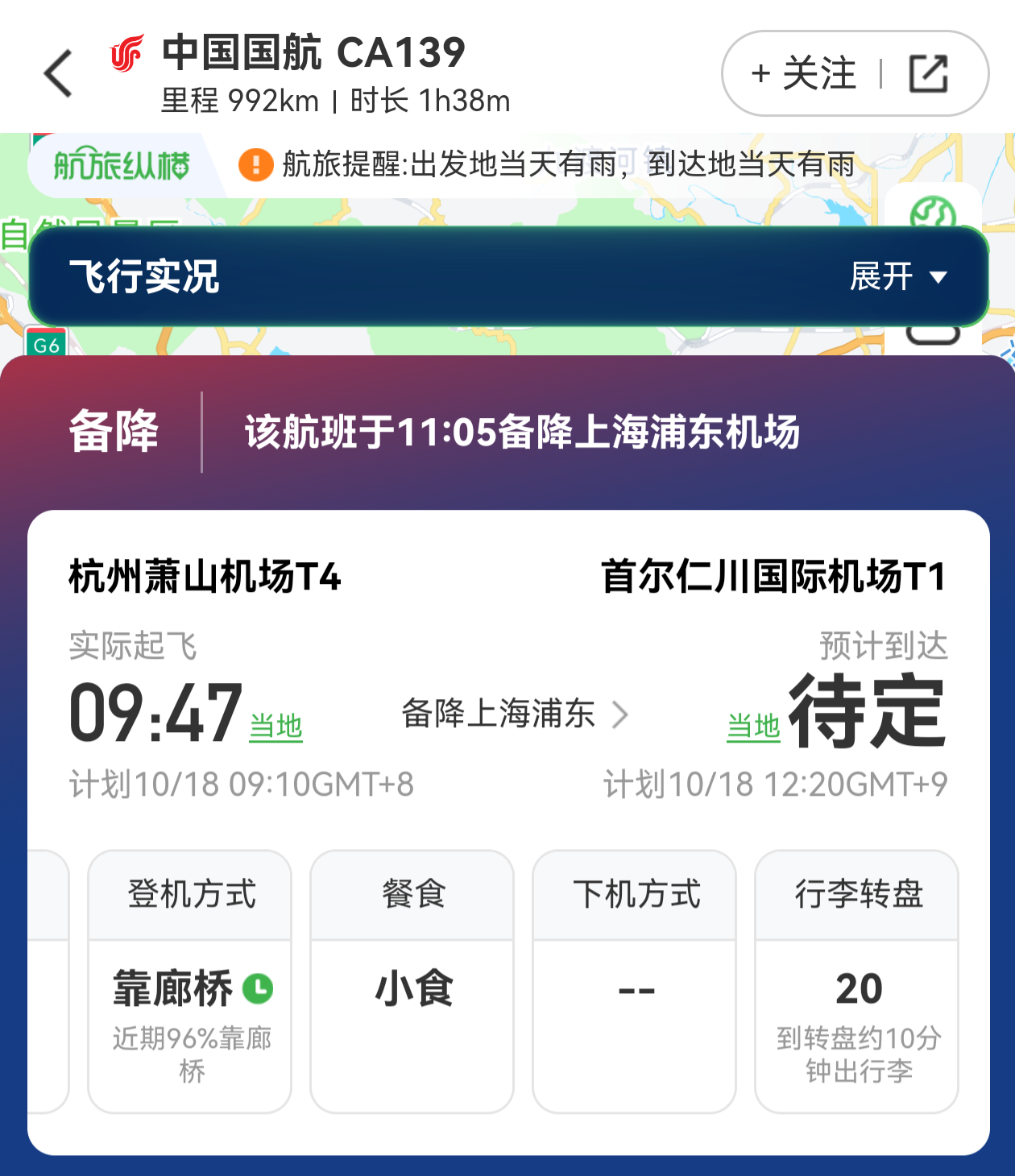
国航回应航班空中起火备降浦东
Ge Long Hui A P P· 2025-10-18 05:26
格隆汇10月18日|网传国航一杭州起飞航班起火备降。中国国际航空发布声明:10月18日,由杭州飞往 仁川的CA139航班,一名旅客存放在行李架上手提行李内锂电池自燃,机组按程序立即处置,未出现人 员受伤。为确保飞行安全,飞机已备降上海浦东机场。国航已调配飞机继续执行该航班任务。 ...
京津冀企业青年主题思享会举行,青年突击队展示科技创新成果
Bei Jing Ri Bao Ke Hu Duan· 2025-10-17 13:30
Core Insights - The "Strong Nation, Prosperous Enterprises, Discussing the Future" 2025 Beijing-Tianjin-Hebei Youth Thematic Forum and "Youth Innovation Beijing" Shopping Fair was launched to create a platform for youth exchange and cooperation among the three regions [1][7]. Group 1: Event Overview - The event took place at the North Star Group National Conference Center Phase II, featuring a vibrant atmosphere [1]. - The forum included presentations from youth representatives showcasing their responsibilities and contributions in technological innovation and regional collaborative development [3]. Group 2: Youth Initiatives - The Beijing Automotive Group's youth team shared their experiences in enhancing the safety performance of new energy vehicle batteries, achieving significant improvements in charging efficiency [3]. - The China Civil Aviation University youth team discussed their contributions to aviation safety, including the development of new bird strike prevention standards and an AI-powered engine maintenance system [3]. Group 3: Digital Innovation in Construction - The Hebei Smart Manufacturing Future Youth Team presented their case on digital practices in the construction industry, utilizing drones for real-time monitoring and developing cybersecurity robots based on GPT technology [5]. Group 4: Shopping Fair Highlights - The "Youth Innovation Beijing" Shopping Fair, running from October 17 to 19, features six themed exhibition areas with nearly 100 booths, showcasing innovative products, intangible cultural heritage brands, and rural revitalization specialties [5][7]. - The fair includes interactive experience zones such as traditional crafts workshops and creative food stations, enhancing consumer engagement through activities like Hanfu parades and NPC tasks [5][7]. Group 5: Organizers and Objectives - The event is co-hosted by various youth and governmental organizations from Beijing, Tianjin, and Hebei, aiming to foster youth collaboration and focus on technological innovation and consumer stimulation [7].





中证A500指数承压,ETF规模跌破2000亿元
2 1 Shi Ji Jing Ji Bao Dao· 2025-10-17 11:53
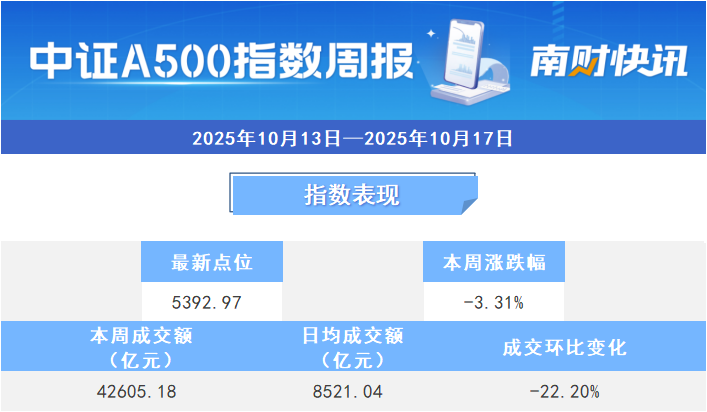
Index Performance - The CSI A500 Index decreased by 3.31% this week, closing at 5392.97 points on October 17 [5] - The average daily trading volume for the week was 8521.04 billion yuan, reflecting a 22.20% decrease compared to the previous week [5] Top Performers - The top ten gainers in the CSI A500 index included: 1. Shanghai Pudong Development Bank (600000.SH) with a gain of 12.50% 2. Agricultural Bank of China (601288.SH) with a gain of 11.57% 3. Huatian Technology (002185.SZ) with a gain of 10.02% 4. Shanghai Jahwa United Co., Ltd. (600315.SH) with a gain of 9.42% 5. Hainan Airport (600515.SH) with a gain of 8.96% 6. Shaanxi Coal and Chemical Industry (601225.SH) with a gain of 8.61% 7. Jiangsu Bank (600919.SH) with a gain of 8.60% 8. Tongwei Co., Ltd. (600438.SH) with a gain of 8.31% 9. Air China (601111.SH) with a gain of 7.63% 10. China Pacific Insurance (601319.SH) with a gain of 7.32% [2] Bottom Performers - The top ten losers in the CSI A500 index included: 1. Shengquan Group (605589.SH) with a loss of 18.04% 2. Wentai Technology (600745.SH) with a loss of 17.17% 3. Betta Pharmaceuticals (300558.SZ) with a loss of 16.98% 4. Leo Group (002131.SZ) with a loss of 16.55% 5. Jinlang Technology (300763.SZ) with a loss of 15.40% 6. Tongfu Microelectronics (002156.SZ) with a loss of 14.98% 7. Yake Technology (002409.SZ) with a loss of 14.35% 8. Lens Technology (300433.SZ) with a loss of 14.26% 9. Zhongding Sealing Parts (000887.SZ) with a loss of 13.99% 10. Robot Technology (300757.SZ) with a loss of 13.95% [2] Fund Performance - All 40 CSI A500 ETFs experienced declines, with notable drops in Huatai-PB's CSI A500 Enhanced ETF and Guolian's A500 Enhanced ETF, both falling over 4% [5] - The total scale of the CSI A500 ETFs fell below 200 billion yuan, with Huatai-PB's fund at 249.03 billion yuan, Guotai's at 226.56 billion yuan, and E Fund's at 221.29 billion yuan [5] Market Insights - Pacific Securities research team suggests a balanced allocation towards low-position sectors, particularly banks and insurance with dividend protection attributes, as well as coal and agriculture sectors benefiting from domestic demand recovery [6] - Guohai Securities research team indicates that uncertainties from trade frictions may lead to a rotation in market styles, with a shift from overvalued growth sectors to undervalued sectors [6]






A股央企ESG评价体系白皮书系列报告之十:交运央企ESG评价结果分析:绿色运输与社会责任彰显行业特色
Shenwan Hongyuan Securities· 2025-10-17 10:20
Investment Rating - The report rates the transportation industry as "Positive" [1] Core Insights - Over 80% of transportation companies have performed well in ESG scores, with 15 companies scoring above 80 and 12 above 90, representing 83% and 67% respectively [9][11] - 94% of the 18 central enterprises in the transportation sector have completed the required disclosures regarding importance assessment, but only 33% have disclosed third-party verification reports [11][13] - Companies in the high score range actively disclose climate change issues, while those in the lower range focus more on environmental issues, indicating a need for improvement in climate-related disclosures [16][17] - The report highlights the social responsibilities of transportation enterprises, particularly in rural revitalization and safety operations, with a 94% disclosure rate for safety operations [37][41] - Governance scores are generally high, with many companies integrating party building into their governance structures, showcasing a unique governance advantage [47][51] Summary by Sections Overall Performance - More than 80% of transportation companies have good overall ESG scores, with detailed financial importance disclosures and high scores in environmental, social responsibility, and governance aspects [9][16] Importance Assessment - 94% of companies have completed the required disclosures, with 17 out of 18 companies highlighting financial importance [11][13] Environmental & Climate - 83% of companies scored between 30-34 in environmental issues, with high disclosure rates for waste management (100%) and energy management (96%) [16][20] - Climate management disclosures show a high completion rate of 89%, but climate strategy disclosures need improvement, with only 56% of companies fully disclosing [32][35] Social Responsibility - Transportation enterprises have detailed their efforts in rural revitalization and social contributions, achieving a 100% disclosure rate for social responsibility [41][42] - Safety operations are a key focus, with 94% of companies disclosing relevant information [37][45] Governance - Governance scores are high, with 14 companies disclosing governance structures and mechanisms, and many integrating party building into their governance [47][51] - 94% of companies focus on safety risk management, with detailed disclosures on safety management systems [53][56]





信达证券:航司客座率高位、票价持续回正 看好四季度出行回暖
智通财经网· 2025-10-17 09:37
Core Viewpoint - The airline industry is experiencing a low growth rate in domestic capacity while focusing on increasing international routes, leading to a tight supply situation and high passenger load factors [1][2][5]. Supply and Demand - Domestic airline capacity growth is below 3%, with a significant focus on international routes, resulting in a tight supply [1][2]. - Passenger load factors remain high, with improvements compared to both the previous year and 2019, particularly in domestic routes [1][3]. - Domestic turnover volume has shown steady growth, while international turnover volume has significantly increased, nearly returning to 2019 levels [1][5]. Pricing - During the National Day and Mid-Autumn Festival holidays, the industry saw a positive year-on-year change in ticket prices, with October prices continuing to show strength [2][3]. - The average domestic ticket price from the beginning of 2025 until mid-October was 861 yuan, down 7.9% year-on-year, while the average ticket price during the holiday period was 942 yuan, down 1.5% year-on-year [3]. - Recent weeks have shown a trend of increasing ticket prices, with a 4.9% year-on-year increase in the latest week [3]. Fuel and Exchange Rates - The average price of aviation fuel in October was 5572 yuan per ton, a slight decrease of 0.1% year-on-year [4]. - The Chinese yuan has appreciated against the US dollar since the beginning of 2025, which may impact operational costs for airlines [4]. Fleet Expansion - In September, Air China had the highest net increase in aircraft, adding 5 planes, while other airlines also showed varying levels of fleet growth [6][7]. - From January to September 2025, several airlines, including Spring Airlines, showed positive growth in domestic capacity, with Spring Airlines leading at a 6.4% increase [5][7]. Investment Focus - Investors are advised to pay attention to key airlines such as China Southern Airlines, China Eastern Airlines, Air China, Spring Airlines, and Juneyao Airlines for potential investment opportunities [8].





航空机场9月数据点评:客座率整体维持较高水平,国际线同比提升明显
Dongxing Securities· 2025-10-17 09:27
Investment Rating - The industry investment rating is "Positive" [6] Core Insights - The overall passenger load factor in September remained high, with significant year-on-year improvements in international routes [1][4] - Domestic capacity growth was modest at approximately 2.2% year-on-year, while there was a notable decrease of about 15.7% compared to August [2][16] - The implementation of the self-discipline convention by the China Air Transport Association is expected to help stabilize the market and improve profitability [5] Summary by Sections 1. Industry Overview - The passenger load factor for listed airlines increased by approximately 2.1 percentage points year-on-year, while it decreased by 1.0 percentage point compared to August [3][34] - Eastern Airlines showed the most aggressive improvement in load factor, with a year-on-year increase of 3.3% in September [48] 2. Domestic Route Capacity - Domestic airlines maintained a low growth rate in capacity, with a year-on-year increase of about 2.2% and a month-on-month decrease of approximately 15.7% [2][16] - The competitive landscape is shifting towards lower price segments, necessitating cost efficiency improvements for airlines [2][18] 3. Domestic Route Load Factor - The overall load factor for domestic routes remained high, with a year-on-year increase of about 2.1 percentage points [34][42] - Major airlines like Eastern Airlines and Air China reported significant year-on-year load factor improvements of 3.3% and 3.0%, respectively [48][39] 4. International Route Capacity - International route capacity for listed airlines increased by approximately 9.4% year-on-year, while it decreased by about 9.5% compared to August [4][54] - The load factor for international routes improved by approximately 3.5 percentage points year-on-year, indicating a strong recovery compared to last year [4][60] 5. Airport Throughput - Major airports such as Shanghai, Beijing, and Shenzhen reported year-on-year growth in international passenger throughput of 19%, 13%, and 15%, respectively [68][74] - Overall, international passenger throughput growth rates are stabilizing as the industry moves into the latter half of the year [68][72]
航空机场板块10月17日涨0.17%,厦门空港领涨,主力资金净流入1.75亿元
Zheng Xing Xing Ye Ri Bao· 2025-10-17 08:31
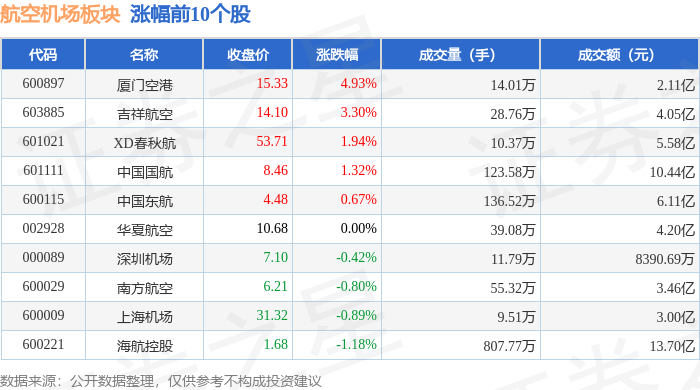
Core Insights - The aviation and airport sector experienced a slight increase of 0.17% on October 17, with Xiamen Airport leading the gains [1] - The Shanghai Composite Index closed at 3839.76, down 1.95%, while the Shenzhen Component Index closed at 12688.94, down 3.04% [1] Stock Performance - Xiamen Airport (600897) closed at 15.33, up 4.93% with a trading volume of 140,100 shares and a turnover of 211 million yuan [1] - Other notable performers include: - 吉祥航空 (603885) at 14.10, up 3.30% [1] - 中国国航 (601111) at 8.46, up 1.32% [1] - 中国东航 (600115) at 4.48, up 0.67% [1] - Conversely, 深圳机场 (000089) closed at 7.10, down 0.42% [1] Capital Flow - The aviation and airport sector saw a net inflow of 175 million yuan from institutional investors, while retail investors experienced a net outflow of 195 million yuan [2] - The detailed capital flow for key stocks includes: - 中国国航 (601111) with a net inflow of 14.4 million yuan from institutional investors [3] - 吉祥航空 (603885) with a net inflow of 64.3 million yuan from institutional investors [3] - 海航控股 (600221) had a net outflow of 54.3 million yuan from retail investors [3]




国盛证券:航司客运量增长、票价修复 关注公商务出行需求及国际航班恢复情况
Zhi Tong Cai Jing· 2025-10-17 07:33
Core Insights - The aviation industry is experiencing a steady increase in flight execution volume and passenger load factors, indicating a recovery in demand and potential for profitability improvement [1][2][5] Flight Volume and Passenger Load Factors - As of October 14, 2025, the daily flight execution volume in civil aviation is 15,539 flights, a 3.73% increase from 14,980 flights in the same period of 2024 [1][2] - Passenger load factors for July to September 2025 are 84.5%, 87.5%, and 85.8%, all exceeding the levels from the same period in 2019 [1][2] - The average passenger load factor for the three major airlines in September 2025 is 85.7%, up 5 percentage points from 2019 [2] Ticket Price Recovery - The average domestic economy class ticket price in September 2025 is 697 yuan, a 0.6% increase year-on-year, and a recovery from a 5% decrease compared to September 2019 [2] - During the National Day and Mid-Autumn Festival holiday, the average domestic economy class ticket price is 849 yuan, reflecting a 0.3% increase year-on-year and a recovery from a 1.4% decrease compared to the same holiday in 2019 [2] International and Domestic Flight Growth - The average daily execution volume of international flights and flights to Hong Kong, Macau, and Taiwan is 2,154 flights, a significant increase of 16.70% year-on-year [3] - Domestic flight execution volume averages 13,885 flights per day, a 1.91% increase year-on-year [3] - By June 2025, international flight volumes have recovered to 88% of the levels seen in the same period of 2019 [3] Supply Constraints and Future Outlook - Global aircraft manufacturers are facing significant supply chain disruptions, leading to a slowdown in aircraft deliveries, with Boeing and Airbus expected to deliver 348 and 766 aircraft in 2024, respectively [4] - The expansion of aviation capacity is expected to remain constrained due to regulatory challenges and the aging fleet [4] Oil Price Trends and Competitive Landscape - International oil prices have been on a downward trend in 2025, which is beneficial for airline profitability due to reduced fuel costs [5] - The "anti-involution" policy initiated in June 2025 aims to address the issue of continuously declining ticket prices, with expectations for price recovery in the aviation sector [5] Investment Recommendations - The combination of low supply growth, recovering demand, and decreasing oil prices suggests a favorable environment for ticket price recovery and airline profitability [6] - Continuous monitoring of demand recovery, particularly in business travel and international flight resumption, is advised [6] - Recommended stocks for investment include Huaxia Airlines, Air China, China Eastern Airlines, China Southern Airlines, Juneyao Airlines, and Spring Airlines [6]

航空运输月度专题:客座率高位、票价持续回正,看好四季度出行回暖-20251017
Xinda Securities· 2025-10-17 07:24
Investment Rating - The investment rating for the airline transportation industry is "Positive" [2]. Core Viewpoints - The industry has maintained a high passenger load factor since the beginning of 2025, with domestic airlines focusing on low growth in capacity while increasing investment in international routes. The supply remains tight with a net fleet growth rate below 3%. The passenger load factor has improved year-on-year and compared to the same period in 2019, particularly in domestic routes. Domestic turnover has shown steady growth, while international turnover has significantly recovered to 2019 levels. Ticket prices have turned positive during the National Day and Mid-Autumn Festival holidays, with demand remaining robust. The fourth quarter is expected to see improvements in year-on-year comparisons due to a low base from the previous year, which will support the recovery of unit revenue for airlines [12][13][36]. Summary by Sections Investment Suggestions - The report suggests focusing on airlines such as China Southern Airlines, China Eastern Airlines, Air China, Spring Airlines, and Juneyao Airlines due to the expected recovery in unit revenue and profitability [13][36]. Passenger Load Factor and Ticket Prices - The passenger load factor remains high, with the industry achieving a load factor of 87.5% in August 2025, up 0.6 percentage points year-on-year and 0.9 percentage points compared to 2019. Domestic turnover increased by 3.5% year-on-year, while international and regional routes have recovered to 100.4% of 2019 levels [15][19]. - Ticket prices have shown a positive trend, with the average domestic ticket price reaching 942 RMB during the National Day holiday, reflecting a year-on-year decrease of only 1.5%. The average ticket price for early October 2025 was up 2.2% year-on-year [4][23]. Oil Prices and Exchange Rates - The average aviation fuel price in October 2025 was 5572 RMB per ton, a slight decrease of 0.1% year-on-year. The Brent crude oil price has also decreased, with an average of 64.25 USD per barrel in October, down 16.7% year-on-year. The Chinese Yuan has appreciated against the US Dollar, with the exchange rate at 7.0968 RMB per USD as of October 16, 2025 [5][36][40]. Airline Operations and Fleet Growth - Airlines have continued to invest in international capacity, with domestic and international passenger load factors remaining high. In September 2025, the domestic load factor for major airlines showed significant year-on-year increases, with China Eastern Airlines leading with a 3.4 percentage point increase compared to 2019 [41][44]. - In terms of fleet growth, Air China had the highest net increase in aircraft in September 2025, adding 5 aircraft, while other airlines also showed modest growth [6][41].
