
GAC GROUP(601238)

Search documents
直击成都车展:自主品牌集体秀“硬核”实力 智能化成最大看点
Zhong Guo Jing Ying Bao· 2025-09-02 08:03
Group 1 - The Chengdu International Auto Show has officially opened, showcasing nearly 120 automotive brands and over 1,600 vehicles, highlighting the latest achievements in China's automotive industry, particularly in the fields of new energy and smart technology [1][2] - Domestic brands, especially BYD and GAC, have made significant impacts at the show, indicating their leadership in the new energy and intelligent vehicle sectors [3][10] - The show reflects a shift in the automotive industry, where it serves as a platform for observing industry trends and competitive dynamics rather than just a brand showcase [3][10] Group 2 - BYD has introduced several key models, including the 2026 Sea Lion 07 DM-i and the new version of the Qin L EV, with prices ranging from 10.98 million to 20 million yuan, aiming to provide high-quality options in the mid-to-large sedan market [4][10] - GAC's new energy segment is also making strides, with the launch of the GAC Aohong HL range extender and the A800 smart flagship sedan, showcasing the company's commitment to high-end electric vehicles [5][6] Group 3 - Other brands like Deep Blue and Xpeng have also presented new models and innovations, with Deep Blue launching the S07 SUV and Xpeng showcasing a range of vehicles and AI technologies, emphasizing their focus on intelligent driving and user experience [7][8] - The show has been strategically leveraged by local government initiatives to stimulate automotive consumption, with financial incentives for buyers during the event [9][10] Group 4 - The overall market environment indicates a strong performance of domestic brands, with retail market share reaching 64% in the first seven months of the year, reflecting a 6.9 percentage point increase year-on-year [10]


大行评级|招银国际:上调广汽集团H股目标价至4.3港元 维持“买入”评级
Ge Long Hui· 2025-09-02 03:57
招银国际发表研究报告指,虽然广汽集团次季亏损13亿元,逊该行预期,但认为市场不会重视其今年盈 亏状况,因广汽明年与华为合作推出的新型号可能更具竞争力,并成为公司一个正面的催化剂。该行又 认为公司的合资企业和联营公司,在员工成本减省上有较大空间。该行将广汽集团H股目标价由3.6港元 上调至4.3港元,维持"买入"评级。 ...
大象转身 自主大集团打响反击战
Zhong Guo Qi Che Bao Wang· 2025-09-02 01:43
Core Insights - The 28th Chengdu International Auto Show highlights the strong presence of domestic automotive groups, particularly in the electric vehicle (EV) sector, contrasting with the absence of many international luxury brands [2] - Major Chinese automotive groups like SAIC, Changan, and others have shown significant growth in their EV segments, indicating a successful transformation towards new energy vehicles [3][4][5][6] Group Performance - The top 15 automotive groups in China sold a total of 7.82 million new energy vehicles (NEVs) from January to July, marking a 41.1% year-on-year increase and accounting for 95.1% of total NEV sales [3] - China FAW's NEV sales reached 28,500 units in July, a 129.03% increase year-on-year, contributing to a total of 209,000 units sold in the first seven months, up 27.9% [4] - SAIC's total vehicle sales in July were 338,000 units, a 34.2% increase, with NEV sales reaching 117,000 units, up 64.9% [5] - Changan's total vehicle sales reached 1.566 million units in the first seven months, with NEV sales at 531,700 units, a 52.34% increase [6] Strategic Collaborations - Automotive groups are increasingly collaborating with technology companies like Huawei to enhance their EV offerings, moving away from a solely self-reliant development model [8][9][10] - SAIC and Huawei have signed a deep cooperation agreement to develop new intelligent EVs, with the first model, the Shangjie H5, receiving over 50,000 pre-orders within 18 hours of its announcement [9] Internal Restructuring - Major automotive groups are undergoing internal restructuring to consolidate resources and enhance efficiency in their NEV segments [11][12][13] - Dongfeng has restructured its brands into a new entity focused on NEVs, while Changan has improved resource allocation and decision-making efficiency following its elevation to a central enterprise [12] Global Expansion - China's NEV exports reached 1.308 million units from January to July, a year-on-year increase of 84.6%, indicating a strategic shift towards international markets [14] - Changan's "Haina Baichuan" plan aims to expand its global footprint, with a target of exporting 56,000 units by 2025 [14] - Dongfeng's strategy includes launching over 30 overseas models by 2027, while GAC Aion is also accelerating its international market entry [15][16]




广汽集团上半年营收422亿:同比降8%,扣非后净亏29亿,经营未达预期
3 6 Ke· 2025-09-02 01:07
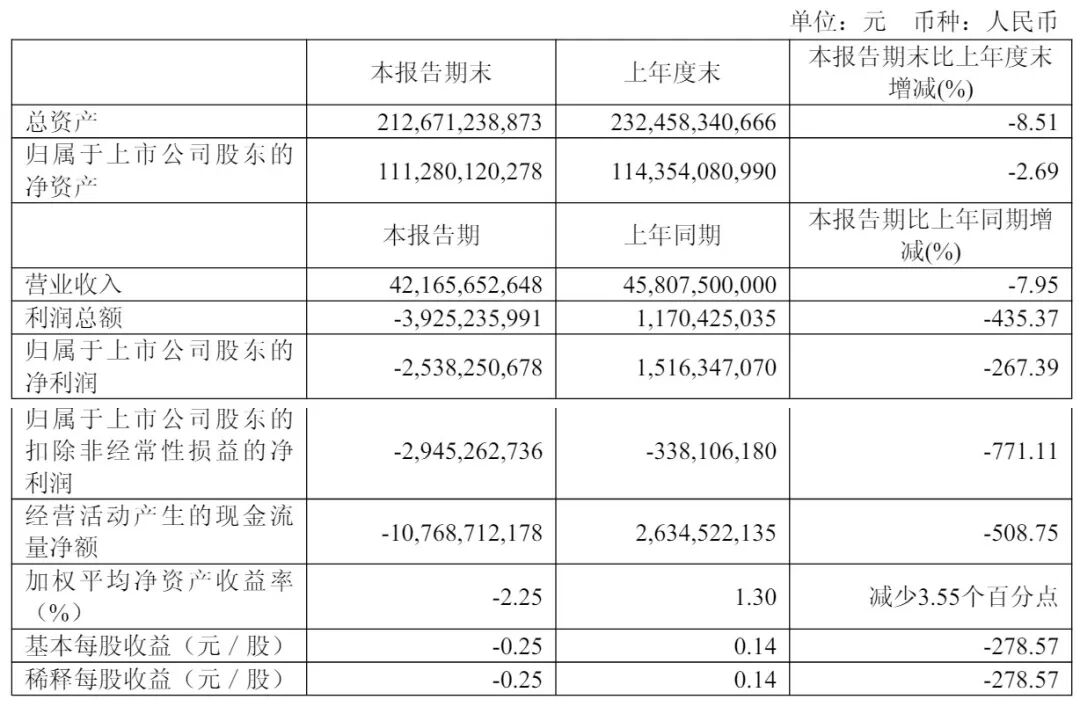
Core Viewpoint - GAC Group reported a decline in revenue and significant net losses for the first half of 2025, indicating challenges in achieving operational targets and overall performance [1][3]. Financial Performance - Revenue for the first half of 2025 was CNY 42.166 billion, down 7.95% from CNY 45.8 billion in the same period last year [1][2]. - The net loss for the first half of 2025 was CNY 2.538 billion, compared to a net profit of CNY 1.516 billion in the previous year, marking a decline of 267.39% [2]. - The total profit for the period was a loss of CNY 3.925 billion, a decrease of 435.37% from the previous year's profit of CNY 1.170 billion [2]. - Cash flow from operating activities showed a significant decline, with a net outflow of CNY 10.769 billion compared to a positive inflow of CNY 2.635 billion in the previous year [2]. Business Segments - GAC Group's main business includes R&D, vehicle manufacturing (cars, motorcycles), parts, trade and mobility, energy and ecology, internationalization, and investment and finance, forming a complete automotive industry chain [5]. - The company produced and sold 801,700 vehicles and 755,300 vehicles respectively, representing a year-on-year decrease of 6.73% and 12.48% [7]. - New energy vehicle sales were 154,100 units, down 6.08% year-on-year, while energy-saving vehicle sales increased by 13.43% to 211,600 units [7]. Revenue Breakdown - Revenue from the automotive manufacturing sector was CNY 24.65 billion, down 19.39% year-on-year [8]. - Revenue from parts manufacturing increased by 9.81% to CNY 2.1 billion [8]. - Revenue from trade services rose by 15.67% to CNY 13.132 billion [8]. - Financial and other income increased by 13.22% to CNY 2.724 billion [8]. Shareholding Structure - As of June 30, 2025, GAC Group held 54.02% of the shares, while HKSCC NOMINEES LIMITED held 27.56% [10]. - The total number of shareholders was 135,756 [11]. Market Performance - As of September 1, 2025, GAC Group's stock price was CNY 7.73, with a market capitalization of CNY 78.8 billion [17].
【2025半年报点评/广汽集团】业绩表现略低预期,静待一体化改革效果显现
东吴汽车黄细里团队· 2025-09-01 14:15
Core Viewpoint - GAC Group's Q2 2025 performance shows a decline in revenue and net profit, indicating challenges in the competitive automotive market, but potential for recovery exists through strategic partnerships and reforms [2][4]. Revenue Performance - Q2 2025 revenue reached 22.73 billion yuan, reflecting a decrease of 8% year-on-year but an increase of 14% quarter-on-quarter [2]. - GAC Passenger Vehicles and GAC Aion's Q2 wholesale sales were 77,000 and 62,000 units, down 25% and 21% year-on-year, but up 11% and 31% quarter-on-quarter respectively [3]. Profitability Metrics - The Q2 gross margin was -3.4%, a decline attributed to the introduction of new energy models that have not yet met sales targets [3]. - The net profit attributable to shareholders was -1.81 billion yuan, compared to a profit of 300 million yuan in Q2 2024 and a loss of 730 million yuan in Q1 2025 [3]. Investment Income - GAC's investment income totaled 1.23 billion yuan in Q2, down 13% year-on-year but up 5% quarter-on-quarter [3]. - GAC Honda and GAC Toyota's Q2 sales were 62,000 and 183,000 units, with Honda down 32% year-on-year and Toyota up 2% [3]. Future Outlook - The company has revised its net profit forecasts for 2025, 2026, and 2027 to -360 million, 1.3 billion, and 4.6 billion yuan respectively, down from previous estimates [4]. - The partnership with Huawei is expected to yield new models by 2026, potentially boosting sales [4].
汽车电子2025Q2业绩综述:国内、电动化承压,全球化、智能化可圈可点
Soochow Securities· 2025-09-01 11:37
Investment Rating - The report suggests a structural allocation strategy in the automotive sector, emphasizing a shift towards "dividend style" investments in the second half of 2025 [3]. Core Insights - The automotive industry is at a crossroads, with the electric vehicle (EV) boom nearing its peak and the smart vehicle sector still in its early stages. Historical transitions in 2011 and 2018 indicate potential for structural market opportunities [3]. - The report highlights a mixed performance across different segments, with passenger vehicles showing strong retail and export growth, while heavy trucks and buses are experiencing a rise in demand due to policy support [4][7][8]. - The overall financial indicators for the automotive sector improved in Q2 2025, but the performance of leading passenger vehicle manufacturers fell short of expectations due to intensified competition and pricing pressures [4]. Summary by Sections Passenger Vehicles - The passenger vehicle sector experienced a high growth phase, with retail, export, and wholesale figures increasing by 14%, 15%, and 14% year-on-year respectively in Q2 2025. This growth was supported by a low base from the previous year [4][30]. - Despite the overall positive growth, the penetration rate of new energy vehicles remained below expectations, influenced by competitive pricing strategies from traditional fuel vehicle brands [4][31]. - Leading companies like BYD and Great Wall Motors showed strong export performance, particularly in non-Russian markets [4][30]. Heavy Trucks - The heavy truck segment saw a slight increase in wholesale sales, with a year-on-year growth of 18.3% in Q2 2025, driven by the effectiveness of trade-in policies [7]. - The report anticipates continued growth in the heavy truck sector due to supportive government policies and a recovering market after a prolonged downturn [7]. Buses - The bus sector's performance was mixed, with leading companies like Yutong achieving excess returns despite overall market challenges. The report suggests that the second half of 2025 may see improved demand due to policy incentives [8]. Motorcycles - The motorcycle industry experienced significant growth in exports, particularly in the large displacement segment, with a year-on-year increase of 22% in Q2 2025. However, domestic sales showed a decline [9]. - The report indicates a favorable outlook for exports, with the potential for continued growth in the overseas motorcycle market [9]. Components - The component sector displayed resilience, with varying performance across companies. The report notes that companies with strong management and competitive structures are better positioned to navigate cost pressures [14]. - The report emphasizes the importance of cost reduction and efficiency improvements as key trends in the component sector [13]. Robotics - The robotics segment showed a mixed performance, with some companies benefiting from structural changes while others faced challenges due to market conditions. The report highlights the potential for growth in the human-robot collaboration space [15].


广汽集团(601238):收入同比有所下滑,加快海外市场拓展
CAITONG SECURITIES· 2025-09-01 11:31
Investment Rating - The investment rating for the company is "Buy" (maintained) [2] Core Views - The company reported a revenue of 42.17 billion yuan in the first half of 2025, a year-on-year decline of 7.95%, and a net profit attributable to shareholders of -2.54 billion yuan, compared to a profit of 1.52 billion yuan in the same period last year [7] - The gross margin decreased to -1.7%, down 7.7 percentage points year-on-year, while the selling expense ratio increased to 6.2%, up 0.8 percentage points year-on-year [7] - The company achieved a significant increase in overseas sales of its self-owned brands, with over 50,000 units sold, representing a year-on-year growth of 45.8% [7] - The company plans to introduce four new models to overseas markets and has entered 84 countries and regions, establishing over 570 outlets [7] - The company aims to achieve net profits of 5.23 billion yuan, 9.99 billion yuan, and 17.19 billion yuan for the years 2025, 2026, and 2027, respectively, with corresponding PE ratios of 150.8, 78.9, and 45.9 [7] Financial Performance Summary - Revenue forecast for 2023A is 128.76 billion yuan, with a growth rate of 17.5%, followed by a decline of 17.1% in 2024A [6] - The net profit for 2023A is projected at 4.43 billion yuan, with a significant drop of 45.1% year-on-year [6] - The EPS for 2023A is 0.42 yuan, expected to decrease to 0.05 yuan in 2025E [6] - The company’s ROE is forecasted to decline from 3.8% in 2023A to 0.5% in 2025E [6]
“大象转身”,自主大集团打响反击战
Zhong Guo Qi Che Bao Wang· 2025-09-01 10:04
Core Viewpoint - The 28th Chengdu International Auto Show highlights the significant progress of domestic automotive groups in the new energy sector, showcasing their collaboration with technology companies like Huawei and their internal reforms to enhance competitiveness in the rapidly evolving market [2][8]. Group 1: Growth in New Energy Sector - From January to July 2023, the top 15 automotive groups in China sold a total of 7.82 million new energy vehicles (NEVs), marking a 41.1% year-on-year increase and accounting for 95.1% of total NEV sales [3]. - China FAW's NEV sales reached 28,500 units in July, a staggering increase of 129.03% year-on-year, contributing significantly to overall growth [4]. - SAIC Motor's NEV sales for the first seven months of 2023 reached 763,600 units, up 43.49% year-on-year, positioning it third in sales after BYD and Geely [5]. Group 2: Strategic Collaborations - Major automotive groups are increasingly collaborating with technology firms, particularly Huawei, to enhance their product offerings and market competitiveness [8][9]. - SAIC and Huawei signed a deep cooperation agreement to develop new energy smart vehicles, leading to the launch of the "Shangjie" brand [9]. - FAW has also partnered with the new energy vehicle startup Leap Motor, indicating a trend of strategic alliances within the industry [9]. Group 3: Internal Restructuring - Automotive groups are undergoing internal restructuring to optimize resources and enhance efficiency in their new energy vehicle segments [11][12]. - Dongfeng Motor has consolidated its brands into Dongfeng Yipai Technology, focusing on new energy products and streamlining operations [12]. - Changan Automobile has improved resource integration efficiency significantly after its restructuring, enhancing decision-making and capital allocation [13]. Group 4: International Expansion - From January to July 2023, China's NEV exports reached 1.308 million units, reflecting an 84.6% year-on-year increase, as companies look to expand into overseas markets [15]. - Changan has launched its "Haina Baichuan" global strategy, aiming to export various models to over 90 countries by 2025 [15]. - Dongfeng Yipai Technology plans to introduce over 30 overseas models by 2027, indicating a strong focus on international market penetration [16].

广汽集团发布2025年半年报, “番禺行动”迅速落地并有积极进展
Zhong Guo Jing Ying Bao· 2025-09-01 09:10
Core Insights - GAC Group reported a consolidated revenue of approximately 42.611 billion yuan for the first half of 2025, with a debt-to-asset ratio of 44.65%, improving by nearly 3 percentage points from the end of 2024 [1] - The company produced 801,700 vehicles and sold 755,300 vehicles in the first half of the year, with energy-efficient and new energy vehicles accounting for 48.43% of total sales [1] - GAC Group has entered 84 countries and regions globally, establishing over 570 outlets, with a 45.8% increase in export sales of its own brands [1] User Insight and Product Development - GAC Group is enhancing its R&D system starting from user insights to product delivery, focusing on both practical and emotional value of products [2] - The company is implementing an Integrated Product Development (IPD) reform to improve communication and decision-making efficiency, thereby reducing product development cycles and costs [2] - GAC Group aims to transform the development of popular models from "accidental" to "inevitable" by establishing a system to enhance user insight capabilities [2] Service Experience and Marketing Strategy - GAC Group is restructuring its marketing service system by introducing an Integrated Product Marketing and Sales (IPMS) system, focusing on a user-centered approach [3] - The company is accelerating its channel penetration in lower-tier cities and building a comprehensive sales service center [3] - GAC Group emphasizes the importance of understanding customer needs and enhancing user experience to adapt to industry changes [3] Strategic Initiatives and Product Launches - GAC Group is in a "wartime state," focusing on three key battles: user demand, product value, and service experience to reshape the company [3] - The company has shortened the standard development cycle for models to 18 months and reduced R&D costs by over 10% through improved management processes [4] - GAC Group is set to launch several new products, including the GAC Aion i60, and has introduced its intelligent technology brand "Starry Intelligence" [4] Collaboration and Global Expansion - GAC Group is enhancing R&D collaboration with joint ventures like GAC Toyota and GAC Honda to accelerate the development of smart electric vehicles [5] - The company plans to create global star products with annual sales targets of 50,000 to 100,000 units in key markets, while expanding its KD factory network [5] - GAC Group is focusing on understanding local market demands in regions like Europe and South America to optimize product offerings [5] Cost Control and Supply Chain Management - GAC Group is prioritizing extreme cost control and building a competitive global supply chain to enhance operational efficiency [6] - The company is integrating supply chain resources and optimizing procurement channels to reduce costs and improve decision-making efficiency [6] - GAC Group aims to achieve core supply chain autonomy to reduce reliance on external suppliers and enhance stability [7] Future Outlook - Despite challenges in the market, GAC Group has made significant progress in user insights, product development, and cost control [8] - The company is expected to stabilize its performance in the second half of the year through continued efforts in new product launches and market expansion [8] - GAC Group is committed to high-quality development and innovation to contribute to the recovery of the automotive industry in China [8]
2025年车企中报公布,广汽集团资产负债率优化至45%
Di Yi Cai Jing Zi Xun· 2025-09-01 08:36
Core Viewpoint - The automotive market in China is experiencing intense competition, and the financial health of companies is crucial for sustainable development. GAC Group stands out with a low debt ratio and is implementing strategic initiatives to improve its performance and market position [1][2]. Financial Performance - GAC Group's debt ratio is approximately 44.65%, significantly lower than the industry average of 55% to 70%, and has improved by nearly 3 percentage points from the end of 2024 [2]. - The company produced 801,700 vehicles and sold 858,000 vehicles in the first half of the year, with energy-efficient and new energy vehicles accounting for 48.43% of total sales [1][3]. Strategic Initiatives - GAC Group is focused on three main tasks: stabilizing joint ventures, strengthening independent brands, and expanding ecosystems, under the "Panyu Action" initiative [1]. - The company is integrating supply chain resources and optimizing its global industrial chain, resulting in a 50% increase in business and decision-making efficiency [3]. Product Development and Innovation - GAC Group invested 3.789 billion yuan in R&D, launching several intelligent technology products and forming strategic partnerships with companies like Huawei and Tencent [5][6]. - The company plans to accelerate the launch of new products, including extended-range models and various new energy vehicles, to enhance its product matrix [3][7]. International Expansion - GAC Group has entered 84 countries and regions, with a 45.8% increase in export sales of its independent brands [6]. - The company is establishing KD (knock-down) production facilities in multiple countries, including Nigeria and Thailand, to support its international market strategy [6][7]. - GAC Group aims to strengthen its presence in high-potential markets such as Europe and Australia, with plans to launch new models and expand its dealer network [7].