CMES(601872)

Search documents
油气板块表现强势,中国海油涨超3%,油气ETF汇添富(159309)涨2%创新高!地缘风险推动油价回升,资源行情轮动到石油了?
Sou Hu Cai Jing· 2026-01-13 06:05
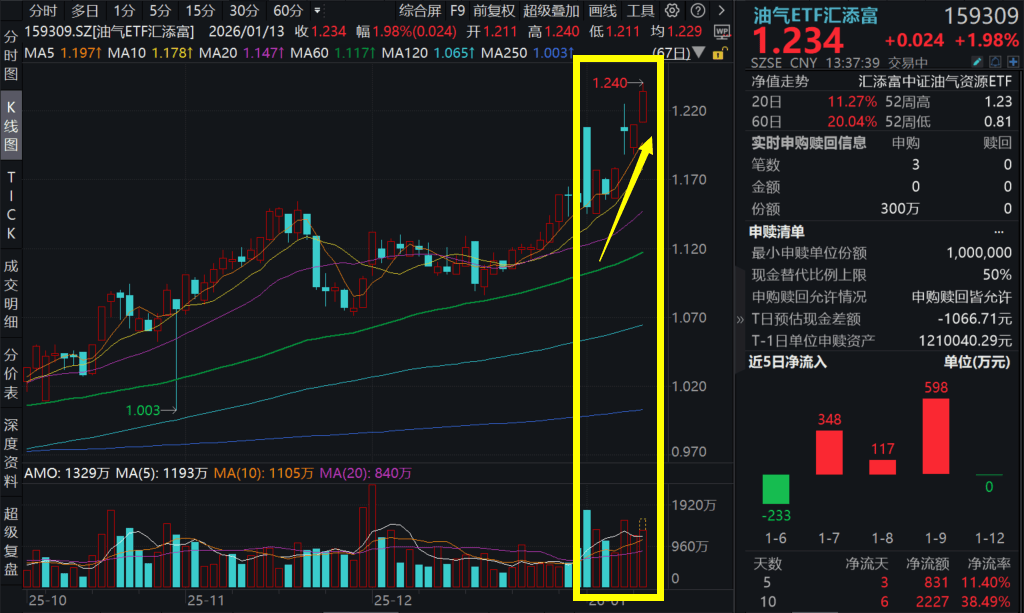
Core Viewpoint - The A-share market shows a mixed trend with the oil and gas sector experiencing significant inflows and price increases, particularly in the oil and gas ETF Huatai (159309), which reached a new high since its listing [1] Group 1: Market Performance - As of 13:38, the oil and gas ETF Huatai (159309) rose by 1.98%, hitting a new intraday high and attracting over 3.6 million yuan in capital [1] - The oil and gas sector saw most component stocks rise, with China National Offshore Oil Corporation (CNOOC) increasing over 3% and China Petroleum & Chemical Corporation (Sinopec) rising over 1% [5] Group 2: Geopolitical Factors - Concerns over the situation in Iran are supporting oil prices, with crude oil futures stabilizing near a one-month high [2] - Citic Futures indicates that geopolitical disturbances are likely to drive oil prices higher in the short term, despite a current oversupply in the global oil market [3] Group 3: Supply and Demand Dynamics - The OPEC+ group has decided to maintain its oil production levels, reflecting a desire to balance oil prices amid geopolitical tensions [4] - The International Energy Agency (IEA) projects a global oil demand increase of 860,000 barrels per day in 2026, with chemical feedstock demand expected to dominate this growth [6] Group 4: Investment Insights - The oil and gas sector is showing signs of recovery, with high dividend characteristics making it attractive for investors [6] - The oil and gas ETF Huatai (159309) focuses on the oil and gas industry chain, presenting long-term investment value amid external uncertainties [7]





招商轮船股价涨5.33%,华泰柏瑞基金旗下1只基金位居十大流通股东,持有5479.54万股浮盈赚取3123.34万元
Xin Lang Cai Jing· 2026-01-13 05:50
Core Viewpoint - China Merchants Energy Transportation Co., Ltd. (招商轮船) has seen a significant stock price increase of 18.76% over the past three days, with a current price of 11.27 CNY per share and a market capitalization of 91 billion CNY [1] Group 1: Company Overview - China Merchants Energy Transportation Co., Ltd. was established on December 31, 2004, and listed on December 1, 2006 [1] - The company is primarily engaged in maritime transportation services, with revenue breakdown as follows: 86.38% from transportation services, 6.75% from other income, 4.77% from merchandise sales, and 2.10% from shipping support services [1] Group 2: Shareholder Insights - Huatai-PineBridge Fund holds a significant position in China Merchants Energy Transportation, with its Huatai-PineBridge CSI 300 ETF (510300) reducing its holdings by 2.88 million shares in Q3, now holding 54.8 million shares, representing 0.68% of the circulating shares [2] - The ETF has generated a floating profit of approximately 31.23 million CNY today and 92.60 million CNY during the three-day price increase [2] Group 3: Fund Performance - The Huatai-PineBridge Oil and Gas Fund (561570) has also invested in China Merchants Energy Transportation, holding 136,300 shares, which is 5.85% of the fund's net value [3] - The Oil and Gas Fund has achieved a floating profit of about 0.0777 million CNY today and 0.2303 million CNY during the three-day price increase [3]
航运港口板块1月12日涨1.65%,招商轮船领涨,主力资金净流出2.31亿元
Zheng Xing Xing Ye Ri Bao· 2026-01-12 09:04
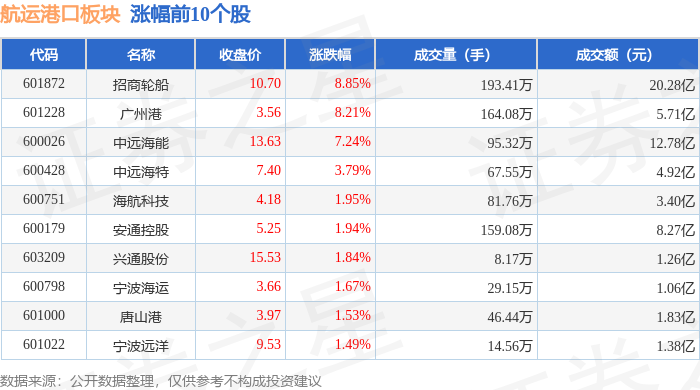
Core Viewpoint - The shipping and port sector experienced a rise of 1.65% on January 12, with China Merchants Energy leading the gains, reflecting positive market sentiment in the industry [1]. Group 1: Market Performance - The Shanghai Composite Index closed at 4165.29, up by 1.09% [1]. - The Shenzhen Component Index closed at 14366.91, up by 1.75% [1]. - Key stocks in the shipping and port sector showed significant increases, with China Merchants Energy rising by 8.85% to a closing price of 10.70 [1]. Group 2: Stock Performance - China Merchants Energy (601872) closed at 10.70, with a trading volume of 1.9341 million shares and a transaction value of 2.028 billion [1]. - Guangzhou Port (601228) closed at 3.56, up by 8.21%, with a trading volume of 1.6408 million shares [1]. - COSCO Shipping Energy (600026) closed at 13.63, up by 7.24%, with a trading volume of 953,200 shares [1]. Group 3: Capital Flow - The shipping and port sector saw a net outflow of 231 million in main funds, while retail investors contributed a net inflow of 214 million [2]. - The sector's stocks experienced varied capital flows, with China Merchants Energy seeing a net inflow of 924.23 million from retail investors despite a net outflow from main funds [3].


交运行业2026年投资策略:航空盈利修复可期,航运绿色转型提速
Southwest Securities· 2026-01-12 07:46
Core Insights - The aviation sector is expected to see profit recovery driven by favorable exchange rates and declining international oil prices, which will alleviate fuel cost pressures for airlines. Structural growth in air travel demand is anticipated due to economic growth, with key recommendations including Southern Airlines, Spring Airlines, and Huaxia Airlines [4][19][22]. - The highway industry in China has entered a mature phase, with future trends expected to include renovation and expansion, mergers and acquisitions, and business diversification. A key recommendation is Zhongyuan Expressway [4][58]. - The shipping industry is transitioning towards green methanol as a mainstream choice for zero-emission energy, with significant growth in renewable methanol projects expected by 2030. Recommended companies include CIMC Enric and COSCO Shipping International [4][89]. - The dry bulk shipping sector is witnessing structural growth due to increased transportation distances for iron ore imports and strong demand for alumina imports. Recommended companies include China Merchants Energy Shipping and Haitong Development [4]. Aviation Sector - The recovery in airline profits is supported by a favorable exchange rate and lower oil prices, with the potential for ticket prices to rise as demand increases [4][22]. - Domestic airlines are facing limited capacity expansion due to engine supply issues, while the demand for air travel is expected to grow structurally [25][31]. - The average fuel price decline is projected to reduce operational costs significantly for airlines, enhancing profitability [24][22]. - The domestic air travel market is expected to grow as the per capita flight frequency in China remains lower than the global average, indicating room for growth [34][35]. Highway Sector - The highway industry is projected to see a slowdown in construction investment, with new regulations potentially extending toll periods for aging highways [4][64]. - The total length of highways in China has surpassed that of the United States, with ongoing investments expected to enhance the network further [63][58]. - The introduction of new toll regulations may provide a framework for sustainable development in the highway sector [67][68]. Shipping Sector - The global shipping industry is increasingly adopting green methanol technology, with a significant number of renewable methanol projects expected to come online by 2030 [4][89]. - The demand for dry bulk shipping is expected to grow due to changes in iron ore import sources and increased distances, presenting opportunities for shipping companies [4].





全球区域局势持续推升油价,油气ETF(159697)冲击3连涨
Sou Hu Cai Jing· 2026-01-12 07:15
Group 1 - The global geopolitical situation continues to drive up oil prices, leading to an upturn in the oil transportation market [1] - In 2025, the annual crude oil production of the Huabei Oilfield is expected to exceed 5 million tons, marking the second consecutive year of surpassing this threshold since 2024 [1] - Venezuela's short-term crude oil exports may remain constrained, but long-term legalization of exports could boost compliant market oil transportation demand [1] Group 2 - Venezuela's crude oil production is projected to account for approximately 1% of global output in 2025, with its maritime export volume representing about 2% of the global total [1] - Of the crude oil exported by Venezuela, around 17% is sent to the United States, while over 50% is exported to Asia via shadow fleets [1] - As of January 12, 2026, the Guozheng Oil and Gas Index (399439) has risen by 0.55%, with significant increases in stocks such as Tai Holdings (up 20.02%) and Jiufeng Energy (up 9.92%) [1] Group 3 - The Guozheng Oil and Gas Index (399439) reflects the price changes of publicly listed companies in the oil and gas sector on the Shanghai and Shenzhen stock exchanges [2] - As of December 31, 2025, the top ten weighted stocks in the Guozheng Oil and Gas Index include China National Petroleum, Sinopec, and China National Offshore Oil Corporation, collectively accounting for 67.11% of the index [2] Group 4 - The Oil and Gas ETF (159697) closely tracks the Guozheng Oil and Gas Index [3]


交运-2025年运价再创新高-2026年期待超级牛市
2026-01-12 01:41
Summary of Conference Call on Oil Shipping Industry Industry Overview - The oil shipping market is expected to face pressure in the second half of 2024 but is projected to recover significantly in the first half of 2025 due to a drop in oil prices, increased refinery operating rates, and enhanced sanctions by the U.S. against Iran, improving supply-demand dynamics in the compliant market [1][8] - Starting from August 2025, the oil shipping market is anticipated to experience rapid growth, with VLCC TCE rates doubling to over $100,000, driven by OPEC+ increasing production, significant output from Venezuela, and U.S. sanctions on Russia and India [1][9] Key Points and Arguments - **Market Recovery**: The oil shipping market is expected to see a significant recovery in 2025, particularly in Q4, with rates reaching over $100,000, despite a challenging period in late 2024 [2][19] - **Investment Opportunities**: The oil shipping sector is projected to have good investment opportunities in 2026, with a steady increase in oil production benefiting shipping demand, while compliant market supply growth remains limited [3][15] - **Super Bull Market Logic**: The anticipated "super bull market" is based on two phases: the first driven by geopolitical conflicts leading to longer shipping distances and increased demand, and the second starting in 2025, driven by global oil production increases [4][18] - **Impact of Gray Market**: Changes in the gray market, characterized by non-compliant trade channels, are expected to positively influence the compliant market by reducing operational efficiency of shadow fleets, thus enhancing demand for compliant shipping [5][10][12] Additional Important Insights - **Geopolitical Influence**: Future changes in U.S. sanctions on countries like Venezuela, Russia, and Iran could significantly impact the oil shipping industry by potentially converting gray market exports to compliant market shipments, increasing overall shipping volumes [14][19] - **Market Sensitivity**: The compliant market's sensitivity to supply-demand changes is expected to increase, with capacity utilization rates remaining high, which could drive prices above $60,000 per day in 2026 [3][16] - **Investment Recommendations**: Investors are advised to focus on companies like COSCO Shipping Energy, China Merchants Energy Shipping, and China Shipbuilding Leasing, which are expected to benefit from the upcoming super bull market [7][17] Conclusion - The outlook for the oil shipping industry remains optimistic, with significant recovery expected in 2025 and continued growth into 2026, driven by geopolitical factors and oil production increases. Investors are encouraged to take advantage of current market conditions and consider strategic investments in key shipping companies [19]

招商轮船年盈利预计首次站上60亿 积极分红回购近三年投入55.56亿
Chang Jiang Shang Bao· 2026-01-11 23:35
Core Viewpoint - China Merchants Energy Shipping Company (招商轮船) is expected to achieve a significant increase in net profit for the fiscal year 2025, driven by market recovery in the oil tanker sector [2][5]. Financial Performance - The company anticipates a net profit attributable to shareholders of between 60 billion to 66 billion yuan for 2025, representing a year-on-year growth of 17% to 29% [2][5]. - The fourth quarter net profit is projected to increase by 9.62 billion to 15.62 billion yuan, with a growth rate of 55% to 90% [2][5]. - The expected net profit for 2025 marks the first time the company’s annual net profit exceeds 60 billion yuan, setting a historical record [5][6]. Profitability Metrics - The company forecasts a net profit excluding non-recurring items (扣非净利润) of 50.05 billion to 56.05 billion yuan for 2025, with a slight increase of -1 million to 5.9 billion yuan year-on-year, reflecting a growth rate of -0.2% to 12% [5][6]. - The fourth quarter's扣非净利润 is expected to rise by 3.77 billion to 9.77 billion yuan, with a growth rate of 22% to 57% [5][6]. Historical Performance - From 2018 to 2024, the company's net profit attributable to shareholders has shown a consistent upward trend, increasing from 11.67 billion yuan to 51.07 billion yuan, representing a growth of 3.38 times [6][7]. - The扣非净利润 has also increased significantly over the same period, demonstrating a growth of 4.93 times [6][7]. Market Position and Strategy - The company has a strong market presence, with its oil tanker fleet being the largest globally, comprising 52 VLCCs and 37 VLOCs [8][9]. - The company is actively expanding its fleet, with recent orders for new vessels totaling approximately 1.79 billion yuan [9]. - The company has maintained a robust shareholder return strategy, distributing a total of 55.56 billion yuan in dividends and buybacks over the past three years [4][9]. Stock Market Performance - Over the past five months, the company's stock price has increased by over 60%, reflecting strong investor interest [3][9]. - As of January 9, the stock price was reported at 9.83 yuan per share, with a market capitalization of approximately 793.73 billion yuan [9].

交通运输行业周报:招商轮船发布业绩预增公告,委内原油出货或利好油运市场-20260111
SINOLINK SECURITIES· 2026-01-11 13:40
Investment Rating - The report does not explicitly state an overall investment rating for the industry Core Views - The logistics sector is seeing price increases due to a reduction in low-cost deliveries, benefiting leading companies like SF Express and ZTO Express [2] - The shipping market is experiencing a stable demand with a potential increase in oil transportation due to Venezuelan oil exports, which may positively impact the oil shipping market [4] - The airline sector is expected to see profit elasticity due to supply optimization and rising ticket prices, with recommendations for China Southern Airlines and Air China [3] Summary by Sections Transportation Market Review - The transportation index remained flat during the week of January 3-9, 2026, while the Shanghai Composite Index rose by 2.8%, indicating underperformance in the transportation sector [1][12] Industry Fundamentals Tracking Shipping and Ports - The shipping market is stabilizing with a good supply-demand relationship, and oil shipping is expected to rise due to the potential for Venezuelan oil to shift from black market to compliant market [20] - The China Export Container Freight Index (CCFI) was 1194.89 points, up 4.2% week-on-week but down 22.8% year-on-year [21] - The domestic trade container freight index (PDCI) was 1337 points, down 0.4% week-on-week and down 1.0% year-on-year [28] Aviation and Airports - In November 2025, civil aviation passenger volume reached 60.17 million, a year-on-year increase of 6%, with domestic routes up 5% and international routes up 19% [59] - The average daily flights in the week of January 3-9, 2026, were 14,725, a slight increase of 0.28% year-on-year [3] Rail and Road - In November 2025, national railway passenger volume was 331 million, up 8.94% year-on-year, while freight volume was 46 million tons, up 1.16% year-on-year [83] - The national highway freight volume was 3.876 billion tons, up 3.57% year-on-year, but the number of trucks on highways decreased by 14.86% week-on-week [89]
A股800亿油运巨头业绩预增200%,国际油价一周涨超4%,全球油轮股暴涨
2 1 Shi Ji Jing Ji Bao Dao· 2026-01-10 02:27
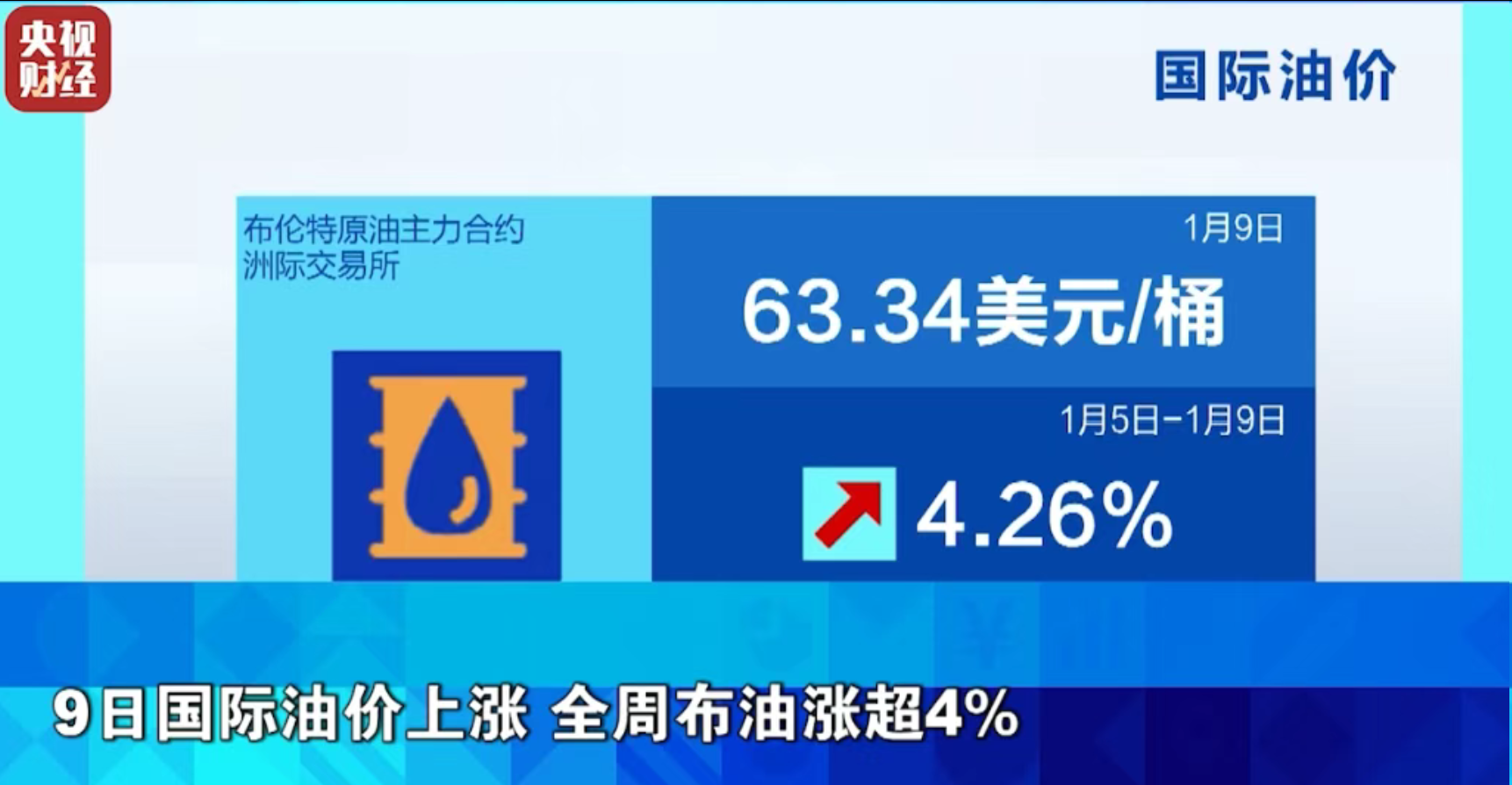
Core Viewpoint - The global oil prices have surged due to escalating geopolitical tensions, leading to a significant increase in oil tanker stocks, particularly in the A-share market and U.S. market [1][3]. Group 1: Oil Price and Market Performance - International oil prices saw a weekly increase, with U.S. oil futures rising by 3.14% and Brent oil futures by 4.26% [1]. - A-share oil transportation companies experienced remarkable gains, with China Merchants Energy (招商轮船) up 9.47% and COSCO Shipping Energy (中远海能) up 8.82% as of January 9 [3]. - In the U.S. market, major oil tanker companies like DHT Holdings, Frontline, and CMB.TECH saw stock increases of 14.4%, 18.7%, and 19.85% respectively [3]. Group 2: Company Performance and Projections - China Merchants Energy's stock reached a new high of 10.08 CNY per share, the highest since July 2015, with a market capitalization nearing 80 billion CNY [6]. - The company forecasts a net profit of 6 to 6.6 billion CNY for 2025, representing a year-on-year increase of 17% to 29%, driven by a 200% to 230% increase in oil tanker business profits [6]. - COSCO Shipping Energy announced plans to increase capital expenditures, including the construction of new oil tankers, indicating confidence in the oil transportation market [6]. Group 3: Supply and Demand Dynamics - The "shadow fleet" of oil tankers, involved in transporting Venezuelan oil, is facing increased scrutiny and sanctions, leading to a tightening of compliant tanker supply [8][9]. - The global VLCC fleet is projected to see minimal growth, with only three new deliveries expected in 2025, resulting in a negative growth rate of -1.2% when excluding sanctioned vessels [11]. - Morgan Stanley's report highlights that VLCCs are in high demand, with a projected demand growth of 0.9% against a supply increase of only 0.2% by 2026, indicating a tight market [12].
A股800亿油运巨头业绩预增200%,国际油价一周涨超4%,全球油轮股暴涨
21世纪经济报道· 2026-01-10 02:11
Core Viewpoint - The article highlights a significant surge in global oil prices and the corresponding rise in the stock prices of oil shipping companies, driven by geopolitical tensions and operational improvements within the industry [1][3][6]. Group 1: Oil Price Surge - Global oil prices have seen a notable increase, with U.S. oil futures rising by 3.14% and Brent oil futures by 4.26% over the week [1]. - The oil shipping market, particularly in A-shares, has experienced a remarkable rally, with companies like China Merchants Energy (招商轮船) and COSCO Shipping Energy (中远海能) seeing stock price increases of 9.47% and 8.82% respectively [3]. Group 2: Company Performance - China Merchants Energy's stock reached a new high of 10.08 CNY per share, the highest since July 2015, reflecting strong market confidence [7]. - The company forecasts a net profit of 6 to 6.6 billion CNY for 2025, representing a year-on-year increase of approximately 17% to 29%, with Q4 expected to see a profit growth of 55% to 90% due to improved oil tanker business profits [7]. - COSCO Shipping Energy is also increasing its capital expenditure, planning to build new vessels, which signals confidence in the oil shipping market [7]. Group 3: Market Dynamics - The "shadow fleet" of oil tankers, which has been targeted by U.S. sanctions, is shrinking, leading to a tighter supply of compliant oil tankers and potentially driving up freight rates [9][10]. - The global VLCC fleet is expected to see minimal growth, with only three new deliveries anticipated in 2025, indicating a tight supply-demand balance in the market [12]. - Morgan Stanley's report suggests that VLCCs are the most constrained segment, with demand expected to grow by 0.9% while supply only increases by 0.2% [12]. Group 4: Future Outlook - The article suggests that the tightening of compliant tanker supply due to sanctions and the aging fleet will likely lead to sustained high freight rates in the future [11][12]. - Despite a potential peak in VLCC deliveries post-2027, rising construction costs and capacity constraints may hinder actual delivery timelines [13].