Roborock(688169)

Search documents
刚刚,最强指数,跌超7%!
中国基金报· 2025-09-04 06:47
Market Overview - The A-share market experienced a significant decline, with major indices continuing to drop on September 4th [2] - The Shanghai Composite Index closed at 3734.20, down 79.36 points or 2.08% [3] - The Shenzhen Component Index fell by 493.1 points, a decrease of 3.95%, closing at 11978.81 [3] - The ChiNext Index saw a decline of 5.36%, closing at 2744.03 [3] Sector Performance - The STAR 50 Index (科创50) dropped over 7%, with major constituent stocks like Cambrian (寒武纪) falling more than 15% [3][6] - The overall trading volume in the A-share market was reported at 418.2 billion [3] Key Stock Movements - Cambrian (688256) saw a significant drop of 15.37%, closing at 1189.02 [6] - Other notable declines included Baillie Gifford (688506) down 7.22% and Huatai Medical (688617) down 4.31% [6] - The STAR 50 Index's performance reflects broader market trends, with a year-to-date decline of 14.54% [4]







石头科技股价跌5.02%,大成基金旗下1只基金重仓,持有1.72万股浮亏损失18.03万元
Xin Lang Cai Jing· 2025-09-04 02:35
Group 1 - The core viewpoint of the news is that Stone Technology's stock has experienced a decline of 5.02%, with a current price of 198.47 CNY per share and a total market capitalization of 51.425 billion CNY [1] - Stone Technology, established on July 4, 2014, specializes in the design, research and development, production, and sales of smart cleaning robots and other smart hardware, with 99.94% of its revenue coming from smart cleaning products and accessories [1] Group 2 - According to data, Dachen Fund has one fund heavily invested in Stone Technology, specifically the Dachen Balanced Growth Mixed A (017764), which reduced its holdings by 2,650 shares in the second quarter, now holding 17,200 shares, accounting for 3.75% of the fund's net value [2] - The Dachen Balanced Growth Mixed A fund has a total scale of 69.3357 million CNY and has achieved a return of 25.42% this year, ranking 2,763 out of 8,180 in its category [2] Group 3 - The fund manager of Dachen Balanced Growth Mixed A is Wang Lei, who has a tenure of 12 years and 93 days, with the fund's total asset scale at 1.079 billion CNY [3] - During Wang Lei's tenure, the best fund return was 137.93%, while the worst return was -19.9% [3]
石头科技(688169):发布激励、持股计划,绑定人才推动长期发展
Changjiang Securities· 2025-09-03 14:42
Investment Rating - The investment rating for the company is "Buy" and is maintained [7] Core Views - The company has disclosed a stock incentive and partnership shareholding plan covering 62 key personnel, with a total of 370,700 restricted shares to be granted, accounting for approximately 0.1431% of the total share capital, at a grant price of 107.03 CNY per share [2][4] - The partnership shareholding plan will cover up to 53 individuals, including some directors and senior management, with a maximum of 366,300 shares, also at a repurchase price of 107.03 CNY per share [2][4] - The incentive plans are set for four years with relatively moderate targets, aiming for revenue growth rates of no less than 10%/14%/18%/22% for the years 2025 to 2028, based on 2024 revenue [10] - The company is expected to maintain high revenue growth due to an aggressive competitive strategy, with projected revenue growth rates of +66.54%/+86.22%/+73.78% for Q4 2024 and Q1/Q2 2025 [10] - The company is positioned as a leading player in the cleaning appliance sector, with strong brand recognition and potential for significant market share growth [10] Summary by Sections Company Overview - The company is engaged in the cleaning appliance industry and has a strong focus on technological innovation and product upgrades [10] Financial Projections - The projected net profits for the company from 2025 to 2027 are 2.047 billion, 2.887 billion, and 3.424 billion CNY, respectively, with corresponding P/E ratios of 26.31, 18.66, and 15.73 [10][15]
龙头品牌经营稳健,关税扰动效应递减
GUOTAI HAITONG SECURITIES· 2025-09-03 12:24
Investment Rating - The report rates the industry as "Increase Holdings" [3] Core Insights - The Q2 performance of leading brands remains stable, with short-term tariff disruptions expected to have diminishing effects. The better-than-expected performance is mainly concentrated in small appliances and cleaning appliances [1][2] - The overall revenue and profit growth for the home appliance sector in Q2 2025 is +5.6% and +3.1% year-on-year, respectively, showing a slight deceleration compared to Q1 [5][6] - The report highlights that the domestic subsidy effect continues but with diminishing marginal returns, while external tariff disruptions are anticipated to ease in the future [5][6] Summary by Sections 1. Performance Overview - The home appliance sector maintained growth in Q2, but the growth rate slowed compared to Q1. The revenue and profit growth for the white goods sector in Q2 2025 was +5.8% and +6.0% year-on-year, respectively [5][7] - Online sales for various categories showed significant growth, with cleaning appliances seeing a +35% increase in Q2 [5][6] 2. Company Performance - Among the 40 companies covered, 6 reported revenue exceeding expectations, while 4 had profits that surpassed forecasts. Conversely, 13 companies had revenue below expectations, and 19 had profits that fell short [20][21] - Leading companies in the white goods sector performed in line with expectations, while traditional kitchen appliance leaders faced slight pressure but overall met expectations [20][21] 3. Investment Recommendations - The report suggests focusing on four main lines: 1. Core drivers for overseas expansion and smart home key targets, recommending leading robot vacuum brands like Roborock and Ecovacs [22] 2. Companies with stable performance and upward elasticity, recommending Ninebot, Anfu Technology, and others [22] 3. Leading companies with stable operations and high dividends, recommending TCL Electronics, Hisense, Midea Group, and Haier [22] 4. Appliance companies expanding into new areas, recommending Rongtai Health and Wanlong Magnetic Plastic [22]





氪星晚报|小米汽车可为避免交通拥堵提供条件专利公布;高盛乐观预测:中国股市仍有上涨空间;英媒:世界黄金协会正计划推出“数字黄金”
3 6 Ke· 2025-09-03 11:18
Group 1 - IKEA China plans to invest 160 million yuan in the fiscal year 2026 to launch over 150 lower-priced products, with 70% focused on best-selling items [1] - Anhui Province Industrial Development Investment Company has been established with a registered capital of 5 billion yuan, focusing on investment activities and asset management [1] - The establishment of the Yu Cheng No.1 (Wenzhou) Equity Investment Center has been announced, with a total investment of approximately 1.24 billion yuan, aimed at venture capital and private equity investments [2] Group 2 - Xiaomi Auto has published a patent for a vehicle inspection method that aims to improve traffic efficiency and reduce congestion [3] - Stone Technology has achieved the top market share in both global cleaning robots and vacuum robots, with shares of 15.2% and 20.7% respectively for the first half of 2025 [4] - Jiangci Electronics has completed a pre-A round financing of several million yuan, with funds allocated for production expansion and commercialization in the high-end piezoelectric materials sector [5] Group 3 - Goldman Sachs expresses optimism about the Chinese stock market, indicating that investor sentiment has significantly improved and there is still room for growth [6] - Swiss bank Pictet states that the A-share market is far from bubble territory, with reasonable valuations and increased market activity, suggesting further upward potential [7] Group 4 - The Ministry of Finance plans a second issuance of 50-year special government bonds, with a total competitive bidding amount of 35 billion yuan and a fixed interest rate of 2.10% [8] - Chongqing has allocated an additional 135 million yuan for the 2025 vehicle and electric bicycle trade-in subsidy program, with specific allocations for vehicle scrapping and replacement [9] - India's service sector PMI reached a 15-year high in August, driven by strong demand, although inflationary pressures are also increasing [10]

小家电板块9月3日跌0.88%,倍益康领跌,主力资金净流出1.14亿元
Zheng Xing Xing Ye Ri Bao· 2025-09-03 08:40
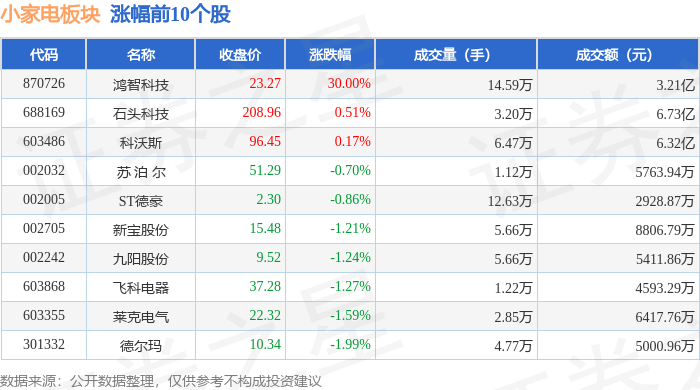
Market Overview - The small home appliance sector experienced a decline of 0.88% on September 3, with BeiYikang leading the drop [1] - The Shanghai Composite Index closed at 3813.56, down 1.16%, while the Shenzhen Component Index closed at 12472.0, down 0.65% [1] Stock Performance - Notable gainers included: - JiZhi Technology (code: 870726) with a closing price of 23.27, up 30.00% and a trading volume of 145,900 shares, totaling 321 million yuan [1] - Major decliners included: - BeiYikang (code: 6610Z8) with a closing price of 39.22, down 5.70% and a trading volume of 22,000 shares, totaling 89.51 million yuan [2] - BiYi Co. (code: 603215) with a closing price of 21.03, down 4.84% and a trading volume of 82,500 shares, totaling 177 million yuan [2] Capital Flow - The small home appliance sector saw a net outflow of 114 million yuan from institutional investors, while retail investors had a net inflow of 72.05 million yuan [2][3] - Specific stock capital flows included: - KaiNeng Health (code: 300272) with a net inflow of 12.42 million yuan from institutional investors [3] - SuBoEr (code: 002032) with a net inflow of 7.08 million yuan from institutional investors [3]


石头科技:领跑全球清洁机器人市场 扫地机品类稳居第一
Zheng Quan Shi Bao Wang· 2025-09-03 08:37
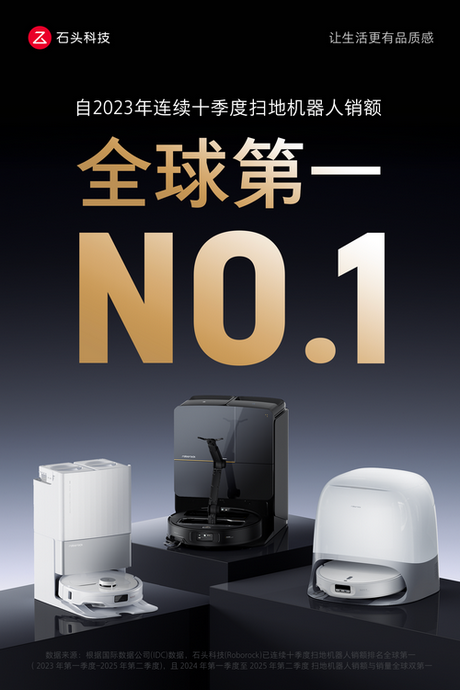
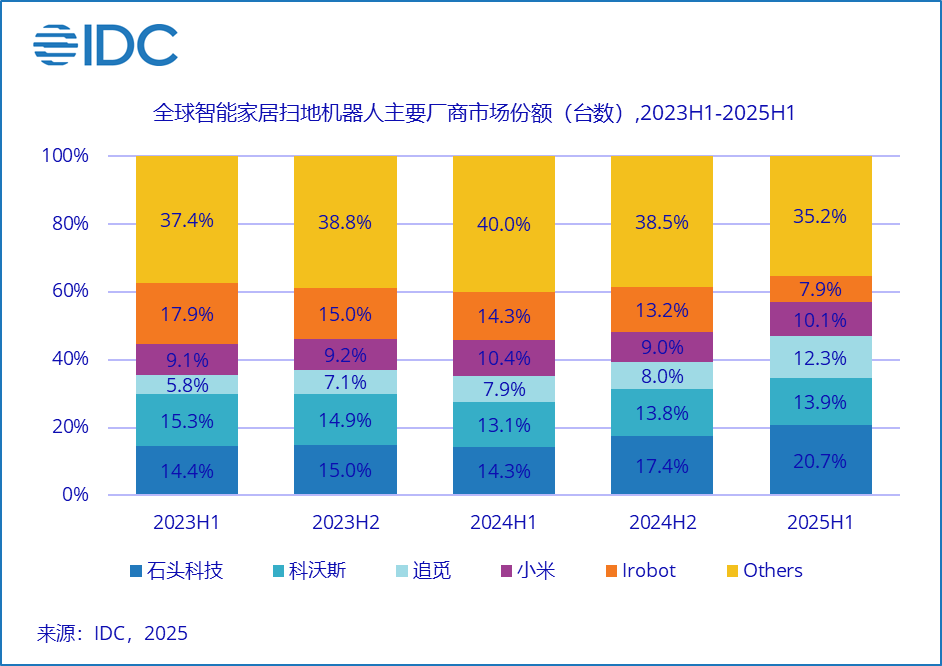
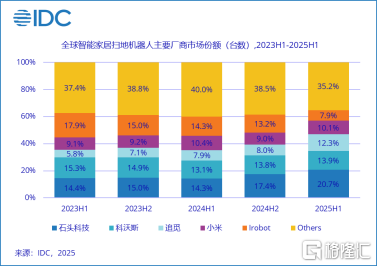
Core Insights - Stone Technology leads the global cleaning robot market with a 15.2% market share and holds the top position in the vacuum robot category with a 20.7% share [1] - The cumulative shipment of Stone's vacuum robots reached 2.326 million units in the first half of 2025, representing a year-on-year growth of 67.9% [1] - The company has maintained the highest sales revenue in the global market for vacuum robots for ten consecutive quarters since 2023 [1] R&D Investment - In the first half of 2025, Stone's R&D investment amounted to 685 million yuan, accounting for 8.67% of its revenue, significantly higher than the industry average, with a year-on-year increase of 67.28% [3] - The company has obtained a total of 4,694 domestic and international patents and software copyrights as of June 2025 [3] - Advanced technologies such as LDS laser radar and AI dual-vision systems enhance the product's obstacle avoidance capabilities in complex environments [3] Global Expansion - Stone Technology has over 300 stores in the domestic market and aims for overseas revenue to account for 53.6% by 2024 [4] - The company collaborates with major international retailers like Target, Best Buy, and Costco, while also establishing flagship stores and service systems [4] - Stone implements localized strategies in different regions, such as optimizing brush systems in Turkey and introducing laser navigation technology in Germany [4] - The company's products are available in over 170 countries and regions, serving more than 20 million households, with significant market share in countries like Turkey, where it exceeds 50% [4] - In North America, a key growth market, the shipment volume increased by 65.3% year-on-year in the first half of 2025 [4]
石头科技(688169.SH)登顶2025上半年全球清洁机器人市场 扫地机品类稳居第一
智通财经网· 2025-09-03 07:38
Core Insights - The global smart home cleaning robot market is projected to ship 32.1 million units by 2025, with a steady market expansion [1] - In the first half of 2025, Roborock (688169.SH) leads the global cleaning robot market with a 15.2% market share and a 20.7% share in the core vacuum robot category [1] Market Performance - The global vacuum robot market showed robust growth in the first half of 2025, with total shipments reaching 11.263 million units, a year-on-year increase of 16.5% [3] - Among the top five brands in global sales, four are Chinese brands, with Roborock leading at 20.7% market share and a shipment volume of 2.326 million units, reflecting a 67.9% year-on-year growth [3] Competitive Position - Roborock has maintained the highest sales in the global market for ten consecutive quarters since 2023, demonstrating its core competitiveness and industry influence in the smart cleaning appliance sector [6] R&D and Innovation - Roborock prioritizes R&D innovation as a core strategy, with R&D expenses increasing from 4.59% of total revenue in 2019 to 8.13% in 2024; in the first half of 2025, R&D investment reached 685 million yuan, accounting for 8.67% of revenue, significantly above the industry average [7] - The company has obtained a total of 4,694 domestic and international patents and software copyrights as of June 2025, supporting its product innovation [7] - Key technological advancements include the large-scale application of LDS laser radar navigation technology and the introduction of AI dual-vision obstacle avoidance, enhancing the robot's capabilities in complex environments [7][9] Product Development - The flagship product, the Roborock G30 Space Exploration Edition, features a world-first five-axis folding bionic arm, marking a significant leap from 2D cleaning to 3D space management [9] - The Roborock P20 Ultra Plus offers triple thermal cleaning capabilities, including 100°C high-temperature sterilization, 60°C hot water stain removal, and 55°C hot air drying, providing a comprehensive cleaning experience [9] Market Expansion Strategy - Roborock continues to deepen its domestic market presence while expanding offline channels, with over 300 stores nationwide [10] - Internationally, the company is accelerating local channel development and has partnered with major retailers like Target, Best Buy, and Costco, enhancing brand visibility and sales [10] - The company is also focusing on localized product and marketing innovations tailored to different regional markets, such as addressing carpet entanglement issues in Turkey and introducing laser radar navigation in Germany [10] Global Reach - Roborock's vacuum robots maintain the top sales position in several countries, including the Nordics, Germany, South Korea, and Turkey, with a market share exceeding 50% in Turkey [12] - In North America, a key market, shipments grew by 65.3% year-on-year in the first half of 2025, indicating strong growth momentum [12] - As of June 2025, Roborock's products are available in over 170 countries and regions, serving more than 20 million households with efficient smart cleaning solutions [12]
石头科技登顶2025上半年全球清洁机器人市场 扫地机品类稳居第一
Ge Long Hui· 2025-09-03 07:30
Core Insights - The global smart home cleaning robot market is projected to ship 32.1 million units by 2025, indicating steady market expansion [1] - Stone Technology leads the global cleaning robot market with a 15.2% market share and a 20.7% share in the core vacuum cleaner category in the first half of 2025 [1][3] - The company has maintained the top sales position for its vacuum robots for ten consecutive quarters, showcasing its core competitiveness and industry influence [5] Market Performance - The global vacuum robot market saw a robust growth, with a total shipment of 11.263 million units in the first half of 2025, representing a year-on-year increase of 16.5% [3] - Among the top five brands in global sales, four are Chinese brands, with Stone Technology leading at 20.7% market share and a shipment volume of 2.326 million units, up 67.9% year-on-year [3] R&D and Innovation - Stone Technology prioritizes R&D innovation, with R&D expenses increasing from 4.59% of total revenue in 2019 to 8.13% in 2024, and reaching 8.67% in the first half of 2025, significantly above the industry average [7] - The company has achieved 4,694 patents and software copyrights by June 2025, reflecting its commitment to technological advancement [7] - Innovations include the application of LDS laser radar navigation technology and the integration of AI dual-camera obstacle avoidance with 3D structured light, enhancing the robot's capabilities in complex environments [7][9] Product Development - The flagship G30 Space exploration version features a world-first five-axis folding bionic arm, marking a significant leap from 2D to 3D cleaning management [9] - The P20 Ultra Plus model offers triple thermal cleaning capabilities, including high-temperature sterilization and self-cleaning functions, providing a comprehensive user experience [9] Global Expansion Strategy - Stone Technology is deepening its domestic market presence while expanding its offline channels, with over 300 stores nationwide [10] - Internationally, the company is building localized channels and partnerships with major retailers like Target and Best Buy, aiming for a 53.6% overseas revenue share by 2024 [10] - The company tailors its products and marketing strategies to local markets, achieving over 50% market share in Turkey and significant growth in North America [10][12] Future Outlook - Stone Technology's products are now available in over 170 countries, serving more than 20 million households, with an active user base of 1.7 million on its app [12] - The company is well-positioned to capitalize on the growing demand for smart home cleaning solutions, leveraging its market leadership, strong R&D capabilities, and optimized branding strategies [12]
石头科技获上半年全球清洁&扫地机器人市场份额双第一,“全市场唯一百亿规模”机器人ETF(562500)成分股博杰股份喜提涨停三连板
Mei Ri Jing Ji Xin Wen· 2025-09-03 05:51
Group 1 - The Robot ETF (562500) experienced a decline of 2.04%, showing a volatile bottoming trend, with significant movements in constituent stocks [1] - Dongjie Intelligent led the gains with an increase of 12.33%, while Bojie Co. hit the daily limit with a 10% rise, marking three consecutive days of limit-up trading [1] - The trading volume reached 1.35 billion yuan, indicating active market participation and continuous release of trading volume [1] Group 2 - The Robot ETF has attracted over 1.27 billion yuan in net inflows over the past four trading days, demonstrating significant "scale effect" [1] - According to IDC's report, Stone Technology holds a market share of 15.2% in cleaning robots and 20.7% in sweeping robots, making it the global leader in both categories [1] - Dongfang Securities predicts a gradual decrease in humanoid robot prices, with potential future costs for Tesla's Optimus robot dropping to $20,000 [1] Group 3 - The Robot ETF is the only robot-themed ETF in the market with a scale exceeding 10 billion yuan, covering various segments including humanoid robots, industrial robots, and service robots [2] - The ETF provides investors with a convenient way to invest in the upstream and downstream supply chains of the robotics industry [2]