CHANGAN AUTOMOBILE-B(000625)

Search documents
重庆:领跑智能网联新能源汽车赛道
Ke Ji Ri Bao· 2026-02-05 06:37
Core Insights - Chongqing is leading the smart connected electric vehicle sector, with a projected annual automobile production of 2.7877 million units by 2025, including 1.2961 million electric vehicles, which is 30 times the production in 2020 [2] - The city is undergoing a significant industrial transformation, shifting from traditional manufacturing to a smart connected ecosystem, thereby accelerating the creation of new high-quality development momentum [2] Innovation Ecosystem - The Chongqing Liangjiang Collaborative Innovation Zone has nurtured nearly 1,000 hard-tech companies and facilitated around 1,500 technology transfer achievements [3] - Companies like Chongqing Zhongke Yaolu Information Technology have developed domestic firsts in 3D glue quality online detection systems, achieving over 20 times growth in five years [3] - Long-term R&D investments by companies such as Changan Automobile exceed 5%, with significant advancements in software and hardware integration [3] Industry Development - Chongqing has established seven national-level enterprise technology centers and three industrial innovation complexes, forming an integrated development pattern of "software + intelligence + hardware" [4] - The region's innovation ecosystem has attracted companies like Beidou Zhili Technology, which has achieved over 3 billion yuan in annual sales and over 12% in R&D investment [4] Industrial Cluster - Chongqing is implementing a world-class smart connected electric vehicle industrial cluster development plan, transitioning from individual efforts to collective action [6] - Changan Automobile reached a milestone of producing its 30 millionth vehicle in just over four years, showcasing the rapid growth of the brand [6] - The city has gathered over 1,200 large-scale component manufacturers, achieving comprehensive coverage of electric vehicle components [6] Supply Chain Optimization - The establishment of a "factory within a factory" model has enhanced supply chain efficiency, with local production and supply capabilities significantly improving response times [8] - Companies like CATL have set up local production facilities within the Seres Super Factory, achieving production adjustments in just 20 minutes [8] - This model has led to a 50% improvement in supply chain collaborative innovation capabilities, streamlining the number of primary suppliers [8] Strategic Vision - Chongqing aims to achieve a local supply rate of 70% for smart connected electric vehicle components by 2027, fostering a deeply integrated industrial ecosystem [7] - The city is leveraging technological innovation and comprehensive chain layout to drive exponential growth in the smart connected electric vehicle industry, aspiring to become a globally influential hub [9]




宁德时代钠电池大规模应用于乘用车
Mei Ri Jing Ji Xin Wen· 2026-02-05 06:30
Core Viewpoint - Changan Automobile has officially launched its global sodium battery strategy and unveiled the world's first mass-produced passenger vehicle powered by sodium batteries in Yakeshi, in collaboration with CATL [1] Group 1: Company Developments - Changan Automobile's brands, including Avita, Deep Blue, Qiyuan, and Inertia, will all feature CATL's new sodium batteries in the future [1] - The sodium battery cells developed by CATL have a maximum energy density of 175Wh/kg, enabling pure electric range upgrades to 500km or even 600km, and hybrid range improvements to over 300km or even 400km [1] Group 2: Industry Infrastructure - By 2026, CATL plans to establish over 3,000 chocolate battery swap stations across more than 140 cities nationwide [1]
长安汽车遭销量市值双重压力 ,长安汽车启动最高20亿元回购计划
Di Yi Cai Jing· 2026-02-05 06:19
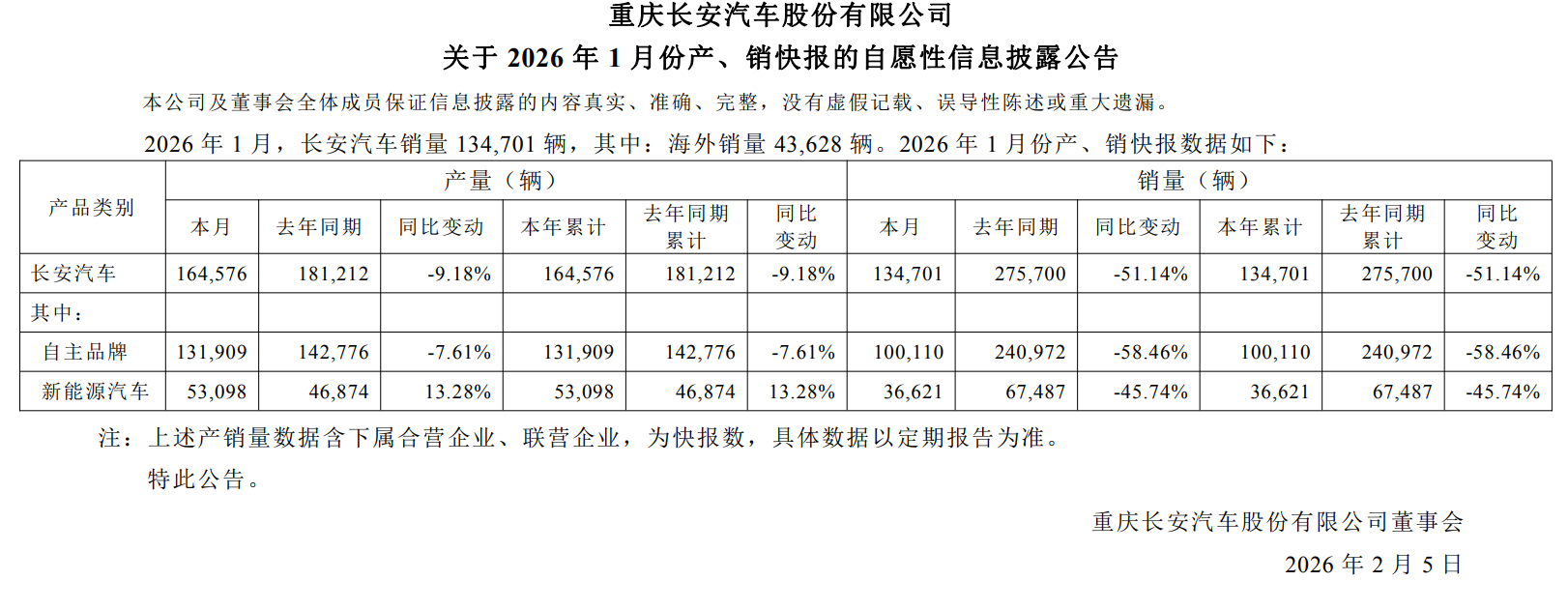
【#长安汽车遭销量市值双重压力# ,#长安汽车启动最高20亿元回购计划#】继多家车企于本月首日披 露1月战绩后,新央企长安汽车(000625.SZ)的销量数据也终于揭开谜底。 2月4日晚间,长安汽车(000625.SZ)连发两份关键公告:一份显示公司2026年1月销量13.47万辆,同 比大幅下滑超过50%;另一份则宣布,公司正在筹划不低于10亿元且不超过20亿元的回购计划,旨 在"减少公司注册资本"。 就在几天前的2月2日,长安汽车股价最低探底至11元/股,创下近年新低,公司市值不足1100亿元。 经国务院批准,中国长安汽车于2025年7月27日注册成立。7月28日开盘后,当日在A股市场的收盘价为 13.42元,涨幅为3.24%。Wind数据显示,截至自新央企成立以来,公司股价已下跌13.69%,市值站在 千亿关口。 最新的销量数据显示,2026年1月,长安汽车销量134701辆,同比大幅下滑51.14%,其中自主品牌销量 100110辆,同比下降58.46%;新能源汽车销量36621辆,同比下降45.74%。 ...
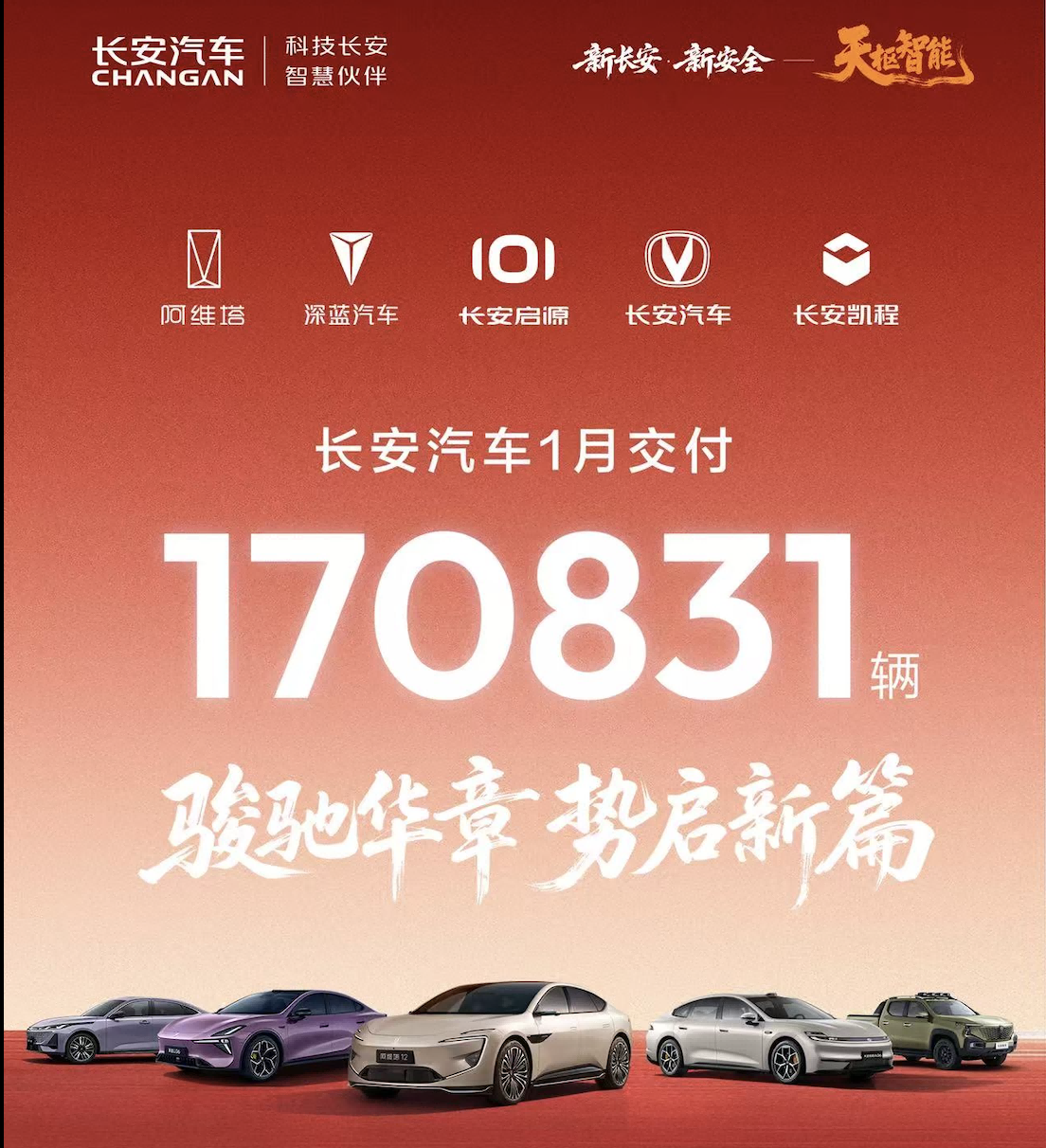
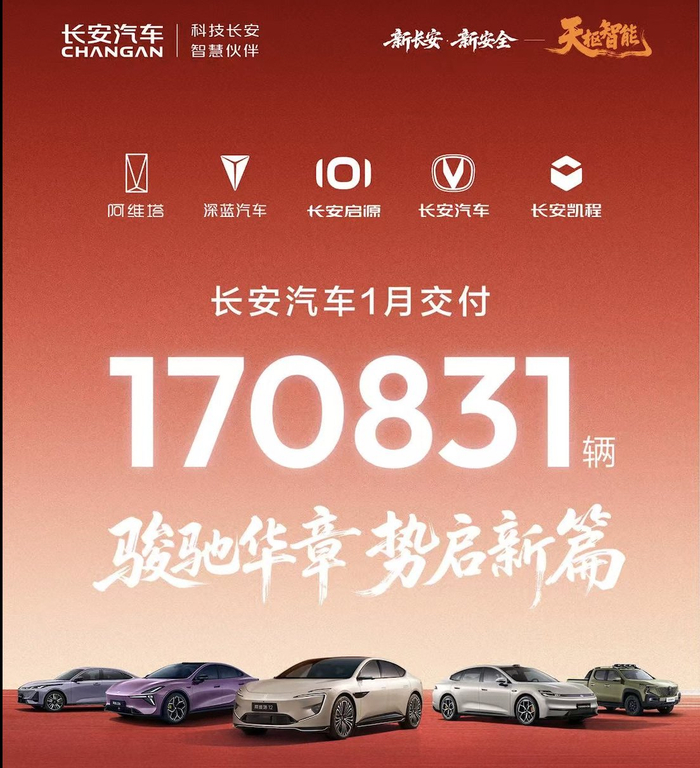
2026年稳健开局,长安汽车1月全球交付17万辆
Zhong Guo Qi Che Bao Wang· 2026-02-05 06:10
Core Insights - Changan Automobile achieved global deliveries of 170,831 vehicles in January 2026, demonstrating resilience in both classic and new energy product lines despite a traditionally slow season and internal adjustments [1][3][16] Group 1: Sales Performance - The Changan CS75 series, a flagship model, sold 17,822 units in January, marking an 11.6% month-on-month increase and surpassing 3 million cumulative sales, joining the "three million club" among domestic SUV brands [5] - The Changan Eado series sold 14,760 units in January, maintaining over 10,000 monthly sales for 11 consecutive months and becoming the top-selling domestic fuel sedan in 2025 [5] Group 2: New Energy Growth - The Deep Blue brand showcased strong performance with the Deep Blue S05 surpassing 170,000 cumulative sales, remaining a member of the "10,000 monthly sales club" [7] - The Changan Qiyuan brand delivered 14,759 units in January, with the AQ series seeing a significant year-on-year increase of 35.2% [7] - The Qiyuan A06 model quickly exceeded 21,460 cumulative deliveries, setting a record for the fastest delivery of a state-owned enterprise's new energy mid-size sedan [7] Group 3: Strategic Initiatives - Changan is advancing its "Shangri-La" plan for new energy, establishing a matrix of three global smart new energy brands: Avita, Deep Blue, and Changan Qiyuan, with solid-state batteries expected to enter vehicle verification by Q3 2026 [9] - The "Beidou Tianshu" plan for smart technology is being implemented, featuring a leading central network SDA platform and the launch of the "New Changan New Safety" brand, which emphasizes comprehensive safety [11] - The "Haina Baichuan" plan for global expansion has seen Changan's products sold in 117 countries, with 41 models launched and 19 overseas KD projects completed [14] Group 4: Future Outlook - 2026 is designated as the first year of the "14th Five-Year Plan," focusing on "steady progress and quality improvement," with a commitment to enhancing core competitiveness through systematic actions [16] - Changan aims to transform into a smart low-carbon mobility technology company, striving to become a world-class automotive brand driven by innovation and safety [16]
全球首款钠电量产乘用车亮相 阿维塔将搭载宁德时代钠电池
Xin Jing Bao· 2026-02-05 05:05
搭载宁德时代钠新电池的这款车,在-30℃条件下,整车放电功率比同电量常规铁锂车型提升近3 倍,-40℃极寒下容量保持率超90%,甚至在-50℃的极端环境下还能稳定放电。 根据实测数据,宁德时代钠电池搭配其第三代CTP系统成组技术,纯电续航可达400km以上,再通过宁 德时代BMS智能管理策略的精准控制,可以实现"表显即所得",而电芯的最高能量密度达175Wh/kg, 也是行业最高水平。未来随着钠电产业链的高速发展,纯电续航可以升级到500km甚至600km、增混续 航突破300km甚至400km,这可以覆盖新能源市场上50%以上的续航需求。 2月5日,长安汽车携手宁德时代举办发布会,长安汽车发布全球钠电战略,全球首款钠电量产乘用车也 正式亮相。同时,长安汽车旗下阿维塔、深蓝、启源、引力等多品牌,未来都将搭载宁德时代钠新电 池。 (文章来源:新京报) ...
全球首款钠电量产乘用车亮相,阿维塔将搭载宁德时代钠电池
Xin Jing Bao· 2026-02-05 05:01
Core Viewpoint - Changan Automobile has launched a global sodium battery strategy in collaboration with CATL, unveiling the world's first mass-produced passenger vehicle equipped with sodium batteries [1] Group 1: Product Launch and Technology - The sodium battery, developed by CATL, features a third-generation CTP system that allows for a pure electric range exceeding 400 km [1] - The battery cell achieves a maximum energy density of 175 Wh/kg, which is the highest in the industry [1] - Future advancements in the sodium battery supply chain could enhance the pure electric range to 500 km or even 600 km, and hybrid range could exceed 300 km to 400 km, covering over 50% of the market's range demands [1] Group 2: Performance in Extreme Conditions - The vehicle equipped with CATL's sodium battery demonstrates nearly three times the discharge power compared to conventional lithium iron phosphate models at -30°C [1] - At -40°C, the capacity retention rate exceeds 90%, and the vehicle can maintain stable discharge even in extreme conditions of -50°C [1]
遭销量市值双重压力,这家汽车新央企火线启动回购计划
Di Yi Cai Jing· 2026-02-05 04:13
Core Viewpoint - The traditional automaker Changan Automobile is facing significant challenges due to a price war and cost pressures, leading to a critical transformation point for the company [1]. Group 1: Sales Performance - In January 2026, Changan Automobile reported a total sales volume of 134,701 vehicles, representing a substantial year-on-year decline of 51.14% [1][4]. - The sales of Changan's self-owned brands fell to 100,110 vehicles, down 58.46% year-on-year, while the sales of new energy vehicles decreased by 45.74% to 36,621 units [1][4]. - The company's January sales only accounted for 4.1% of its annual sales target of 3.3 million vehicles, with the new energy vehicle target completion rate at 2.6% [4]. Group 2: Financial Measures - Changan Automobile announced a share repurchase plan with a total fund of no less than 1 billion yuan and no more than 2 billion yuan, aimed at reducing the company's registered capital [1][4]. - The repurchase plan includes a minimum of 700 million yuan and a maximum of 1.4 billion yuan for A-shares, and a minimum of 300 million yuan and a maximum of 600 million yuan for B-shares [4]. - The company stated that this initiative reflects its confidence in the strategic development and intrinsic value, aiming to enhance shareholder rights and optimize capital structure [4]. Group 3: Market Position and Challenges - Changan's stock price hit a recent low of 11 yuan per share, with a market capitalization of less than 110 billion yuan, marking a 13.69% decline since the establishment of the new state-owned enterprise [1]. - The company’s sales performance in January puts pressure on its overall sales goals for the year, especially in the context of a broader industry growth of 1% in new energy vehicle wholesale [4]. - Despite a 3.58% increase in revenue to 114.93 billion yuan for the first three quarters of 2025, the net profit dropped by 14.66% to 3.055 billion yuan due to a 56.25% surge in sales expenses and reduced government subsidies [5].
三大战略计划纵深提速 长安汽车1月实现170831辆全球交付量
Zheng Quan Ri Bao Zhi Sheng· 2026-02-05 03:39
Core Insights - Changan Automobile achieved a global delivery of 170,831 vehicles in January 2026, demonstrating resilience in both traditional and new energy vehicle segments despite seasonal market challenges [1][3]. Sales Performance - The Changan CS75 series recorded sales of 17,822 units in January, marking an 11.6% month-on-month increase and surpassing 3 million cumulative sales, establishing it as a leading SUV in the domestic market [3][4]. - The Changan Eado series sold 14,760 units in January, maintaining over 10,000 monthly sales for 11 consecutive months and becoming the top-selling domestic fuel sedan in 2025 [4]. New Energy Growth - The Deep Blue brand showcased strong performance with the Deep Blue S05 surpassing 170,000 cumulative sales, consistently selling over 10,000 units monthly [4]. - The Changan Qiyuan brand delivered 14,759 units in January, with the AQ series seeing a significant year-on-year increase of 35.2% [4]. - The Qiyuan A06 model quickly exceeded 21,460 units in cumulative deliveries, setting a record for the fastest delivery of a new energy mid-size sedan from a state-owned enterprise [4]. Strategic Initiatives - Changan is advancing its "Shangri-La" plan for new energy, establishing a matrix of three global smart new energy brands: Avita, Deep Blue, and Changan Qiyuan [5]. - The company is implementing the "Beidou Tianshu" plan for smart technology, launching a leading central network SDA platform and achieving the first L3 level autonomous driving license in China [5]. - Changan's global expansion plan has seen its products sold in 117 countries, with 41 models launched and 19 overseas KD projects completed [5]. Future Outlook - 2026 is designated as the first year of the "14th Five-Year Plan," focusing on "stability and progress, quality improvement, and efficiency enhancement" [6]. - Changan aims to enhance core competitiveness through systematic actions centered on "creating global flagship products" and "forging extreme technology" [6]. - The company is transitioning towards becoming a world-class automotive brand with a focus on innovation, safety, and global vision [6].
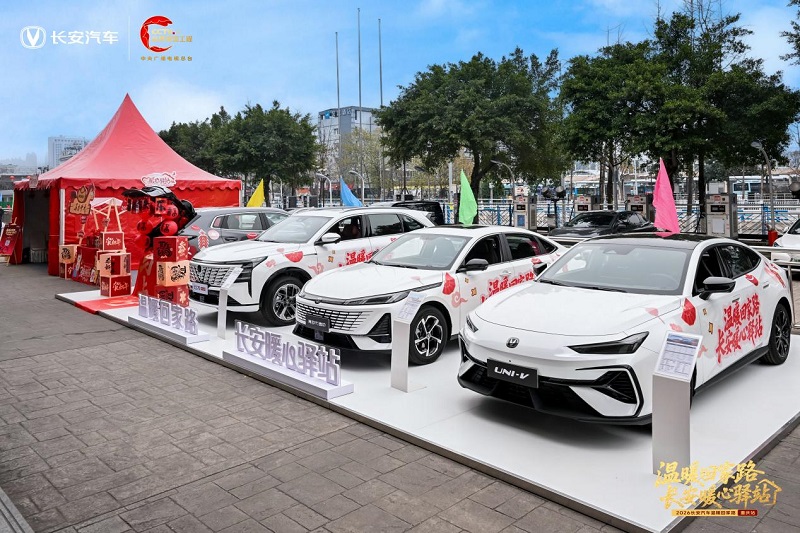
长安汽车“温暖回家路 长安暖心驿站”2026重庆北站温暖抵达
Jing Ji Wang· 2026-02-05 03:27
Core Viewpoint - Changan Automobile continues its "Warm Homecoming Road" initiative, providing support and services to travelers during the Spring Festival, showcasing its commitment to social responsibility and community support [3][5][7] Group 1: Event Overview - On February 2, Changan Automobile launched the fifth "Warm Heart Station" at Chongqing North Station, following previous events in Zhengzhou, Guangzhou, Shanghai, and Beijing [3] - The initiative aims to offer travelers a comforting experience with services such as free hot water, charging stations, and comfortable resting areas [5][7] - Since its inception in 2019, the "Warm Homecoming Road" initiative has conducted over 10,000 service events nationwide, serving more than 100 million people [3][5] Group 2: Community Engagement - The "Warm Heart Station" features interactive areas with festive themes, allowing travelers to engage and create warm memories during their journey [5] - Changan Automobile emphasizes its role as a national brand that prioritizes the well-being of its users, having supported over 30 million customers [3][5] Group 3: Product Promotion - Changan Automobile is offering special promotions for several popular models during February, including the fourth-generation Yidong and CS series, with prices starting from 61,900 yuan [7] - The event also showcases the latest models, attracting potential buyers and enhancing brand visibility [5][7] Group 4: Future Commitment - Changan Automobile plans to continue its "Warm Homecoming Road" initiative, reinforcing its mission of combining technology with warmth to support travelers [7]
长安汽车1月销售汽车13.47万辆,同比下降超五成
Ju Chao Zi Xun· 2026-02-05 03:08
Group 1 - The core viewpoint of the news is that Changan Automobile has reported a significant decline in both production and sales for January compared to the same period last year, with total sales down by 51.14% and total production down by 9.18% [3] Group 2 - In January, Changan's total production was 164,576 vehicles, a decrease of 9.18% from 181,212 vehicles in the same month last year [3] - The total sales for January were 134,701 vehicles, which represents a 51.14% decline from 275,700 vehicles in January of the previous year [3] - The production of Changan's self-owned brand vehicles in January was 131,909 units, down 7.61% from 142,776 units year-on-year [1] - The sales of self-owned brand vehicles in January were 100,110 units, reflecting a significant drop of 58.46% compared to 240,972 units in the same month last year [1] - In the new energy vehicle segment, production reached 53,098 units, marking a 13.28% increase from 46,874 units year-on-year [2] - However, sales of new energy vehicles fell to 36,621 units, a decrease of 45.74% from 67,487 units in January of the previous year [2] - The company disclosed that overseas sales in January 2026 amounted to 43,628 units [2]