CITIC Steel(000708)

Search documents
全球第一大产钢国背后:四家最赚钱上市钢企利润之和,不及日本制铁一家
第一财经· 2025-07-19 14:58
Core Viewpoint - The profitability of Chinese steel companies is significantly lower than that of Japanese steel companies, with the CEO of Nippon Steel highlighting the challenges faced by Chinese manufacturers due to low pricing strategies [1][2]. Financial Performance Comparison - In 2024, Nippon Steel's net profit was 350.2 billion yen (approximately 16.9 billion RMB), while the top five Chinese steel companies had net profits of 7.362 billion RMB (Baowu Steel), 5.126 billion RMB (CITIC Special Steel), 2.261 billion RMB (Nanjing Steel), 2.032 billion RMB (Hualing Steel), and 1.49 billion RMB (Jiuli Special Materials) [1][2]. - The combined net profit of the top four Chinese steel companies in 2024 was less than that of Nippon Steel alone [2]. Industry Challenges - The Chinese steel industry is facing overcapacity, price competition, and increasing technical standards, leading to a decline in profitability [2][6]. - In 2024, the total profit of key Chinese steel companies was 42.9 billion RMB, a year-on-year decrease of 50.3% [6][7]. - The apparent consumption of crude steel in China has decreased from 1.048 billion tons in 2020 to 892 million tons in 2024, indicating a significant drop in demand [8]. Export Dynamics - Despite increasing steel exports, the average export price has declined, with the volume of steel exports doubling from 53.67 million tons in 2020 to 111 million tons in 2024, while the average price fell from 847.2 USD/ton to 755 USD/ton [9][10]. - Trade protectionism against Chinese steel products is rising, with multiple anti-dumping investigations initiated by countries like Vietnam and South Korea [9][10]. Strategic Adjustments - Chinese steel companies are attempting to improve their competitiveness by focusing on high-end steel production and reducing costs through better management practices [13][14]. - The industry is urged to adopt a more flexible production mechanism to balance supply and demand, especially in light of declining domestic demand and increasing export challenges [15].


再论供给侧改革:制度优势实现供给约束破局通缩困局,掘金钢铁、有色行业投资机会
Soochow Securities· 2025-07-16 12:12
Investment Rating - The report maintains an "Overweight" rating for the steel and non-ferrous metal industries [1] Core Viewpoints - The supply-side reform in China is expected to break the deflationary cycle and create investment opportunities in the steel and non-ferrous metal sectors [1][6] - The report emphasizes the importance of "supply constraints" to manage the supply-demand balance and mitigate economic downturn risks [6][12] - The steel industry is facing severe overcapacity, with state-owned enterprises holding a significant market share, which facilitates the implementation of administrative measures to control production [6][28] Summary by Sections 1. Supply-Side Reform and Economic Management - The socialist market economy in China allows for effective macroeconomic control, contrasting with the cyclical issues faced in capitalist economies [12][13] - Historical experiences show that demand stimulus alone is insufficient to resolve deep-seated deflationary pressures [14][15] - The supply-side reform initiated in 2016 has proven successful in stabilizing prices and improving corporate profitability [21][22] 2. Steel Industry Analysis - The steel industry has been in a state of oversupply from 2007 to 2024, with crude steel production increasing from 490 million tons to 1.01 billion tons, while apparent consumption has not kept pace [28][29] - The production capacity utilization rates for rebar and wire rod are expected to decline from around 70% to 50% due to weak real estate demand [33][34] - The concentration of production among state-owned enterprises is high, with central state-owned enterprises accounting for approximately 63% of total production in 2024 [38][39] 3. Investment Recommendations - The report suggests focusing on three categories of investment targets: profit recovery, stable profit with valuation repair, and stable high-dividend stocks [51] - Specific companies recommended for profit recovery include Liugang Co., Taigang Stainless Steel, and Shandong Iron and Steel, with projected annualized PE ratios improving significantly under favorable conditions [51]


中信特钢(000708) - 2025年第二次临时股东大会决议公告
2025-07-15 10:00
证券代码:000708 证券简称:中信特钢 公告编号:2025-052 中信泰富特钢集团股份有限公司 2025 年第二次临时股东大会决议公告 公司及董事会全体成员保证信息披露内容的真实、准确和完整,没有虚假记 载、误导性陈述或重大遗漏。 特别提示: 1.本次股东大会未出现否决议案。 2.本次股东大会未涉及变更以往股东大会决议。 一、会议召开和出席的情况 (一)会议召开情况 1.召开时间: 现场会议时间:2025 年 7 月 15 日(星期二)下午 14:45 网络投票时间:2025 年 7 月 15 日(星期二) 其中通过深圳证券交易所交易系统进行网络投票的具体时间为: 2025 年 7 月 15 日 9:15—9:25,9:30—11:30 和 13:00—15:00;通过 深圳证券交易所互联网系统投票的具体时间为:2025 年 7 月 15 日 9:15—15:00 期间的任意时间。 2.召开地点:江苏省无锡市江阴市长山大道 1 号中信特钢科技大 楼三楼会议中心 3.召开方式:现场会议与网络投票相结合的方式 通过现场和网络投票的中小股东 263 名,代表股份 74,982,150 股,占上市公司有表决权股 ...
中信特钢(000708) - 2025年第二次临时股东大会法律意见书
2025-07-15 10:00
致:中信泰富特钢集团股份有限公司 北京中伦(武汉)律师事务所(以下简称"本所")接受中信泰富特钢集团股份有 限公司(以下简称"公司")的委托,指派律师对公司 2025 年第二次临时股东大会(以 下简称"本次股东大会")进行见证。现根据《中华人民共和国公司法》(以下简称"《公 司法》")、《中华人民共和国证券法》(以下简称"《证券法》")、《上市公司股东会规则》 等法律法规和规范性文件以及《中信泰富特钢集团股份有限公司章程》(以下简称"《公 司章程》")的有关规定,就公司本次股东大会的有关事宜出具法律意见书。 本所律师对公司本次股东大会的召集和召开程序的合法有效性、本次股东大会召集 人资格的合法有效性、出席本次会议人员资格的合法有效性及会议表决程序、表决结果 的合法有效性,发表法律意见。 本所律师依据对法律意见书出具日以前已经发生或存在的事实的了解及对现行相 关法律、法规的理解发表法律意见。 本所律师按照律师行业公认的业务标准、道德规范和勤勉尽责的精神,对公司提供 的出具法律意见书所必须的、全部的、真实的有关公司本次股东大会的文件资料进行核 查和验证,现出具如下法律意见: 北京中伦(武汉)律师事务所 关于中信泰 ...
钢铁行业周报(20250707-20250711):“反内卷”,建议关注钢铁股底部修复机遇-20250713
Huachuang Securities· 2025-07-13 10:14
Investment Rating - The report maintains a "Recommended" rating for the steel industry, suggesting to focus on the bottom repair opportunities in steel stocks [1]. Core Viewpoints - The steel market is currently experiencing a dual weakness in supply and demand during the off-season, but improved market sentiment has led to an increase in steel prices [2][3]. - The overall profitability of the steel industry has improved in the first half of the year due to a significant decline in raw material prices, which has positively impacted steel production costs [3][9]. - The "anti-involution" policy proposed by the Central Financial Committee is expected to enhance market conditions for the steel industry, leading to both valuation and performance recovery in the long term [4][10]. Industry Data Summary Production Data - As of July 11, the production of five major steel products totaled 8.7272 million tons, a week-on-week decrease of 124,000 tons [1]. - The average daily molten iron output from 247 steel enterprises was 2.3981 million tons, down 10,400 tons week-on-week, with a blast furnace capacity utilization rate of 89.9%, a decrease of 0.39 percentage points [1][2]. Consumption Data - The apparent consumption of the five major steel products was 8.7307 million tons, a week-on-week decrease of 121,900 tons [1][2]. - The consumption changes for specific products included a decrease of 33,700 tons for rebar, 29,100 tons for wire rod, and 18,600 tons for hot-rolled products [1]. Inventory Situation - Total steel inventory was reported at 13.3958 million tons, with a slight week-on-week decrease of 3,500 tons [1]. - Social inventory decreased by 21,200 tons to 9.1401 million tons, while steel mill inventory increased by 17,700 tons to 4.2557 million tons [1]. Profitability Data - The average cost of molten iron for 114 steel mills was stable at 2,256 yuan per ton [1]. - As of July 11, the gross profit per ton for high furnace rebar was 196 yuan, hot-rolled sheets 142 yuan, and cold-rolled sheets 31 yuan, with week-on-week increases of 9 yuan, 16 yuan, and 20 yuan respectively [1][3].


“反内卷”持续发酵,钢价偏强运行
Minsheng Securities· 2025-07-13 08:08
Investment Rating - The report maintains a "Buy" recommendation for the steel sector, highlighting strong price performance and potential recovery in profitability for steel companies [5][6]. Core Insights - The "anti-involution" policy continues to influence the market, leading to stronger expectations for supply-side constraints and supporting higher steel prices [5]. - As of July 11, 2025, steel prices have increased, with notable rises in various categories such as rebar and hot-rolled steel [3][11]. - The report indicates a decrease in steel production and inventory levels, suggesting a tightening supply situation [4][5]. Price Summary - As of July 11, 2025, the prices for key steel products are as follows: - Rebar (20mm HRB400): 3,240 CNY/ton, up 60 CNY/ton from last week - High-line (8.0mm): 3,410 CNY/ton, up 50 CNY/ton - Hot-rolled (3.0mm): 3,350 CNY/ton, up 60 CNY/ton - Cold-rolled (1.0mm): 3,680 CNY/ton, up 70 CNY/ton - Common medium plate (20mm): 3,330 CNY/ton, up 10 CNY/ton [3][11][12]. Production and Inventory - As of July 11, 2025, total steel production for the five major categories was 8.73 million tons, a decrease of 124,400 tons week-on-week [4]. - Total social inventory of the five major steel products decreased by 20,200 tons to 9.1278 million tons, while steel mill inventory increased by 17,700 tons to 4.2557 million tons [4]. Profitability Analysis - The report notes fluctuations in steel profitability, with rebar, hot-rolled, and cold-rolled steel margins changing by -14 CNY/ton, -13 CNY/ton, and +33 CNY/ton respectively week-on-week [3][4]. Investment Recommendations - The report recommends several companies based on their performance and market position: - For flat steel: Baosteel, Hualing Steel, Nanjing Steel - For special steel: Xianglou New Materials, CITIC Special Steel, Yongjin Co. - For pipe materials: Jiuli Special Materials, Youfa Group, Wujin Stainless Steel - Additionally, it suggests paying attention to high-temperature alloy companies like Fushun Special Steel [5].

湖北2024年新增5家上市公司 IPO募资额达33.9亿中部居首
Chang Jiang Shang Bao· 2025-07-06 22:35
Group 1 - Hubei listed companies are becoming the core engine for high-quality regional economic development under the innovation-driven development strategy [1][2] - As of the end of 2024, Hubei has 151 A-share listed companies with a total market value of 1.46 trillion yuan, ranking 10th and 13th nationally in terms of quantity and market value respectively [1][2] - The total R&D expenditure of Hubei listed companies reached 37.9 billion yuan in 2024, with an overall R&D investment intensity of 3.97%, significantly higher than the national average [1][4] Group 2 - Hubei's IPO fundraising amount of 3.39 billion yuan in 2024 ranks first among central provinces, indicating strong market confidence in Hubei enterprises [2] - The structure of Hubei listed companies is optimizing, with an increasing proportion of new productivity-related fields, including advanced manufacturing and biomedicine [2] - The report highlights that the successful listing of Damo Data, a leading domestic database company, marks a breakthrough in key core technology fields for Hubei [2] Group 3 - Hubei listed companies face structural challenges, including a high proportion of traditional industries and low overall securitization rates, which need attention [3] - The report suggests accelerating the cultivation of capital market entities and encouraging quality enterprises to expedite their listing process [3] Group 4 - R&D expenditure among Hubei listed companies has shown a continuous growth trend for three consecutive years, with 67,86 patents authorized in 2024, a year-on-year increase of 26.77% [4] - Seven companies have annual R&D investments exceeding 1 billion yuan, demonstrating the leading role of large enterprises in driving technological innovation [4] - The efficient cycle of "input-output" supports Hubei's goal of becoming a nationally influential technology innovation center [4] Group 5 - Hubei is leveraging its advantages as a manufacturing and industrial province to implement an industrial doubling strategy, transitioning from a "manufacturing province" to an "intelligent manufacturing strong province" [5] - The report recommends further improving the innovation mechanism and enhancing support for technology-based enterprises to boost high-quality development [5]


钢铁行业2025年度中期投资策略:枕戈待旦
Changjiang Securities· 2025-07-06 08:41
Core Insights - The report highlights the steel industry's two main contradictions: weak demand and strong costs, with the industry entering its fourth year of a downward cycle in 2025. The effective demand has significantly decreased, particularly in the real estate sector, leading to a 42.9% drop in demand for steel used in real estate from 377 million tons in 2020 to 215 million tons in 2024 [6][18][25]. - The report anticipates a marginal rebound in the steel sector due to weakening costs and resilient demand, driven by a decline in coking coal prices and an expected increase in iron ore supply [6][37][45]. Demand and Cost Analysis - Weak demand is characterized by insufficient effective demand, making it easier to maintain volume than prices. The real estate sector's demand for steel has plummeted, contributing to a significant overall decline in steel prices [6][18][25]. - Strong costs are attributed to tight supply of raw materials like iron ore and coking coal, which have severely squeezed steel profits. The profit share of steel in the industrial chain has dropped to 16%, significantly below the historical average of 28% [6][31][34]. Supply-Side Strategies - The report discusses the "anti-involution" policy aimed at addressing excess capacity in the steel industry, which is expected to stabilize steel prices and improve profitability for steel companies. A potential reduction of 30 million tons in crude steel production in 2025 could lead to a price increase of 229 yuan per ton for rebar [6][8][37]. - Long-term capacity reduction is expected to be gradual, with approximately 20% of capacity facing compliance challenges, particularly among small private enterprises, which may face pressure to exit the market starting in 2026 [6][8][37]. Investment Opportunities - The report suggests focusing on leading companies in high-end steel products, such as Nanjing Steel, Hualing Steel, and Baosteel, which are expected to maintain profitability and enhance shareholder returns through capital expenditure and asset optimization [6][8][37]. - It also highlights the potential for recovery in valuation and performance for companies with low price-to-book ratios, such as New Steel and Fangda Special Steel, as well as opportunities in state-owned enterprise reforms and mergers and acquisitions [6][8][37].

“反内卷”政策拉动钢价上涨,继续看好钢铁板块价值修复
Xinda Securities· 2025-07-06 07:12
Investment Rating - The report maintains a "Positive" investment rating for the steel industry, consistent with the previous rating [2]. Core Viewpoints - The "anti-involution" policy has driven an increase in steel prices, leading to a positive outlook for value recovery in the steel sector [3][4]. - The steel sector outperformed the broader market, with a weekly increase of 5.27%, compared to a 1.54% rise in the CSI 300 index [11]. - The report highlights that while the steel industry faces supply-demand imbalances, the implementation of "stability growth" policies is expected to support steel demand, particularly in real estate and infrastructure [4]. Summary by Sections Market Performance - The steel sector saw a weekly increase of 5.27%, outperforming the market, with specific segments like long products rising by 8.32% and flat products by 6.95% [3][11]. - The average daily pig iron production was 2.4085 million tons, showing a week-on-week decrease of 1.44 tons but a year-on-year increase of 1.41 tons [3][26]. Supply Data - As of July 4, the capacity utilization rate for blast furnaces was 90.3%, down 0.54 percentage points week-on-week, while electric furnace utilization was at 51.1%, down 3.45 percentage points [3][26]. - The total production of five major steel products reached 7.734 million tons, a week-on-week increase of 3.06 thousand tons [3][26]. Demand Data - The consumption of five major steel products increased to 8.853 million tons, a week-on-week rise of 5.41 thousand tons [3][35]. - The transaction volume of construction steel by mainstream traders was 107 thousand tons, up 0.81 thousand tons week-on-week, reflecting an increase of 8.23% [3][35]. Inventory Levels - Social inventory of five major steel products rose to 9.161 million tons, an increase of 9.62 thousand tons week-on-week, but down 29.01% year-on-year [3][42]. - Factory inventory decreased to 4.238 million tons, down 9.72 thousand tons week-on-week, and down 13.43% year-on-year [3][42]. Price Trends - The comprehensive index for ordinary steel increased to 3,390.0 CNY/ton, a week-on-week rise of 45.42 CNY/ton [3][49]. - The comprehensive index for special steel decreased to 6,576.5 CNY/ton, down 14.61 CNY/ton week-on-week [3][49]. Profitability - The profit per ton for rebar was 187 CNY, an increase of 42.0 CNY/ton week-on-week [3][58]. - The average iron water cost was 2,148 CNY/ton, with a week-on-week increase of 10.0 CNY/ton [3][58]. Investment Recommendations - The report suggests focusing on regional leaders with advanced equipment and environmental standards, as well as companies benefiting from the new energy cycle and high-margin special steel producers [4].

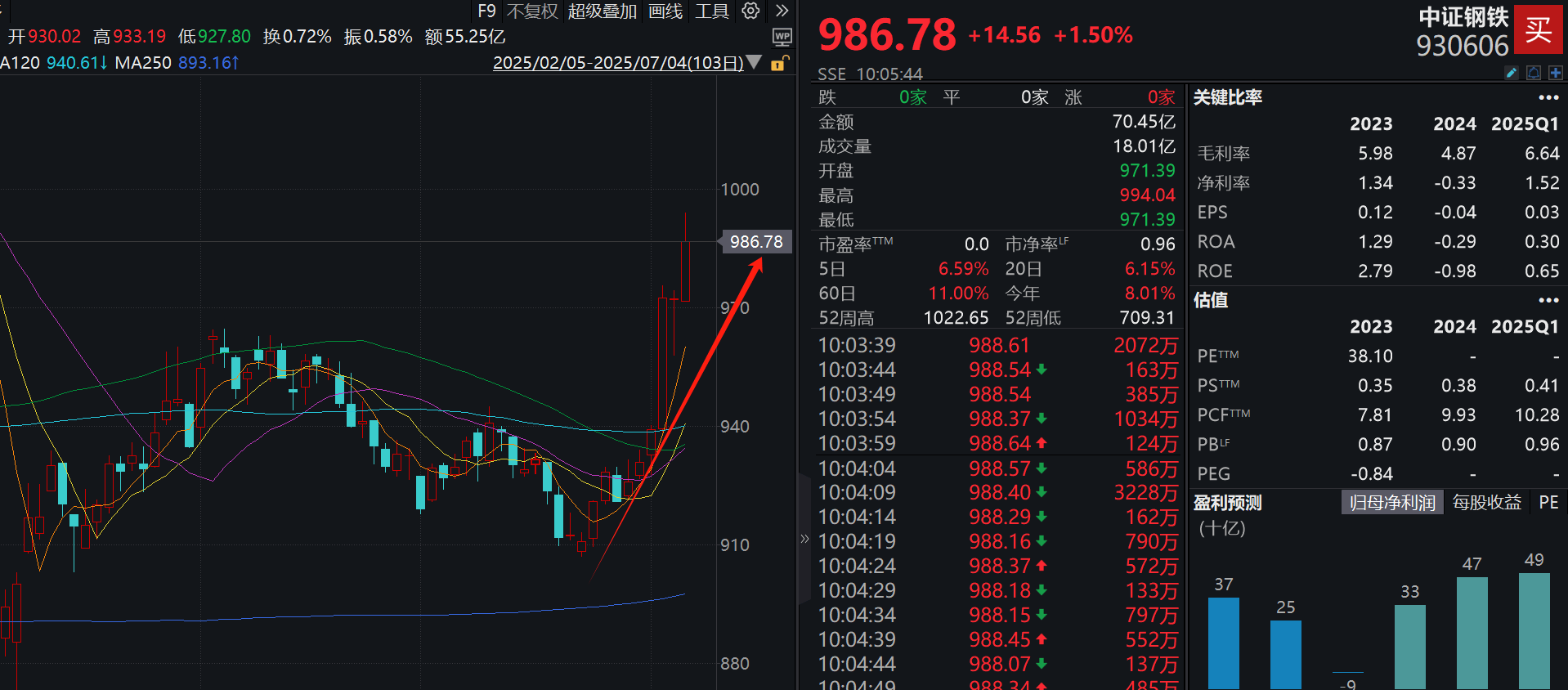
供给侧改革2.0启动,钢铁指数人气回升!相关ETF布局正当时?
Sou Hu Cai Jing· 2025-07-04 07:47
Group 1 - The core viewpoint of the article emphasizes the significance of the supply-side reform 2.0, which aims to eliminate backward production capacity and effectively address chaotic competition in the industry [1] - The supply-side reform initiated in 2015 led to substantial price increases in commodities, with rebar futures soaring from 843 yuan/ton to 3147 yuan/ton, a 273% increase, and coking coal prices rising from 203 yuan to 719 yuan, a 3.5-fold increase [1] - The recent performance of the steel industry, particularly the China Steel Index, has mirrored past trends, with a notable increase of over 3.5% in a single day, indicating a potential revival similar to the previous supply-side reform [1][4] Group 2 - The current supply-side reform is characterized by unprecedented policy strength, focusing on eliminating low-price competition and orderly phasing out of backward production capacity, suggesting a potential for significant market recovery [6] - The valuation of steel stocks should consider the cyclical nature of the industry, with many steel companies currently valued below their replacement cost by 0.35 times, indicating a sufficient margin of safety [6] - The comparison between the China Steel Index and the National Steel Industry Index shows a high degree of overlap, with both indices focusing on the steel industry, although the China Steel Index includes some coal companies [7] Group 3 - The performance of funds tracking the China Steel Index and the National Steel Industry Index has been similar, with differences in returns being minimal, generally within 0.1% [12] - Specific funds, such as the Guolian National Steel A and Penghua National Steel Industry A, have shown significant returns of 8.10% and 7.66% respectively, outperforming the CSI 300 index [14] - The article suggests that as the economy develops, steel consumption will stabilize, with a shift from rebar consumption in construction to sheet metal consumption in manufacturing, indicating a potential improvement in profitability for the steel sector [14]