
Yanjing Brewery(000729)

Search documents
燕京啤酒(000729) - 000729燕京啤酒投资者关系管理信息20250515
2025-05-15 11:14
Financial Performance - In 2024, the company achieved operating revenue of 1,466,701.69 million yuan, a year-on-year increase of 3.20% [2] - Operating profit reached 160,874.05 million yuan, up 56.96% year-on-year [2] - Total profit amounted to 157,171.87 million yuan, reflecting a 51.26% increase [2] - Net profit attributable to shareholders was 105,567.85 million yuan, with a year-on-year growth of 63.74% [2] - The net profit after deducting non-recurring gains and losses was 104,063.74 million yuan, marking a 108.03% increase [2] - In Q1 2025, the company reported operating revenue of 382,683 million yuan, a 6.69% increase year-on-year [4] Market Growth and Strategy - The company sold 400.44 million hectoliters of beer in 2024, a 1.57% increase from the previous year [2] - The flagship product, Yanjing U8, sold 69.60 million hectoliters, with a growth of 31.40% [2] - The company is focusing on market segmentation and strategic expansion, enhancing its market development system [5][20] Management and Operational Efficiency - The company has integrated ESG principles into its core strategy, promoting a "green brewing-responsible supply chain-value co-creation" system [10] - Cost control measures and a robust management system have improved operational efficiency [3] - The company is advancing digital transformation to enhance supply chain management and operational capabilities [20] Brand Promotion and Consumer Engagement - The company is enhancing its brand positioning as "China's own beer" and implementing diverse marketing strategies to attract younger consumers [5] - A focus on multi-channel marketing and cultural IP development is aimed at increasing brand influence [10] - The company reported that mid-to-high-end products generated revenue of 886,543.04 million yuan, accounting for 67.01% of beer revenue [6] Risk Management and Compliance - The company has strengthened its compliance and risk management capabilities to ensure sustainable development [4] - It has implemented a comprehensive risk prevention framework to support stable growth [10] Future Outlook - The company anticipates continued growth in beer sales, driven by flagship products and market channel upgrades [20] - The beer industry is expected to stabilize in 2025, with a focus on product quality and consumer preferences [6]

燕京啤酒谈推倍斯特汽水:聚焦餐饮现饮场景,优先切入火锅店、烧烤店、夜市等
Cai Jing Wang· 2025-05-15 10:03
Core Viewpoint - Yanjing Beer is expanding into the non-alcoholic beverage market with the launch of Beiste Soda, responding to market trends and consumer demands for diverse beverage options, particularly in dining scenarios where non-alcoholic choices are preferred [1][2] Group 1: Market Trends and Consumer Demand - The beverage market is experiencing rapid growth, with consumers increasingly seeking diverse options, especially non-alcoholic beverages in dining settings [1] - The carbonated beverage market is projected to grow at an annual rate of 8.58%, reaching a market size of 162.2 billion yuan by 2027 [1] Group 2: Competitive Landscape - Despite Yanjing Beer maintaining growth, the production of major beer companies in China is expected to decline by 1.9% in 2024, with a total output of 35.9 million kiloliters [1] - The introduction of Beiste Soda aims to maximize channel value by leveraging existing beer sales channels [1] Group 3: Strategic Focus and Brand Positioning - The company is utilizing its nationwide beer distribution network to focus on dining scenarios, particularly in hot pot, barbecue, and night market settings, creating a "beer + soda" consumption combination [2] - Yanjing Beer is leveraging its brand strength to connect with younger consumers, emphasizing health and local branding, and enhancing emotional resonance through the slogan "Double Refreshment, Double Joy" [2]
观酒|主业增长乏力布局饮料等外业,啤酒公司能做好副业吗?
Nan Fang Du Shi Bao· 2025-05-13 09:23
Core Viewpoint - The beer industry is experiencing performance pressure, leading companies to explore diversification through cross-industry ventures to boost growth and attract investment [1][4][5]. Group 1: Industry Trends - Major beer companies in China, including Chongqing Beer, Qingdao Beer, and Yanjing Beer, are increasingly engaging in cross-industry expansions, particularly into beverage and liquor sectors, as a response to declining beer sales [1][2][4]. - The trend of diversification is seen as a way to build a "second growth curve" and create a competitive advantage, although it may take around five years for these new ventures to significantly impact performance [1][6]. Group 2: Company Strategies - Chongqing Beer has launched new beverage products, such as Cang'e soda, leveraging existing distribution channels in strong markets like Xinjiang and Chongqing [2][3]. - Qingdao Beer is pursuing a full acquisition of a Huangjiu (yellow wine) factory and has integrated its beverage business with existing operations, aiming to avoid competition with its beer products [2][3]. - Yanjing Beer has introduced a new soda brand, Best, and plans to utilize its beer distribution channels to penetrate the market quickly, focusing on dining establishments [3][4]. Group 3: Performance Insights - Despite some positive signs in Q1, overall performance for major beer companies remains mixed, with revenue and profit declines reported for several firms in 2024 [4][5][7]. - The sales volume for beer has decreased, with notable declines for companies like China Resources Beer and Qingdao Beer, attributed to high previous year bases and changing consumer preferences [5][6]. Group 4: Market Outlook - Analysts suggest that while cross-industry ventures are necessary for growth, the actual benefits may take time to materialize, with successful examples from other industries taking over a decade to develop [6]. - The diversification trend among beer companies is expected to continue, driven by changing consumer environments and the need for companies to establish strong brand recognition [6].



食品饮料周报(25年第19周):大众品旺季催化渐显,功能饮料等多个品类验证高景气-20250512
Guoxin Securities· 2025-05-12 06:52
Investment Rating - The report maintains an "Outperform the Market" rating for the food and beverage sector [4][5][76] Core Views - The food and beverage sector is showing signs of seasonal demand recovery, particularly in functional beverages and other categories, indicating high market vitality [1][10] - The overall demand for liquor remains weak, with a consensus among liquor companies on slowing growth, highlighting the need for policies to stimulate domestic demand [2][10] - The beer industry is entering a phase of inventory replenishment and demand stabilization, with leading brands showing positive growth [13][14] - The snack food sector is experiencing a mixed performance, with some companies showing significant revenue growth while others face profitability challenges [15][16] - The condiment sector is performing well, with leading companies maintaining strong cash flow and exploring acquisitions to enhance market presence [16] - The frozen food sector is facing challenges due to a weak restaurant industry, but some companies are improving through acquisitions [17] - The dairy sector is expected to see a recovery in demand, supported by favorable policies and improved supply conditions [18] - The beverage sector is entering a peak season, with leading companies optimistic about maintaining growth [18] Summary by Sections 1. Weekly Insights - The food and beverage sector rose by 1.88% during the week of May 6 to May 9, 2025, slightly underperforming the Shanghai Composite Index [19] - The liquor sector is under pressure, with a reported revenue of CNY 442.23 billion for 2024, a year-on-year increase of 7.3% [2][10] - The beer sector's revenue grew by 3.7% year-on-year in Q1 2025, with leading brands like Yanjing and Zhujiang showing strong performance [13][14] 2. Key Data Tracking - The liquor index increased by 2.3% during the week, with policy measures boosting market confidence [12][19] - The snack food sector's revenue grew by 31% year-on-year in Q1 2025, although profitability faced challenges due to rising raw material costs [15][16] - The condiment sector's revenue for 2024 was CNY 92.8 billion, with a 3% year-on-year increase [16] 3. Company Profit Forecasts and Investment Ratings - Key companies such as Kweichow Moutai, Shanxi Fenjiu, and Luzhou Laojiao are rated as "Outperform the Market" with projected earnings per share (EPS) growth [4][5] - The report highlights the importance of digital transformation and market share expansion for companies like Luzhou Laojiao and Jinsuiyuan [2][10]




Z世代不爱豪饮爱微醺,存量博弈下啤酒巨头如何“大象转身”?
Xin Lang Cai Jing· 2025-05-12 05:40
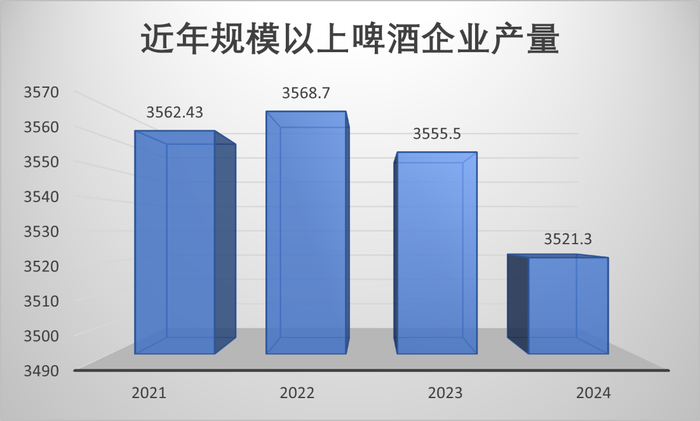
Core Insights - The Chinese beer market is entering a new phase characterized by stock competition and structural adjustments, with a projected 0.6% decline in production for 2024, marking the beginning of a "volume reduction and price increase" cycle [1][3] - Major beer companies are experiencing revenue declines, with the top five companies reporting a 4% drop in total revenue, while profit performance is increasingly divergent [3][5] Industry Performance - In 2024, the beer industry saw a 5.7% decline in revenue, making it the only category in the food and beverage sector to experience negative growth [5] - Key players like China Resources Beer, Budweiser APAC, and Tsingtao Brewery reported revenue declines of 0.76%, 8.9%, and 5.3% respectively, while Chongqing Brewery's revenue fell by 1.15% [5][8] - The total sales volume for major companies also decreased, with China Resources Beer down 2.5% and Budweiser APAC down 11.8% [8] Profitability Trends - Tsingtao Brewery managed a slight profit increase of 1.81%, while Yanjing Brewery saw a significant profit growth of 63.74%, contrasting with declines in profits for other major players [3][10] - Yanjing Brewery's revenue grew by 3.2%, allowing it to surpass Chongqing Brewery and become the fourth largest in the industry [10] Market Dynamics - The beer market is witnessing a shift in consumer preferences, particularly among younger generations who favor lighter drinking experiences, leading to a decrease in traditional beer consumption [12][13] - The restaurant industry is facing challenges, with a significant reduction in the number of registered dining establishments, impacting beer sales in on-premise channels [12][13] Strategic Responses - Companies are adapting by exploring new sales channels such as e-commerce and instant retail to meet changing consumer demands [13][14] - The rise of craft beer is also influencing the market, with a notable increase in the number of craft beer companies established in recent years [14] High-End Market Challenges - Despite efforts to target the high-end market, growth appears to be plateauing, with many companies facing competition from lower-priced craft beers [15][16] - Companies like Qingdao Beer and China Resources Beer are focusing on brand building and product innovation to maintain competitiveness in the high-end segment [15][18]

食品饮料2024年年报&2025年一季报总结:白酒主动降速减压、提高分红率,大众品关注新渠道/新品类机会
China Post Securities· 2025-05-12 03:23
Industry Investment Rating - The investment rating for the food and beverage industry is "Outperform the Market" and is maintained [2] Core Viewpoints - The food and beverage industry is experiencing a mixed performance across various segments, with opportunities in new channels and product categories. The report highlights the need for companies to adapt to changing consumer preferences and market dynamics [5][6][7] Summary by Relevant Sections 1. Baijiu Sector - The baijiu sector achieved a total revenue of CNY 440.515 billion in 2024, with a year-on-year growth of 6.89%, and a net profit of CNY 166.778 billion, up 7.50%. In Q1 2025, revenue was CNY 152.933 billion, growing 1.82%, and net profit was CNY 63.340 billion, increasing 2.33% [15][19] - High-end baijiu brands like Moutai, Wuliangye, and Luzhou Laojiao are expected to see stable growth targets of around 9%, 5%, and steady progress respectively for 2025 [19][21] - The report notes that companies are increasing dividend rates to enhance returns for investors, with expected dividend yields for major brands ranging from 1.39% to 6.28% in 2025 [18] 2. Frozen Food - The frozen food industry is facing a slowdown in growth, with leading companies like Anjijia showing resilience while others like Qianwei Central Kitchen are under pressure due to product structure. The industry is seeking breakthroughs in products and channels to improve revenue and profit [6] 3. Snack Foods - The snack food sector is experiencing differentiation, with leading companies leveraging product innovation and channel expansion to drive growth. Salted Fish's brand "Big Demon King" has shown significant results from brand investment [6] 4. Soft Drinks - The soft drink segment is seeing high growth from brands like Dongpeng, while companies like LuLu and Master Kong maintain operational resilience. New products in the health drink category are also performing well [6] 5. Pet Food - The pet food industry remains highly prosperous, with leading companies like Guibao Pet and Zhongchong Co. showing revenue growth rates of 21.22% and 19.15% respectively in 2024 [7] 6. Bakery Products - The bakery sector is recovering, with significant growth in supermarket channels driven by new product launches. Companies like Angel Yeast are expanding their international business, contributing to overall growth [8] 7. Dairy Products - Yili's revenue is stabilizing with better-than-expected profit performance, while New Dairy is seeing continuous profit margin improvements. Yili aims for a total revenue of CNY 119 billion in 2025 [8] 8. Beer - The beer market is witnessing a recovery in consumption, with major brands like Qingdao Beer and Chongqing Beer showing positive sales growth in Q1 2025 [9] 9. Seasoning Products - The seasoning industry is under pressure, but companies like Haitian are performing steadily, with core products like soy sauce maintaining growth [9]


雀巢、康师傅等131家快消品上市公司发布年报,68家营收下滑!
Sou Hu Cai Jing· 2025-05-12 02:12
Core Insights - In 2024, China's total retail sales of consumer goods reached 48.79 trillion yuan, growing by 3.5%, marking the first time it fell below the GDP growth rate of 5% [1] - The fast-moving consumer goods (FMCG) industry is transitioning into a phase dominated by "stock competition," focusing on efficiency improvement, brand optimization, and structural adjustments [1] FMCG Company Performance - **Kang Shifu**: Achieved revenue of 806.51 billion yuan, a slight increase of 0.30%, with net profit rising by 19.80% to 37.34 billion yuan [2][6][8] - **Nongfu Spring**: Revenue of 428.96 billion yuan, up 0.50%, with net profit at 121.23 billion yuan, a marginal increase of 0.40% [2][6][9] - **Uni-President**: Revenue reached 303.32 billion yuan, a 6.09% increase, with net profit of 18.49 billion yuan, up 10.90% [2][6][10] - **China Foods**: Reported revenue of 214.92 billion yuan, a 0.20% increase, and net profit of 8.61 billion yuan, up 3.40% [2][6][11] - **Dongpeng Beverage**: Revenue surged to 158.39 billion yuan, a 40.63% increase, with net profit at 33.27 billion yuan, up 63.09% [2][6][12] - **Three Squirrels**: Revenue of 106.22 billion yuan, a significant increase of 49.30%, with net profit rising by 85.51% to 4.08 billion yuan [2][6][14] - **Liangpinpuzi**: Revenue decreased to 71.59 billion yuan, down 11.02%, with a net loss of 0.46 billion yuan [2][6][15] - **Zhi Zhi Food**: Revenue of 71.31 billion yuan, up 4.79%, with net profit of 8.49 billion yuan, up 5.82% [2][6][15] - **Tao Li Bread**: Revenue of 60.87 billion yuan, down 9.93%, with net profit of 5.22 billion yuan, down 9.05% [2][6][15] Industry Trends - The FMCG sector is experiencing a shift towards efficiency and brand optimization as the market matures, with companies adapting to changing consumer preferences and competitive pressures [1][16] - Companies like Dongpeng Beverage and Three Squirrels are successfully leveraging product innovation and market expansion to drive growth, while others like Liangpinpuzi face challenges due to strategic missteps [12][14][15] - The beverage segment, particularly tea drinks, is emerging as a key growth area for companies like Nongfu Spring, which is focusing on enhancing its product offerings and maintaining its market leadership [9][16] Dairy Industry Performance - **Yili**: Achieved revenue of 1157.80 billion yuan, a decline of 8.24%, with net profit of 84.53 billion yuan, down 18.94% [18][19] - **Mengniu**: Revenue fell to 886.75 billion yuan, down 10.09%, with a net profit of 1.05 billion yuan, a drastic drop of 97.83% [18][20] - **Bright Dairy**: Revenue of 242.78 billion yuan, down 8.33%, with net profit of 7.22 billion yuan, down 25.36% [18][21] - **Feihe**: Revenue increased to 207.50 billion yuan, up 6.00%, with net profit of 36.50 billion yuan, up 11.00% [18][22] - The dairy sector is facing significant challenges, with many companies reporting revenue and profit declines due to oversupply and weak consumer demand [22]





寻觅“举杯”新场景 啤酒企业双重压力下的销量困局
Bei Jing Shang Bao· 2025-05-08 11:19
Core Viewpoint - The Chinese beer industry faces significant challenges in 2024, with a notable decline in sales and a shift in consumer behavior impacting revenue and profit margins [1][4][5]. Revenue and Profit Summary - In 2024, seven listed beer companies achieved a total revenue of approximately 152.13 billion yuan and a net profit of about 17.44 billion yuan [1]. - The revenue distribution among these companies shows three main tiers: over 30 billion yuan, between 10 billion and 30 billion yuan, and below 10 billion yuan [1]. - Budweiser APAC leads with a revenue of 62.46 billion yuan, followed by China Resources Beer and Tsingtao Brewery with revenues of 38.64 billion yuan and 32.14 billion yuan, respectively [1]. Performance Disparity - 57% of the beer companies experienced a decline in sales volume, attributed to a decrease in on-the-go consumption and high-end product sales [1][4]. - Among the seven companies, four reported a decrease in revenue, with Budweiser APAC, China Resources Beer, Tsingtao Brewery, and Chongqing Beer showing declines of 8.9%, 0.76%, 5.3%, and 1.15%, respectively [2][3]. - Conversely, Yanjing Beer, Zhujiang Beer, and Huichuan Beer saw revenue increases of 3.2%, 6.56%, and 5.44%, respectively [2]. Market Challenges - The decline in on-the-go consumption channels, such as restaurants and bars, has significantly impacted beer sales [4][5]. - The average per capita consumption in the restaurant sector dropped to 39.8 yuan, a decrease of 6.6% year-on-year, with the beverage segment experiencing the most significant decline [4]. - High-end product sales are also under pressure, with Budweiser APAC's market share in the high-end segment falling from approximately 50% to 42% [5]. Strategic Shifts - Beer companies are shifting focus from traditional on-premise sales to new consumption scenarios, particularly instant retail, which is gaining traction [6][7]. - Instant retail for beer has seen significant growth, with a reported 83% increase in market size from 2020 to 2022 [6]. - Companies like China Resources Snow Beer and Tsingtao Brewery are exploring customized products and services to meet evolving consumer demands [6]. Future Trends - The competition in the beer industry is transitioning from channel acquisition to the exploration of consumer scenarios, especially in the high-end segment [7]. - The future development of the beer market is expected to focus on technology-driven high-end products and the capture of instant consumption scenarios [7].
上市啤酒企业减员数量曝光:百威亚太减员4000人,燕京、华润减员上千人
Sou Hu Cai Jing· 2025-05-08 09:54
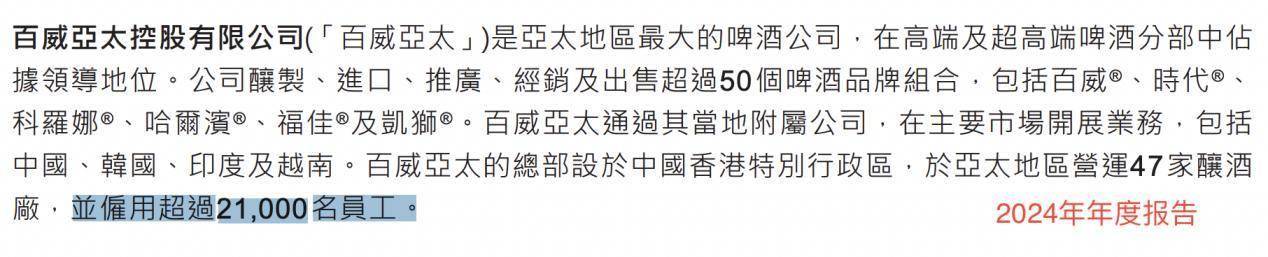
Employment Changes - Budweiser APAC reduced its workforce from approximately 25,000 employees in 2023 to over 21,000 in 2024, resulting in a decrease of about 4,000 employees, which is a reduction rate of approximately 16% [1] - Yanjing Beer reduced its workforce by 1,440 employees, with total employees dropping from 21,405 in 2023 to 19,965 in 2024 [2][5] - China Resources Beer employed around 26,000 people in 2024, down from about 27,000 in 2023, a decrease of 1,000 employees [6] - Qingdao Beer saw a reduction of 817 employees, with total employees decreasing from 30,687 in 2023 to 29,870 in 2024, a reduction rate of 2.66% [8] Financial Performance - Budweiser APAC's beer sales in 2024 were 8.481 million kiloliters, a year-on-year decline of 8.8%, with revenue of $6.246 billion, down 7%, and normalized EBITDA of $1.807 billion, down 6.3% [2] - Yanjing Beer achieved beer sales of 4.0044 million kiloliters in 2024, a year-on-year increase of 1.57%, with revenue of 14.667 billion yuan, up 3.20%, and net profit attributable to shareholders of 1.056 billion yuan, up 63.74% [6] - China Resources Beer reported a total revenue of 38.635 billion yuan in 2024, a slight decline of 0.76%, with net profit attributable to shareholders of 4.739 billion yuan, down 8.03%, and a gross margin of 42.6%, which is an increase of 1.2 percentage points [8] - Qingdao Beer reported revenue of 32.138 billion yuan in 2024, a decrease of 5.3%, while net profit attributable to shareholders was 4.345 billion yuan, an increase of 1.81%, and net profit excluding non-recurring items was 3.951 billion yuan, up 6.19% [10]
中国消费行业2025年5月投资策略:热点增多弱化消费板块行情
Haitong Securities International· 2025-05-08 06:32
Core Insights - The report indicates that the increase in investment hotspots has weakened the performance of consumer stocks in China [1] - The consumer sector is experiencing slow growth, with a lack of fundamental catalysts in the short term, although long-term asset revaluation logic remains intact [8] Industry Overview - In April 2025, five out of eight tracked industries maintained positive growth, while two experienced negative growth and one remained flat. The industries with single-digit growth included dairy (+3.4%), dining (+3.1%), soft drinks (+2.7%), condiments (+2.3%), and frozen foods (+1.5%). The declining sectors were mass-market and below liquor (-10.7%) and mid-to-high-end liquor (-1.5%), with the beer industry remaining flat [3][10] - The revenue for the high-end liquor sector in April was 26.4 billion yuan, down 1.5% year-on-year, while the cumulative revenue for the first four months was 167 billion yuan, up 0.3% year-on-year [12] - The mass-market liquor sector saw a revenue of 15 billion yuan in April, down 10.7% year-on-year, with a cumulative revenue of 75.2 billion yuan for the first four months, down 13.9% year-on-year [13] - The beer industry reported a revenue of 14 billion yuan in April, remaining flat year-on-year, with a cumulative revenue of 60.6 billion yuan, showing a slight decline of 0.2% [14] Price Trends - In April, the wholesale prices of high-end liquor such as Feitian Moutai continued to decline, with prices for whole boxes and individual bottles down by 70 yuan compared to the previous month [4][22] - The prices of most high-end liquor remained stable, while mid-range and lower-end liquor prices saw more declines than increases [12][13] Cost Analysis - The cost indices for various products in April showed increases for beer (+2.69%), frozen foods (+1.67%), dairy (+1.09%), while condiments (-0.12%), instant noodles (-0.18%), and soft drinks (-1.58%) experienced declines [5] - The prices of packaging materials varied, with aluminum can prices rising by 8.37% year-on-year, while glass, plastic, and pulp prices fell by 23.17%, 20.90%, and 4.59% respectively [5] Investment Recommendations - The report suggests waiting for the right opportunity to increase positions in consumer stocks, particularly in the dairy sector, soft drinks, and liquor, with specific companies highlighted for potential investment [8]

