ZGXT(000831)

Search documents
“美国又作妖欲封杀华为AI芯片?中国稀土反杀直戳命门
Sou Hu Cai Jing· 2025-05-20 02:44
Group 1 - The article discusses the escalating technological conflict between the US and China, particularly focusing on the implications of US sanctions against Huawei's Ascend AI chips and the strategic importance of rare earth elements [1][5]. - China's response to US sanctions includes a comprehensive meeting involving multiple ministries and provinces to strengthen the control over the entire supply chain of rare earths, emphasizing the importance of preventing illegal outflow [3][4]. - China supplies 92% of the world's rare earth refining, with the US relying on China for 70% of its imports, highlighting the critical role of rare earths in military applications, such as the F-35 fighter jet [3][5]. Group 2 - The article notes that the US military-industrial complex is heavily dependent on rare earths, with each F-35 requiring 417 kilograms of these materials, and the price of essential elements like dysprosium has surged by 300% in just 30 days [3][5]. - China's dominance in the deep processing of rare earths has created significant challenges for US companies, with projections indicating that by 2026, 78% of US military production lines could be severely impacted [3][5]. - The article emphasizes that the ongoing conflict has transcended traditional trade disputes, becoming a direct confrontation of military capabilities, with China's control over rare earths serving as a strategic leverage point against US sanctions [5][6].


“比美国先进20年,但中国稀土业要居安思危”
Guan Cha Zhe Wang· 2025-05-20 01:11
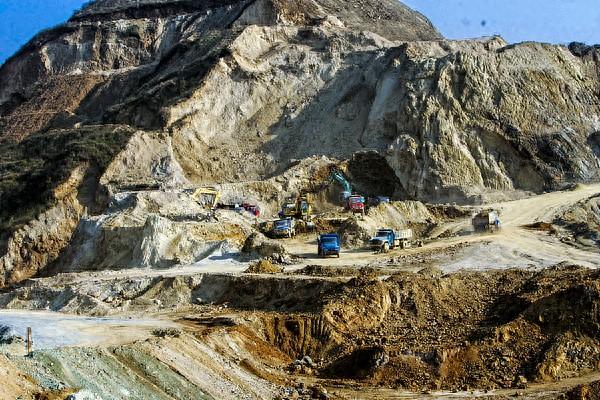
几周后,广西媒体也报道了一起类似事件。根据广西南宁海关发布的"情况说明",3月18日,一公司按 程序向海关申报1票出口泰国的货物焊锡膏,外包装标注"低温锡膏",内包装标签显示"锡铋合金",用 途为电子焊接用。经查验检测,该批焊锡膏铋含量为55.3%。 尽管铋属于氮族元素,不属于稀土,但根据有关规定,出口该批含铋的货物需向管理部门申领出口许可 证件,因公司无法提供该证件,海关不予放行。 中国稀土矿 视觉中国 【文/观察者网 刘程辉】稀土管制被广泛视作中国对美博弈的"反制王牌"。香港英文媒体《南华早报》5 月20日文章提到,中国在稀土等关键矿产供应链上占据绝对主导地位,美国尤其在重稀土分离提纯技术 上落后中国20年。尽管美国试图通过"矿产外交"等方式摆脱对华依赖,但短期内难以撼动中国地位。 不过也有业内分析人士提醒,中国需在保持优势的同时居安思危,加强基础研究和人才培养以防范长期 风险。 "中方管制不会放松" 文章称,虽然中美达成协议暂缓关税战,但中国仍在加强对稀土等关键矿物的供应控制,能随时切断美 国的获取渠道。 就在3月中旬,香港海关破获一起重大战略资源走私案,在北部边境货场截获伪装成普通医疗设备的25 吨锑 ...
澳企放话打破中国稀土垄断,掌握分离技术,加工成本暴露真正底细
Sou Hu Cai Jing· 2025-05-19 09:15
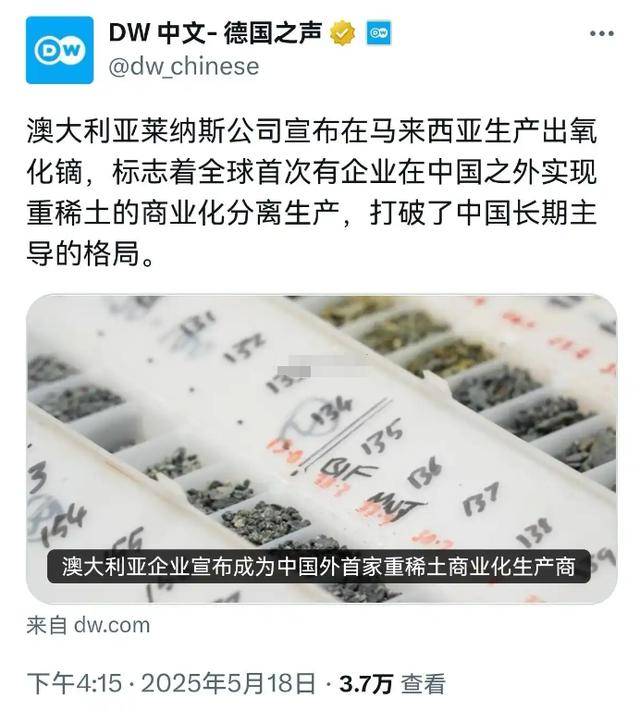
Core Viewpoint - The announcement by Lynas, an Australian company, claiming to have mastered rare earth separation technology, raises questions about China's dominance in the rare earth industry and its ability to use rare earths as a leverage tool in international trade [1][3]. Group 1: Lynas's Claims and Market Impact - Lynas's assertion of achieving heavy rare earth separation technology is seen as an attempt to attract global attention, especially as China tightens its export policies [3][5]. - The production capacity of Lynas's Malaysian plant for heavy rare earths is only 1,500 tons per year, which pales in comparison to China's total production capabilities, estimated to be over twenty times greater [5][7]. - The U.S. military's reliance on Chinese materials for critical components highlights the challenges Lynas faces in meeting Western market demands [7][14]. Group 2: Cost and Efficiency Disadvantages - China's advanced extraction techniques, such as the cascade extraction method developed in the 1970s, yield a purity of 99.9999%, significantly outperforming Lynas's methods [5][8]. - The cost of producing light rare earth oxides in China ranges from $4 to $7 per kilogram, while Lynas incurs costs of $10 to $15 per kilogram due to logistical challenges and operational inefficiencies [8][10]. - The entire processing timeline for Lynas, involving transport from Australia to Malaysia and potentially to the U.S., takes about three months, compared to China's 15-day turnaround for similar processes [10][12]. Group 3: Strategic Moves by China - China has implemented export controls on various metals and rare earth products, indicating a strategic approach to maintain its competitive edge in the global market [21][23]. - The Chinese government has classified rare earth separation technology as restricted for export since 2019, making it difficult for Western countries to replicate the entire rare earth supply chain without Chinese support [23][25]. - Continuous investment in technology and industry upgrades by China aims to strengthen its position in the rare earth market, making it challenging for competitors to catch up [23][25].
英媒抱怨:中国稀土出口许可制度审批速度太慢,远不能满足全球供应链需求
Guan Cha Zhe Wang· 2025-05-19 03:34
【文/观察者网 熊超然】在美国总统特朗普于4月初挑起全面关税战后,稀土出口管制成为了中方众多 的"反制王牌"之一。外媒当时解读称,中方正在建立出口许可制度,要想购买中国稀土,就得先申请出 口许可证。 当地时间5月18日,英国《金融时报》援引业内出口商、行业组织和供应链专家称,在数周延迟后,中 方已批准部分对欧出口许可证,但审批速度"太慢",远不能满足需求。报道中出现的"抱怨声"还炒作渲 染,这种缓慢的审批进度恐将扰乱全球供应链。 德国工业联合会(BDI)执行董事会成员沃尔夫冈·尼德马克(Wolfgang Niedermark)表示:"避免欧洲 生产受到重大损害的窗口正在迅速关闭。"而包括特斯拉、福特和洛克希德·马丁在内的美国制造商,则 在最近的投资者吹风会上表达了对中国新出口管制的担忧。一名不愿透露姓名的欧洲驻华行业高管声 称,目前的延误对外国制造商来说是"无法承受的"。 江苏连云港等待出口的稀土 路透社 今年4月初,面对美国总统特朗普执意挑起关税战,中国也发起了一系列反制措施,其中就包括对钐、 钆、铽、镝、镥、钪、钇等7类中重稀土相关物项实施出口管制措施。英国《金融时报》当时曾援引业 内人士透露,中方正在建 ...

行业周报:有色金属周报:稀土内外同涨逻辑加速,全面看多战略金属-20250518
SINOLINK SECURITIES· 2025-05-18 15:23
Investment Ratings - The report does not explicitly provide investment ratings for the industry sectors discussed. Core Insights - The industrial metals sector is experiencing an upward turning point in market conditions, particularly for copper and aluminum, driven by easing trade tensions between the US and China [13]. - Precious metals, particularly gold, are facing downward pressure due to a stronger US dollar and reduced appeal as a safe-haven asset amid improving trade relations [15]. - The rare earth sector is witnessing a simultaneous increase in both domestic and international prices, driven by export controls and a recovering market sentiment [32]. Summary by Sections 1. Overview of Bulk and Precious Metals Market - Copper prices increased slightly, with LME copper at $9,440.00 per ton and Shanghai copper at ¥78,100 per ton. A notable rise in copper inventory was observed, ending a ten-week decline, attributed to weakened downstream demand [13]. - Aluminum prices rose by 2.75% to $2,484.50 per ton, with domestic inventories remaining low despite a slight decrease in stock levels [14]. - Gold prices fell by 1.13% to $3,205.30 per ounce, influenced by a stronger dollar and easing trade tensions between the US and China [15]. 2. Updates on Bulk and Precious Metals Fundamentals 2.1 Copper - The report highlights a significant increase in copper inventory, reaching 132,000 tons, marking a shift in market dynamics due to reduced demand [13]. - The processing fee for imported copper concentrate has dropped to -$43.05 per ton, indicating pressure on the supply side [13]. 2.2 Aluminum - Domestic electrolytic aluminum ingot inventory decreased to 581,000 tons, remaining at a near three-year low, while the cost of prebaked anodes increased slightly [14]. - The report notes that the Guinean government has revoked mining licenses for over 40 companies, impacting aluminum ore production capacity [14]. 2.3 Precious Metals - The report discusses the impact of US-China trade negotiations on gold prices, with a significant reduction in SPDR gold holdings [15]. - Economic indicators such as the US CPI and PPI suggest a cooling inflation environment, which may influence future monetary policy [15]. 3. Overview of Minor Metals and Rare Earths Market - The rare earth market is experiencing price increases, particularly for dysprosium and terbium, driven by export controls and a recovering market sentiment [32]. - The antimony market is expected to see price recovery due to supply disruptions from Myanmar and ongoing anti-smuggling efforts in China [33]. - Tin prices have risen, supported by positive expectations from US-China trade negotiations, despite some production concerns [35]. 4. Updates on Minor Metals and Rare Earths Fundamentals 4.1 Rare Earths - Prices for rare earth elements are showing upward trends, with significant increases in overseas prices following export control measures [32]. - The report anticipates a continued tightening of supply due to regulatory changes and geopolitical factors affecting production [32]. 4.2 Antimony - Antimony prices are expected to recover as supply constraints from Myanmar persist, alongside increased demand from various sectors [33]. 4.3 Tin - Tin prices are supported by a favorable market outlook, driven by demand recovery in sectors such as semiconductors and photovoltaics [35].


宏观情绪回暖,看好基本金属向上修复
Tianfeng Securities· 2025-05-18 14:19
Investment Rating - The industry rating is maintained as "Outperform the Market" [6] Core Views - The macro sentiment is improving, leading to a recovery in base metal prices, particularly copper and aluminum [1][10] - Gold prices are under pressure due to easing risk sentiment and trade negotiations between the US and China [2][25] - Supply tightness is pushing tungsten prices higher, while other small metals show mixed trends [3][43] Summary by Sections Base and Precious Metals - **Copper**: Copper prices are fluctuating at high levels, with social inventory showing signs of recovery. The current inventory level is low, but demand is weakening as it enters the off-season [1][13] - **Aluminum**: Aluminum prices have rebounded, supported by improved macro sentiment and declining social inventory. The theoretical operating capacity of the electrolytic aluminum industry has slightly increased [1][20] - **Precious Metals**: Gold prices have decreased by 3.54% to an average of 768.56 CNY/g, while silver prices fell by 1.13% to 8111 CNY/kg. The easing of trade tensions has limited gold's rebound potential [2][25] Minor Metals - **Tungsten**: Prices for tungsten have increased due to supply tightness, with black tungsten concentrate averaging 161,500 CNY/ton, up by 8,000 CNY/ton. The market is cautious due to high prices and limited low-cost supply [3][63] - **Lithium**: The lithium market remains stable with prices holding steady, but demand is weak, leading to a supply surplus [43][43] - **Cobalt**: Cobalt prices are stable, with limited trading activity due to cautious market sentiment and reduced purchasing intentions from downstream manufacturers [45][46] Rare Earths - **Light Rare Earths**: Prices for light rare earths, such as praseodymium and neodymium, have increased by 2.6% to 434,000 CNY/ton, supported by improving macro conditions and easing export controls [4][4] Other Metals - **Molybdenum**: The molybdenum market is stable with slight price increases, but the overall market remains cautious with limited trading activity [68][69]



有色钢铁行业周观点(2025年第20周):积极关注稀土等战略金属板块的投资机会-20250518
Orient Securities· 2025-05-18 14:13
Investment Rating - The report maintains a "Positive" investment rating for the non-ferrous and steel industry [5]. Core Viewpoints - The report emphasizes the importance of closely monitoring investment opportunities in strategic metals such as rare earths, especially following significant price increases in overseas markets due to China's export controls [8][13]. - In the steel sector, there has been a notable increase in rebar consumption and a slight rise in overall steel prices, indicating a positive trend in demand [14][38]. Summary by Sections 1. Core Viewpoints: Focus on Strategic Metals - The report highlights the strategic importance of rare earth metals, particularly in light of recent U.S.-China trade discussions that aim to reduce tariffs, which could enhance global economic recovery [8][13]. - Following China's export restrictions on heavy rare earths, overseas prices have surged, with dysprosium and terbium prices in Europe increasing nearly threefold [8][13]. 2. Steel Sector: Price Trends - Rebar consumption has risen significantly, with a reported consumption of 2.6 million tons, marking a 21.69% increase week-on-week [14][18]. - The overall steel price index has seen a slight increase of 0.92%, with hot-rolled coil prices rising to 3,320 CNY/ton, a 1.40% increase, and cold-rolled prices at 3,767 CNY/ton, a 1.31% increase [14][38]. 3. New Energy Metals: Supply and Price Declines - Lithium production in April 2025 was reported at 70,640 tons, a year-on-year increase of 40.38%, but with a slight month-on-month decline [15][42]. - Nickel production has seen a significant year-on-year decrease of 14.18%, while cobalt prices have shown a downward trend [15][44]. 4. Industrial Metals: Copper and Aluminum - Copper smelting fees have slightly increased, with the LME aluminum price settling at 2,474 USD/ton, reflecting a minor week-on-week rise of 0.20% [16]. - The production costs for electrolytic aluminum have decreased significantly, leading to increased profitability for producers [16][28]. 5. Precious Metals: Market Adjustments - Gold prices have experienced a notable decline of 3.72% week-on-week, attributed to reduced demand for safe-haven assets following positive developments in U.S.-China relations [17].


中国稀土出口管制,韩国船厂新船交付延迟?
Sou Hu Cai Jing· 2025-05-16 14:13
Group 1 - China has announced export restrictions on seven key rare earth elements, including dysprosium, terbium, samarium, and gadolinium, requiring exporters to obtain permits from the Ministry of Commerce, with approval processes taking from six weeks to several months [1] - China dominates the rare earth production sector, accounting for approximately 90% of global supply, raising concerns in advanced manufacturing sectors, including shipbuilding [3] - Delays in procurement of rare earth materials are hindering equipment suppliers' delivery schedules to shipyards, potentially affecting the outfitting progress of vessels and leading to delayed deliveries [3] Group 2 - Rare earth elements are critical in various technological fields, including electric and hybrid vehicle batteries, wind turbines, advanced ceramics, displays, lighting, fiber optics, superconductors, and glass polishing [4] - The U.S. is particularly vulnerable to supply chain disruptions due to its heavy reliance on China for rare earth compounds and metals, with 70% of imports from China between 2020 and 2023 [4]
中国稀土收盘下跌1.42%,滚动市盈率483.08倍,总市值359.75亿元
Jin Rong Jie· 2025-05-16 08:34
Group 1 - The core viewpoint of the article highlights the performance and valuation of China Rare Earth, which closed at 33.9 yuan, down 1.42%, with a rolling PE ratio of 483.08 times and a total market value of 35.975 billion yuan [1] - The average PE ratio for the small metals industry is 72.06 times, with a median of 56.42 times, placing China Rare Earth at the 39th position in the industry ranking [1] - As of the first quarter of 2025, 44 institutions hold shares in China Rare Earth, including 38 funds, 5 others, and 1 insurance company, with a total shareholding of 48.12771 million shares valued at 15.242 billion yuan [1] Group 2 - The main business of China Rare Earth includes rare earth mining, processing, production of rare earth oxides, and technology research and consulting services [1] - The company has applied for 26 new patents, with 7 invention patents and 4 utility model patents granted [1] - In the latest performance report for the first quarter of 2025, the company achieved an operating income of 728 million yuan, a year-on-year increase of 141.32%, and a net profit of 72.6181 million yuan, a year-on-year increase of 125.15%, with a sales gross margin of 9.77% [1]
2025年中国稀土行业资源分布现状:稀土资源主要集中在内蒙古地区
Qian Zhan Wang· 2025-05-16 08:08
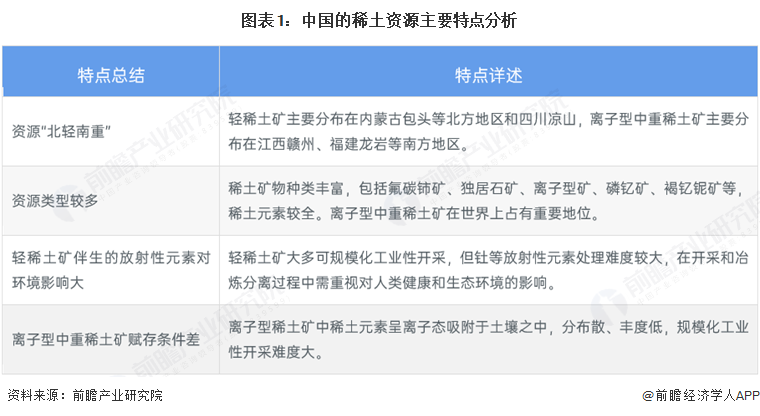
Core Insights - China possesses abundant rare earth resources, characterized by a distribution of "light in the north and heavy in the south" [1][3] - The Baiyun Obo mine in Inner Mongolia is the largest rare earth resource area in the world, with a total rare earth reserve of 1 million tons, accounting for 83% of China's rare earth resources [11][5] - The production and extraction of rare earth elements in China are concentrated in specific regions, with significant environmental considerations due to the presence of radioactive elements in light rare earth mining [1][12] Distribution of Rare Earth Resources - Light rare earths are primarily found in Inner Mongolia, particularly in Baotou, which is known as the "world capital of rare earths" [3][4] - The total control plan for rare earth products in Baotou for 2023 is set at 179,000 tons for mining products and 163,000 tons for smelting and separation products, representing 70% and 67% of the national total, respectively [3] - Ion-type heavy rare earths are mainly distributed in southern regions such as Jiangxi, Guangdong, and Fujian, with Jiangxi having the largest share of ion-type rare earth resources [7][3] Baiyun Obo Mine Development - The Baiyun Obo mine is located in Inner Mongolia and is managed by Baotou Steel Group, which is the leading enterprise in rare earth production [12][11] - The mine has a proven rare earth oxide reserve of approximately 35 million tons, which is 83% of China's total and 38% of the world's total [12] - The mine also contains significant reserves of iron ore (1.4 billion tons) and fluorite (130 million tons), making it a multi-metal resource area [12]