WLY(000858)

Search documents
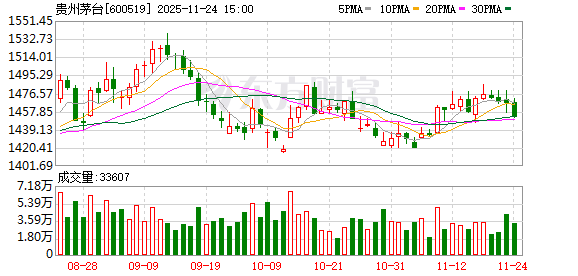
11只白酒股上涨 贵州茅台1452元/股收盘
Bei Jing Shang Bao· 2025-11-24 08:05
Core Viewpoint - The liquor sector, particularly the baijiu industry, is experiencing a market correction with valuations at relatively low historical levels, while market expectations remain weak [2] Group 1: Market Performance - On November 24, the Shanghai Composite Index closed at 3836.77 points, up 0.05% [2] - The baijiu sector closed at 2248.25 points, increasing by 0.17%, with 11 baijiu stocks rising [2] Group 2: Individual Stock Performance - Kweichow Moutai closed at 1452.00 CNY per share, down 1.00% [2] - Wuliangye closed at 118.52 CNY per share, down 0.97% [2] - Shanxi Fenjiu closed at 192.40 CNY per share, down 0.31% [2] - Luzhou Laojiao closed at 132.92 CNY per share, down 0.95% [2] - Yanghe Brewery closed at 66.50 CNY per share, down 0.67% [2] Group 3: Industry Insights - CITIC Securities noted that the baijiu industry is currently in a phase of bottoming out, with ongoing sales struggles [2] - Moutai is addressing e-commerce chaos to stabilize price expectations, supported by performance-driven strategies and strong brand influence [2] - The industry is exploring new marketing models while leveraging strong operational capabilities to enhance channel performance [2]






A股白酒年报图鉴:最“有钱”的不是茅台 酒鬼酒等股价增长3倍的逻辑在哪
Mei Ri Jing Ji Xin Wen· 2025-11-24 07:53
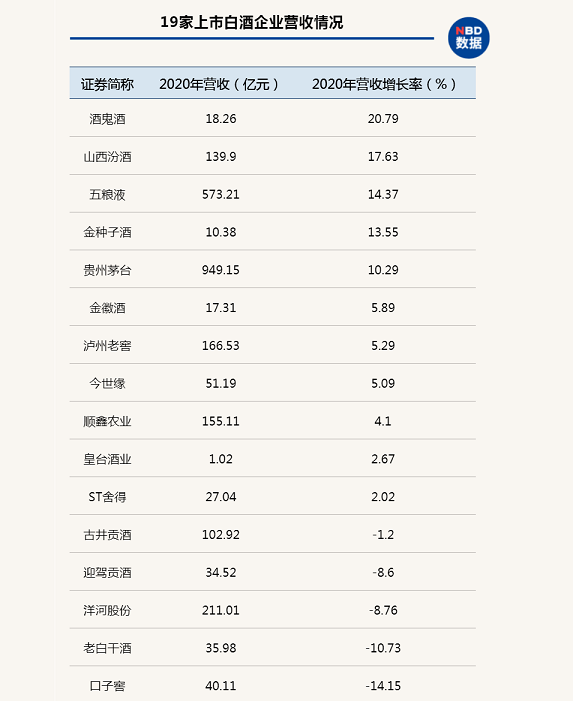
Core Insights - The Chinese liquor market, particularly the baijiu sector, experienced significant growth in 2020, with A-shares leading globally. The overall revenue for 19 listed baijiu companies reached 258.94 billion yuan, a year-on-year increase of 6.58% [1][5] - The net profit attributable to shareholders for these companies totaled 92.068 billion yuan, reflecting a growth of 11.95% compared to the previous year [1][5] - There is a notable divergence in performance among baijiu companies, with leading brands like Moutai and Wuliangye achieving double-digit growth, while some smaller brands faced significant declines [4][9] Revenue Performance - In 2020, 19 listed baijiu companies reported a total revenue of 258.94 billion yuan, with 11 companies showing positive growth and 8 experiencing negative growth [2][5] - The highest revenue growth was recorded by Jiugui Liquor at 20.79%, while Qingqing Qiao experienced a decline of 39.07%, marking a difference of 59.86 percentage points [2][3] - The top three companies by revenue were Moutai (94.915 billion yuan), Wuliangye (57.321 billion yuan), and Yanghe (21.101 billion yuan) [4] Profit Analysis - The six leading baijiu companies accounted for over 90% of the total profits in the sector, with Moutai alone contributing more than 36% of total revenue and over 50% of total profits [7][9] - Moutai's net profit reached 46.697 billion yuan, with a growth rate of 13.33%, while Wuliangye's net profit was 19.955 billion yuan, growing by 14.67% [6][7] - Jiugui Liquor showed remarkable performance with a net profit growth of 64.15%, while Qingqing Qiao reported a significant loss of 1.15 billion yuan [6][7] Market Dynamics - The pandemic initially impacted the baijiu industry negatively, but leading brands demonstrated resilience, with Moutai, Wuliangye, and Shanxi Fenjiu achieving substantial growth [9] - The disparity in performance is evident, with some companies like Shanxi Fenjiu and Jiugui Liquor seeing stock prices increase over threefold, while others struggled [9][11] - The overall tax contributions from the baijiu sector increased significantly, with a 48% rise in the first quarter of 2021 compared to the previous year, attributed to a recovery from the pandemic [14][15] Financial Health - As of March 2021, Wuliangye had the highest cash reserves among listed baijiu companies, totaling 73.38 billion yuan, while Moutai had approximately 50.743 billion yuan [17][18] - The financial strength of these companies is crucial for their ability to invest and expand in a competitive market [17] Compensation Trends - Moutai reported the highest average employee salary in the sector at over 300,000 yuan, while the lowest was at less than 52,000 yuan for Huangtai Liquor [19][20] - The management compensation for Moutai was relatively low compared to other companies, with total management salaries below 3.72 million yuan [21][23]

食品饮料行业周报:大众品成长优先,白酒预期先行-20251124
Haitong Securities International· 2025-11-24 07:10
Investment Rating - Investment advice indicates a focus on growth and supply-demand inflection points, with a positive outlook for the sector driven by recent CPI data [5][18]. Core Insights - The report emphasizes the recovery of traditional consumer leaders with strong long-term growth certainty, highlighting Yili's shareholder return plan as a sign of stability [1][10]. - The baijiu sector is expected to benefit from market style shifts, with notable sales growth during promotional events, indicating a potential recovery in demand [6][19]. - Consumer goods are showing structural prosperity, particularly in beverages, snacks, and food ingredients, with companies that innovate and expand channels having growth advantages [8][20]. Summary by Sections Investment Recommendations - Focus on growth opportunities in the baijiu sector, with key companies such as Shanxi Xinghuacun Fen Wine Factory, Gujing Distillery, and stable targets like Kweichow Moutai and Wuliangye [5][18]. - Highlighting structural growth in beverages with a focus on companies like Eastroc Beverage and Nongfu Spring, as well as low valuation and high dividend stocks such as China Foods and Tingyi [5][18]. - Emphasis on snack and food ingredient companies like Shandong Bailong Chuangyuan and Three Squirrels, alongside beer companies like Yanjing Brewery and Tsingtao Brewery [5][18]. Baijiu Sector Analysis - The baijiu market is experiencing a bottoming phase, with improved expectations driven by recent CPI data and accelerated inventory clearance [6][19]. - Notable sales growth of 18% year-on-year during the Double 11 promotion for alcohol products, with major brands showing double-digit growth [6][19]. Consumer Goods Overview - The consumer goods sector is expected to recover before the baijiu sector, with clear structural differences and growth potential in beverages, snacks, and health products [8][20]. - Yili's announcement of a dividend ratio of at least 75% for 2025-2027, with a per-share dividend of no less than RMB 1.22, reflects a commitment to shareholder returns [10][20].

文明互鉴 和美共生 2025全球熊猫伙伴大会五粮液推介获中外嘉宾点赞
Xin Hua Cai Jing· 2025-11-24 06:10
Group 1 - The core theme of the event is the integration of culture and tourism, with Wuliangye showcasing its historical and cultural significance as a leading Chinese liquor brand during the 2025 Global Panda Partners Conference [1][9] - Wuliangye's presentation included an immersive performance that highlighted the historical connection between the brand and the famous poet Huang Tingjian, emphasizing the aesthetic of Chinese liquor tasting [1][3] - The event featured a virtual tour of Wuliangye's 4A scenic area, showcasing various cultural and historical elements related to the brand, thus demonstrating a blend of cultural warmth and technological appeal [3] Group 2 - Wuliangye is positioned as a cultural ambassador for China, paralleling the giant panda in representing the country's rich heritage and commitment to ecological preservation [5][7] - The tasting experience of Wuliangye's cocktails received positive feedback from international guests, indicating a successful fusion of Eastern and Western flavors [7] - The event reinforced the idea that protecting biodiversity and cultural heritage is essential, aligning with the conference's theme of "co-protecting, co-building, and sharing" [5][8]

食品饮料行业2026年上半年投资策略:曙光渐近,蓄力前行
Dongguan Securities· 2025-11-24 05:13
Group 1 - The food and beverage industry underperformed the CSI 300 index from January to October 2025, with the SW food and beverage index declining by 5.52%, the largest drop among all Shenwan first-level industries, lagging behind the CSI 300 by 23.46 percentage points [5][14][15] - All sub-sectors within the food and beverage industry also underperformed the CSI 300 index, with the beer sector experiencing the largest decline of 10.74%, while the health products sector saw an increase of 15.02% [15][19] - The overall valuation of the food and beverage industry is below the historical average, with a PE ratio of approximately 21 times as of October 31, 2025, compared to a five-year average of 32 times [19][21] Group 2 - The liquor sector is undergoing a deep adjustment, with sales under pressure due to weak demand recovery and restrictions on alcohol consumption, leading to a significant decline in sales during key festive periods [23][24] - Major liquor companies are pragmatically lowering growth targets to alleviate channel pressures, with firms like Moutai and Wuliangye adopting flexible strategies in response to market changes [29][30] - Liquor companies are actively embracing new consumption trends by innovating products and channels, focusing on younger consumers and developing lower-alcohol products to cater to changing preferences [30][32] Group 3 - The beer sector is experiencing stable sales, with a focus on the recovery of consumption scenarios and the ongoing trend of product structure upgrades [3][14] - Beer companies are leveraging instant retail channels to contribute to sales growth, although cost advantages may narrow in the future [3][17] - The third quarter of 2025 saw a decline in beer sales, but there are expectations for marginal improvements moving forward [3][18] Group 4 - The condiment sector is expected to benefit from the recovery of the restaurant industry, which will drive demand growth for condiments [19][20] - Health-oriented products are pushing for structural optimization within the condiment industry, with leading companies likely to increase their market share [20][21] - The overall cost for condiment companies is anticipated to remain manageable, despite a slowdown in growth during the third quarter [22][23] Group 5 - The dairy sector is witnessing a weak recovery in demand, with a focus on supply and demand structures [23][25] - The penetration rate of low-temperature milk is expected to increase, supported by online channels and instant retail contributing to sales growth [25][26] - Leading dairy companies are likely to enhance their competitive advantages in the market [26][27] Group 6 - The snack sector is experiencing steady growth, with an increase in per capita consumption and a focus on core products driving company performance [27][28] - Companies in the snack sector are utilizing multiple channels to enhance market competitiveness, although performance remains varied across the sector [28][30] - The overall market size of the snack industry is steadily increasing, with significant growth potential in consumer spending [27][28]


京东双十一酒类商品销售双位数大涨!吃喝板块红盘震荡,机构:食饮板块基本面拐点或将至
Xin Lang Ji Jin· 2025-11-24 02:51
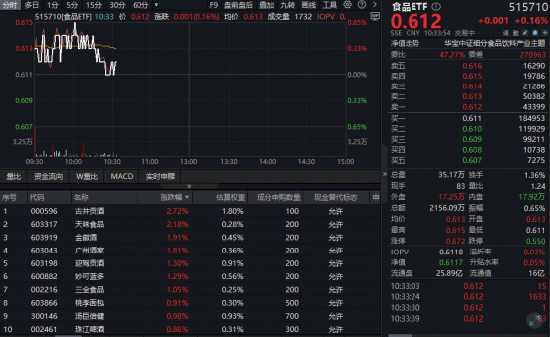
Core Viewpoint - The food and beverage sector is experiencing a period of consolidation, with the Food ETF (515710) showing a slight increase of 0.16% as of the latest report, indicating a potential recovery phase in the market [1][3]. Market Performance - The Food ETF (515710) fluctuated during the trading session, reaching a peak increase of 0.65% before settling at a 0.16% gain [1]. - Major consumer goods, particularly in the liquor segment, have shown strong performance, with stocks like Gujing Gongjiu and Tianwei Foods rising over 2% [1]. Sales Growth - JD.com reported an 18% year-on-year increase in sales of alcoholic beverages during the recent Double Eleven shopping festival, with brands like Moutai and Wuliangye achieving double-digit growth [2][4]. - The liquor industry is expected to benefit from trends such as online sales, lower alcohol content products, and internationalization, which may provide structural growth opportunities [2]. Valuation Insights - The food and beverage sector is currently at a historical low in terms of valuation, with the Food ETF's underlying index PE ratio at 20.86, placing it in the 9.41% percentile over the past decade, suggesting a favorable entry point for long-term investments [3][4]. - Analysts indicate that the food and beverage sector is in a "difficult to fall, easy to rise" phase, with expectations of a recovery in earnings and valuation improvements starting from 2026 [4]. Investment Strategy - The Food ETF (515710) is recommended for investors looking to gain exposure to high-end and mid-range liquor stocks, as well as other segments like beverages and condiments [5]. - The ETF's portfolio consists of approximately 60% allocation to leading liquor brands and 40% to other food and beverage sectors, making it a diversified investment option [5].
食品饮料行业双周报:CPI同比转正,食饮板块预期修复-20251124
Guoyuan Securities· 2025-11-24 02:43
Investment Rating - The report maintains a "Recommended" investment rating for the food and beverage industry [4] Core Insights - The food and beverage sector in A-shares has shown a 1.34% increase over the past two weeks, outperforming major indices such as the Shanghai Composite Index by 5.41 percentage points [12] - The Consumer Price Index (CPI) turned positive in October, with a year-on-year increase of 0.2%, indicating a potential recovery in consumer sentiment [3][62] - The report highlights a structural shift in dairy imports towards high-value products, driven by changing consumer preferences for low-fat, high-protein, and organic options [7][62] Summary by Sections 1. Market Review - A-shares in the food and beverage industry rose by 1.34% from November 10 to November 21, outperforming the Shanghai Composite Index by 5.41 percentage points [12] - Within the sector, dairy (+6.67%), processed foods (+2.60%), and liquor (+2.52%) saw the highest gains, while soft drinks (-4.27%), health products (-2.25%), and snacks (-1.02%) experienced declines [12] 2. Key Data Tracking - The average price of fresh milk in major production areas is 3.03 yuan/kg, down 2.9% year-on-year [39] - The national market price for pork is 23.13 yuan/kg, reflecting a year-on-year decrease of 19.7% [44] - The price of PET (water bottle grade) is 6,100 yuan/ton, down 3.9% year-on-year [44] 3. Key Events Tracking - The October CPI data showed a year-on-year increase of 0.2%, with food prices decreasing by 2.9% [3][62] - Retail sales in October grew by 2.9% year-on-year, with significant increases in the sales of grain, oil, and beverages [3][62] - Dairy imports have returned to positive growth, driven by strong demand for high-end products [7][62] 4. Important Company Announcements - Yili Group plans to maintain a cash dividend payout ratio of no less than 75% over the next three years [63] - Huangtai Liquor's major shareholder intends to increase their stake in the company through market purchases [63] 5. Investment Recommendations - For liquor, focus on high-end brands with strong market positions such as Kweichow Moutai and Wuliangye [8][65] - In the consumer goods sector, consider companies in the snack and energy drink markets, as well as those benefiting from the recovery of the dairy and restaurant supply chains [8][65]



小红日报 | 标普红利ETF(562060)标的指数收跌-2.27%,资金逢跌积极布局
Xin Lang Ji Jin· 2025-11-24 01:11
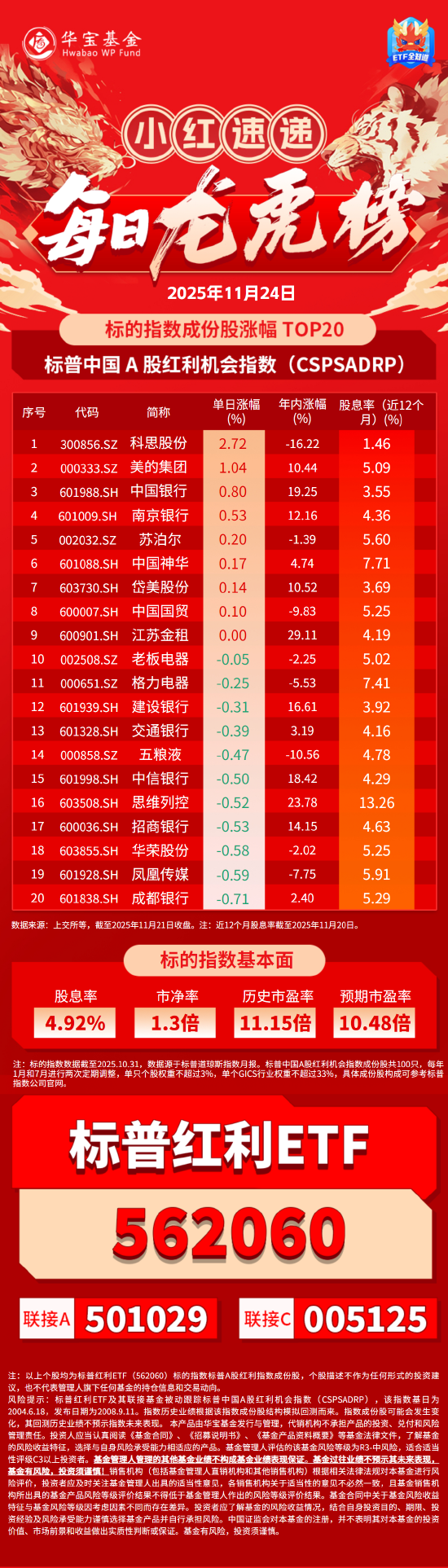
Core Insights - The article presents the top 20 stocks in the S&P China A-Share Dividend Opportunity Index, highlighting their performance in terms of daily increase, year-to-date increase, and dividend yield [1] Group 1: Stock Performance - The top performer is Kesheng Co., Ltd. (300856.SZ) with a daily increase of 2.72% but a year-to-date decrease of 16.22% and a dividend yield of 1.46% [1] - Midea Group (000333.SZ) shows a daily increase of 1.04% and a year-to-date increase of 10.44%, with a dividend yield of 5.09% [1] - China Bank (601988.SH) has a daily increase of 0.80% and a year-to-date increase of 19.25%, with a dividend yield of 3.55% [1] Group 2: Dividend Yields - The highest dividend yield is from Siwei Liekong (603508.SH) at 13.26%, despite a daily decrease of 0.52% and a year-to-date increase of 23.78% [1] - Other notable dividend yields include China Shenhua (601088.SH) at 7.71% and Gree Electric Appliances (000651.SZ) at 7.41% [1] - Jiangsu Jinxiang (600901.SH) has a year-to-date increase of 29.11% with a dividend yield of 4.19% [1]





酒价内参11月24日价格发布 整体价格延续升势青花郎领涨五连阳
Xin Lang Cai Jing· 2025-11-24 00:55
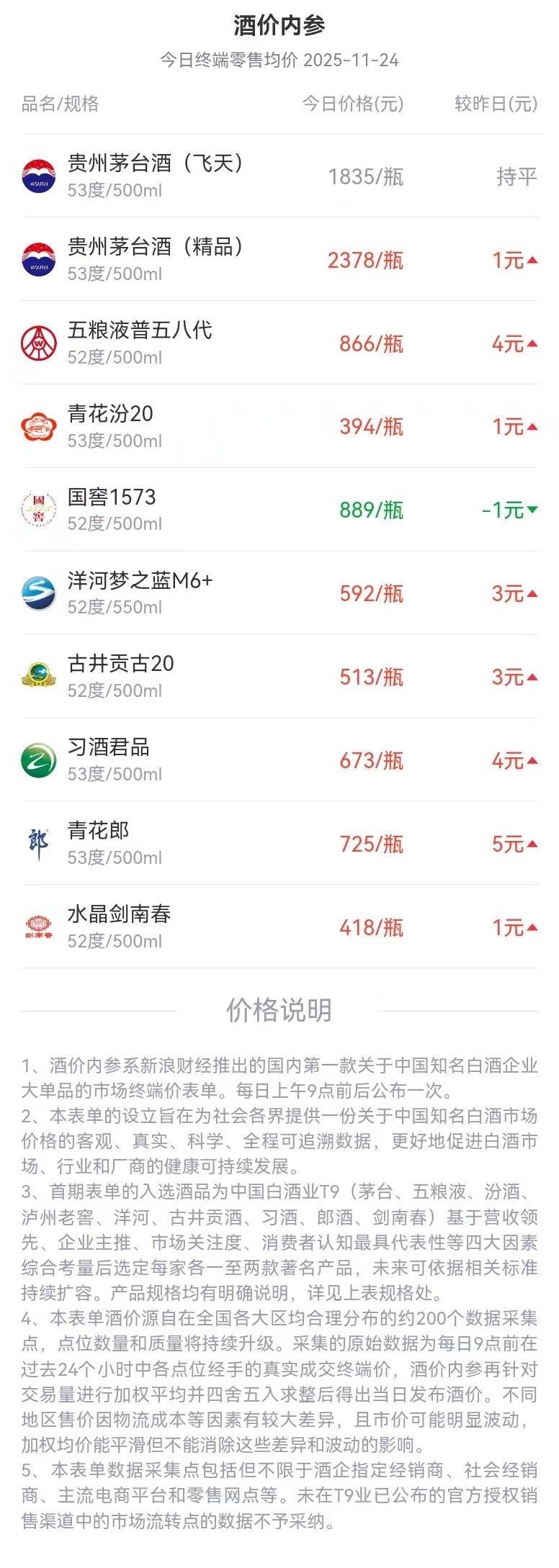
Core Viewpoint - The white liquor market shows a strong performance with a general price increase across the top ten products, indicating positive market sentiment and consumer demand [1]. Price Trends - The average retail price of the top ten white liquor products reached 9283 yuan, an increase of 21 yuan from the previous day, marking a recent high in daily price growth [1]. - Qinghua Lang leads the market with a price increase of 5 yuan per bottle, achieving its fifth consecutive day of price rise [1]. - Xijiu Junpin and Wuliangye Pu Wu Ba Dai both saw a price increase of 4 yuan per bottle, reflecting a steady upward trend [1]. - Yanghe Dream Blue M6+ and Gujing Gong Gu 20 both increased by 3 yuan per bottle, while most products maintained stable or slightly rising prices [1]. - Moutai's boutique price ended its recent decline with a 1 yuan increase, while Feitian Moutai's price remained unchanged [1]. Product Pricing Summary - The following are the current prices and changes for notable products: - Feitian Moutai 53°/500ml: 1835 yuan, unchanged [3] - Boutique Moutai 53°/500ml: 2378 yuan, up 1 yuan [3] - Wuliangye Pu Wu Ba Dai 52°/500ml: 866 yuan, up 4 yuan [3] - Qinghua Fen 20 53°/500ml: 394 yuan, up 1 yuan [3] - Guojiao 1573 52°/500ml: 889 yuan, down 1 yuan [3] - Yanghe Dream Blue M6+ 52°/550ml: 592 yuan, up 3 yuan [4] - Gujing Gong Gu 20 52°/500ml: 513 yuan, up 3 yuan [4] - Xijiu Junpin 53°/500ml: 673 yuan, up 4 yuan [4] - Qinghua Lang 53°/500ml: 725 yuan, up 5 yuan [4] - Shuijing Jian Nan Chun 52°/500ml: 418 yuan, up 1 yuan [4]
食品饮料行业周报:白酒筑底配置回暖,大众品细分赛道景气延续-20251123
Huaxin Securities· 2025-11-23 13:35
Investment Rating - The report maintains a "Recommended" investment rating for the food and beverage & commercial sectors [9][56] Core Insights - The white liquor sector is showing signs of bottoming out, with market sentiment improving, presenting a good opportunity for low-level positioning. Recent CPI recovery and consensus on destocking, along with the Double 11 shopping festival, have contributed to this trend. The Federal Reserve's dovish signals on November 21 have also created favorable conditions for the market [5][54] - Long-term prospects for leading liquor companies are promising due to their strong risk resistance and increasing market concentration, supported by domestic demand policies and recovering consumer sentiment. The industry is still in a destocking phase, with demand at a low point [5][54] - The consumer goods sector is experiencing structural differentiation, with the snack food segment remaining robust and soft drink leaders maintaining stability during the off-season. The dairy sector is approaching a supply-demand improvement point, while the restaurant industry is shifting from incremental to stock competition due to demand pressure [55] Summary by Sections Industry News - From January to October, white liquor production decreased by 11.5% [16] - The overall sentiment in the sector is improving, driven by the upcoming holiday season and promotional activities [5][54] Company News - Guizhou Moutai has initiated its annual meeting season for Moutai liquor [4] - Wuliangye is launching a new zodiac-themed product for the Year of the Horse [4] Key Company Feedback - The report highlights key companies with strong long-term investment value, including Guizhou Moutai, Wuliangye, Luzhou Laojiao, and Fenjiu, as well as more flexible stocks like Jiu Gui Jiu and Shede Liquor [5][54][57] Core Data Trends - The cumulative production of white liquor in 2024 is projected at 4.145 million tons, a decrease of 7.72% year-on-year, while industry revenue is expected to reach 796.4 billion yuan, an increase of 5.3% [32][33]