
WLY(000858)

Search documents
五粮液陈年酒拍卖专场成交逾449万元 陈年名酒市场热度不减
Xin Hua Cai Jing· 2025-11-25 08:56
Core Insights - The auction of "Da Guo Nong Xiang - Wuliangye Aged Collection" held by China Guardian on November 24 showcased the active state of the aged liquor market, with a total transaction amount of 4.49075 million yuan [2] - This auction marked the first time aged Wuliangye was presented in a dedicated session, featuring 47 lots and a total of 948 bottles, including various commemorative and historical products [2] - The auction results highlighted three major trends in the aged liquor market: the continued strength of top brands with cultural and historical value, the high demand for well-preserved and orderly circulated premium products, and the resilience of high-end aged liquor as an investment [2] Company Insights - Wuliangye's performance in the auction serves as a testament to its over a thousand years of brewing heritage and deep brand foundation [3] - The company aims to solidify its development foundation through consistent quality pursuit and expand its value boundaries via ongoing brand upgrades, establishing an irreplaceable corporate "moat" [3] - Wuliangye is positioned to maintain its leadership in the high-end aged liquor market, showcasing the strength of China's leading liquor brand [3]


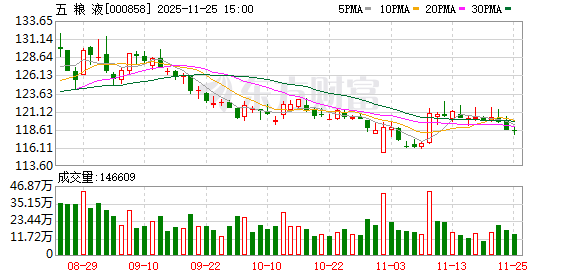
12只白酒股上涨 贵州茅台1444.65元/股收盘
Bei Jing Shang Bao· 2025-11-25 08:34
Core Viewpoint - The liquor industry, particularly the baijiu sector, is undergoing a significant adjustment, with expectations of a gradual bottoming phase by 2026 despite current challenges [1]. Industry Summary - The Shanghai Composite Index closed at 3870.02 points, up 0.87%, while the baijiu sector index closed at 2254.47 points, up 0.28% [1]. - A total of 12 baijiu stocks saw gains, with the leading stock, Jiu Gui Jiu, increasing by 1.73% [1]. - The report from Galaxy Securities indicates that the baijiu industry has been in deep adjustment this year, with a notable acceleration in supply-side clearing since the third quarter [1]. - The industry is expected to remain in an adjustment phase until 2026, but signs of a bottoming phase are anticipated, characterized by narrowing declines in sales and prices, along with continued clearing in financial statements [1]. Company Summary - Kweichow Moutai's stock closed at 1444.65 yuan per share, down 0.51% [1]. - Wuliangye's stock closed at 118.51 yuan per share, down 0.01% [1]. - Shanxi Fenjiu's stock closed at 192.99 yuan per share, up 0.31% [1]. - Luzhou Laojiao's stock closed at 133.59 yuan per share, up 0.50% [1]. - Yanghe's stock closed at 65.71 yuan per share, down 1.19% [1].





宁德时代赋能五粮液,开启“光储+物流”全方位合作
中关村储能产业技术联盟· 2025-11-25 06:22
Core Viewpoint - CATL has established a strategic partnership with Wuliangye Group to integrate traditional liquor production with new energy technology, focusing on zero-carbon transformation and green development in Yibin [2][4]. Group 1: Strategic Collaboration - The collaboration will focus on three main areas: project co-construction, capital cooperation, and supply chain integration [2]. - Both companies aim to create a zero-carbon park, utilizing CATL's expertise in photovoltaic power stations and energy storage systems to upgrade green energy infrastructure [2]. Group 2: Electric Transportation and Logistics - The partnership will promote the electrification of Wuliangye's own vehicles and those of its suppliers, prioritizing the use of CATL's battery products [4]. - There will be an exploration of establishing battery swap demonstration routes to enhance logistics efficiency [4]. Group 3: Battery Business Synergy - The collaboration will deepen the synergy in battery business, focusing on the development of battery pack composite structural components and new product categories [4]. - Leveraging Wuliangye's technology in high-end packaging and anti-counterfeiting, the partnership aims to create high-standard and efficient battery packaging solutions [4].


食品饮料周报(25 年第43 周):白酒板块红利属性凸显,关注大众品消费场景恢复-20251125
Guoxin Securities· 2025-11-25 05:52
Investment Rating - The report maintains an "Outperform the Market" rating for the food and beverage sector [4][5][15]. Core Views - The food and beverage sector is expected to perform well in 2026, driven by recovery in consumer demand and the sector's inherent growth potential [3][10]. - The report highlights the differentiation in performance across categories, with beverages outperforming food and alcoholic beverages [2][10]. - Key investment opportunities are identified in premium liquor brands, dairy products, and innovative snack foods, with a focus on companies that demonstrate strong growth potential and market positioning [2][10][15]. Summary by Sections Market Overview - The food and beverage sector experienced a decline of 1.52% this week, with A-shares down 1.36% and H-shares down 3.69%. Notably, South Qiao Food and Yili Co. showed positive performance with increases of 11.91% and 2.65% respectively [1][3]. Alcoholic Beverages - The liquor sector is entering a left-side layout phase, with premium brands like Luzhou Laojiao, Shanxi Fenjiu, and Guizhou Moutai expected to gain market share. The report suggests a focus on companies with pricing power and regional influence [2][10]. - Moutai's price is currently down 26% year-on-year, indicating a potential for recovery in consumer demand during the upcoming festive season [10][15]. Beer - The beer industry is showing healthy inventory levels, with expectations for demand recovery. The report recommends investing in leading brands like Yanjing Beer, which is expected to see profit growth supported by strong market fundamentals [2][11]. Dairy Products - The dairy sector is experiencing a steady recovery in demand, with leading companies like Yili expected to benefit from improved supply-demand dynamics by 2026 [2][13]. Snacks - The report emphasizes the growth potential in the konjac snack category, recommending companies like Weilong and Yanjinpuzi for their competitive advantages and strong growth trajectories [2][12][16]. Investment Recommendations - The recommended investment portfolio includes Guizhou Moutai, Baba Foods, Dongpeng Beverage, Weilong, and Luzhou Laojiao, reflecting a diversified approach across high-potential segments [3][15].


税收利剑出鞘,白酒行业迎来“透明”大考
Sou Hu Cai Jing· 2025-11-25 04:05
Core Viewpoint - The new tax regulation, effective from October 1, 2025, aims to enhance tax compliance in the traditional liquor industry, particularly targeting the opaque practices of small and medium-sized liquor merchants, leading to a significant industry reshaping and a "transparency revolution" [2][5]. Group 1: Compliance and Survival Pressure - The new regulation connects data reporting between platforms and tax authorities, rendering traditional tax evasion methods ineffective [3]. - The automatic identification of zero or low reporting and private account transactions will trigger tax audits, increasing the tax burden for merchants with monthly sales exceeding 100,000 yuan [5]. - Many small liquor merchants, previously surviving on tax loopholes, now face a critical survival test as their profit margins shrink significantly [5]. Group 2: Price System Reconstruction - The regulation is reshaping the e-commerce pricing system, moving away from the previous chaotic pricing strategies during events like Double 11 [6][7]. - Liquor prices on platforms have become more rational, with brands gaining unprecedented control over distribution channels, leading to a reduction in low-price dumping by unauthorized sellers [8]. Group 3: Channel Value Reassessment - The disappearance of e-commerce tax benefits has led to a renewed appreciation for offline channels, as they offer superior service experiences compared to online platforms [9]. - Traditional liquor stores are experiencing a revival as consumers prefer one-stop services, especially when online and offline prices are comparable [11]. Group 4: Industry Structure Reshaping - The transformation is accelerating the polarization within the liquor industry, benefiting leading brands with strong compliance and brand power while putting immense pressure on smaller players [12]. - The new regulation allows top brands to eliminate long-standing pricing issues and capture the market space left by struggling smaller merchants [12][13]. Group 5: Future Outlook - While the new regulation presents challenges, it is seen as a necessary step towards a more compliant and sustainable industry, marking the end of "wild growth" and the beginning of a "compliance-driven" era [15]. - The long-term competition in the liquor industry will focus on brand strength, service quality, and supply chain efficiency rather than mere price competition [16][17].
酒价内参11月25日价格发布 市场整体续涨青花郎五连阳
Xin Lang Cai Jing· 2025-11-25 01:57
Core Insights - The retail prices of the top ten liquor products in the white liquor market have continued to rise, with an overall price of 9,291 yuan for a bundled sale, marking an increase of 8 yuan from the previous day, achieving four consecutive days of price increases [1] Price Movements - Yanghe Dream Blue M6+ saw a strong performance with a daily price increase of 8 yuan per bottle [1] - Guojiao 1573's price increased by 6 yuan per bottle [1] - Qinghualang's price rose by 5 yuan per bottle, marking five consecutive days of increases [1] - Prices for Shuijing Jian'nan Chun and Xijiu Junpin increased by 3 yuan and 2 yuan per bottle, respectively, showing stable trends [1] - Qinghualan 20's price rose by 2 yuan per bottle, while Wuliangye Pu 58's price also increased by 2 yuan per bottle [1] - In contrast, the prices of some products decreased, with the boutique Moutai and Gujing Gong Gu 20 dropping by 9 yuan and 7 yuan per bottle, respectively [1] - Feitian Moutai's price fell by 4 yuan per bottle [1] Specific Product Prices - Feitian Moutai: 1,831 yuan per bottle, down 470 yuan [3] - Boutique Moutai: 2,369 yuan per bottle, down 9 yuan [3] - Wuliangye Pu 58: 868 yuan per bottle, up 2 yuan [3] - Qinghualan 20: 396 yuan per bottle, up 2 yuan [3] - Guojiao 1573: 895 yuan per bottle, up 670 yuan [3] - Yanghe Dream Blue M6+: 600 yuan per bottle [3] - Gujing Gong Gu 20: 506 yuan per bottle, down 7 yuan [3] - Qinghualang: 730 yuan per bottle, down 570 yuan [4] - Shuijing Jian'nan Chun: 421 yuan per bottle, up 3 yuan [4] - Xijiu Junpin: 675 yuan per bottle, up 2 yuan [4]

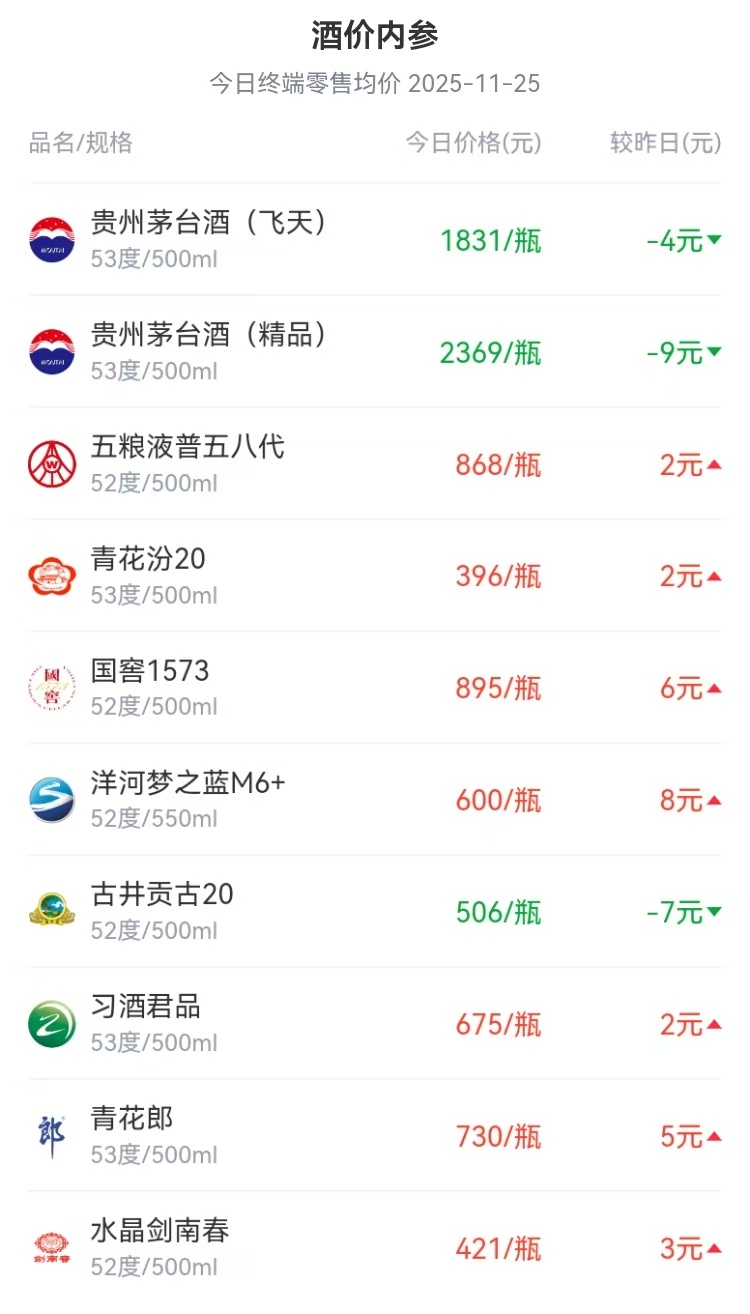
今日白酒市场整体续涨 青花郎五连阳
Ge Long Hui· 2025-11-25 01:21
Core Insights - The retail average price of the top ten liquor products in the white liquor market continues to rise, reaching 9,291 yuan, an increase of 8 yuan from the previous day, marking four consecutive days of price increases [1] Price Movements - Yanghe Dream Blue M6+ shows strong performance with a daily price increase of 8 yuan per bottle [1] - Guojiao 1573 price increased by 6 yuan per bottle [1] - Qinghua Lang price rose by 5 yuan per bottle, achieving five consecutive days of increases, leading the market [1] - Crystal Jian Nan Chun and Xijiu Junpin prices increased by 3 yuan and 2 yuan per bottle, respectively, showing stable trends [1] - Qinghua Fen 20 price increased by 2 yuan per bottle [1] - Wuliangye Pu 58 price also rose by 2 yuan per bottle [1] Price Declines - Premium Moutai and Gujing Gong Gu 20 experienced significant declines, with prices dropping by 9 yuan and 7 yuan per bottle, respectively [1] - Feitian Moutai price decreased by 4 yuan per bottle [1]
营收净利双降五粮液瞄准年轻消费群体
Xin Lang Cai Jing· 2025-11-24 21:12
Core Insights - The white liquor industry is undergoing a deep adjustment period due to policy changes, consumption transformation, and intense competition [1] - Wuliangye's recent quarterly report shows a significant decline in both revenue and net profit, raising concerns about its position as the "second" in the white liquor market [1] Financial Performance - In the third quarter of 2025, Wuliangye reported revenue of 60.945 billion yuan, a year-on-year decrease of 10.26%, and a net profit attributable to shareholders of 21.511 billion yuan, down 30.09% year-on-year [1] - For the third quarter of 2025, Shanxi Fenjiu surpassed Wuliangye in single-quarter revenue, achieving 8.960 billion yuan compared to Wuliangye's 8.174 billion yuan [1] - Wuliangye's net profit has dropped to fourth place among listed companies in the industry, with profits of 2.019 billion yuan in the third quarter of 2025 [1] Market Challenges - Wuliangye is facing a significant challenge with price inversion in the terminal market, particularly for its flagship product, the 52-degree/500ml Wuliangye [1] - The market price for this product has decreased from 950 yuan at the beginning of 2025 to 855 yuan as of November 2025 [1] - The decline in market prices has led to reduced willingness among distributors to make payments, with Wuliangye's contract liabilities decreasing for three consecutive quarters [1] Strategic Initiatives - In response to market pressures, Wuliangye is actively seeking to innovate its market strategy and product offerings to cater to diverse consumer needs [1] - The company has introduced a high-end low-alcohol product, "29-degree Wuliangye: One Glance and Heart," aimed at attracting younger consumers [1] - Wuliangye's chairman emphasized the importance of adapting to changing consumer trends, including younger demographics and digital channels [1] Industry Outlook - The overall development environment for the white liquor industry remains challenging, with Wuliangye's ability to stabilize core product prices and invigorate distribution channels being critical for navigating the current market downturn [1]
中国必选消费品11月价格报告:白酒批价多数下跌,方便食品与调味品价格回升
Haitong Securities International· 2025-11-24 13:11
Investment Rating - The report assigns an "Outperform" rating to multiple companies in the essential consumer goods sector, including Guizhou Moutai, Wuliangye, and others [1]. Core Insights - The wholesale prices of Baijiu have mostly declined, while prices for instant foods and condiments have rebounded [1][10]. - Discounts for convenience foods and seasonings have narrowed compared to the end of October, indicating a potential recovery in consumer spending [19][38]. - The report highlights the stability of discounts for infant formula and beer, while discounts for liquid milk and soft drinks have increased [21][38]. Summary by Sections Baijiu Pricing - The wholesale prices for various Baijiu brands, such as Moutai and Wuliangye, have shown significant declines compared to previous months and year-to-date figures [9][40]. - For instance, the price of Feitian Moutai (case) is 1650 yuan, down by 110 yuan from last month, and down 590 yuan year-to-date [40]. Consumer Goods Discounts - Convenience foods have seen an increase in average and median discount rates, moving from 93.2%/95.9% at the end of October to 95.8%/97.0% [19][38]. - Seasonings also experienced a rise in discount rates, from 83.7%/84.9% to 85.9%/88.9% [19][38]. - In contrast, liquid milk discounts have widened, with average rates dropping from 69.6% to 66.0% [21][38]. Company Ratings - The report lists several companies with an "Outperform" rating, including: - Guizhou Moutai - Wuliangye - Luzhou Laojiao - Shanxi Fenjiu - Yanghe - Others [1].
11只白酒股上涨贵州茅台1452元/股收盘
Xin Lang Cai Jing· 2025-11-24 09:05
Group 1 - The core viewpoint of the article highlights the launch of a new platform "Wine Price Insider" by Sina Finance, which aims to provide real-time market prices for well-known liquor brands [1] - The Shanghai Composite Index closed at 3836.77 points, up 0.05%, while the liquor sector index closed at 2248.25 points, up 0.17%, with 11 liquor stocks experiencing gains [1] Group 2 - Individual stock performance shows that Kweichow Moutai closed at 1452.00 CNY per share, down 1.00%; Wuliangye closed at 118.52 CNY per share, down 0.97%; Shanxi Fenjiu closed at 192.40 CNY per share, down 0.31%; and Luzhou Laojiao closed at 132.92 CNY per share [2] - Citic Securities noted in its report that the food and beverage sector is currently undergoing a correction, with valuations at relatively low historical levels and weak market expectations [2] - The liquor industry is experiencing a bottoming out in sales, with Moutai addressing e-commerce chaos to stabilize price expectations, supported by strong brand power and performance to clear burdens [2]