
WLY(000858)

Search documents
2025年第53周:酒行业周度市场观察
艾瑞咨询· 2026-01-06 00:03
Industry Environment - The liquor industry is undergoing a channel transformation, with traditional inventory strategies failing and instant retail emerging as a new opportunity. Leading companies like Moutai and Luzhou Laojiao are exploring online channels and new models such as "live streaming + instant fulfillment" [3] - The scattered liquor market is expected to grow from 80 billion yuan in 2024 to over 100 billion yuan in 2025, driven by companies like Gujing Gongjiu and Kuozi Jiao, which are targeting young consumers with experiential and diverse product offerings [5] - The competition in the liquor industry is shifting towards "value deepening," with companies focusing on product reconstruction and cultural resonance to meet the demands of younger and female consumers [6] Market Trends - The trend of low-alcohol liquor is gaining traction, with major brands like Wuliangye and Gujing Gongjiu launching new products to cater to younger consumers' preferences for lower alcohol content. The low-alcohol market is projected to reach 57 billion yuan by 2025 [7] - The white liquor market is experiencing a shift from "face consumption" to "substance consumption," with a focus on quality and experience rather than just brand prestige [9][14] - The scattered liquor market is becoming a new growth area, with brands leveraging community consumption and flexible pricing strategies to attract consumers [20][21] Sales and Marketing Strategies - Companies are increasingly focusing on enhancing bottle opening rates to address high inventory levels and declining consumption. Some brands have reported significant increases in opening rates through targeted marketing strategies [15] - The concept of "user co-creation" is emerging as a key strategy for brands to engage consumers and enhance brand loyalty, with companies like Wuliangye and Fenjiu exploring new ways to connect with their audience [16][17] - The wedding market is seeing a resurgence, with a 30% increase in wedding events in certain regions, although overall liquor consumption at these events is declining due to economic pressures [19] Brand Dynamics - Moutai is facing challenges with declining prices and inventory buildup, prompting the company to optimize its product structure and marketing strategies to attract younger consumers [12][14] - The introduction of new products and collaborations, such as the partnership between Water Well and actor Tony Leung, is aimed at enhancing brand image and connecting with consumers on an emotional level [26][34] - The rise of health-oriented products, particularly in the health liquor segment, is attracting younger female consumers, with brands like Jinjiu successfully tapping into this demographic [36] Future Outlook - The liquor industry is expected to continue evolving, with a focus on digital transformation and the integration of AI technologies to enhance operational efficiency and consumer engagement [37] - The scattered liquor market is projected to exceed 100 billion yuan, indicating a significant shift in consumer preferences towards more affordable and accessible options [20][21] - The industry is likely to see a continued emphasis on quality and value, as brands adapt to changing consumer demands and market conditions [22][29]





年度投资策略报告:底部向阳,寻找结构性亮点-20260105
Tai Ping Yang Zheng Quan· 2026-01-05 14:15
Overall Industry Review - The food and beverage sector significantly underperformed the market, with a year-to-date decline of -0.62%, lagging behind the Shanghai Composite Index by 15.0 percentage points [7][11] - The snack sector showed strong performance with a year-to-date increase of 28.88%, driven by channel expansion and a total revenue growth of 30.97% in the first three quarters of 2025 [11] - The beverage sector, particularly soft drinks, benefited from travel demand and low-price, high-frequency consumption, achieving a revenue and profit growth in double digits [11][14] Alcoholic Beverages - The liquor sector exhibited weak performance, with a decline in sales and prices, particularly for white liquor, which saw a year-on-year revenue drop of -5.83% and a net profit decline of -6.93% in the first three quarters of 2025 [11][44] - The overall white liquor sector's revenue decreased by -5.8% and net profit by -6.9% in the first three quarters of 2025, with a significant drop in Q3, where total revenue fell by -18.4% [44] - The report indicates that the white liquor industry is in a prolonged adjustment phase, with the current downturn lasting 57 months, marking the longest adjustment period in history [35][40] Future Outlook - The central economic work conference emphasized the importance of boosting domestic demand in 2026, with expectations for policy support to stimulate recovery [3] - The report suggests focusing on sectors with low bases for recovery, such as frozen foods and beverages, which are expected to benefit from demand recovery and new product opportunities [3][4] - The report highlights the potential for structural opportunities in the food and beverage sector, particularly in overseas markets and cost improvements, recommending companies like Anqi Yeast and Mijiu Group for their overseas expansion strategies [4][34] Investment Strategies - The report identifies four key investment themes for 2026: opportunities in overseas markets, cost benefits, new product launches, and value-for-money consumption [4] - Companies with strong platform capabilities and innovative products, such as Dongpeng Beverage and Wancheng Group, are recommended for their potential in the beverage sector [4] - The report also emphasizes the importance of identifying companies that can adapt to a low-inflation, low-confidence environment by offering high-value products [14]



中国必选消费26年1月投资策略:欲买必选消费,先买乳业中游
Haitong Securities International· 2026-01-05 13:31
Investment Focus - The report emphasizes prioritizing midstream dairy companies for consumer staples exposure in China, suggesting that this sector is expected to recover first in terms of performance and valuation [1][6]. Industry Overview - In December 2025, among the eight tracked essential consumer sectors, four showed positive growth while four experienced declines. The growing sectors included condiments, frozen foods, soft drinks, and dining, while the declining sectors were premium and mass-market baijiu, dairy products, and beer [3][9]. - The report indicates that the overall demand in most sectors remains subdued, with traditional categories like baijiu, beer, and dairy under pressure due to weakened consumer sentiment and competition from substitutes [3][9]. Price Trends - Baijiu wholesale prices mostly stabilized in December, with notable price changes for various brands. For instance, the price for Moutai (飞天) was reported at 1600 RMB for a full box, down 50 RMB from the previous month [4][22]. - Discounts on liquid milk and convenience foods increased significantly, reflecting a lack of demand, while discounts on condiments and soft drinks decreased [4][36]. Cost Analysis - The cost index for six categories of consumer goods showed mixed results in December, with soft drinks and instant noodles experiencing slight increases, while dairy products and beer saw modest declines [4][5]. - The prices of raw materials such as aluminum cans and paper increased year-on-year, impacting overall production costs [4]. Market Capitalization and Valuation - As of the end of December, net inflows into Hong Kong Stock Connect amounted to 20.825 billion RMB, with the consumer staples sector's market capitalization share rising to 5.61% [5]. - The report notes that the historical PE ratio for A-share food and beverage companies was at 16% (20.3x), indicating a decrease of 5 percentage points from the previous month [5]. Recommendations - The report suggests a two-pronged investment strategy for January: focusing on high-risk preference stocks like Luzhou Laojiao and Wuliangye, and on stocks with improving fundamentals and dividend yields such as Yili and Mengniu [6].

大众价格带韧性较强:白酒行业周报(20251229-20260104)-20260105
Huachuang Securities· 2026-01-05 10:13
Investment Rating - The report maintains a "Recommendation" rating for the liquor industry, indicating an expectation that the industry index will outperform the benchmark index by more than 5% in the next 3-6 months [21]. Core Insights - The report highlights that the demand for liquor is showing weak recovery, with a year-on-year decline of over 20% during the New Year period, although there is a slight month-on-month improvement from November and December [4]. - The report notes that the high-end liquor prices are under pressure, with a decline of over 10% for high-end products and 5-10% for mid-range products, while the mass consumption segment remains resilient [4]. - The report anticipates a narrowing of the decline in demand for the upcoming Spring Festival, with expectations of a double-digit decline but less severe than during the New Year [4]. - The report emphasizes that the pricing for high-end liquor will remain under pressure, with expectations of continued marginal declines in prices [4]. Industry Overview - The liquor industry consists of 20 listed companies with a total market capitalization of 288.22 billion yuan and a circulating market value of 288.18 billion yuan [1]. - The report provides a comparative performance analysis, indicating absolute performance declines of -6.0% over one month, -1.4% over six months, and -9.9% over twelve months [2]. Company Feedback and Strategies - Moutai is focusing on market-oriented transformation and has introduced a digital platform to stimulate consumer demand [5]. - Wuliangye is emphasizing sales growth and market order maintenance, with a strategy to enhance market share in the 800 yuan price range [5]. - Luzhou Laojiao plans to increase subsidies and rebates to ensure consumer affordability while maintaining its brand position [5]. - Shanxi Fenjiu is focusing on key markets and maintaining growth momentum for its premium products [5]. - Yanghe is adjusting its sales strategies based on terminal orders and distributor inventory, with a focus on maintaining reasonable inventory levels [5]. - Jinsiyuan is experiencing growth in its mass price segment, which is expected to continue contributing to overall growth [5]. Investment Recommendations - The report suggests that pessimistic factors have been priced in, and as the Spring Festival approaches, demand is expected to recover, particularly for Moutai and Gujing [4]. - The report recommends focusing on Moutai for its high certainty and dividend yield, while also highlighting Gujing as a key player in the mass price segment [4].

白酒板块1月5日涨2.87%,贵州茅台领涨,主力资金净流入14.41亿元
Zheng Xing Xing Ye Ri Bao· 2026-01-05 08:59
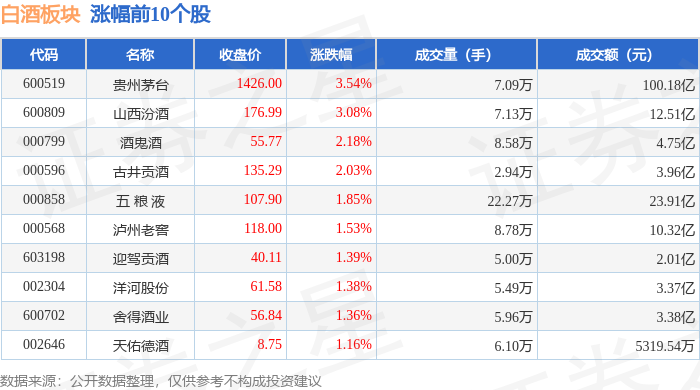
Group 1 - The core viewpoint of the article highlights the significant rise in the liquor sector, particularly led by Kweichow Moutai, which saw a 2.87% increase in the sector on January 5, with the Shanghai Composite Index rising by 1.38% and the Shenzhen Component Index by 2.24% [1] Group 2 - Kweichow Moutai (stock code: 600519) closed at 1426.00 CNY, up 3.54%, with a trading volume of 70,900 shares and a transaction value of 10.018 billion CNY [1] - Other notable stocks in the liquor sector included Shanxi Fenjiu (600809) with a 3.08% increase, closing at 176.99 CNY, and Wuliangye (000858) which rose by 1.85% to 107.90 CNY [1] - The liquor sector experienced a net inflow of 1.441 billion CNY from main funds, while retail funds saw a net outflow of 1.07 billion CNY [1][2]

招商白酒指数基金乏力,基民应该焦虑吗?
Xin Lang Cai Jing· 2026-01-05 08:51
来源:翠鸟资本 净值不上不下,反弹力度有限,持有人开始频繁问一个问题:白酒到底还行不行? 在很多普通投资者的记忆里,白酒指数曾经是一条清晰而省心的赛道。不用选股,不用判断公司治理, 只要我国消费升级存在,白酒龙头就会走出趋势。 招商中证白酒指数LOF就是这一轮逻辑下的典型代表之一,但是,当时间拉长到最近几年,这种熟悉的 安全感正在被反复消耗。 站在今天回看这只产品的阶段性表现,它并不是突然失效,而是被完整地拖进了一个行业与估值同步消 化的周期里。 下跌时间长 从阶段性数据看,招商中证白酒指数基金A份额的表现给人的第一感受是:乏力。 截至2025年12月26日,产品近3个月下跌5.91%。近1年下跌11.27%,近2年下跌20.14%,近3年下跌 36.15%。 这组数据的特点很清晰:下跌时间长,反弹幅度弱。 即便在近6个月内实现0.72%的微弱正收益,也很难给投资者带来明显的信心修复。 但同时也要看到,这并不是一只出现极端回撤或结构性失控的产品,而是一种典型的行业横盘期指数表 现。 什么情况? 这意味着可以得出一个非常直接的结论:招商中证白酒指数的表现,本质上就是几家核心白酒公司的加 权组合。 当茅台、五粮液 ...

五粮液涨2.00%,成交额18.93亿元,主力资金净流入1.71亿元
Xin Lang Cai Jing· 2026-01-05 06:07
Core Viewpoint - Wuliangye's stock price has increased by 2.00% this year, but it has experienced declines of 2.30% over the last five trading days, 3.41% over the last twenty days, and 8.87% over the last sixty days [2]. Group 1: Stock Performance - As of January 5, Wuliangye's stock price reached 108.06 CNY per share, with a trading volume of 1.893 billion CNY and a turnover rate of 0.45%, resulting in a total market capitalization of 419.447 billion CNY [1]. - The net inflow of main funds was 171 million CNY, with large orders accounting for 27.58% of purchases and 24.44% of sales [1]. Group 2: Company Overview - Wuliangye Yibin Co., Ltd. is located in Yibin City, Sichuan Province, and was established on April 21, 1998, with its stock listed on April 27, 1998. The company primarily engages in the production and sales of Wuliangye liquor and related products, with its main business revenue composition being 93.08% from liquor, 3.81% from plastic products, 2.87% from other sources, 0.19% from printing, and 0.05% from glass bottles [2]. - The company is classified under the food and beverage industry, specifically in the subcategories of liquor [2]. Group 3: Financial Performance - For the period from January to September 2025, Wuliangye reported operating revenue of 60.945 billion CNY, a year-on-year decrease of 10.26%, and a net profit attributable to shareholders of 21.511 billion CNY, down 13.72% year-on-year [2]. - Since its A-share listing, Wuliangye has distributed a total of 126.445 billion CNY in dividends, with 65.114 billion CNY distributed over the last three years [3]. Group 4: Shareholder Structure - As of September 30, 2025, the top ten circulating shareholders of Wuliangye include Hong Kong Central Clearing Limited as the third-largest shareholder with 111 million shares, a decrease of 9.0232 million shares from the previous period [3]. - China Securities Finance Corporation holds 92.3859 million shares, unchanged from the previous period, while the China Securities Index A (161725) increased its holdings by 5.8697 million shares to 53.7738 million shares [3].
白酒概念盘初拉升,怡亚通涨超3%
Mei Ri Jing Ji Xin Wen· 2026-01-05 02:01
Group 1 - The liquor sector experienced a significant rally at the beginning of trading, with notable increases in stock prices [1] - Yiyaton saw a rise of over 3%, while Kweichow Moutai increased by more than 2% [1] - Other companies in the sector, including Yingjia Gongjiu, Shanxi Fenjiu, and Wuliangye, also followed suit with price increases [1]

酒价内参1月5日价格发布 习酒君品价格下跌5元/瓶
Xin Lang Cai Jing· 2026-01-05 01:32
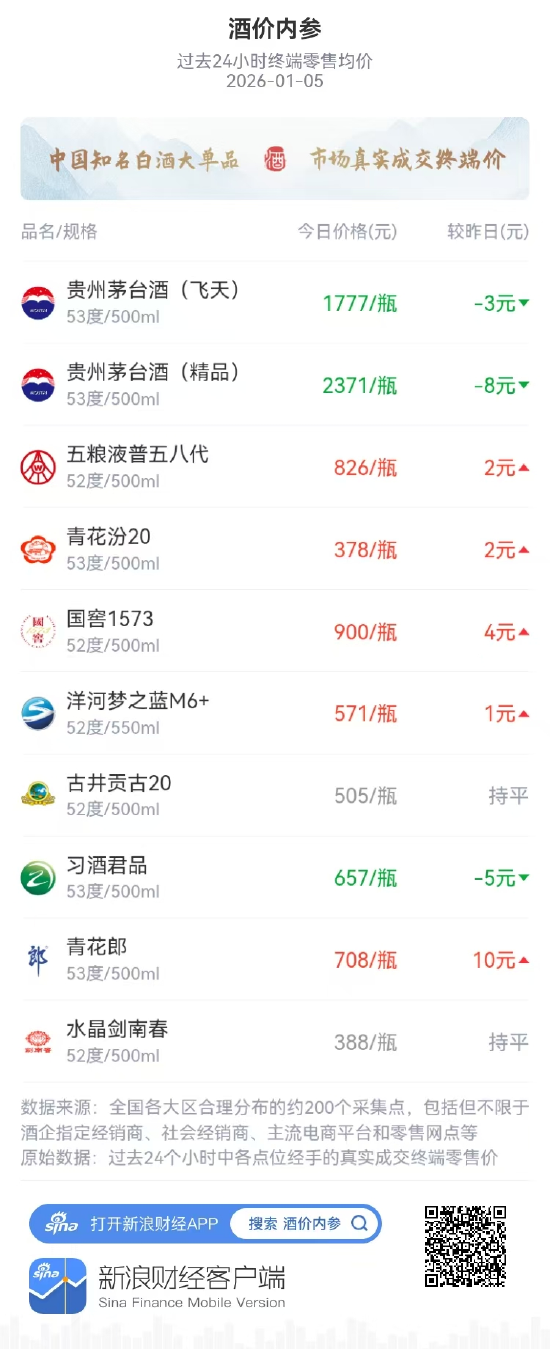
Core Insights - The article highlights the recent slight rebound in the retail prices of China's top ten liquor products, indicating a stabilization after a period of decline [1][5]. Price Trends - The overall retail price for the top ten liquor products reached 9081 yuan, an increase of 3 yuan from the previous day, suggesting a potential market recovery [1][5]. - The market exhibited a trend of more price increases than decreases, with notable price rises for several products, including: - Qinghua Lang increased by 10 yuan per bottle, leading the market [6]. - Guojiao 1573 rose by 4 yuan per bottle, marking its fifth consecutive day of price increases [6]. - Qinghua Fen 20 and Wuliangye Pu 58th generation both saw increases of 2 yuan per bottle [6]. - Yanghe Dream Blue M6+ experienced a slight increase of 1 yuan per bottle [6]. - Conversely, some products saw price declines, with: - The price of the premium Moutai dropping by 8 yuan per bottle [6]. - Xijiu Junpin decreased by 5 yuan per bottle [6]. - Feitian Moutai fell by 3 yuan per bottle [6]. Data Collection Methodology - The data for the "Liquor Price Reference" is sourced from approximately 200 collection points across various regions, including designated distributors, social distributors, mainstream e-commerce platforms, and retail outlets, ensuring a comprehensive and objective representation of market prices [2][6]. Industry News - On January 4, Kweichow Moutai Co., Ltd. issued a warning regarding fraudulent recruitment information circulating online, falsely using the Moutai name and claiming direct sales at 1169 yuan, which the company has not authorized [2][6].
酒价内参1月5日价格发布:青花汾20价格上涨2元/瓶
Xin Lang Cai Jing· 2026-01-05 01:27
Core Insights - The core viewpoint of the news is that the Chinese liquor market, particularly the top ten baijiu products, has shown signs of price stabilization after a period of decline, with a slight rebound in retail prices observed on January 5 [1][5]. Price Trends - The overall retail price for the top ten baijiu products reached 9081 yuan, reflecting a minor increase of 3 yuan compared to the previous day, indicating a potential stabilization after hitting new lows [1][5]. - The market is experiencing a recovery pattern with more products increasing in price than decreasing. Notably, Qinghua Lang saw a significant increase of 10 yuan per bottle, leading the market [6]. - Other products that increased in price include Guojiao 1573 (+4 yuan), Qinghua Fen 20 (+2 yuan), and Wuliangye Pu 58th generation (+2 yuan). Yanghe Dream Blue M6+ saw a slight increase of 1 yuan [6][8]. - Conversely, the prices of some products have decreased, with the premium Moutai dropping by 8 yuan, Xijiu Junpin down by 5 yuan, and Feitian Moutai down by 3 yuan [6][8]. Data Collection Methodology - The data for the "Liquor Price Reference" is sourced from approximately 200 collection points across various regions, including designated distributors, social distributors, mainstream e-commerce platforms, and retail outlets. This aims to provide an objective and traceable representation of the market prices for well-known baijiu [2][6]. Industry News - On January 4, Kweichow Moutai Co., Ltd. issued a warning regarding false recruitment information circulating online, claiming to offer Moutai at 1169 yuan. The company clarified that it has not authorized any such offers and is cooperating with authorities to address the issue [2][6].