CHACHA FOOD CO.,LTD(002557)

Search documents
华西证券:汇率升值利好国内资产 重视食品饮料板块三重共振机会
智通财经网· 2026-01-23 03:56
Core Viewpoint - The recent appreciation of the RMB is expected to benefit the food and beverage sector through reduced import costs, improved domestic demand, and increased foreign investment allocation [1][2]. Group 1: Recent Developments - The RMB has accelerated its appreciation, breaking the 7 mark offshore on December 25 and reaching 6.96 onshore by January 22, indicating enhanced economic momentum and improved export competitiveness [1]. - Historical analysis shows that during previous RMB appreciation cycles (May-November 2020 and November-December 2022), the food and beverage sector outperformed the CSI 300 index by 18% and 12%, respectively [2]. Group 2: Cost, Demand, and Valuation Dynamics - Cost: The appreciation of the RMB reduces the converted prices of imported raw materials, leading to lower manufacturing costs and improved profitability. Key raw materials affected include soybeans, palm oil, oats, barley, and tree nuts [2]. - Demand: The recovery of domestic demand is a fundamental support for the strong RMB, which will further lower companies' restocking costs, shifting the industry from passive destocking to active restocking, thus reinforcing demand resilience [2]. - Valuation: The liquidity remains ample during the RMB appreciation cycle, enhancing the inflow of foreign capital into A-shares, which is expected to bring liquidity premiums to the food and beverage sector, known for its high foreign ownership [2]. Group 3: Investment Recommendations - The report highlights three main lines of focus for investment: 1. Cost benefits, recommending companies such as Ximai Food, Lihigh Food, Miaokelando, Qiaqia Food, and H&H [3]. 2. Demand recovery, recommending companies like Anjijia Food, Qianwei Central Kitchen, Youran Dairy, Modern Farming, New Dairy, and Wancheng Group [3]. 3. Valuation recovery, recommending companies including Yili Group, Mengniu Dairy, Xianle Health, Weilong Delicious, and Yanjinpuzi [3].





汇率升值利好国内资产,重视板块三重共振机会
HUAXI Securities· 2026-01-22 13:25
Investment Rating - Industry rating: Recommended [5] Core Insights - Recent appreciation of the RMB is expected to continue, enhancing domestic asset attractiveness and improving the competitiveness of export products [1] - Historical analysis shows that during previous RMB appreciation periods, the food and beverage sector outperformed the CSI 300 index by 18% and 12% respectively, indicating strong performance potential in the current cycle [2] - The current RMB appreciation is anticipated to create a triple resonance effect in the sector, leading to cost reduction, increased demand, and valuation recovery [2] Summary by Sections Cost Side - RMB appreciation reduces the import cost of raw materials, leading to lower manufacturing costs and improved profitability. Key raw materials affected include soybeans, palm oil, oats, barley, and tree nuts [2] Demand Side - Domestic demand recovery is a fundamental support for the strengthening RMB. The appreciation will lower inventory replenishment costs for companies, shifting the industry from passive destocking to active replenishment, thus reinforcing domestic demand resilience [2] Capital Side - The liquidity remains ample during the RMB appreciation cycle, increasing foreign capital inflow into A-shares. The food and beverage sector, with a high proportion of foreign holdings, is expected to benefit from valuation recovery driven by increased foreign allocation [2] Investment Recommendations - Focus on three main lines of investment: 1. Cost benefits: Recommended companies include Ximai Food, Lihigh Food, Miaokelando, Qiaqia Food, and H&H [3] 2. Demand recovery: Recommended companies include Anjijia Food, Qianwei Central Kitchen, Youran Livestock, Modern Dairy, New Dairy, and Wancheng Group [3] 3. Valuation recovery: Recommended companies include Yili, Mengniu Dairy, Xianle Health, Weilong Delicious, and Yanjinpuzi [3] Earnings Forecast and Valuation - Key companies and their respective ratings, earnings per share (EPS) forecasts, and price-to-earnings (P/E) ratios for the years 2024 to 2027 are provided, indicating a positive outlook for several companies in the sector [7]
食品饮料行业:月聚焦:如何布局零食“春季躁动”?
GF SECURITIES· 2026-01-20 06:14
Group 1 - The report highlights the "Spring Excitement" in the snack sector, indicating a historical high relative win rate of 70% for the food and beverage sector in the 40 days leading up to the Spring Festival [7][16] - The report emphasizes that the "Spring Excitement" is not solely dependent on the annual beta of the food and beverage sector, as structural opportunities still exist despite a long-term adjustment period since 2021 [7][16] - Key catalysts for the upcoming Spring Festival include concentrated demand for gifts and gatherings, which leads to more planned channel stocking, creating a positive feedback loop of expectations and validations [7][16][28] Group 2 - In December, the food and beverage sector underperformed the market by 7.5 percentage points, with a decline of 5.2%, ranking last among 31 primary industries [7][61] - The report notes a divergence in performance among sub-sectors, with snacks and soft drinks showing gains while liquor and beer experienced declines [7][61][64] - The absolute and relative valuations of the food and beverage sector are at their lowest since 2010, indicating potential investment opportunities [7][61][64] Group 3 - The report tracks the recovery of consumer confidence, with a 0.9% year-on-year increase in retail sales in December, showing improvement from the previous month [7][63] - It highlights that the liquor sector is facing weak demand and declining prices, with the price adjustments for premium liquor nearing levels seen between 2011 and 2015 [7][63][64] - The report identifies structural differentiation in costs, with some packaging materials and agricultural products experiencing price increases [7][63][64] Group 4 - Investment recommendations include a focus on liquor stocks that have undergone a four-year adjustment period, with potential for a "valuation + performance" double bottom [7][64] - For consumer goods, the report anticipates a moderate increase in industry prices in 2026, with specific recommendations for companies like Anjuke Foods, Qianhe Flavor, and Eastroc Beverage [7][64] - The report suggests that the upcoming Spring Festival will provide a favorable environment for growth narratives, particularly in the restaurant supply chain and certain chain formats [7][64]






食品饮料行业掘金系列专题报告(一):挖掘成本红利,把握优质龙头的盈利改善机会
Guoxin Securities· 2026-01-19 12:26
Investment Rating - The report maintains an "Outperform" rating for the food and beverage industry [5][4]. Core Insights - The report emphasizes the importance of cost fluctuations as a significant factor affecting short-term performance in the consumer goods sector, where operating costs account for approximately 70% of revenue [12][13]. - Historical analysis indicates that material cost declines typically occur during commodity bear markets or due to supply-demand changes in specific agricultural products [17][18]. - The effective transmission of cost benefits to company performance is often non-linear, influenced by market competition, demand stability, and cost control capabilities [24][25]. Summary by Sections Cost Decline Impact on Consumer Goods - Cost fluctuations are crucial for short-term performance, with material costs making up 65%-85% of operating costs [12][13]. - Cost benefits are most effectively realized when competition is stable, demand is not shrinking, and companies have strong cost management [24][25]. 2026 Cost Benefits: Sunflower Seeds and Konjac Snacks - Sunflower seed prices are expected to decline in 2026, benefiting leading companies like Qiaqia Food, which derives over 60% of its revenue from sunflower seeds [33][34]. - The konjac powder price is projected to decrease by 10%-20% in 2026, positively impacting leading companies such as Weidong Delicious and Yanjinpuzi, which have significant revenue contributions from konjac snacks [45][46]. Company Profit Forecasts and Investment Ratings - Qiaqia Food is expected to see a profit recovery due to lower sunflower seed costs, with projected revenues of 6,810 million in 2025 and a net profit of 382 million [44]. - Weidong Delicious is anticipated to achieve revenues of 7,403 million in 2025, with a net profit of 1,420 million, benefiting from a strong brand presence in the konjac market [56]. - Yanjinpuzi is also expected to see positive contributions to its overall margin from declining konjac powder prices, with a projected revenue increase [56].
休闲食品板块1月19日涨3.01%,立高食品领涨,主力资金净流入1835.13万元
Zheng Xing Xing Ye Ri Bao· 2026-01-19 08:52
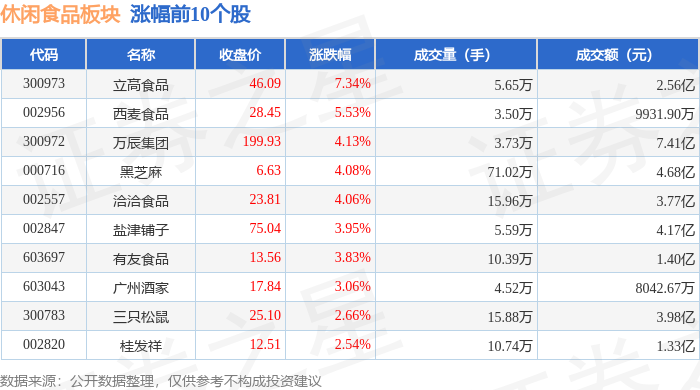
Group 1 - The leisure food sector increased by 3.01% on January 19, with Li Gao Food leading the gains [1] - The Shanghai Composite Index closed at 4114.0, up 0.29%, while the Shenzhen Component Index closed at 14294.05, up 0.09% [1] - Key stocks in the leisure food sector showed significant price increases, with Li Gao Food rising by 7.34% to a closing price of 46.09 [1] Group 2 - The leisure food sector experienced a net inflow of 18.35 million yuan from institutional investors, while retail investors contributed a net inflow of 18.64 million yuan [2] - Notable stocks included San Zhi Song Shu, which had a net inflow of 36.54 million yuan from institutional investors, despite a net outflow from retail investors [3] - The overall trading volume and turnover in the leisure food sector indicated active market participation, with significant movements in individual stock prices [1][2]


洽洽食品涨2.01%,成交额5995.14万元,主力资金净流入230.00万元
Xin Lang Zheng Quan· 2026-01-19 02:04
Group 1 - The core viewpoint of the news is that Qiaqia Food's stock has shown a positive trend in recent trading sessions, with a year-to-date increase of 7.96% and a market capitalization of 11.807 billion yuan [1] - As of January 19, Qiaqia Food's stock price reached 23.34 yuan per share, with a trading volume of 59.95 million yuan and a turnover rate of 0.51% [1] - The company's main business involves the production and sale of nut snacks and baked leisure foods, with revenue composition being 64.38% from sunflower seeds, 22.32% from nuts, and 11.05% from other products [1] Group 2 - As of September 30, Qiaqia Food reported a total revenue of 4.501 billion yuan for the first nine months of 2025, a year-on-year decrease of 5.38%, and a net profit attributable to shareholders of 168 million yuan, down 73.17% year-on-year [2] - The number of shareholders decreased by 5.84% to 54,300, while the average circulating shares per person increased by 6.20% to 9,297 shares [2] - Qiaqia Food has distributed a total of 4.693 billion yuan in dividends since its A-share listing, with 1.654 billion yuan distributed in the last three years [2]
年度复盘:2025年零售圈十大跨界联名事件发布
3 6 Ke· 2026-01-16 12:06
Core Insights - The retail industry in China is experiencing intense competition, with cross-industry integration becoming a key strategy for brands to achieve growth in a saturated market [1] - Brands are increasingly moving beyond traditional boundaries, utilizing cross-industry innovation to explore new consumer demands and retail formats [1] Group 1: Cross-Industry Innovations - Kudi Coffee has entered the fast-food sector by launching hot meal options in select Beijing stores, aiming to enhance store efficiency and customer traffic through a "coffee + hot food" model [2][3] - Armani has opened its first restaurant in Beijing, offering a unique dining experience that combines luxury branding with a relatively affordable average spend of 354 yuan per person [4][5] - Haidilao has launched a new brand, "Haini," focusing on beef hot pot, as part of its multi-brand strategy to find new growth avenues beyond traditional hot pot offerings [6] Group 2: Market Adaptations - Ningji has introduced grilled sausage products priced at 4 yuan each to complement its lemon tea offerings, aiming to increase customer spending and overall sales [7] - Haidilao has also ventured into the bakery sector with its brand "Schwasua," offering products primarily priced under 10 yuan, leveraging its supply chain advantages [8] - Prada has opened its first independent restaurant in Asia, integrating Italian and Chinese culinary traditions, marking a significant step in luxury brand engagement in the dining sector [9][10] Group 3: Strategic Expansions - Hailan Home has established a beverage company to enter the bottled water market, responding to declining profits in its core clothing business [11] - Zuli Jian has opened an organic food store, selling frozen dumplings at competitive prices, as part of its strategy to diversify and address financial challenges [12] - Wuliangye has launched a new craft beer brand, "Fenghuolun," incorporating its traditional liquor-making techniques, reflecting a trend of traditional alcohol companies seeking new growth opportunities [14] Group 4: Industry Trends - The cross-industry trend in retail is characterized by deeper integration of core capabilities rather than simple category additions, as seen with Haidilao and Wuliangye [17] - Brands are targeting specific consumer groups more effectively, such as Kudi Coffee's focus on all-day dining and Zuli Jian's appeal to older consumers [17] - Luxury brands are using dining experiences to convey lifestyle aesthetics, while mass-market brands are leveraging cross-industry strategies to overcome growth challenges [18]





2025年坚果零食电商消费趋势
知行战略咨询· 2026-01-14 13:57
Investment Rating - The report indicates a positive investment outlook for the nut snack industry, highlighting significant growth opportunities in e-commerce channels, particularly on platforms like Douyin [8][15]. Core Insights - The nut snack market has shown a recovery with a 16.2% growth in online sales in 2024, reversing the decline seen in 2023 [8]. - Douyin has emerged as a dominant player, increasing its market share from 26.3% in 2022 to 49.3% in 2024, while traditional platforms like Taobao and JD have stagnated [8][9]. - Mixed nuts remain the largest category but have experienced a decline of 6.1% in sales, while other categories like sunflower seeds and peanuts have shown positive growth [10][12]. E-commerce Performance - Douyin's overall growth in the nut category reached 38.9%, with mixed nuts growing by 63.1% and nut gift boxes skyrocketing by 304.5% [15][17]. - Taobao saw a slight decline of 0.6% in the nut category, but specific segments like sunflower seeds and paper-shelled walnuts experienced growth rates of 9.6% and 19.3%, respectively [10][12]. - JD reported a modest growth of 1.5%, with mixed nuts achieving a notable increase of 12.7% [13][14]. Sales Data - The total e-commerce sales for nuts in 2024 are projected at approximately 92.87 billion, with significant contributions from Douyin [9]. - Key sales figures for 2024 include: - Mixed nuts: 21.19 billion with a -6.1% growth - Sunflower seeds: 7.02 billion with a 9.6% growth - Peanuts: 4.30 billion with a 14.2% growth [12]. Brand Rankings - The leading brands in the nut snack market for 2024 include: - Three Squirrels: 11.12 billion with a 23.3% growth - Be&cheery: 5.07 billion with a -18.9% growth - Wolong: 2.75 billion with a 4.0% growth [19][21]. - On Douyin, Three Squirrels also leads with 25.28 billion in sales, reflecting a 63.1% growth [17]. Market Trends - The nut snack industry is witnessing a shift towards online purchasing, with consumers increasingly favoring platforms that offer convenience and variety [6][8]. - The growth of specific categories, such as nut gift boxes and certain types of nuts, indicates changing consumer preferences towards premium and gift-oriented products [15][16].


休闲食品板块1月14日跌0%,万辰集团领跌,主力资金净流出6821.32万元
Zheng Xing Xing Ye Ri Bao· 2026-01-14 08:50
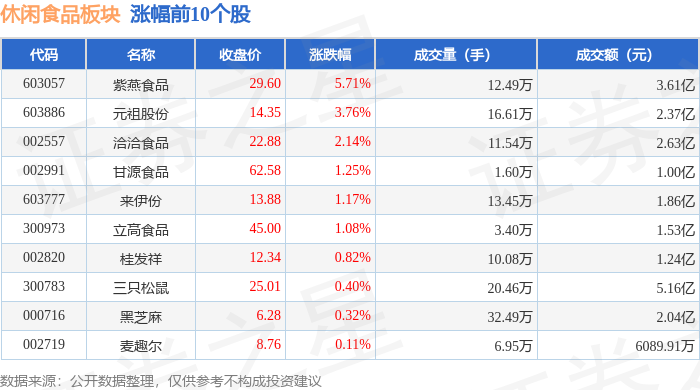
Core Viewpoint - The leisure food sector experienced a slight decline of 0.01% on January 14, with Wanchen Group leading the drop. The Shanghai Composite Index closed at 4126.09, down 0.31%, while the Shenzhen Component Index rose by 0.56% to 14248.6 [1]. Group 1: Market Performance - The leisure food sector's individual stock performance showed varied results, with Ziyan Food leading with a 5.71% increase, closing at 29.60, and Wanchen Group declining by 2.11% to 190.40 [1][2]. - The trading volume for Ziyan Food was 124,900 shares, with a transaction value of 361 million yuan, while Wanchen Group had a trading volume of 24,700 shares and a transaction value of 473 million yuan [1][2]. Group 2: Capital Flow - The leisure food sector saw a net outflow of 68.21 million yuan from main funds, while retail investors contributed a net inflow of 111 million yuan [2]. - Specific stocks like Ziyan Food had a main fund net inflow of 18.88 million yuan, while retail investors showed a net inflow of 13.51 million yuan [3].


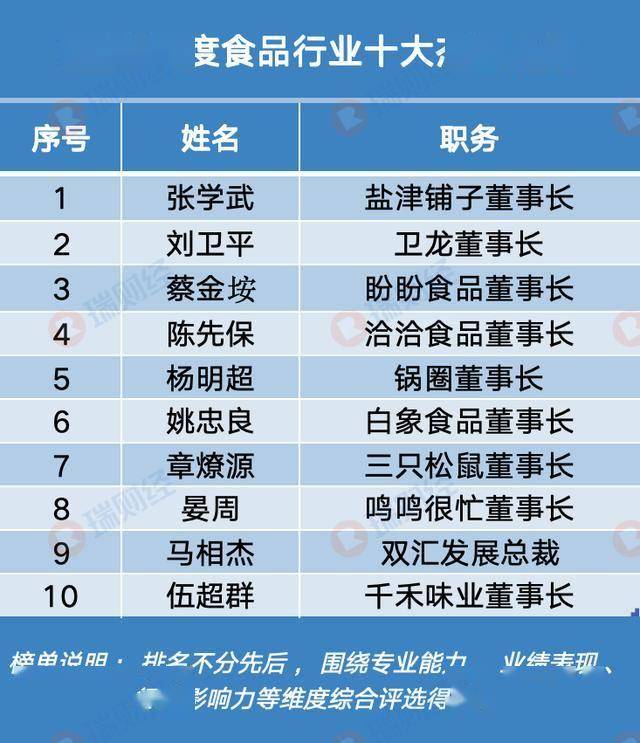
千禾味业董事长伍超群入选“2025年度食品行业十大杰出人物”
Sou Hu Cai Jing· 2026-01-13 09:45
Core Viewpoint - The "2025 Annual Top Ten Outstanding Figures in the Food Industry" list was announced by Rui Finance, highlighting key leaders in the sector, with Wu Chaoqun, Chairman of Qianhe Flavor Industry, being recognized for his contributions [2]. Group 1: Recognition and Achievements - Wu Chaoqun was selected for the "2025 Annual Top Ten Outstanding Figures in the Food Industry" list based on his professional capabilities, performance, and industry influence [2]. - Wu Chaoqun, born in May 1969, holds a Master's degree in Business Administration and founded Hengtai Industrial in January 1996, serving in various leadership roles [2]. Group 2: Industry Innovations - Wu Chaoqun is recognized as a pioneer in the "zero additives" segment of the seasoning industry, focusing on product packaging renewal and optimizing label information presentation [3]. - The company is strategically expanding its oyster sauce category to create a "second growth curve" for its product line [3].