
BYD(002594)

Search documents
寻中国特色范式,筑金融强国根基
ZHONGTAI SECURITIES· 2026-03-02 03:05
Investment Rating - The report does not explicitly provide an investment rating for the insurance industry, but it emphasizes the importance of addressing risks in small and medium-sized insurance companies as a key regulatory task for 2026 [4][32]. Core Insights - The risk resolution of small and medium-sized insurance institutions is a significant regulatory focus during the "14th Five-Year Plan" period, with a particular emphasis on market-oriented solutions for existing risks [4][32]. - The report highlights that 19 life insurance companies are currently unable to disclose their solvency reports, with recognized liabilities totaling approximately 4.31 trillion yuan, accounting for about 11.4% of the industry [4][17]. - The report discusses the transition from a "single fund guarantee" model for the insurance guarantee fund to a more diversified market-oriented risk resolution approach [4][32]. Summary by Sections Introduction - The report outlines the challenges faced by small and medium-sized insurance institutions in a persistently low interest rate environment, which has led to operational difficulties and increased risk exposure [10][14]. Current Situation of Small and Medium-Sized Insurance Institutions - The report categorizes the 19 life insurance companies unable to disclose solvency reports into three stages: newly established companies, those undergoing risk resolution, and those with slow progress in risk resolution [22][24]. - It notes that the current risk resolution approach in the insurance sector is characterized by "one company, one policy," allowing new entities to take over business without reducing the total number of insurance licenses [33][35]. Comparison with Historical Events - The report draws parallels between the current situation in China's insurance industry and the insurance crisis in Japan during the 1990s, noting that the current environment has not yet broken the "guaranteed return" constraint [4][38]. Changes in Risk Resolution Models - The report indicates that the insurance guarantee fund's model will shift from a single fund to a multi-faceted market-oriented resolution strategy, highlighting the need for capable market participants to assist in risk resolution [4][32]. Investment Recommendations - The report suggests that accelerating the risk resolution process for small problem insurance companies is essential for promoting a healthier competitive ecosystem in the industry, transitioning from quantity expansion to quality improvement [4][32].



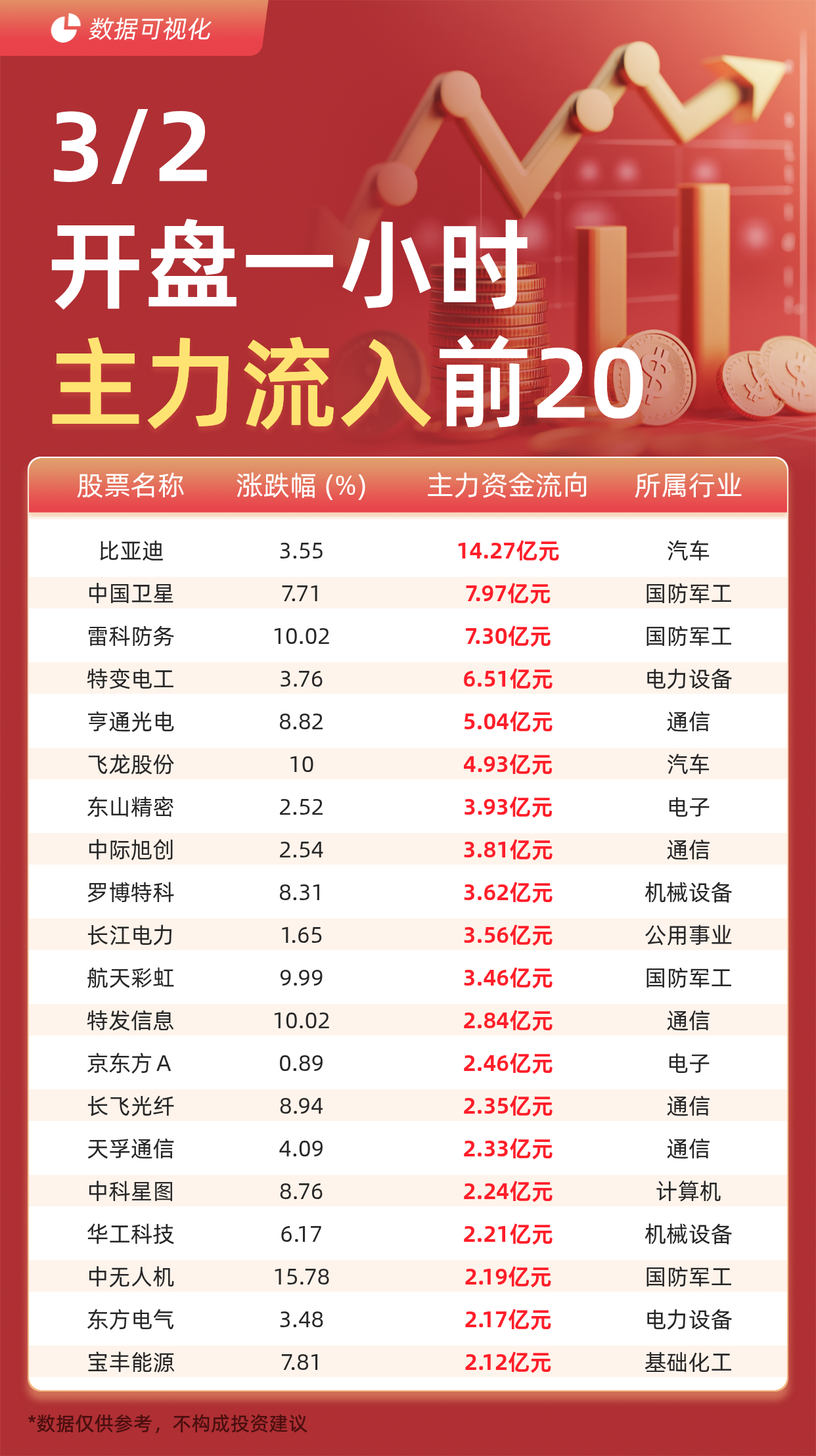
主力资金流入前20:比亚迪流入14.27亿元、中国卫星流入7.97亿元
Jin Rong Jie· 2026-03-02 02:59
Core Insights - The main focus of the news is the significant inflow of capital into various stocks, indicating strong investor interest in specific sectors and companies. Group 1: Stock Performance and Capital Inflow - BYD saw a capital inflow of 1.427 billion, with a price increase of 3.55% [1][2] - China Satellite experienced a capital inflow of 0.797 billion, with a price increase of 7.71% [1][2] - Aerospace Rainbow had a capital inflow of 0.346 billion, with a price increase of 9.99% [1][2] - The stock with the highest capital inflow was BYD, followed by China Satellite and Raytheon Defense [1][2] Group 2: Sector Analysis - The automotive sector, represented by BYD and Feilong Co., showed strong performance with inflows of 1.427 billion and 0.493 billion respectively [1][2] - The defense sector, including China Satellite and Raytheon Defense, also attracted significant capital, with inflows of 0.797 billion and 0.730 billion respectively [1][2] - The communication sector, represented by companies like Hengtong Optic-Electric and Tianfu Communication, saw inflows of 0.504 billion and 0.233 billion respectively [1][2][3]






比亚迪,大涨
Di Yi Cai Jing Zi Xun· 2026-03-02 02:56
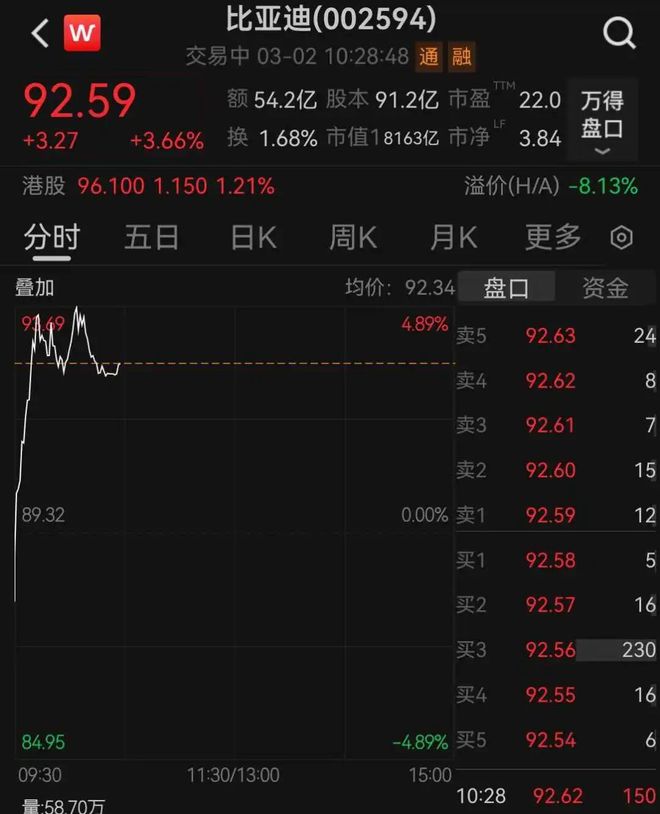
Core Viewpoint - BYD's stock price experienced significant gains, with an increase of nearly 5% in the A-share market and over 3% in the Hong Kong market, leading the automotive sector despite a decline in overall sales figures for February [1][2]. Group 1: Stock Performance - BYD's A-share stock opened with a price increase, reaching a peak gain of nearly 5% [1]. - In the Hong Kong market, BYD's stock price rose by over 3%, showing resilience against market trends [1]. Group 2: Sales Data - In February, BYD sold approximately 190,000 vehicles, representing a year-on-year decline of over 40% [2]. - Overseas sales exceeded 100,000 units, marking a year-on-year growth of 41.4%, and for the first two months of the year, cumulative overseas sales surpassed 200,000 units [2].
比亚迪领涨汽车股 盘中一度涨近5%
Di Yi Cai Jing· 2026-03-02 02:24
消息面上,比亚迪昨日公布2月销量数据,当月销售约19万辆,同比下跌超40%。其中海外销量超10万 辆,同比增长41.4%,首次超过国内销量。今年1~2月,比亚迪海外累计销量突破20万辆。 (文章来源:第一财经) 3月2日,比亚迪开盘即上涨,股价盘中涨幅一度逼近5%,领涨汽车整车板块;比亚迪股份股价盘中一 度涨超3%,在港股逆势上涨。 ...
比亚迪领涨汽车股,盘中一度涨近5%
Di Yi Cai Jing· 2026-03-02 02:24
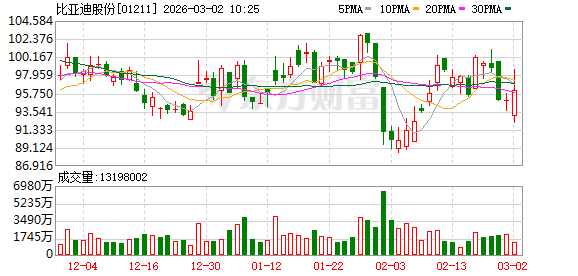
消息面上,比亚迪昨日公布2月销量数据,当月销售约19万辆,同比下跌超40%。其中海外销量超10万 辆,同比增长41.4%,首次超过国内销量。今年1~2月,比亚迪海外累计销量突破20万辆。(第一财经 记者 黄琳) 3月2日,比亚迪开盘即上涨,股价盘中涨幅一度逼近5%,领涨汽车整车板块;比亚迪股份股价盘中一 度涨超3%,在港股逆势上涨。 ...
2月份销量公布!比亚迪2025年海外销量破100万辆!博世关停德国工厂!蔚来芯片子公司完成22亿首轮股权融资!丨一周大事件
电动车公社· 2026-03-02 02:01
New Car Launches - Toyota launched the bZ Woodland, a mid-size all-electric crossover SUV, featuring a dual-motor all-wheel drive system with a maximum power of 375 hp and an EPA range of 281 miles (452 km) [1][2][4] - Dongfeng's Xinghai T5 was launched with a price range of 153,900 to 161,900 yuan, featuring a compact SUV design and a 64.4 kWh lithium iron phosphate battery with a CLTC range of 530 km [1][8][12] - The new Changan UNI-Z PHEV was launched with a price range of 118,900 to 135,900 yuan, offering a 130 km pure electric range and various advanced features [1][15][22] Company Dynamics - BYD aims to achieve over 1 million overseas sales by 2025, while SAIC MG has surpassed 1 million sales in Europe [1][23][25] - Huawei's QianKun assisted driving system recorded over 470 million kilometers during the Spring Festival, with a significant increase in active user engagement [1][26][30] - Bosch confirmed the closure of its factory in Germany, affecting 560 jobs, as part of a global cost-cutting and capacity restructuring plan [1][31][33] - Xiaomi's assisted driving system recorded over 100 million kilometers during the Spring Festival, indicating a rise in usage frequency [1][34][36] - NIO's battery technology company was established with a registered capital of 100 million yuan, focusing on R&D [1][45][47] - NIO's chip subsidiary completed a 2.2 billion yuan financing round, marking a significant step in domestic high-end chip development [1][48][49] Sales Performance - In February, BYD sold 187,782 passenger vehicles, maintaining its leadership in the new energy sector [1][54][55] - Geely's total sales reached 204,910 units in February, with 117,488 units being new energy vehicles [1][57][58] - Leap Motor delivered 28,067 units in February, showcasing strong sales momentum [1][66] - Li Auto delivered 26,421 units in February, maintaining a dual strategy of pure electric and range-extended vehicles [1][69][70] - NIO delivered 20,797 units in February, benefiting from the launch of the new ES8 model [1][71][73] - Xiaomi's automotive division delivered over 20,000 units in February, with new models expected to boost sales further [1][74][75] - AITO's sales reached approximately 18,000 units in February, with a strong market presence [1][76][77] - XPeng delivered 15,256 units in February, continuing its dual technology strategy [1][78][79] - Great Wall Motors sold 12,744 new energy vehicles in February, reflecting a significant growth in its electric vehicle segment [1][83][86]


电力设备行业跟踪周报:缺电带来电网Supercycle,户储景气向好-20260302
Soochow Securities· 2026-03-02 01:10
Investment Rating - The report maintains an "Overweight" investment rating for the power equipment industry [1] Core Insights - The power equipment industry is experiencing a supercycle driven by electricity shortages, with a positive outlook for household energy storage systems [1] - The report highlights significant growth in energy storage demand, particularly in the U.S. and Australia, with expectations of over 60% growth in global energy storage installations in 2026 [3][6] - The electric vehicle sector is projected to recover in sales, with a forecasted 5% growth in domestic electric vehicle sales in 2026 [3][24] Industry Trends - Energy Storage: The National Energy Administration has approved 43 pilot projects for new power systems with a total investment of 3.968 billion yuan, indicating strong government support for energy storage [3] - Electric Vehicles: January 2026 saw domestic electric vehicle sales of 945,000 units, with expectations for recovery in March due to the arrival of subsidies [3][24] - Market Prices: Lithium carbonate prices have increased by 21.3% to 165,000 yuan/ton, reflecting rising demand in the battery sector [3] Company Performance - Ningde Times is highlighted as a global leader in power and energy storage batteries, with a low valuation and confirmed growth trajectory [3][5] - Trina Solar is expected to enter a harvest period for energy storage, with significant revenue projections for 2025 [3] - Other companies such as Gotion High-tech and BYD are also noted for their strong performance and growth potential in the electric vehicle and energy storage markets [3][5] Investment Strategy - The report recommends focusing on leading companies in energy storage and lithium battery sectors, including Ningde Times, Gotion High-tech, and others, due to their strong market positions and growth potential [3][5] - The report emphasizes the importance of technological advancements and market expansion opportunities in the robotics and automation sectors, particularly with the anticipated launch of Tesla's Gen3 robot [3][9]




全球大公司要闻 | 苹果将发布新品,千问进军AI硬件领域
Wind万得· 2026-03-02 00:58
Group 1 - Apple is set to hold a spring product launch this week, with potential price reductions for new models, including a low-cost device; a touch version of the MacBook Pro is confirmed for release by the end of 2026, maintaining the independence of the Mac and iPad product lines [2] - SpaceX is considering submitting its IPO documents as early as March, aiming for a valuation exceeding $1.75 trillion and potentially raising up to $50 billion, which would make it one of the largest IPOs in recent years [2] - OpenAI's founder Altman announced a potential agreement with the U.S. Department of Defense regarding the use of its AI models, with the company retaining control over technology implementation and deployment [2] Group 2 - Nvidia plans to launch a new AI processor tailored for OpenAI and other clients, aimed at creating faster and more efficient tools; this new platform will be unveiled at the GTC developer conference in San Jose [3] - BYD reported a 35.8% year-on-year decline in vehicle sales and a 38.4% drop in production for January and February, with plans to optimize product structure and enhance supply chain efficiency [3] - Alibaba's personal AI assistant "Qianwen" is entering the AI hardware market, with plans to launch various AI hardware products globally, including AI glasses and rings, starting from March [3] Group 3 - JD.com announced that its food delivery service has served over 240 million users in its first year, capturing over 15% of the market share, with plans to expand into in-store pickup and group buying by 2026 [6] - Li Auto delivered 26,421 new vehicles in February and aims to continue optimizing its product matrix to meet diverse consumer needs [7] - NIO delivered 20,797 new vehicles in February and announced a limited-time purchase promotion for March, including low-interest plans and tax subsidies [8] Group 4 - Amazon Web Services (AWS) experienced a fire at its data center in the Middle East, causing power outages and service delays, but operations are gradually recovering [10] - Microsoft reported that Windows 11's market share has surged to nearly 75% following the end of support for Windows 10, while also collaborating with companies like Anthropic and Meta to advance AI technology [10] - Tesla increased the price of the Cybertruck dual-motor all-wheel-drive version to $69,990 and initiated road tests for its Full Self-Driving (FSD) technology in Abu Dhabi [10] Group 5 - Samsung Electronics plans to establish AI-driven factories by 2030, deploying digital twin systems and humanoid robots to enhance operational efficiency [13] - SK Hynix is set to expand its production capacity for storage devices, benefiting the supply chain in March [14] - Mitsubishi Electric and Toshiba are negotiating on power chip matters, which could strengthen their competitiveness in the semiconductor sector [15]





电力设备与新能源行业研究:绿醇内外部催化共振,太空光伏再次蓄势待发,AIDC迎GTC催化
SINOLINK SECURITIES· 2026-03-02 00:24
Investment Rating - The report emphasizes a positive outlook on sectors such as green hydrogen, wind power, lithium batteries, and space photovoltaic technology, indicating strong investment opportunities in these areas [2][3][6]. Core Insights - The upcoming Two Sessions are expected to focus on "green hydrogen and methanol" as key components of carbon reduction strategies, with potential policy support driving demand [6][11]. - The geopolitical situation in Iran is likely to push up methanol prices, enhancing the competitiveness of green methanol as a substitute in various industries [11][12]. - The report highlights significant investment opportunities in core equipment and materials related to space photovoltaic technology, driven by collaborations between major tech companies [2][6][8]. Summary by Relevant Sections Hydrogen and Fuel Cells - The hydrogen industry is at a pivotal moment, with strategic importance elevated due to upcoming policies and geopolitical factors affecting methanol supply [3][11]. - The report suggests that green methanol producers will benefit from high premium returns due to supply shortages, with a projected demand increase for green methanol in shipping and chemical sectors [11][12]. Wind Power - Wind turbine bidding prices remain high, indicating a stable market, with recommendations to focus on the wind turbine segment for profit potential [3][13]. - The UK government has publicly released a memorandum on clean energy cooperation with China, which may catalyze opportunities in offshore wind exports [13][18]. Lithium Batteries - The lithium battery supply chain is showing signs of recovery, with significant month-on-month increases in production across various segments [19][20]. - The suspension of lithium concentrate exports from Zimbabwe is expected to tighten supply and elevate market prices, creating investment opportunities in battery materials [20][21]. Space Photovoltaics - The report notes a rebound in space photovoltaic stocks, driven by significant partnerships and upcoming launches, suggesting a bullish outlook for related companies [2][6][8]. - Key recommendations include focusing on companies involved in core equipment and materials for space and ground applications [8][9]. Investment Recommendations - The report provides a detailed list of recommended companies across various sectors, including wind power, solar energy, energy storage, and hydrogen, emphasizing their potential for growth and profitability [34][35][36].


电力设备行业跟踪周报:缺电带来电网Supercycle,户储景气向好
Soochow Securities· 2026-03-02 00:24
Investment Rating - The report maintains an "Accumulate" rating for the electric power equipment industry [1] Core Insights - The report highlights a positive outlook for the energy storage sector, driven by government policies and increasing demand for household storage solutions, predicting a global installation growth of over 60% in 2026 [3][6] - The electric vehicle market is expected to recover in March, with a projected 5% growth in domestic electric vehicle sales in 2026, alongside a 50% increase in exports [3][24] - The report emphasizes the importance of technological advancements in robotics and energy storage, with significant market potential anticipated in these sectors [3][9] Industry Trends - Energy Storage: The National Energy Administration has approved 43 pilot projects for new power systems, with a total investment of 3.968 billion yuan [3] - Electric Vehicles: January saw domestic electric vehicle sales of 945,000 units, with expectations for recovery in March [3][24] - Robotics: The report notes the rapid development and market potential for humanoid robots, with a projected market size exceeding 15 trillion yuan [3][9] Company Performance - Companies like Ningde Times and Sunshine Power are highlighted as leaders in their respective fields, with strong growth forecasts and competitive advantages [3][5] - The report details various companies' financial projections, indicating significant revenue growth for several key players in the industry [5] Investment Strategy - The report recommends focusing on leading companies in energy storage and electric vehicles, such as Ningde Times and Sunshine Power, due to their strong market positions and growth potential [3][5]


