BYD(002594)

Search documents
【快讯】每日快讯(2026年3月6日)
乘联分会· 2026-03-06 08:49
Domestic News - The government work report emphasizes that by 2025, China's development will focus on new and superior growth, showcasing vibrant vitality. Key sectors such as high-tech manufacturing and equipment manufacturing have seen value-added growth of 9.4% and 9.2% respectively, with the production of industrial robots and integrated circuits increasing by 28% and 10.9% respectively. The annual production of new energy vehicles has exceeded 16 million, and the number of electric vehicle charging facilities has surpassed 20 million [7] - The Minister of Industry and Information Technology, Li Lecheng, stated that in 2026, the ministry will vigorously promote the dual development of artificial intelligence (AI) and manufacturing, aiming to produce more world-class intelligent products. The focus will be on advancing AI computers, AI smartphones, and smart home devices to better meet the public's needs [8] - A new group standard for "Requirements and Test Methods for Drive Motor Systems of Flying Cars" has been approved, filling a gap in the domestic flying car industry regarding core power components and providing key technical support for cross-industry integration [9] - BYD has launched its second-generation blade battery, which has a 5% increase in energy density. The charging time from 10% to 70% is 5 minutes, and from 10% to 97% is 9 minutes. Models equipped with this battery include several new vehicles with a range of up to 1,036 km [10] - NIO has established a battery research and development base in Shanghai, focusing on core technology development and holding nearly 10,000 patents [11] - Zeekr has announced plans to launch four new models in the second quarter of 2026, including a brand new model, Zeekr 8X [12] - GAC Aion's RT battery swap version will be launched in April, with a battery swap time of just 99 seconds, significantly faster than refueling [13] - The Firefly brand from NIO has officially entered the Thai market, expanding its presence to 10 countries globally [14] Foreign News - The European Union has officially approved the revised European Climate Law, which mandates a 90% reduction in greenhouse gas emissions by 2040 compared to 1990 levels [16] - Tata Motors and Stellantis have signed a memorandum of understanding to expand their long-term cooperation into hybrid system development and lightweight engineering for engines and battery components [17] - BMW will adopt smart connectivity technology from Japan's NTT Docomo for its new electric vehicle models set to launch in 2026, marking a significant shift in its connectivity infrastructure [18] - Subaru will release a new electric SUV, "Trailseeker," developed in collaboration with Toyota, on April 9 in Japan [19] Commercial Vehicles - Geely's sub-brand Riddara plans to assemble its pure electric pickup RD6 in Thailand to meet local electric vehicle demand and establish Thailand as a regional production hub for the ASEAN market. The RD6 is expected to launch in Thailand in October 2024 [21] - Hunan province will build 48 heavy-duty truck charging and battery swap stations across 24 highway service areas, aiming to create a comprehensive green energy supply system for heavy-duty trucks [22] - A new group standard for "General Technical Conditions for Functional Unmanned Vehicles" has been approved, marking the first comprehensive technical standard in the field of functional unmanned vehicles in China [23] - Li Shufu, chairman of Geely, proposed promoting methanol electric trucks to support the green transition in the freight sector, highlighting the high energy consumption and emissions associated with traditional diesel engines [24][25]



花旗重申比亚迪买入评级,称其刀片电池充电速度全球领先
Bei Ke Cai Jing· 2026-03-06 08:39
Core Viewpoint - Citigroup reaffirms a "Buy" rating for BYD, highlighting the launch of its second-generation blade battery as a new global benchmark for mass production battery charging speed [1] Group 1 - BYD officially launched its second-generation blade battery on March 5, setting a new global standard for charging speed in mass production batteries [1] - Citigroup expects that BYD's inventory reduction in March, the rollout of new models from now until the second quarter, and the growth momentum in exports for March and April will act as catalysts for the company's performance [1] - The target price set by Citigroup for BYD is HKD 174 [1]

“5分钟充好,9分钟充饱”比亚迪闪充技术亮相 计划年底前建设2万座闪充站
Zhong Guo Jing Ji Wang· 2026-03-06 08:37
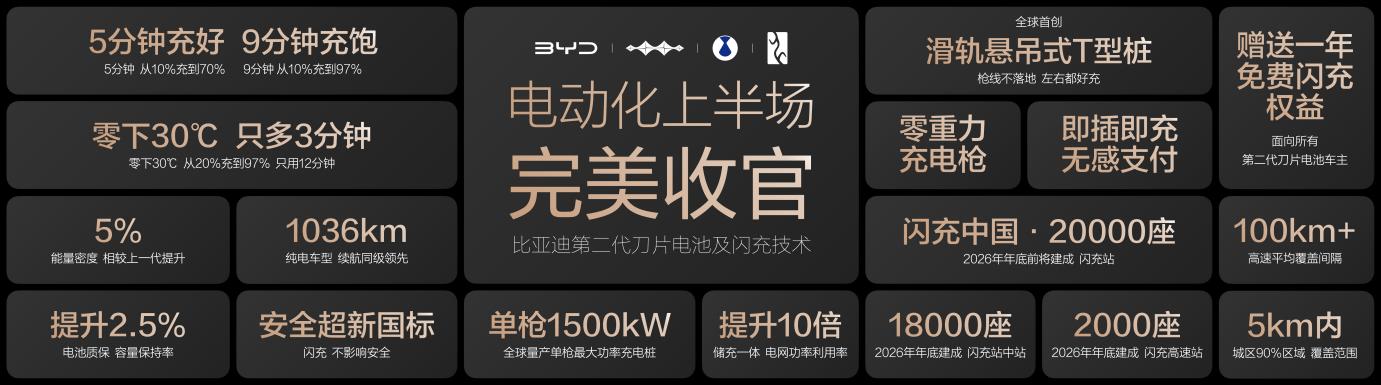
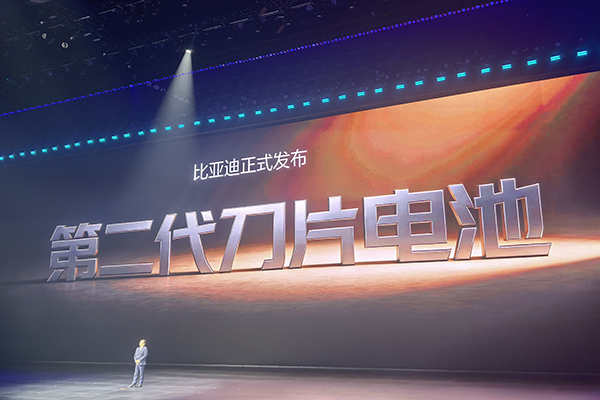
Core Viewpoint - BYD unveiled its "disruptive technology" during the "Waking of Insects" solar term, introducing the second-generation blade battery and flash charging technology, aiming to enhance its position in the electric vehicle market [1][3]. Group 1: Product Launch and Technology - On March 5, BYD held a launch event for its second-generation blade battery and flash charging technology, showcasing 10 models across its four brands equipped with this technology [3]. - The second-generation blade battery allows for "normal temperature charging in 5 minutes to 80%, and 9 minutes to full," and can charge in low temperatures with only a slight increase in time [3][9]. - The new battery technology has improved energy density by over 5% compared to the first generation, while also achieving a pure electric range of 1,036 kilometers for the Tengshi Z9GT model [11]. Group 2: Market Strategy and Sales Performance - BYD's sales have grown significantly, from over 700,000 units in 2021 to over 4.6 million units in 2023, placing it among the top five global automakers [5][6]. - Despite this growth, BYD faces challenges with declining domestic sales and increased competition, leading to a projected sales growth rate of only 7.73% in 2025 [6][8]. - The company plans to build 20,000 flash charging stations across China by the end of the year, enhancing its infrastructure to support the new technology [15][19]. Group 3: User Experience and Safety - The flash charging technology addresses user pain points such as slow charging speeds and range anxiety, which have been significant barriers to electric vehicle adoption [8][13]. - BYD has conducted extensive safety tests on the second-generation battery, demonstrating its safety under various conditions, including puncture tests and short-circuit tests [15]. - The new charging stations will feature a design that allows for easy user interaction and payment through the BYD flash charging app, promoting a seamless charging experience [17].
看完发布会,摩根大通更坚定看好比亚迪:不要纠结25年业绩,闪充有望颠覆行业!
Hua Er Jie Jian Wen· 2026-03-06 08:21
Core Viewpoint - Morgan Stanley maintains a positive outlook on BYD, highlighting that the combination of the second-generation blade battery and ultra-fast charging network positions BYD as a leader in the next phase of electric vehicle adoption [1][5] Group 1: Battery Technology - BYD's second-generation blade battery supports a maximum charging rate of 8C, allowing it to charge from 10% to 97% in just 9 minutes, setting a global record for mass-produced vehicles [2] - The new battery has an energy density of approximately 200Wh/kg, a 50% improvement over the first generation, and a theoretical cycle life of up to 4000 times, corresponding to about 15 years of vehicle use [2] - Safety tests exceed national standards, with no smoke or fire after 500 cycles of flash charging, and the thermal diffusion test conditions raised significantly [2] Group 2: Charging Infrastructure - BYD has established 4,239 ultra-fast charging stations and plans to expand to 20,000 by the end of 2026, ensuring that 90% of urban areas will have a charging station within 5 kilometers [5] - The charging stations are designed with a single-gun power of 1.5 megawatts and integrated energy storage systems to reduce grid impact [5] Group 3: Market Outlook - Morgan Stanley expects BYD's sales to rebound from approximately 700,000 units in Q1 2026 to between 1.1 million and 1.2 million units in Q2 2026, driven by the launch of 10 new models [5] - The year 2026 is anticipated to be a pivotal point for BYD's globalization strategy, with production capacity in Thailand, Indonesia, Brazil, and Hungary gradually increasing [5] - Morgan Stanley calculates a long-term reasonable stock price range for BYD between 94 and 121 HKD, with a target price of 110 HKD reflecting strong confidence in its future value [5]
花旗:比亚迪股份(01211)为量产电池充电速度树立全球标竿 重申“买入”评级
智通财经网· 2026-03-06 08:10
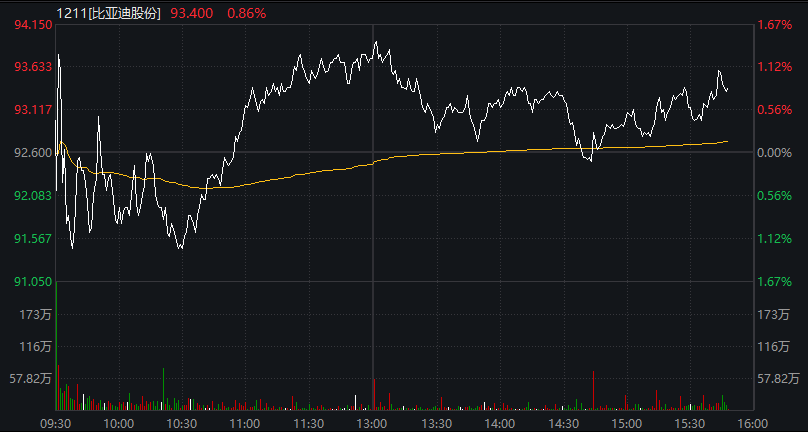
Core Viewpoint - Citigroup has reiterated a "Buy" rating for BYD Company Limited (01211) following the launch of its second-generation blade battery, which sets a new global benchmark for battery charging speed [1] Group 1: Product Development - BYD officially launched its second-generation blade battery, which is expected to lead the market in charging technology by at least one year [1] - The new battery technology is designed to perform strongly even in low-temperature environments, enhancing BYD's penetration into northern China and allowing it to capture market share from traditional fuel vehicles [1] Group 2: Market Strategy - The new strategy will unify BYD's electric vehicle battery and energy storage system battery businesses, creating a complementary relationship that is expected to enhance long-term operational leverage in battery production and potentially lower cost curves [1] - Citigroup anticipates that inventory reduction in March, the rollout of new models from now until the second quarter, and the month-on-month growth momentum in exports for March and April will serve as catalysts for BYD's performance [1] Group 3: Financial Outlook - Citigroup has set a target price of HKD 174 for BYD, reflecting confidence in the company's growth prospects [1] - The second-generation blade battery establishes new safety standards and limits for battery capacity degradation, which could further strengthen BYD's market position [1]
比加油还快!比亚迪发布第二代刀片电池:从10%充至97%仅需9分钟,极寒充电少于12分钟【附比亚迪企业分析】
Qian Zhan Wang· 2026-03-06 08:05
Core Insights - BYD has launched its second-generation blade battery, significantly improving charging efficiency, with the ability to charge from 10% to 70% in just 5 minutes and to 97% in 9 minutes, setting a new record for charging speed [2][3] - The second-generation blade battery features a 5% increase in energy density compared to the first generation, utilizing lithium iron phosphate with manganese and silicon-carbon anodes, and has optimized voltage platform and internal resistance [5] Charging Performance - In a controlled environment in Shenzhen, all tested models achieved charging from 10% to 70% in 5 minutes and from 10% to 97% in 9 minutes, comparable to refueling a gasoline vehicle [3][4] - The battery can also charge from 20% to 97% in 12 minutes in extreme cold conditions, demonstrating its reliability in low temperatures [4] Market Position and Sales - BYD has become a leading player in the global electric vehicle market, achieving sales of 1.8635 million electric vehicles in 2022, securing the title of the world's largest electric vehicle seller [9] - In 2025, BYD is projected to surpass Tesla in annual sales of pure electric vehicles, marking a significant milestone in the competitive landscape [11] Research and Development - BYD has consistently prioritized R&D, with 13 out of 14 years from 2011 to 2024 seeing R&D investments exceed net profits, and a 53% year-on-year increase in R&D spending in the first half of 2025, reaching 30.9 billion yuan [7][8] - The company is building a comprehensive battery ecosystem, covering upstream materials to recycling, and is advancing the development of semi-solid and all-solid-state batteries [7]
鑫椤锂电一周观察 | 中东开战 碳酸锂“受扰”
鑫椤锂电· 2026-03-06 07:51
Core Viewpoint - The article provides a comprehensive overview of the lithium battery industry, highlighting key developments, market trends, and price fluctuations across various segments, including lithium carbonate, ternary materials, and phosphoric iron lithium. Lithium Carbonate Market - The domestic lithium carbonate market has seen a significant price drop due to short-term market sentiment influenced by the outbreak of conflict in the Middle East, with prices expected to fluctuate between 150,000 to 160,000 yuan/ton in the short term [6]. - As of March 5, the latest prices for battery-grade lithium carbonate are between 154,000 to 159,000 yuan/ton, and for industrial-grade, they are between 139,000 to 145,000 yuan/ton [7]. Ternary Materials Market - The price of ternary materials has decreased, primarily due to the drop in lithium carbonate prices. March is a crucial month for exports, with production ramping up to meet overseas orders, and prices are expected to return to year-end levels by April [8]. - The latest prices for ternary materials as of March 5 are 193,000 to 200,000 yuan/ton for 5-series single crystal type and 193,000 to 211,000 yuan/ton for 8-series 811 type [9]. Phosphoric Iron Lithium Market - The phosphoric iron lithium market has also experienced a slight price decline, although demand has rebounded quickly, with leading companies reporting a month-on-month growth of 20-30%. Some companies are facing production cuts due to unresolved pricing with downstream clients [10]. - The latest prices for phosphoric iron lithium as of March 5 are 52,800 to 53,800 yuan/ton for power type and 52,600 to 53,600 yuan/ton for energy storage type [10]. Negative Material Market - The price of negative materials has remained stable, with leading manufacturers increasing production capacity. Despite a significant rise in raw material prices, negative material manufacturers have not raised prices yet, pending downstream acceptance [11]. - The latest prices for negative materials as of March 5 are 50,000 to 65,000 yuan/ton for high-end natural graphite products and 31,800 to 64,800 yuan/ton for high-end artificial graphite [12]. Separator Market - The separator market has seen stable prices, with most manufacturers operating at full capacity. A recent fundraising initiative by a major company aims to enhance liquidity [13]. - The latest prices for separators as of March 5 are 0.55 to 1.025 yuan/square meter for 9μm wet method and 0.35 to 0.5 yuan/square meter for 16μm dry method [14]. Electrolyte Market - The electrolyte market has experienced a slight price decline, with a recovery in operating rates to around 20%. A major company is undergoing maintenance, and new capacity is expected to be released in May-June [15]. - The latest prices for electrolytes as of March 5 are 110,000 to 115,000 yuan/ton for lithium hexafluorophosphate electrolyte and 29,000 to 34,000 yuan/ton for ternary electrolyte [15]. Battery Market - The battery cell market has maintained stable prices, with varying performances across manufacturers. The market is closely watching the upcoming Beijing Auto Show in April for further developments [16]. - The latest prices for battery cells as of March 5 are 0.44 to 0.5 yuan/Wh for square ternary power cells and 0.29 to 0.38 yuan/Wh for square phosphoric iron lithium power cells [16]. New Energy Vehicle Market - In February, domestic new energy vehicle sales saw a normal seasonal decline. However, the gradual rollout of subsidy policies is expected to stimulate demand, with a further recovery anticipated in March [17]. Energy Storage Market - The energy storage market has shown little price change, with stable production capacity due to export demands. The recent geopolitical tensions have had a limited impact on the energy storage market [18].



3月19-20日相聚常州!2026锂电关键材料及应用市场高峰论坛
鑫椤锂电· 2026-03-06 07:51
Core Viewpoint - The lithium battery industry is expected to enter a new growth cycle in 2026, characterized by strong demand recovery, accelerated global expansion, and disruptive technological iterations, leading to a spiral growth pattern of "increased volume and price + technological leap" [3]. Group 1: Market Predictions - Global lithium battery production is projected to reach 2297 GWh by 2025, with a growth rate of 34.6% in 2026. The shipment growth rate for energy storage cells is expected to reach 70%, driven by both domestic and international demand [5]. - There is a significant supply gap for battery cells and various materials, highlighting the need for stable and efficient supply chains to capitalize on this growth opportunity [5]. Group 2: Conference Overview - The 2026 Lithium Key Materials and Application Market Summit will be held on March 19-20, 2026, in Changzhou, Jiangsu, focusing on two main topics: advanced technology and market supply-demand discussions, and upstream-downstream procurement matchmaking [4][6]. - The summit will feature specialized forums on lithium carbonate, key materials for power batteries, and key materials for energy storage batteries, with participation from experts, leading companies, and international specialists [5]. Group 3: Key Topics and Participants - Key topics include the potential of global lithium resources, the impact of solid-state battery development on lithium salt companies, and the practical aspects of lithium carbonate futures and supply-demand outlook [7]. - Notable participants include top battery companies like CATL, BYD, and LGES, as well as material suppliers covering the entire industry chain, which will facilitate efficient resource matching and cost reduction [6]. Group 4: Industry Trends and Strategic Insights - The lithium battery industry is positioned to play a crucial role in energy transition and carbon neutrality goals as it enters the 14th Five-Year Plan's conclusion and the 15th Five-Year Plan's initiation [6]. - The summit aims to provide authoritative data releases, benchmark company rankings, and deep industry chain connections to offer forward-looking insights and practical cooperation platforms for high-quality development in the lithium battery sector [6].




9分钟充到97%,比亚迪发布第二代刀片电池及闪充技术
鑫椤锂电· 2026-03-06 07:51
Group 1 - The core viewpoint of the article emphasizes the significant advancements in lithium battery technology and the market outlook for various components related to lithium batteries by 2025 [1][2][3] Group 2 - The article discusses the introduction of BYD's new fast charging technology, which can reach a power of 1500 kW, allowing for a 10% to 70% charge in just 5 minutes and up to 97% in 9 minutes, even in extreme cold conditions [2] - It highlights that charging efficiency is a critical issue for the development of electric vehicles, with the turnaround rate of public charging guns being only one-tenth that of gasoline pumps [2] - The article outlines various market segments related to lithium batteries, including lithium carbonate, electrolytes, copper foil, lithium cobalt oxide, ternary materials, lithium iron phosphate, and more, indicating a comprehensive analysis of the lithium battery market landscape [1]

闪充收官电动化上半场:比亚迪以技术破局,重新定义全球新能源补能未来
Zhong Guo Qi Che Bao Wang· 2026-03-06 07:46
Core Viewpoint - The introduction of BYD's second-generation blade battery and fast-charging technology marks a significant advancement in the electric vehicle industry, addressing critical issues of slow charging and low-temperature charging difficulties, thus leading the industry into a new era of fast charging [3][16]. Group 1: Product Innovation - BYD's second-generation blade battery features a revolutionary design that includes a lithium-ion high-speed channel and an all-temperature intelligent thermal management system, allowing for rapid charging without significantly affecting battery life [5]. - The battery can charge from 10% to 70% in just 5 minutes and from 10% to 97% in 9 minutes under normal conditions, and even in extreme cold at -30 degrees Celsius, it only takes 3 additional minutes to charge from 20% to 97% [5]. - The energy density of the second-generation blade battery has increased by over 5% compared to the first generation, enabling vehicles like the Tengshi Z9GT to achieve a range of 1,036 kilometers [6]. Group 2: Charging Infrastructure - BYD has developed a new 1500kW single-gun fast-charging pile, setting a record for the highest power output for mass-produced charging stations, which can effectively alleviate grid capacity limitations [8]. - The design of the charging gun is innovative, featuring a nearly "zero-gravity" design for ease of use, and the charging process is optimized through a dedicated app for seamless user experience [8]. Group 3: Strategic Vision - BYD has launched the "Fast Charging China" strategy, aiming to build 20,000 fast charging stations by the end of 2026, significantly enhancing the accessibility of fast charging services across various urban and rural areas [9]. - The initiative includes a plan to establish 1,000 fast charging stations along highways before the May Day holiday, addressing long-distance travel and holiday charging queue issues [9]. Group 4: Market Impact - The advancements in battery and charging technology are expected to shift the electric vehicle industry from a policy-driven and scale-driven model to a technology-driven and experience-driven model, promoting sustainable and efficient development [16]. - BYD's commitment to innovation and the establishment of a global fast charging network positions it as a leader in the transition from traditional fuel vehicles to electric vehicles, with a vision to influence global standards in electric mobility [16][17].