BYD(002594)

Search documents
比亚迪二代刀片电池发布 产业链哪些企业将受益?
起点锂电· 2026-03-06 10:06
Core Viewpoint - The article discusses the advancements in BYD's second-generation blade battery technology, highlighting its performance improvements in safety, charging speed, and energy density, which are expected to reshape the electric vehicle battery landscape and enhance the competitiveness of China's battery industry globally [4][8]. Group 1: Event Details - The second "Starting Point Lithium Battery Cylindrical Battery Technology Forum" will be held on April 10, 2026, in Shenzhen, focusing on advancements in battery technology and the release of the top 20 cylindrical battery rankings [2][3]. Group 2: Second-Generation Blade Battery Features - The second-generation blade battery features a comprehensive redesign addressing key pain points in electric vehicle performance, including safety, range, fast charging, and low-temperature operation [4]. - The battery achieves a charging speed that allows it to go from 10% to 70% in just 5 minutes and from 10% to 97% in 9 minutes, significantly reducing charging anxiety for users [6]. - The energy density of the second-generation blade battery is reported to reach 190 Wh/kg, a 35% increase from the first generation's 140 Wh/kg, bringing it closer to high-end ternary lithium batteries [6][7]. Group 3: Market Impact and Industry Chain Benefits - The introduction of the second-generation blade battery is expected to lead to a redistribution of value within the industry chain, benefiting upstream raw material suppliers and core component manufacturers [9]. - Companies like Deyang Nano, which has the largest production capacity for manganese iron phosphate, are likely to see increased demand due to the new battery technology [10]. - Other suppliers, such as Fengyuan Co., Hunan Youneng, and Hubei Wanrun, are positioned to benefit from stable order growth as they supply key materials for the new battery technology [11][12]. Group 4: Supporting Technologies and Components - The development of high-performance silicon-carbon anode materials is crucial for enhancing battery performance, with companies like Bettery and Shanshan expected to see significant growth in production and market share [12]. - The electrolyte segment is also poised for growth, with companies like Tianci Materials leading in the production of high-rate additives that meet the demands of the new battery technology [12]. - The separator segment will benefit from increased demand for high porosity and thermal stability, with companies like Enjie and Xingyuan Materials expected to see order increases [13]. Group 5: Charging Infrastructure - BYD plans to establish a network of 20,000 fast charging stations by the end of 2026, which will enhance the accessibility of fast charging for electric vehicle users [8]. - Companies involved in the manufacturing of fast charging equipment, such as Shenghong Co. and XJ Electric, are likely to benefit from the expansion of BYD's charging network [14].


伊朗导弹炸翻比亚迪!史上最硬核广告诞生!
商业洞察· 2026-03-06 09:28
Core Viewpoint - The article emphasizes the resilience of Chinese electric vehicles, particularly BYD, in the face of geopolitical tensions, highlighting the shift in China's energy security strategy from oil dependency to electric power [8][21][29]. Group 1: Incident Analysis - A BYD electric vehicle survived an explosion caused by an Iranian missile near Jerusalem, with all five occupants surviving, showcasing the vehicle's structural integrity and safety features [4][10]. - Military experts noted that while luck played a role in the vehicle's survival, it also reflects advancements in China's automotive industry regarding materials science and vehicle design [12][17]. Group 2: Energy Security and Market Impact - The closure of the Strait of Hormuz by Iran led to a surge in global oil prices, but China remained relatively unaffected due to its increasing reliance on electric vehicles [18][20]. - As of 2025, China's electric vehicle ownership is projected to exceed 43 million, with a penetration rate surpassing 57%, significantly reducing oil consumption by approximately 90 million tons annually, equivalent to a 14% decrease in oil imports [28][29]. Group 3: Historical Context and Strategic Development - The development of China's electric vehicle industry has been a strategic initiative for over 30 years, initiated by early advocacy for skipping the gasoline phase and directly advancing electric vehicles [33][34]. - The "Ten Cities, Thousand Vehicles" initiative in 2009 marked a significant turning point, leading to the rapid growth of the electric vehicle market and infrastructure [34][35]. Group 4: Conclusion and Future Outlook - The article concludes that the resilience of BYD vehicles amidst conflict symbolizes a broader national strategy that has successfully transitioned China from oil dependency to energy independence through electric vehicles [40][41]. - This shift not only enhances energy security but also positions China favorably in the global market, with electric vehicles now accounting for over 70% of global sales [36][37].

比亚迪股份(01211):Trading Buy 区间操作:公司发布新一代电池及闪充技术,三电技术保持领先,建议“区间操作”
CSC SECURITIES (HK) LTD· 2026-03-06 09:12
Investment Rating - The investment rating for the company is "Trading Buy" with a target price of 106 HKD [2][4]. Core Insights - The company has launched a new generation of blade batteries and fast-charging technology, significantly reducing charging times. The battery can charge from 10% to 97% in just 9 minutes. The company plans to establish 20,000 fast-charging stations by the end of the year [6]. - Due to an expected slowdown in the domestic market, overseas markets are projected to become a crucial growth driver, with overseas sales expected to account for 30% of total sales by 2026, up from 23% in 2025 [6][8]. - The company anticipates net profits of 333.8 billion RMB, 395 billion RMB, and 468.8 billion RMB for 2025, 2026, and 2027 respectively, with year-over-year changes of -17%, +18.3%, and +18.7% [6][8]. Company Overview - The company operates primarily in the automotive industry, with 81.5% of its business derived from automotive sales and 18.5% from mobile components and assembly [8]. - As of March 5, 2026, the company's H-share price was 92.6 HKD, with a market capitalization of approximately 341.08 billion RMB [3]. Financial Projections - The company projects net profits for 2025, 2026, and 2027 to be 333.8 billion RMB, 394.98 billion RMB, and 468.84 billion RMB respectively, with corresponding EPS of 3.66 RMB, 4.33 RMB, and 5.14 RMB [10]. - The H-share price-to-earnings (P/E) ratios are expected to be 25.6, 21.6, and 18.2 for the years 2025, 2026, and 2027 respectively [6][10].

比亚迪发布第二代刀片电池及闪充技术
Cai Jing Wang· 2026-03-06 09:10
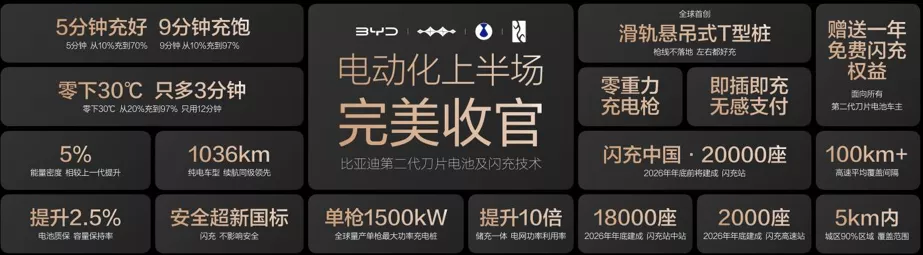
Core Insights - BYD has officially launched its second-generation blade battery and flash charging technology, achieving a charging speed that allows users to charge from 10% to 70% in just 5 minutes and from 10% to 97% in 9 minutes, even in low temperatures [1][3] - The company has introduced the "Flash Charge China" strategy, aiming to build 20,000 flash charging stations across the country by the end of the year, marking a significant advancement in the electric vehicle charging experience [1][5] Battery Technology - The second-generation blade battery features a 5% increase in energy density compared to the first generation, while also enabling fast charging capabilities [3] - The battery incorporates a "lithium-ion high-speed channel" and an "all-temperature intelligent thermal management system," resulting in lower heat generation and more efficient heat dissipation [3] - The battery's capacity retention rate has improved by 2.5%, and it continues to offer a lifetime warranty on the cells [3] Charging Infrastructure - BYD has developed a new flash charging pile with a single-gun charging power of 1500kW, designed to be user-friendly and environmentally friendly [5] - The innovative "sliding rail suspension T-type pile" design allows for a lightweight and clean charging experience, eliminating tangled cables [5] - The company plans to collaborate with national charging network operators to accelerate the construction of flash charging stations, ensuring coverage within 3 to 6 kilometers in urban areas [6] Strategic Expansion - BYD's flash charging stations will also be established at nearly one-third of highway service areas, with plans to build 2,000 stations by the end of the year [6] - The company has committed to building 1,000 "flash charging highway stations" before the May Day holiday, addressing long-distance travel charging concerns [6] - Future plans include expanding flash charging stations internationally by the end of 2026, contributing to global electric vehicle development [8]
小摩:预计比亚迪次季销量按季反弹 评级“增持”
Zhi Tong Cai Jing· 2026-03-06 09:07
Core Viewpoint - Morgan Stanley maintains a target price of HKD 110 for BYD (002594)(01211) with a rating of "Overweight" [1] Group 1: Product Developments - BYD has launched its second-generation blade battery and announced an expansion of its fast-charging network [1] - The company has introduced a total of 10 new pure electric and plug-in hybrid models across its brands, with deliveries expected to start in April or May [1] Group 2: Sales Forecast - BYD's sales are projected to rebound from approximately 700,000 units in the first quarter to between 1.1 million and 1.2 million units in the second quarter [1] Group 3: Market Focus - Investor attention is expected to shift towards the increase in store foot traffic around the Beijing Auto Show on April 24 [1]
泰国篇:企业出海合规要点与案例指南
GUOTAI HAITONG SECURITIES· 2026-03-06 09:05
Economic Overview - Thailand's GDP growth has been volatile, with an average growth rate of 2.5% projected for 2024, lower than the global average of 2.9% and emerging markets at 4.3%[8] - The contribution of tourism to Thailand's GDP is significant, averaging around 17.7% from 2015 to 2019, and rebounding to 18% in 2024 after pandemic impacts[29] Manufacturing and Exports - Manufacturing, particularly in automotive and electronics, is a key driver of Thailand's economy, with manufacturing contributing over 25% to GDP[17] - Thailand is the largest automotive producer in Southeast Asia, with automotive exports accounting for nearly 2% of global exports[23] Foreign Investment Landscape - China is a major source of foreign direct investment (FDI) in Thailand, with Chinese investments reaching approximately $3.16 billion in 2024, representing 22.1% of total FDI[34] - From 2018 to 2024, Chinese investment applications in Thailand totaled 1,941 projects, amounting to 779.6 billion Thai Baht[34] Compliance and Regulatory Environment - Foreign investment in Thailand is subject to strict regulations, including restrictions on land ownership and specific industries requiring government approval[43] - The Thai government mandates that foreign companies must have local partners holding at least 40% of shares in certain restricted sectors[45] Labor and Employment - Thailand has a minimum wage policy and a high number of public holidays, with 13 public holidays and 6 paid leave days annually[43] - There are restrictions on foreign labor, including quotas and limitations on certain job types for expatriates[43]





小摩:预计比亚迪(01211)次季销量按季反弹 评级“增持”
智通财经网· 2026-03-06 09:01
Core Viewpoint - Morgan Stanley maintains a target price of HKD 110 for BYD (01211) with an "Overweight" rating, highlighting the company's recent product launches and expected sales growth [1] Group 1: Product Developments - BYD has launched its second-generation blade battery and announced an expansion of its fast-charging network [1] - The company has introduced a total of 10 new pure electric and plug-in hybrid models across its brands, with deliveries expected to start in April or May [1] Group 2: Sales Forecast - BYD's sales are projected to rebound from approximately 700,000 units in Q1 to between 1.1 million and 1.2 million units in Q2 [1] - Investor focus is anticipated to shift towards the increase in store traffic around the Beijing Auto Show on April 24 [1]
美银证券:比亚迪股份(01211)推第二代刀片电池 重申“买入”评级
智通财经网· 2026-03-06 09:01
智通财经APP获悉,美银证券发布研报称,比亚迪股份(01211)昨日(5日)举办2026年科技日,正式推出 第二代刀片电池及闪充技术。第二代刀片电池在常温下的充电时间缩短至5分钟及9分钟,而第一代刀片 电池则约需30分钟。在极寒天气下,充电时间少于12分钟。新一代电池在零下20度的容量保持率高于 85%。第二代刀片电池的能量密度较第一代刀片电池提升5%,因此可支持超过1,000公里的续航里程。 该行重申比亚迪"买入"评级及目标价122港元,因比亚迪海外业务贡献增加应有助其毛利率。 ...
美银证券:比亚迪股份推第二代刀片电池 重申“买入”评级
Zhi Tong Cai Jing· 2026-03-06 09:00
Group 1 - The core viewpoint of the article is that BYD has launched its second-generation blade battery and fast-charging technology, significantly improving charging times and energy density [1] Group 2 - The second-generation blade battery can be charged in 5 to 9 minutes at room temperature, compared to approximately 30 minutes for the first generation [1] - In extremely cold weather, the charging time is less than 12 minutes, with a capacity retention rate above 85% at -20 degrees Celsius [1] - The energy density of the second-generation blade battery is 5% higher than that of the first generation, enabling a range of over 1,000 kilometers [1] Group 3 - Bank of America Securities has reiterated a "buy" rating for BYD with a target price of HKD 122, citing increased contributions from overseas business that should help improve gross margins [1]
【联合发布】一周新车快讯(2026年2月28日-3月6日)
乘联分会· 2026-03-06 08:49
Core Viewpoint - The article provides an overview of new vehicle models set to be launched in 2026, detailing specifications, market segments, and pricing strategies for various manufacturers in the automotive industry. Group 1: New Vehicle Launches - Dongfeng Liuzhou's Fengxing Xinghai T5 is an A SUV set to launch on February 28, 2026, with a price range of 153,900 to 161,900 CNY and a pure electric range of 530 km [9]. - Xpeng Motors' X9, a C MPV, will be available from March 2, 2026, with prices ranging from 309,800 to 369,800 CNY and a maximum range of 750 km [17]. - GAC Aion's Aion i60, another A SUV, is scheduled for release on March 2, 2026, priced at 102,800 CNY, featuring a 1.5L range extender engine [25]. - SAIC Volkswagen's Volkswagen Teramont Pro, a C SUV, will launch on March 3, 2026, with a price of 344,900 CNY [33]. - Changan Automobile's Qiyuan A06, a C NB, will also be released on March 3, 2026, priced at 139,900 CNY [41]. Group 2: Specifications and Features - The Fengxing Xinghai T5 features a pure electric powertrain with a power output of 120 kW and torque of 240 N·m, with a battery capacity of 64.4 kWh [9]. - The Xpeng X9 offers multiple configurations with power outputs ranging from 235 kW to 370 kW, and a battery capacity of 94.8 kWh [17]. - The Aion i60 has a power output of 74 kW from its engine and 180 kW from its electric motor, with a battery capacity of 29.165 kWh [25]. - The Teramont Pro is equipped with a 2.0T engine producing 200 kW and 400 N·m of torque [33]. - The Qiyuan A06 features a 1.5L range extender engine with a power output of 72 kW and an electric motor output of 120 kW [41]. Group 3: Market Segmentation and Pricing - The article categorizes the new models into various segments, including A SUVs, C MPVs, and B SUVs, indicating a diverse market strategy [9][17][25][33][41]. - Pricing strategies vary significantly, with models like the Aion i60 positioned as more affordable options at 102,800 CNY, while luxury models like the BMW X5 are priced at 688,000 CNY [25][62]. - The introduction of multiple configurations for models like the Xpeng X9 allows for a broader appeal across different consumer segments [17].