JINZAI FOOD GROUP CO.(003000)

Search documents
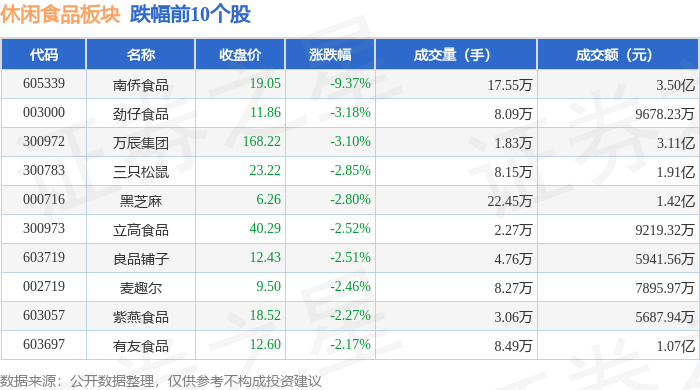
休闲食品板块11月20日跌2.33%,南侨食品领跌,主力资金净流出1.78亿元
Zheng Xing Xing Ye Ri Bao· 2025-11-20 09:09
Market Overview - The leisure food sector experienced a decline of 2.33% on November 20, with Nanjiao Food leading the drop [1] - The Shanghai Composite Index closed at 3931.05, down 0.4%, while the Shenzhen Component Index closed at 12980.82, down 0.76% [1] Individual Stock Performance - Nanjiao Food (605339) closed at 19.05, down 9.37% with a trading volume of 175,500 shares [1] - Jin Zai Food (003000) closed at 11.86, down 3.18% with a trading volume of 80,900 shares [1] - Wanchen Group (300972) closed at 168.22, down 3.10% with a trading volume of 18,300 shares [1] - Three Squirrels (300783) closed at 23.22, down 2.85% with a trading volume of 81,500 shares [1] - Black Sesame (000716) closed at 6.26, down 2.80% with a trading volume of 224,500 shares [1] - Other notable declines include Lihai Food (300973) down 2.52% and Liangpinpuzi (603719) down 2.51% [1] Capital Flow Analysis - The leisure food sector saw a net outflow of 178 million yuan from main funds, while retail investors contributed a net inflow of 118 million yuan [1] - Speculative funds recorded a net inflow of 60.43 million yuan [1] Detailed Capital Flow for Selected Stocks - Lihai Food (300973) had a main fund net inflow of 5.90 million yuan, but a retail net outflow of 13.17 million yuan [2] - Ziyan Food (603057) experienced a main fund net inflow of 42,400 yuan, with a retail net outflow of 1.79 million yuan [2] - Maquur (002719) had a negligible main fund net inflow of 4,364 yuan, with a retail net outflow of 127,690 yuan [2] - Other stocks like Guangzhou Restaurant (603043) and Huangshanghuang (002695) also reported net outflows from main funds [2]





休闲食品板块11月18日跌1.9%,万辰集团领跌,主力资金净流出2.22亿元
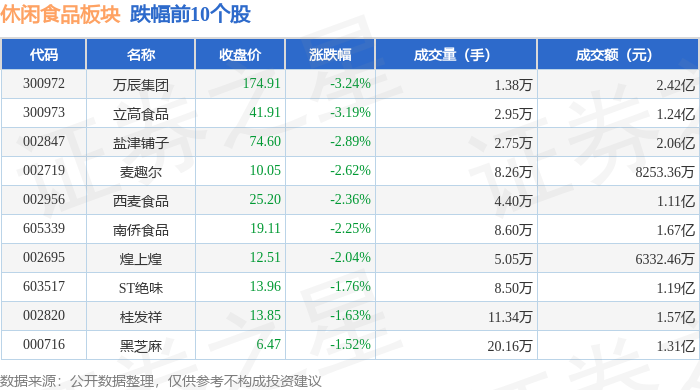
Zheng Xing Xing Ye Ri Bao· 2025-11-18 08:04
Market Overview - The leisure food sector experienced a decline of 1.9% on November 18, with Wancheng Group leading the drop [1] - The Shanghai Composite Index closed at 3939.81, down 0.81%, while the Shenzhen Component Index closed at 13080.49, down 0.92% [1] Individual Stock Performance - Wancheng Group (300972) closed at 174.91, down 3.24% with a trading volume of 13,800 [1] - Lihai Food (300973) closed at 41.91, down 3.19% with a trading volume of 29,500 [1] - Yanjinpuzi (002847) closed at 74.60, down 2.89% with a trading volume of 27,500 [1] - Maiqu'er (002719) closed at 10.05, down 2.62% with a trading volume of 82,600 [1] - Ximai Food (002956) closed at 25.20, down 2.36% with a trading volume of 44,000 [1] - Nanjiao Food (605339) closed at 19.11, down 2.25% with a trading volume of 86,000 [1] - Huangshanghuang (002695) closed at 12.51, down 2.04% with a trading volume of 50,500 [1] - ST Juewei (603517) closed at 13.96, down 1.76% with a trading volume of 85,000 [1] - Guifaxiang (002820) closed at 13.85, down 1.63% with a trading volume of 113,400 [1] - Hezhima (000716) closed at 6.47, down 1.52% with a trading volume of 201,600 [1] Capital Flow Analysis - The leisure food sector saw a net outflow of 222 million yuan from main funds, while retail investors had a net inflow of 254 million yuan [1] - The table of capital flow indicates varying levels of net inflow and outflow among individual stocks, with notable movements in stocks like Huangshanghuang and Guifaxiang [2]




食品饮料行业周报:CPI催化预期,底部价值凸显-20251117



Haitong Securities International· 2025-11-17 07:10
Investment Rating - Investment advice indicates a sector recovery catalyzed by recent CPI data, focusing on growth and supply-demand inflection points [5][16]. Core Views - The report emphasizes the importance of consumer goods growth, particularly in beverages, snacks, and food ingredients, while also highlighting structural opportunities in the baijiu sector [5][16]. - CPI data shows a positive trend with October CPI year-on-year at +0.2% and core CPI at +1.2%, indicating a recovery in domestic demand [6][16]. - The baijiu industry is undergoing accelerated clearing, with expectations for improved sales and inventory adjustments leading into 2026 [7][16]. - Consumer goods are expected to benefit from stabilization and recovery, with a focus on low valuation and high dividend stocks [8][16]. Summary by Sections Investment Recommendations - Recommended baijiu stocks include Shanxi Xinghuacun Fen Wine Factory, Gujing Distillery, and stable targets like Kweichow Moutai and Wuliangye [5][16]. - Beverage growth is highlighted with recommendations for Eastroc Beverage and Nongfu Spring, alongside low valuation stocks like China Foods and Tingyi [5][16]. - Snack and food ingredient stocks recommended include Bailong Chuangyuan, Yankershop Food, and Three Squirrels [5][16]. - Beer recommendations include Yanjing Brewery and Tsingtao Brewery, while condiment stocks like Haitian Flavoring & Food are also suggested [5][16]. Baijiu Sector Insights - The baijiu sector is experiencing a significant adjustment, with industry destocking still in progress and a focus on promotional sales for 2026 [7][16]. - Recent sales data from JD.com shows a +18% year-on-year increase in liquor sales during the Double 11 shopping festival, indicating a positive market response [7][16]. Consumer Goods Outlook - Consumer goods are expected to see growth as the mainline, with structural differentiation evident in beverages, snacks, and health products [8][16]. - The report notes that companies with product innovation and channel expansion will have growth advantages, particularly in the context of recent service and non-food price recoveries [8][16].
食品饮料行业点评:近期更新反馈:固本强基,趋时驭势
GOLDEN SUN SECURITIES· 2025-11-16 09:39
Investment Rating - The report maintains an "Accumulate" rating for the food and beverage industry, indicating a positive outlook for investment opportunities in this sector [5]. Core Insights - The food and beverage industry is experiencing a transformation driven by health-conscious consumer trends, product innovation, and channel expansion, with companies actively enhancing their product offerings and exploring overseas markets [1][9]. - In the liquor segment, the supply side is undergoing continuous changes to seek growth, while the demand side is gradually recovering, highlighting the absolute investment value in the industry [2][3]. - The beverage sector is focusing on product innovation and network expansion to uncover growth potential, with a strong emphasis on health upgrades and premiumization [4][7]. Summary by Relevant Sections Liquor Industry - **Water Well**: The company is optimizing its product matrix and plans to launch a new high-end product in 2025, focusing on brand collaboration and expanding its terminal network [2]. - **Jiu Gui Jiu**: The brand is implementing a strategic focus on brand depth and product line simplification, with expectations for improved sales performance [3]. - **She De Jiu Ye**: The company is maintaining its core strategy while expanding its product offerings, particularly in e-commerce, to drive growth [3]. Beverage Industry - **Kang Shi Fu**: The company is committed to innovation and quality, focusing on expanding its product range to meet diverse consumer needs [4]. - **Unified Enterprises**: The company is experiencing stable performance with a focus on product innovation and market expansion, particularly in the instant noodle and beverage segments [7]. - **Hua Run Beverage**: Short-term performance is under pressure due to competition, but long-term growth prospects remain strong due to the essential nature of its products [7]. Health and Wellness Trends - **Anqi Yeast**: The company is targeting over 10% revenue growth, with a focus on expanding its overseas market presence and maintaining cost advantages [9]. - **Xian Le Health**: The company is advancing its global strategy and product innovation to capture new consumer trends, with a focus on high-margin products [9]. - **Jian Yi Health**: The company is enhancing its probiotic offerings and expanding its product lines to meet evolving consumer demands [10]. Overall Market Trends - The food and beverage industry is witnessing a shift towards healthier products and innovative marketing strategies, with companies adapting to changing consumer preferences and exploring new growth avenues [1][4].


食品饮料步入消费旺季 产业链上市公司乘风布局
Zheng Quan Ri Bao Wang· 2025-11-13 12:28
Group 1 - The food and beverage industry is entering its most important sales window, with capital expenditure growth of 15.15% year-on-year in November 2025, indicating proactive market positioning by listed companies [1] - The industry is experiencing a structural recovery, with significant online sales growth in the liquor sector during the National Day and Mid-Autumn Festival, including over 100% year-on-year growth on JD's platform and a 58% increase on Douyin [1] - Institutional research activity has surged, with 202 total investigations in the food and beverage sector over the past three months, particularly in the snack and seasoning segments [1] Group 2 - Individual companies such as Chongqing Fuling Zhacai, Angel Yeast, and Xiangpiaopiao have been the focus of institutional attention, each receiving multiple investigations in the last three months [2] - Li Gao Food's third-quarter earnings call attracted 88 institutions, showcasing a nearly 40% year-on-year growth in new channel revenue, indicating strong growth momentum [2] Group 3 - Companies are innovating in products, channels, branding, and supply chain capabilities to capitalize on the consumption peak, with examples including Jiu Gui Jiu's successful product launch and Jin Zai Food's channel innovation strategy [3] - Yanjinpuzi is leveraging local sports events to enhance brand visibility and sales, while ensuring stable production orders in preparation for the upcoming peak season [3] Group 4 - Absolute Food is optimizing its supply chain and market dispatch mechanisms to address regional demand fluctuations and market changes, ensuring stable product supply [4] - Research indicates that product innovation and new channel development are key growth strategies for consumer goods companies, with expectations of a fundamental turning point and policy catalysts for traditional consumer categories [4]


休闲食品板块11月12日跌0.01%,桂发祥领跌,主力资金净流出1.71亿元
Zheng Xing Xing Ye Ri Bao· 2025-11-12 08:42
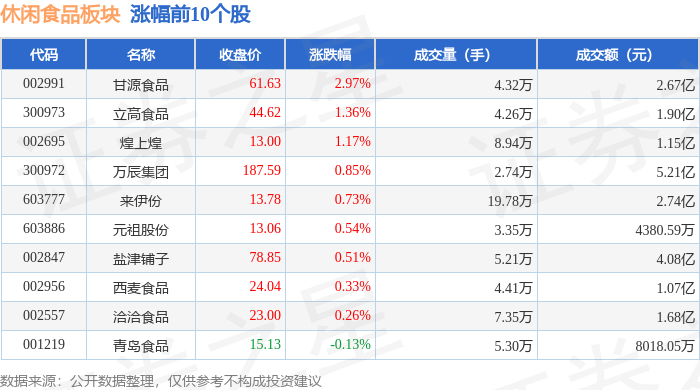
Market Overview - The leisure food sector experienced a slight decline of 0.01% on November 12, with Gui Faxiang leading the drop [1] - The Shanghai Composite Index closed at 4000.14, down 0.07%, while the Shenzhen Component Index closed at 13240.62, down 0.36% [1] Stock Performance - Notable gainers in the leisure food sector included: - Ganyuan Food: closed at 61.63, up 2.97% with a trading volume of 43,200 lots and a transaction value of 267 million [1] - Lihai Food: closed at 44.62, up 1.36% with a trading volume of 42,600 lots and a transaction value of 206.1 million [1] - Major decliners included: - Gui Faxiang: closed at 14.30, down 2.26% with a trading volume of 273,100 lots and a transaction value of 394 million [2] - Ziyan Food: closed at 19.27, down 2.18% with a trading volume of 29,900 lots and a transaction value of 58.19 million [2] Capital Flow - The leisure food sector saw a net outflow of 171 million from institutional investors, while retail investors contributed a net inflow of 249 million [2] - Specific stock capital flows included: - Ganyuan Food: net inflow of 17.70 million from institutional investors, with a net outflow of 12.58 million from speculative funds [3] - Lihai Food: net inflow of 10.29 million from institutional investors, with a net outflow of 7.30 million from speculative funds [3]



劲仔食品:公司第三季度营业收入增长主要是渠道拓展所致
Zheng Quan Ri Bao Zhi Sheng· 2025-11-11 10:13
Core Insights - The company reported that the increase in third-quarter revenue was primarily due to channel expansion, with accounts receivable rising due to increased sales from direct customers [1] - The growth in sales expenses was attributed to higher brand and personnel costs [1] - The overall increase in business tax was slightly due to revenue growth and changes in tax policies applicable to certain subsidiaries [1] - The company's profit margins have fluctuated this year due to adjustments in channels and product structure, as well as increased market expenses, but it aims to continue high-quality development to enhance market scale and profitability [1]
劲仔食品上新周鲜鲜低GI豆干
Bei Jing Shang Bao· 2025-11-09 12:16
Core Insights - The company, Jinzhai Foods, has recently launched a new product called "Zhou Fresh Low GI Tofu" which features 6 times the milk protein and is free from trans fats [1] - The product has a glycemic index (GI) of less than 40 and contains approximately 32 kcal per bag, making it a low-calorie option [1] - The packaging is designed for convenience, utilizing independent nitrogen-filled packaging [1]
休闲食品板块11月7日涨0.1%,好想你领涨,主力资金净流出2563.74万元
Zheng Xing Xing Ye Ri Bao· 2025-11-07 08:41
Market Overview - The leisure food sector increased by 0.1% on November 7, with "Hao Xiang Ni" leading the gains [1] - The Shanghai Composite Index closed at 3997.56, down 0.25%, while the Shenzhen Component Index closed at 13404.06, down 0.36% [1] Top Performers - "Hao Xiang Ni" (002582) closed at 10.17, up 2.01% with a trading volume of 136,900 shares and a turnover of 139 million yuan [1] - "Gui Fa Xiang" (002820) closed at 13.65, up 1.41% with a trading volume of 226,700 shares and a turnover of 310 million yuan [1] - "Mai Qu Er" (002719) closed at 696, up 1.04% with a trading volume of 58,400 shares and a turnover of approximately 56.37 million yuan [1] Underperformers - "Li Gao Food" (300973) closed at 40.34, down 1.22% with a trading volume of 16,100 shares and a turnover of approximately 65.46 million yuan [2] - "Xi Mai Food" (002956) closed at 22.24, down 1.20% with a trading volume of 22,600 shares and a turnover of approximately 50.49 million yuan [2] - "ST Jue Wei" (603517) closed at 13.52, down 0.88% with a trading volume of 67,400 shares and a turnover of approximately 91.68 million yuan [2] Capital Flow - The leisure food sector experienced a net outflow of 25.64 million yuan from institutional investors, while retail investors saw a net inflow of 21.83 million yuan [2] - The overall capital flow indicates a mixed sentiment within the sector, with institutional investors pulling back while retail investors are more active [2] Individual Stock Capital Flow - "Hao Xiang Ni" saw a net inflow of 15.22 million yuan from institutional investors, but a net outflow of 10.14 million yuan from retail investors [3] - "Yan Jin Pu Zi" (002847) had a net inflow of 8.44 million yuan from institutional investors, with retail investors also showing a net outflow [3] - "Mai Qu Er" experienced a slight net outflow from institutional investors, while retail investors contributed positively with a net inflow of 2.12 million yuan [3]


食品饮料行业2026年策略:从胜率和赔率角度看食品饮料行业投资机会
Dongxing Securities· 2025-11-07 08:26
Core Insights - The report emphasizes the investment opportunities in the food and beverage industry from the perspectives of win rate and odds, suggesting a transition from low win rates to high win rates driven by macroeconomic changes [4][13][22]. Investment Summary - The theoretical expected return formula is defined as expected investment = win rate × odds - (1 - win rate), where odds reflect valuation and potential upside versus downside risk, while win rate indicates the probability of successful investment based on fundamental momentum [4][13]. - The food and beverage sector is currently in a phase of high odds and low win rates, with the potential for improvement in win rates depending on macroeconomic conditions and overall demand changes [4][13][14]. - The report predicts that the food and beverage sector could achieve dual growth in fundamentals and valuations in 2026, contingent on macroeconomic recovery [4][14]. Investment Strategy - High win rate opportunities are primarily found in the mass consumer goods sector, particularly companies benefiting from new channels and product categories, such as leading snack food companies [5][14]. - The liquor sector is in a bottoming phase, with win rates expected to improve as fundamentals recover, representing an "odds-first" investment choice [5][14]. Valuation Perspective - The food and beverage sector's overall valuation is currently low, with the Shenwan Food and Beverage Index's price-to-earnings (PE) ratio at 21.29, which is in the 11.85th percentile historically, indicating limited downside potential and significant upside potential if fundamentals improve [15][16]. - The calculated odds for the food and beverage industry stand at 4.57, indicating a favorable risk-reward ratio [16]. Win Rate Analysis - The win rate is assessed through various dimensions, including profitability momentum, funding conditions, and macroeconomic policy environments, with a focus on how these factors influence the food and beverage sector [22][23]. - The report highlights a strong correlation between macroeconomic indicators and the revenue and net profit of the food and beverage sector, suggesting that macroeconomic changes will significantly impact industry performance [24][26]. Macroeconomic and Policy Impact - Recent macroeconomic policies aimed at boosting consumption and expanding domestic demand are expected to create a favorable environment for the recovery of the food and beverage sector [27][29]. - The report notes that as macroeconomic totals increase, food and beverage consumption is likely to follow suit, enhancing the certainty of growth in the sector [27][29]. Interest Rate Influence - The report discusses the negative correlation between interest rates and asset pricing in the food and beverage sector, indicating that a decrease in U.S. interest rates could positively impact domestic valuations [30][31]. Growth Momentum - The report identifies three underlying forces affecting the profitability momentum in the food and beverage sector: demand-side changes, cost-side pressures, and corporate governance [35]. - It emphasizes that the recovery of the macroeconomic environment will lead to improved demand, thereby enhancing the overall win rate for the food and beverage sector [35]. Conclusion on Investment Opportunities - The food and beverage sector is positioned for a transition from low to high win rates, with significant investment potential as macroeconomic conditions improve [36][40]. - Recommended companies include leading snack food firms such as Salted Fish and Sweet Potato, as well as liquor giants like Kweichow Moutai and Wuliangye [40].