CATL(300750)

Search documents
一图看懂公募2025持仓变迁
天天基金网· 2026-01-23 08:52
Core Viewpoint - The public fund holdings in 2025 show a significant shift towards technology growth sectors, moving away from traditional consumer and financial sectors [9][10]. Group 1: Changes in Top Holdings - Ningde Times consistently ranked as the top holding throughout 2025, with a market value of 146.8 billion in Q1, 142.7 billion in Q2, 207.1 billion in Q3, and 181.9 billion in Q4 [3]. - Guizhou Moutai, a traditional consumer staple, saw a decline in its ranking and market value, dropping from second place at the beginning of the year to fifth by Q4 [10]. - Tencent Holdings maintained a relatively stable position, fluctuating between second and fourth place [10]. - Notable rises in rankings were observed for Zhongji Xuchuang and Xinyi Sheng, both of which entered the top ten in Q3 and continued to rise in Q4, indicating a strong interest in AI-related stocks [10]. Group 2: Changes in Industry Holdings - The electronics sector remained the top industry for public fund holdings across all four quarters of 2025, with investment values increasing from 518.9 billion in Q1 to 774.5 billion in Q4 [6]. - The food and beverage sector declined from second place in Q1 to seventh place by Q4, reflecting a shift in investor preference [12]. - The medical and biological sector, which ranked high in the first three quarters, was overtaken by the electric equipment and communication sectors in Q4 [12]. - The electric equipment sector improved its ranking from fourth to second place by Q4, while the communication sector rose from outside the top ten to third place [12]. - Non-bank financial and banking sectors experienced an overall decline in rankings, while the non-ferrous metals sector entered the top six in Q4 [13].






一图看懂公募2025持仓变迁
天天基金网· 2026-01-23 08:48
Core Viewpoint - The public fund holdings in 2025 show a significant shift towards technology growth sectors, moving away from traditional consumer and financial sectors, with Ningde Times consistently ranking as the top heavy stock throughout the year [9][10]. Group 1: Changes in Top Holdings - Ningde Times maintained its position as the top heavy stock across all quarters, with a market value of 146.8 billion in Q1, 142.7 billion in Q2, 207.1 billion in Q3, and 181.9 billion in Q4 [3]. - Guizhou Moutai, a traditional consumer staple, saw a decline in its ranking and market value, dropping from second place at the beginning of the year to fifth by Q4 [10]. - Tencent Holdings remained relatively stable, fluctuating between second and fourth positions throughout the year [10]. - Notable rises in rankings were observed for technology stocks such as Zhongji Xuchuang and Xinyi Sheng, which entered the top ten in Q3 and Q4, indicating a strong demand driven by AI computing needs [10]. Group 2: Changes in Industry Holdings - The electronics sector consistently ranked as the top industry for public fund holdings across all four quarters, with investment values increasing from 518.9 billion in Q1 to 774.5 billion in Q4 [6]. - The food and beverage sector declined from second place in Q1 to seventh place by Q4, reflecting a shift in investor preference [12]. - The medical and biological sector maintained a strong presence in the first three quarters but was surpassed by the electric equipment and communication sectors in Q4 [12]. - The electric equipment sector rose from fourth place at the beginning of the year to second place by Q4, while the communication sector made a notable leap from outside the top ten to third place [12]. - Non-bank financial and banking sectors experienced an overall decline in rankings, while the non-ferrous metals sector entered the top six in Q4 [13].

宁德时代发布轻商行业首款量产钠电池
鑫椤锂电· 2026-01-23 08:11
Core Viewpoint - The article discusses the advancements and market outlook for sodium-ion batteries, highlighting the launch of the Tianxing II light commercial series battery by CATL, which includes the industry's first mass-produced sodium-ion battery with low-temperature capabilities [1][2]. Group 1: Sodium-Ion Battery Market Overview - The Tianxing II light commercial series battery features a low-temperature version with an energy density of 175Wh/kg and a cycle life exceeding 10,000 times, making it suitable for small vans and micro trucks [1]. - The sodium-ion battery demonstrates excellent low-temperature performance, retaining 90% usable capacity at -40°C and allowing for immediate charging at -30°C, addressing winter usage challenges for commercial vehicles in northern regions [2]. - Sodium is significantly more abundant in the earth's crust than lithium, with a ratio of over 1000:1, and its extraction cost is only 1/20th that of lithium, which is expected to lower battery costs and enhance the economic viability of light commercial vehicles in the long term [2]. Group 2: Product Variants - In addition to the low-temperature version, the Tianxing II series includes variants such as supercharging, long-range, and high-temperature supercharging models [4].
重磅消息!宁德时代发布行业首款实现量产钠离子电池,-40℃极寒仍可保持90%电量【附钠离子电池行业市场分析】
Qian Zhan Wang· 2026-01-23 07:26
Core Viewpoint - CATL has launched the first mass-produced sodium-ion battery for light commercial vehicles, showcasing significant advancements in low-temperature performance and cycle life, addressing key industry challenges in cold climates [2][5]. Group 1: Product Launch and Features - CATL introduced the 45kWh sodium-ion battery pack with an energy density of 175Wh/kg and a cycle life exceeding 10,000 times, achieving certification under the new national standard GB 38031-2025 [2]. - The battery maintains 90% usable capacity at -40°C and can be charged immediately at -30°C, solving winter range and charging issues for commercial vehicles in northern regions [2]. - Mass production is set to begin in July 2026, with plans to introduce both charging and battery swapping modes [2]. Group 2: Market Potential and Competitive Landscape - Sodium-ion batteries are seen as a potential alternative to lithium-ion batteries due to their lower cost and resource advantages, with sodium being significantly more abundant and cheaper to extract [5]. - The technology has attracted substantial investment and research resources, with major companies like Guoxuan High-Tech, BYD, AVIC Lithium Battery, and Times New Energy actively developing sodium-ion battery solutions [5][6]. - Despite the advantages, the commercial development of sodium-ion batteries is still in its early stages, with actual shipments in China reaching only 0.7GWh in 2023, indicating a need for further exploration of commercialization pathways [6]. Group 3: Future Outlook - The sodium-ion battery industry is transitioning from sample validation to commercial application, with expectations that by 2026, sodium batteries will enter a phase of large-scale application, significantly reducing lifecycle costs for users [9]. - As production scales up and energy density improves, costs are projected to decrease by half within the next two to three years, paving the way for sustainable commercialization [9].

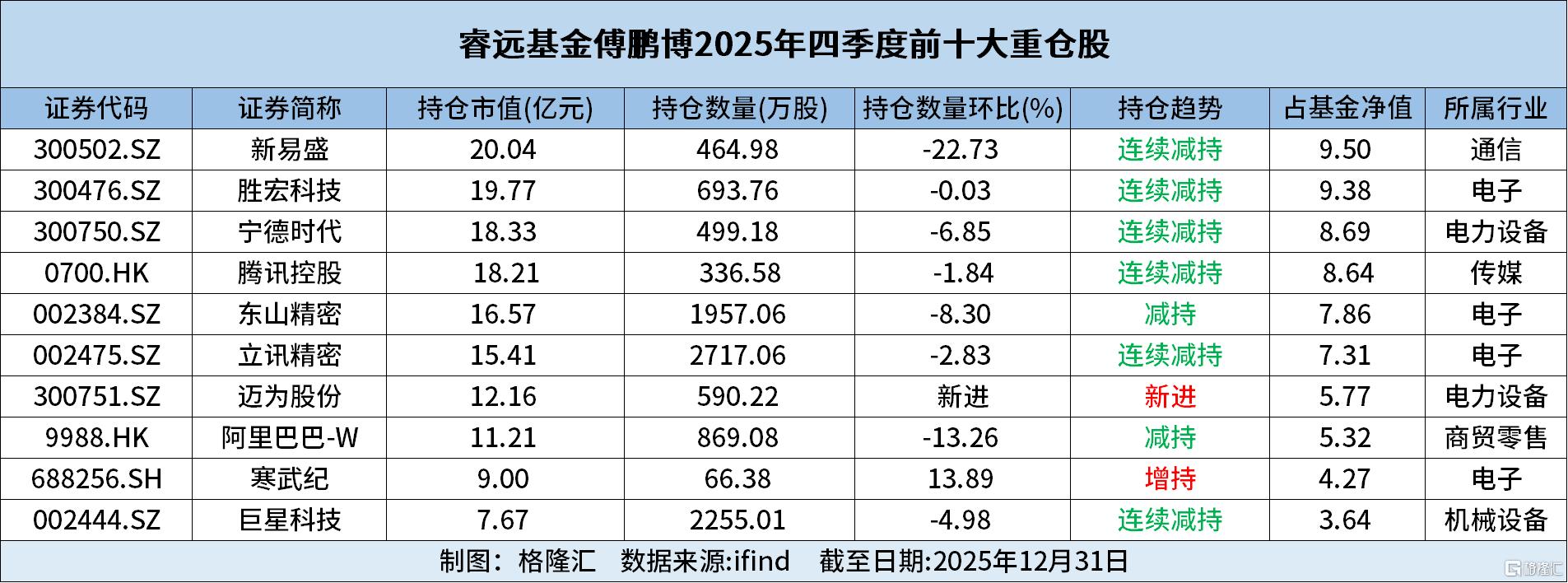
睿远基金傅鹏博最新重仓股新进迈为股份,增持寒武纪
Ge Long Hui A P P· 2026-01-23 06:28
Core Insights - The fourth quarter of 2025 saw significant adjustments in the portfolio of renowned fund manager Fu Pengbo, with notable changes in top holdings and investment strategies [1][4]. Group 1: Portfolio Adjustments - In the fourth quarter of 2025, Maiwei Co. replaced China Mobile in Fu Pengbo's top ten holdings, indicating a shift in focus towards high-performing sectors [1]. - Fu Pengbo increased holdings in Cambricon Technologies while reducing positions in several companies including Xinyi Semiconductor, Shenghong Technology, CATL, Tencent Holdings, Dongshan Precision, Luxshare Precision, Alibaba-W, and Juxing Technology [1][3]. Group 2: Market Conditions and Economic Outlook - The central economic work conference and political bureau meeting emphasized maintaining low social financing costs and leaving room for fiscal policy to address future risks, reflecting a cautious yet optimistic outlook for domestic demand policies [1][4]. - The macroeconomic data for the fourth quarter indicated a mixed performance in consumption and investment, with automotive consumption boosted by trade-in subsidies, while real estate remained weak [4]. Group 3: Investment Strategy and Future Outlook - The concentration of the top ten holdings in the fund increased to 70.38%, up from 66.04% in the previous quarter, indicating a strategic focus on fewer, high-potential stocks [5]. - Preparations for the 2026 portfolio include reducing exposure to companies with weak fundamentals and increasing investments in data center cooling, storage, and computing power-related firms, based on industry trends and individual stock research [5]. - The market is expected to see heightened activity in early 2026, with a focus on sectors like AI, non-ferrous metals, and lithium battery materials anticipated to show significant growth [6].


富国基金朱少醒旗下基金四季报出炉!宁德时代(300750.SZ)获进一步加仓
智通财经网· 2026-01-23 06:26
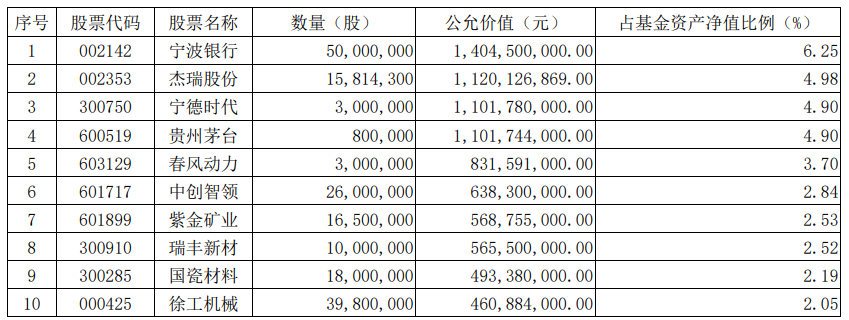
Group 1 - The core viewpoint of the article highlights the performance and adjustments of the fund managed by Zhu Shaoxing, with a net asset value of 22.484 billion yuan as of Q4 2025 [1] - The fund's performance during the reporting period shows a return of 1.12% for both the A/B and D classes, while the C class returned 0.91%, compared to a benchmark return of -0.09% across all classes [1][2] - The top ten holdings of the fund include notable companies such as Ningbo Bank, Jerry Holdings, CATL, and Kweichow Moutai, indicating a diversified investment strategy [1][2] Group 2 - Zhu Shaoxing's recent adjustments in the portfolio include a reversal on Zijin Mining, which was sold off in the first half of 2025 and repurchased in the second half, now ranking as the seventh largest holding [2] - The fund has reduced its exposure to the new energy vehicle sector, with companies like Luxshare Precision exiting the top ten holdings, while increasing its stake in CATL [2] - The analysis indicates that the current monetary policy remains accommodative, and the fiscal policy is actively supporting the market, leading to improved investor risk appetite [3] Group 3 - The A-share market is noted to have seen a significant increase in overall valuations, yet it remains within a reasonable range in a long-term cycle, suggesting continued attractiveness of equity assets [3] - The focus on selecting stocks with strong corporate governance and management is emphasized as a strategy for future value creation, aligning with the fund's growth-oriented investment approach [3]



谢治宇旗下兴全合润混合四季报:加仓宁德时代(300750.SZ) 重点配置海外算力、半导体设备
智通财经网· 2026-01-23 06:26
Group 1 - The core viewpoint of the report highlights the strategic adjustments made by the fund manager, including increased positions in semiconductor-related stocks and a focus on domestic storage manufacturers set to go public in 2026 [1][3] - The fund has increased its holdings in companies such as Ningde Times, Baiwei Storage, and Tuojing Technology, while reducing positions in stocks like Zhongji Xuchuang and Juhua Co., Ltd. [1] - The report indicates a significant focus on overseas computing power and semiconductor equipment sectors, with an emphasis on domestic semiconductor equipment and consumables as key investment areas [1][3] Group 2 - Financial performance shows that the fund achieved a profit of approximately 1.858 billion yuan for the A share class, while the C share class reported a profit of about 7.4413 million yuan [2] - The net asset value for the A share class at the end of the reporting period was approximately 21.688 billion yuan, with a net asset value per share of 2.0802 yuan, reflecting a growth rate of -3.81% [2] - The report notes that the market experienced increased volatility in the fourth quarter, with ongoing investment opportunities driven by AI and related technologies [2][3] Group 3 - The report emphasizes the high demand in the domestic storage and energy sectors due to overseas challenges such as power shortages and storage issues, presenting numerous investment opportunities [3] - The domestic semiconductor industry is expected to see significant growth, particularly with the upcoming public listings of local storage manufacturers in 2026 [3] - The fund maintains a high position and plans to continue tracking core competitive trends in companies, aiming to identify investment opportunities arising from technological transformations and sectoral recoveries [3]

富国基金朱少醒旗下基金四季报出炉!宁德时代获进一步加仓
Zhi Tong Cai Jing· 2026-01-23 06:23
Core Viewpoint - The report highlights the performance and asset allocation of the fund managed by Zhu Shaoxing, indicating a strategic shift in investment focus and a positive outlook on certain sectors amid a changing economic environment [1][3]. Fund Performance - As of the end of Q4 2025, the net asset value of the fund managed by Zhu Shaoxing is 22.484 billion yuan [1]. - The performance of various fund classes during the reporting period shows: - Fund Class A/B: 1.12% return, benchmark return: -0.09% - Fund Class C: 0.91% return, benchmark return: -0.09% - Fund Class D: 1.12% return, benchmark return: -0.09% [1]. Top Holdings - The top ten holdings of the fund include: 1. Ningbo Bank (002142.SZ) - 6.25% of net asset value 2. Jerry Holdings (002353.SZ) - 4.98% 3. CATL (300750.SZ) - 4.90% 4. Kweichow Moutai (600519.SH) - 4.90% 5. Chuanfeng Power (603129.SH) - 3.70% 6. Zhongchuang Zhiling (601717.SH) - 2.84% 7. Zijin Mining (601899.SH) - 2.53% 8. Ruifeng New Materials (300910.SZ) - 2.52% 9. Guocer Materials (300285.SZ) - 2.19% 10. Xugong Machinery (000425.SZ) - 2.05% [2]. Investment Strategy - Zhu Shaoxing indicates a clear adjustment in investment strategy, with a notable reversal in the position of Zijin Mining, which was sold off in the first half of 2025 and repurchased in the second half [2]. - The fund has reduced its holdings in the new energy sector, with companies like Luxshare Precision exiting the top ten holdings, while increasing its position in CATL during Q4 2025 [2]. - The report emphasizes a favorable economic outlook, with a focus on sectors such as communications, electronics, and non-ferrous metals, which are expected to perform well [3]. Market Outlook - The current A-share market is described as having risen in valuation but still within a reasonable range for long-term investment [3]. - The report suggests that equities remain attractive compared to other asset classes, and emphasizes the importance of selecting individual stocks with strong corporate governance and management to maximize future value creation [3].


谢治宇旗下兴全合润混合四季报:加仓宁德时代 重点配置海外算力、半导体设备
Zhi Tong Cai Jing· 2026-01-23 06:23
Core Viewpoint - The report highlights the strategic adjustments made by Xingquan Fund in its mixed securities investment fund, focusing on increasing positions in semiconductor-related stocks and emphasizing the potential of domestic storage manufacturers ahead of their anticipated IPOs in 2026 [1][3]. Group 1: Fund Performance - Xingquan He Run Mixed A achieved a profit of approximately 1.858 billion yuan, with a net loss of about 974 million yuan during the reporting period, resulting in a net asset value of approximately 21.688 billion yuan and a net asset value per share of 2.0802 yuan [2]. - Xingquan He Run Mixed C reported a profit of around 7.4413 million yuan, with a net loss of about 172.69 thousand yuan, leading to a net asset value of approximately 135 million yuan and a net asset value per share of 2.0717 yuan [2]. - The net asset value growth rate for Xingquan He Run Mixed A was -3.81%, while the benchmark return for the same period was -0.13% [2]. Group 2: Market Insights - The fourth quarter saw increased market volatility, with indices entering a fluctuating trend, yet opportunities remained abundant, particularly around AI-related sectors [2][3]. - The overseas computing power sector, exemplified by optical modules, continued to reach new highs due to increased orders from major clients and advancements in new technologies [2]. - Domestic supply chain leaders in optical modules and PCB are gaining greater influence on the international stage, while breakthroughs are being made in liquid cooling and power supply sectors [2][3]. Group 3: Investment Strategy - The fund maintained a high position during the reporting period and plans to continue tracking changes in core competitiveness over a longer cycle, aiming to uncover investment opportunities arising from technological transformations and sectoral reversals [3]. - The domestic semiconductor industry is experiencing heightened activity, particularly with the anticipated IPOs of domestic storage manufacturers in 2026, making domestic semiconductor equipment and consumables a focal point for investment [3].



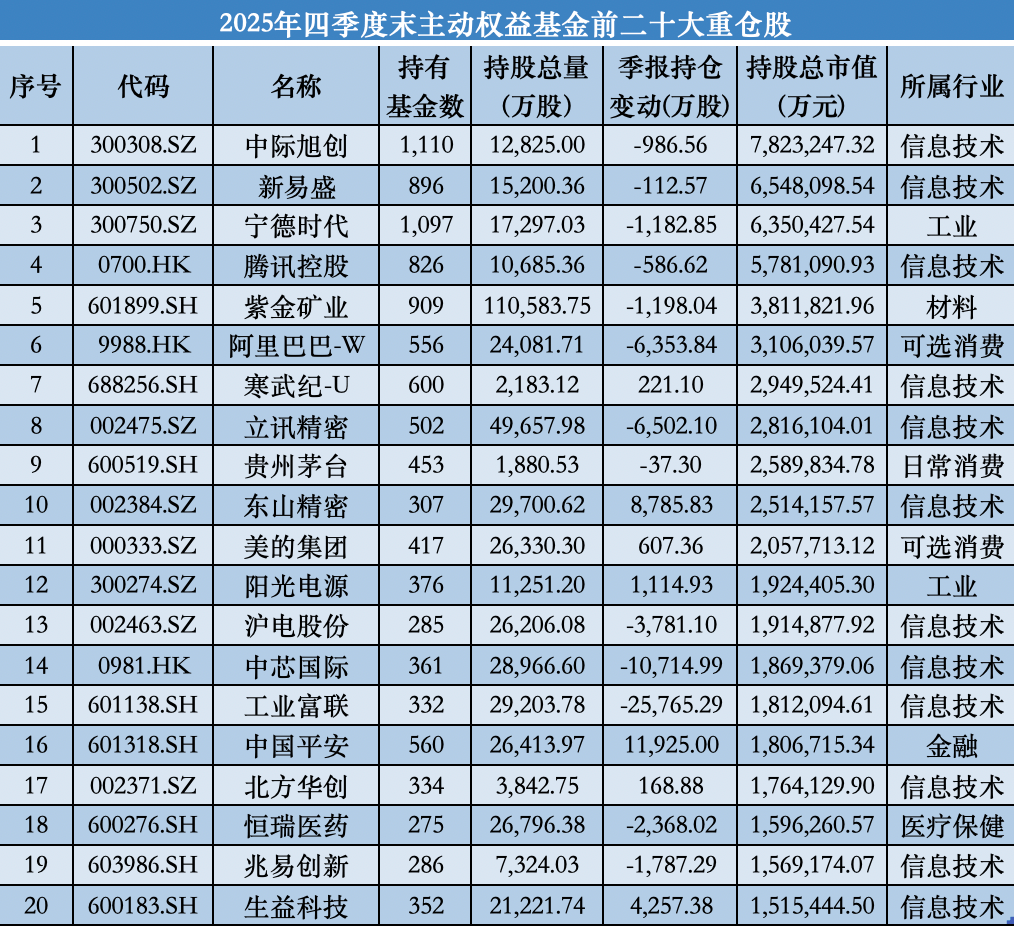
新面孔突围!中际旭创超越宁德时代,登顶主动权益基金去年末第一重仓股
Sou Hu Cai Jing· 2026-01-23 05:21
Core Insights - The top holdings of active equity funds have shifted, with Zhongji Xuchuang and Xinyi Sheng surpassing CATL and Tencent as the top two positions [1][2] Group 1: Fund Holdings Changes - As of the end of Q4 2025, Zhongji Xuchuang (300308.SZ) and Xinyi Sheng (300502.SZ) have become the top two holdings in active equity funds, overtaking CATL (300750.SZ) and Tencent (00700.HK) [1] - Significant increases in holdings were noted, with the Invesco Great Wall Fund increasing its stake in Zhongji Xuchuang by 1.747 million shares, making it the fund's largest holding [1] - The GF Technology Pioneer Fund also increased its position in Zhongji Xuchuang by 1.076 million shares, marking its first investment in the stock [1] Group 2: Other Notable Changes - In Q4 2025, major reductions were observed in holdings of traditional leaders like CATL and Tencent, which fell to third and fourth positions respectively [2] - East Mountain Precision (002384.SZ) saw a substantial increase of 8.785 million shares, entering the top ten holdings of active equity funds [2] - The overall trend indicates a shift from traditional consumer internet stocks to AI hardware and semiconductor sectors, reflecting a structural rebalancing by institutions [3]