
Wanchen Group(300972)

Search documents
食品饮料行业:月聚焦:如何布局零食“春季躁动”?
GF SECURITIES· 2026-01-20 06:14
Group 1 - The report highlights the "Spring Excitement" in the snack sector, indicating a historical high relative win rate of 70% for the food and beverage sector in the 40 days leading up to the Spring Festival [7][16] - The report emphasizes that the "Spring Excitement" is not solely dependent on the annual beta of the food and beverage sector, as structural opportunities still exist despite a long-term adjustment period since 2021 [7][16] - Key catalysts for the upcoming Spring Festival include concentrated demand for gifts and gatherings, which leads to more planned channel stocking, creating a positive feedback loop of expectations and validations [7][16][28] Group 2 - In December, the food and beverage sector underperformed the market by 7.5 percentage points, with a decline of 5.2%, ranking last among 31 primary industries [7][61] - The report notes a divergence in performance among sub-sectors, with snacks and soft drinks showing gains while liquor and beer experienced declines [7][61][64] - The absolute and relative valuations of the food and beverage sector are at their lowest since 2010, indicating potential investment opportunities [7][61][64] Group 3 - The report tracks the recovery of consumer confidence, with a 0.9% year-on-year increase in retail sales in December, showing improvement from the previous month [7][63] - It highlights that the liquor sector is facing weak demand and declining prices, with the price adjustments for premium liquor nearing levels seen between 2011 and 2015 [7][63][64] - The report identifies structural differentiation in costs, with some packaging materials and agricultural products experiencing price increases [7][63][64] Group 4 - Investment recommendations include a focus on liquor stocks that have undergone a four-year adjustment period, with potential for a "valuation + performance" double bottom [7][64] - For consumer goods, the report anticipates a moderate increase in industry prices in 2026, with specific recommendations for companies like Anjuke Foods, Qianhe Flavor, and Eastroc Beverage [7][64] - The report suggests that the upcoming Spring Festival will provide a favorable environment for growth narratives, particularly in the restaurant supply chain and certain chain formats [7][64]






零售板块拉升
Di Yi Cai Jing Zi Xun· 2026-01-20 03:19
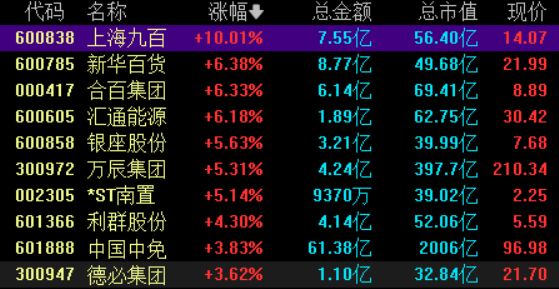
Group 1 - The retail sector experienced significant gains on January 20, with Shanghai Jiubai and Xinhua Department Store hitting the daily limit, while companies like Hebei Group and Huitong Energy rose over 6% [1] - Shanghai Jiubai's stock price increased by 10.01%, reaching a total market value of 56.40 billion, with a current price of 14.07 [2] - Xinhua Free Trade's stock rose by 6.38%, with a total amount of 8.77 billion and a market value of 49.68 billion, currently priced at 21.99 [2] Group 2 - The National Development and Reform Commission (NDRC) emphasized the importance of strengthening domestic circulation and expanding domestic demand, aligning with the trend of upgrading the country's demand structure [1] - The NDRC plans to develop a strategic implementation plan for expanding domestic demand from 2026 to 2030, focusing on creating new demand through new supply and providing strong innovation measures and resource guarantees [1]




零售板块拉升
第一财经· 2026-01-20 03:17
编辑丨瑜见 | 名称 | | 涨幅量 | 总金额 | 总市值 | 现价 | | --- | --- | --- | --- | --- | --- | | 600838 | 上海九百 | +10.01% | 7.55 | 56.40亿 | 14.07 | | 600785 | 新华百货 | +6.38% | 8.77 乙 | 49.68亿 | 21.99 | | 000417 | 合自集团 | +6.33% | 6.14 乙 | 69.41 乙 | 8.89 | | 600605 汇通能源 | | +6.18% | 1.89亿 | 62.75 Z | 30.42 | | 600858 银座股份 | | +5.63% | 3.21 Z | 39.99 7 | 7.68 | | 300972 万辰集团 | | +5.31% | 4.24 Z | 397.7 Z | 210.34 | | 002305 *STEE | | +5.14% | 93707 | 39.02 Z | 2.25 | | 601366 利群股份 | | +4.30% | 4.14 Z | 52.06 Z | 5.59 | | 601888 | ...


未知机构:东吴食饮苏铖团队0120Q1消费看大众旺季零食闪亮餐饮餐供季节性饮-20260120
未知机构· 2026-01-20 02:25
Summary of Conference Call Notes Industry Overview - The focus is on the consumer sector, particularly in the food and beverage industry, highlighting a seasonal uptick in demand during spring [1][2]. - The report emphasizes the recovery of service consumption, particularly in the restaurant and food supply sectors, supported by government initiatives to boost consumer spending [2]. Key Companies and Recommendations - **Snack Food Companies**: - Recommended leading snack brands include Wanchen Group, Yanjinpuzi, Weilong, Youyou, and Ganyuan [1][2]. - **Restaurant Supply Chain**: - Key players include Babi, Anjins, Guoquan, and Yihai International, along with Baoli Foods and Lihai Foods [1][2]. - **Beverage Companies**: - Notable recommendations are Yangyuan Beverage and Dongpeng Beverage [1][2]. Company-Specific Insights - **Babi**: Focused on diversified growth strategies to recreate its business model [2]. - **Anjins**: Confirming a bottoming out phase and restarting growth initiatives [2]. - **Guoquan**: Demonstrating a resilient business model with accelerated store openings [2]. Market Trends and Predictions - Historical data indicates that Q1 typically shows positive performance for many restaurant companies, with factors such as market profitability, delayed corporate events, and favorable seasonal reporting expected to drive growth in Q1 2026 [3]. - The report anticipates a multi-factor resonance effect in Q1 2026, which may positively impact metrics like customer spending, same-store sales, and table turnover rates [3]. Government Initiatives - The government has implemented a series of fiscal and financial policies aimed at stimulating domestic demand, which includes measures to clear overdue payments to businesses and ensure wage payments to migrant workers [2]. Additional Insights - The report highlights the cyclical nature of the consumer sector and its role as a leader in consumption recovery, with key companies showing continued improvement [4]. - Emphasis on valuation switching as a strategy to recommend high-quality stocks such as Ximai, Babi, Guoquan, and Yanjinpuzi [4].





国补高基数下12月社零同增0.9%
HTSC· 2026-01-20 02:02
Investment Rating - The report maintains a "Buy" rating for the consumer discretionary sector, highlighting structural investment opportunities [5][10]. Core Insights - The report indicates that in December, the total retail sales of consumer goods increased by 0.9% year-on-year to 4.5 trillion yuan, with a month-on-month decline of 0.4 percentage points, primarily due to high base effects from durable goods like automobiles and home appliances [7][9]. - The report emphasizes the importance of the new round of trade-in policies for 2026, which focus on core home appliance categories and expand into new categories like smart glasses and products for the elderly, supporting demand in these segments [7]. - The report suggests that consumer sentiment remains strong, particularly in sectors like emotional consumption, technology consumption, and undervalued high-dividend stocks, recommending a focus on domestic brands and global brand expansion [10]. Summary by Sections Retail Sales Performance - In December, retail sales of food and beverages grew by 2.2% and 0.7% respectively, with urban and rural retail sales increasing by 0.7% and 1.7% year-on-year [8]. - Online retail sales of physical goods in December increased by 0.8% year-on-year, with a total annual growth of 5.2%, accounting for 26.1% of total retail sales [8]. Consumer Categories - The report notes a structural differentiation in consumer categories, with home appliances, building materials, and furniture experiencing declines of 18.7%, 11.8%, and 2.2% respectively due to high base effects and trade-in policy impacts [9]. - Conversely, communication equipment saw a significant increase of 20.9% year-on-year, while emotional and self-care products like sports and entertainment goods and cosmetics grew by 9.0% and 8.8% respectively [9]. Investment Recommendations - The report identifies four main investment themes: 1. Rise of domestic brands and global brand expansion, recommending companies like Pop Mart, Shangmei, and Anta Sports [10]. 2. Technology consumption empowered by AI, recommending companies like Midea Group and Haier Smart Home [10]. 3. Emotional consumption, recommending companies like Gu Ming and Yum China [10]. 4. Undervalued high-dividend blue-chip leaders, recommending companies like Li Ning and Shenzhou International [10]. Company-Specific Insights - For Smoore International (6969 HK), the report forecasts a revenue of 10.21 billion yuan for Q1-3 2025, with a year-on-year growth of 21.8%, and maintains a "Buy" rating with a target price of 27.00 HKD [48]. - For Juzhibio (2367 HK), the report highlights the approval of a new collagen product, projecting significant sales potential and maintaining a "Buy" rating with a target price of 85.00 HKD [49]. - For Pop Mart (9992 HK), the report notes a revenue increase of 245-250% in Q3 2025, driven by strong performance in both domestic and international markets, maintaining a "Buy" rating with an updated target price of 410 HKD [51].



2026年食品饮料行业投资策略报告:筑底修复为主线,结构分化藏良机-20260119
Wanlian Securities· 2026-01-19 11:02
Group 1 - The core viewpoint of the report indicates that the food and beverage industry experienced a downturn in performance and stock prices in 2025, with revenue growth slowing and net profit declining for the first time [2][16][23] - The food and beverage sector's revenue for the first three quarters of 2025 was 831.395 billion yuan, a year-on-year increase of only 0.14%, while net profit decreased by 4.57%, ranking 20th and 21st among 31 industries respectively [16][20] - The stock prices of the food and beverage sector fell by 4.72% from January to November 2025, placing it at the bottom of the performance rankings among the 31 industries [23][27] Group 2 - In the liquor industry, the report notes that channel destocking and low valuations combined with high dividend yields provide support for stock prices, despite a challenging environment due to policy impacts [3][36] - The report predicts that the white liquor industry will enter a "volume-price double kill" phase, characterized by intensified competition and market consolidation [3][36] - The report highlights that the beer sector is expected to see marginal improvements in 2026 due to cost advantages and a recovery in on-premise consumption [4][36] Group 3 - The dairy sector is experiencing a recovery in demand, with low-temperature and deep-processed dairy products showing positive growth, while the overall profitability of dairy companies varies significantly [4][9] - The condiment industry is evolving towards customization driven by the rise of chain restaurants and strong retail channels, with a focus on companies that can meet tailored demands [4][9] - The frozen food sector is expected to return to positive growth as price wars ease, with companies like Anji actively exploring new sales channels [4][9] Group 4 - The soft drink market is primarily driven by functional beverages, which are seen as a high-growth segment, while the overall market growth is expected to rely on structural upgrades [4][9] - The snack industry is facing challenges with "revenue without profit," and companies with health-oriented products and strong channel advantages are recommended for attention [4][9]




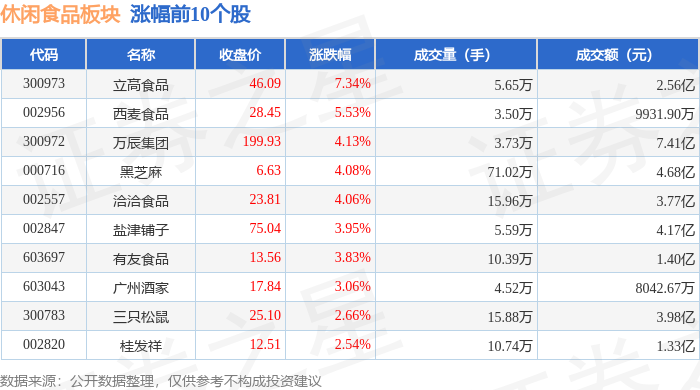
休闲食品板块1月19日涨3.01%,立高食品领涨,主力资金净流入1835.13万元
Zheng Xing Xing Ye Ri Bao· 2026-01-19 08:52
Group 1 - The leisure food sector increased by 3.01% on January 19, with Li Gao Food leading the gains [1] - The Shanghai Composite Index closed at 4114.0, up 0.29%, while the Shenzhen Component Index closed at 14294.05, up 0.09% [1] - Key stocks in the leisure food sector showed significant price increases, with Li Gao Food rising by 7.34% to a closing price of 46.09 [1] Group 2 - The leisure food sector experienced a net inflow of 18.35 million yuan from institutional investors, while retail investors contributed a net inflow of 18.64 million yuan [2] - Notable stocks included San Zhi Song Shu, which had a net inflow of 36.54 million yuan from institutional investors, despite a net outflow from retail investors [3] - The overall trading volume and turnover in the leisure food sector indicated active market participation, with significant movements in individual stock prices [1][2]

从双强视角看行业发展:量贩零食行业深度研究:从豆蔻时代,到万里繁花
Changjiang Securities· 2026-01-18 14:24
Investment Rating - The report maintains a "Positive" investment rating for the industry [11] Core Insights - The bulk snack industry has successfully captured current consumer trends through "extreme cost performance" and "efficient supply chains," leading to a stable "dual strong" market structure with significant scale effects for leading companies [4][6] - The market for leisure food and beverages is expected to approach 4 trillion yuan by 2025, with a compound annual growth rate (CAGR) of over single digits from 2025 to 2029 [6][30] - The two leading companies, Mingming and Wancheng, have established themselves as industry champions, with Mingming showing stronger profitability and Wancheng focusing on operational efficiency and turnover speed [4][7] Market Structure and Growth - The snack industry is transitioning from fragmented operations to brand and chain development, entering an innovative phase represented by bulk snack stores [19][21] - The leisure food and beverage market is projected to grow significantly, with the down-market segment expected to see a growth rate of 6.8% from 2024 to 2029, surpassing the high-line market's 4.1% [6][33] - The retail market for bulk snacks is expected to exceed 200 billion yuan by 2025, with significant contributions from lower-tier markets [36][38] Company Performance - As of mid-2025, both leading companies have over 15,000 stores, with Mingming's store count reaching 21,041 by November 2025, while Wancheng is enhancing its presence in lower-tier markets [7][54] - Mingming has approximately 180 million registered members, with a repurchase rate of about 77%, while Wancheng has over 150 million registered members and an average monthly purchase frequency of 2.9 times [54][55] - Profitability for both companies is improving, with Mingming's gross margin at 9.7% and Wancheng's at 11.7% for the first three quarters of 2025 [8][55] Future Outlook - The report suggests that the future growth of bulk snack companies will rely on scale effects and operational efficiency, with potential for category expansion and overseas market penetration [9][30] - The Southeast Asian snack and beverage market is projected to reach approximately 48.4 billion USD by 2025, presenting opportunities for Chinese snack companies to expand internationally [9][30]
【转|太平洋食饮-26年度策略】底部向阳,寻找结构性亮点
远峰电子· 2026-01-18 11:38
Overall Sector Review - The food and beverage sector significantly underperformed the market, with a year-to-date decline of -0.62%, lagging behind the Shanghai Composite Index by 15.0 percentage points [2] - The sector experienced a deep correction after an initial rebound driven by expectations of consumption recovery and supportive policies, but the actual recovery rate was lower than anticipated, leading to a consensus on weak domestic demand [2] Subsector Performance - The snack sector outperformed with a year-to-date increase of 28.88%, driven by channel expansion and a revenue growth rate of 30.97% in the first three quarters [4] - Soft drinks also showed resilience with a 10.11% stock price increase, benefiting from strong travel demand and low-cost, high-frequency consumption [4] - The restaurant chain sector saw a rebound with gains of approximately 10.34% and 10.29% for pre-processed and baked goods, respectively [4] - The liquor sector, particularly high-end liquor, faced challenges with weaker sales and declining prices, while beer performance was supported but affected by high-end market constraints [4] Investment Insights - The sector is under pressure from deflationary trends and a weak recovery, with consumer confidence remaining low, indicating a shift to a "new normal" of low growth [8] - High-end consumption has shown slight recovery due to stock market wealth effects, but sustainability remains a concern [9] - The food and beverage sector's valuation is at historical lows, with a current PE (TTM) of 21.9X, indicating potential investment opportunities in undervalued segments [12] Fund Holdings - As of Q3 2025, the food and beverage sector's fund holdings decreased to 6.38%, nearing levels seen in 2016, with the liquor segment comprising 5.52% of this [14] - Fund holdings in the liquor sector increased for certain subsectors, including white liquor and seasoning products, while others saw declines [16] Long-term Trends - The liquor industry is undergoing its longest adjustment period since 2003, with significant price corrections and a potential bottoming out of valuations [21] - The white liquor sector has underperformed the market with a year-to-date return of -4.87%, reflecting weak demand and a divergence from broader market trends [24] - The third quarter of 2025 saw a significant decline in revenue and net profit for the white liquor sector, indicating a deep adjustment phase [27] Pricing Dynamics - The white liquor market is experiencing a general decline in prices, particularly in high-end segments, while lower price segments show resilience [29] - The average price of high-end products like Moutai has dropped significantly, while mid-range and lower-range products have maintained stability or slight increases [31] Investment Recommendations - The white liquor sector is advised to focus on inventory reduction and demand recovery, with a preference for leading brands that can maintain pricing power and product stability [32]



万辰集团设公益基金 未来五年捐2500万践行社会责任
Chang Jiang Shang Bao· 2026-01-16 00:28
Core Viewpoint - Wancheng Group has established the "Wancheng·Guangcai Fund" in collaboration with the Fujian Guangcai Charity Promotion Association, committing to donate 5 million yuan annually for five years, totaling 25 million yuan for public welfare initiatives, supported by a significant profit increase of 917.04% in the first three quarters of 2025 [1][3] Group 1: Fund Establishment and Purpose - The fund aims to support local poverty alleviation, rural revitalization, collaboration between eastern and western regions, care for vulnerable groups, and disaster relief efforts [1][2] - The fund's establishment was approved by the company's board on January 13, and the funding will come from the company's operating profits, not requiring shareholder approval [1][2] Group 2: Fund Management and Usage - At least 20% of the donation will be allocated to projects designated by the Guangcai Association, with no management fees for that portion; the remaining funds will incur a 3% management fee based on actual disbursements [2] - Wancheng Group can propose targeted donation plans, with the Guangcai Association required to respond within 15 working days to ensure efficient implementation of the company's philanthropic intentions [2] Group 3: Financial Performance and Social Responsibility - For the first three quarters of 2025, Wancheng Group reported revenues of 36.562 billion yuan, a year-on-year increase of 77.37%, and a net profit of 855 million yuan, reflecting a substantial year-on-year growth of 917.04% [3] - The company's strong financial performance underpins its commitment to social responsibility, demonstrating a cycle of "operational efficiency—philanthropic empowerment" [3] - Wancheng Group has a history of philanthropic activities, including donations for disaster relief and educational support, reinforcing its role as a socially responsible leader in the snack food industry [2][3]