
BYD(BYDDY)

Search documents
比亚迪目标价涨幅超40%,26股获推荐
2 1 Shi Ji Jing Ji Bao Dao· 2026-01-07 01:27
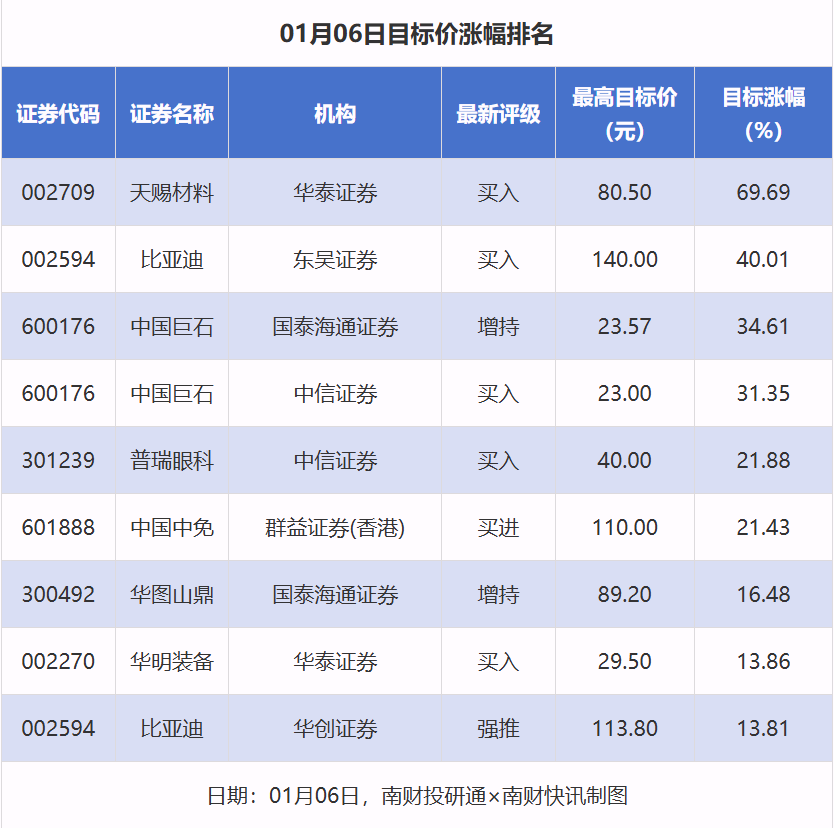
Group 1: Target Price Increases - The companies with the highest target price increases as of January 6 are Tianqi Materials (002709) with a target price increase of 69.69%, BYD (002594) with 40.01%, and China Jushi (600176) with 34.61% [1][2] - Tianqi Materials is rated "Buy" by Huatai Securities with a target price of 80.50 yuan [2] - BYD has two different ratings, one from Dongwu Securities with a target price of 140.00 yuan and another from Huachuang Securities with a target price of 113.80 yuan [2] Group 2: Broker Recommendations - A total of 26 listed companies received broker recommendations on January 6, with Hengyi Petrochemical (000703), China Jushi, and BYD each receiving two recommendations [1][3] - Hengyi Petrochemical has a closing price of 10.75 yuan and is in the refining and trading industry [3] - China Jushi has a closing price of 17.51 yuan and operates in the glass fiber industry [3] Group 3: Rating Adjustments - On January 6, there was one rating upgrade, with Qunyi Securities (Hong Kong) raising China Duty Free (601888) from "Range Operation" to "Buy" [4] - China Duty Free operates in the tourism retail industry [4] Group 4: First Coverage - Five companies received first coverage on January 6, including Xincheng Holdings (601155) rated "Buy" by Caitong Securities, Huaming Equipment (002270) rated "Buy" by Huatai Securities, and Yidong Electronics (301123) rated "Buy" by Zhongyou Securities [5] - Other companies receiving first coverage include Huatu Mountain Ding (300492) rated "Increase" by Guotai Haitong Securities and Hehe Information rated "Buy" by Dongbei Securities [5]


比亚迪取得电池寿命预测方法专利
Sou Hu Cai Jing· 2026-01-07 00:50
Group 1 - BYD Company Limited and Shenzhen BYD Electronics Co., Ltd. have obtained a patent for a "battery lifespan prediction method, device, storage medium, and equipment," with authorization announcement number CN118311459B, applied for on February 2023 [1] - BYD Company Limited, established in 1995 and located in Shenzhen, primarily engages in the automotive manufacturing industry, with a registered capital of 9,117.197565 million RMB [1] - BYD Company Limited has invested in 108 enterprises, participated in 1,010 bidding projects, holds 1,823 trademark records, and has 5,000 patent records, in addition to possessing 154 administrative licenses [1] Group 2 - Shenzhen BYD Electronics Co., Ltd., established in 2019 and located in Shenzhen, primarily focuses on the manufacturing of computers, communications, and other electronic devices, with a registered capital of 10 million RMB [1] - Shenzhen BYD Electronics Co., Ltd. has participated in 6 bidding projects, holds 14 patent records, and has 14 administrative licenses [1]
6股获券商买入评级,比亚迪目标涨幅达40.01%
Mei Ri Jing Ji Xin Wen· 2026-01-07 00:40
Group 1 - On January 6, a total of 6 stocks received buy ratings from brokerages, with 1 stock announcing a target price [1] - BYD ranked highest in target price increase potential, with a projected rise of 40.01% [1] - The sectors with the most stocks receiving buy ratings include pharmaceuticals, biotechnology and life sciences, medical equipment and services, and capital goods, each with 1 stock [1]
比亚迪12月德英销量超越特斯拉,德国销量一年暴增8倍
Hua Er Jie Jian Wen· 2026-01-06 18:39
这一结构性变化发生在特斯拉全球销量下滑的背景下。特斯拉去年第四季度交付量同比下滑16%,年度 总销量亦连续第二年下降。全球电动车销量冠军的头衔由比亚迪接棒,2025年比亚迪预计交付226万辆 电动车,特斯拉为164万辆。 德国市场实现突破性增长 比亚迪在德国市场的表现尤为突出。作为欧洲最大的电动车市场,德国去年见证了比亚迪销量的爆发式 增长。23,306辆的年度销量较前一年增长八倍,显示出中国品牌在传统汽车强国的快速渗透能力。 比亚迪12月在德国与英国两大欧洲关键市场的销量已双双超越特斯拉,标志着中国车企全球扩张取得关 键进展。 相比之下,特斯拉在德国的销量几乎腰斩,反映出特斯拉在欧洲市场面临的双重压力:一方面是来自中 国新进入者的竞争,另一方面则是欧洲本土车企电动车产品线的扩张,大众汽车、雷诺和宝马等欧洲传 统车企已大幅扩充其电动车产品阵容。 据德国联邦汽车运输管理局周二公布的数据,比亚迪12月份在德国的新车注册量是特斯拉的两倍多。全 年来看,比亚迪在德国的销量飙升八倍,达到23306辆,而特斯拉的销量则下降了近一半,至19390辆。 比亚迪在英国的表现也超过了特斯拉,英国是欧洲第二大插电式汽车市场。比亚迪 ...

欧洲两大电车市场去年销量不及比亚迪 特斯拉(TSLA.US)跌超2.8%
Zhi Tong Cai Jing· 2026-01-06 14:49
周二,特斯拉(TSLA.US)开盘后股价快速下跌,截至发稿,该股跌超2.8%,报439美元。消息面上,比 亚迪(002594)去年在欧洲两大电动汽车市场的销量均超过了特斯拉,凸显出其强劲的全球扩张势头。 在德国市场,比亚迪2025年销量激增8倍,达到23306辆;而特斯拉销量近乎腰斩,仅为19390辆。尤其 在12月单月,比亚迪的汽车上牌量更是特斯拉的两倍以上。在英国市场,比亚迪自2025年9月实现销量 反超后持续领跑,全年累计上牌量达51422辆,超过特斯拉的45513辆。 ...
美股异动 | 欧洲两大电车市场去年销量不及比亚迪 特斯拉(TSLA.US)跌超2.8%
智通财经网· 2026-01-06 14:47
智通财经APP获悉,周二,特斯拉(TSLA.US)开盘后股价快速下跌,截至发稿,该股跌超2.8%,报439 美元。消息面上,比亚迪去年在欧洲两大电动汽车市场的销量均超过了特斯拉,凸显出其强劲的全球扩 张势头。在德国市场,比亚迪2025年销量激增8倍,达到23306辆;而特斯拉销量近乎腰斩,仅为19390 辆。尤其在12月单月,比亚迪的汽车上牌量更是特斯拉的两倍以上。在英国市场,比亚迪自2025年9月 实现销量反超后持续领跑,全年累计上牌量达51422辆,超过特斯拉的45513辆。 ...
比亚迪在德英两大欧洲市场销量超越特斯拉
Xin Lang Ke Ji· 2026-01-06 13:33
【#比亚迪在欧洲两大市场销量超特斯拉#】比亚迪去年在欧洲最大的两个电动车市场销量均超过特斯 拉。根据德国联邦机动车管理局周二公布的数据,去年12月,比亚迪在德国的新车注册量是特斯拉的两 倍以上。以全年计,比亚迪在欧洲最大的电动车市场德国的销量增长七倍,至23,306辆,而特斯拉的销 量几乎腰斩,降至19,390辆。比亚迪在英国这一欧洲第二大插电式汽车市场同样领先特斯拉。比亚迪在 去年9月超过特斯拉,并以51,422辆的全年销量收官,高于特斯拉的45,513辆。(智通财经) ...
比亚迪夺得全球纯电车销冠为何如此受关注|说商道市
Chang Sha Wan Bao· 2026-01-06 09:11
Core Insights - BYD has achieved the title of the global champion in pure electric vehicle sales for 2025, with total sales of 4.602 million new energy vehicles, including approximately 2.257 million pure electric vehicles, marking a year-on-year growth of 27.86% [1] - The competition in the electric vehicle market is significant, as BYD has surpassed Tesla, which has been traditionally viewed as the leader in the electric vehicle sector [1] - The success of BYD is not only a personal victory but also a representation of the strength of Chinese manufacturing in the global market, particularly in the automotive sector [2] Industry Overview - The automotive industry requires a high level of integration across various segments, including batteries, electric motors, and artificial intelligence, making BYD's achievement particularly noteworthy [2] - BYD's new energy vehicle business has expanded globally, reaching 119 countries and regions, becoming a mainstream choice for consumers in key markets such as South America and Asia-Pacific [2] - Other Chinese automakers like Chery, Geely, and SAIC have also shown significant performance in overseas markets, highlighting the collective strength of Chinese automotive manufacturers [2] Future Outlook - The competition in pure electric vehicles will focus on further optimization of "three electric" technologies (batteries, electric motors, and electronic control) and advancements in intelligent driving technologies [3] - Chinese automakers are currently leading in these areas, suggesting that future victories in the electric vehicle market may become more routine and less sensational [3]

比亚迪(002594):全年销量460万辆,方程豹与出口表现亮眼:比亚迪(002594):2025年12月销量点评
Huachuang Securities· 2026-01-06 08:16
Investment Rating - The report maintains a "Strong Buy" rating for BYD, expecting it to outperform the benchmark index by over 20% in the next six months [2][17]. Core Views - BYD's total sales for the year are projected to reach 4.6 million vehicles, with strong performance from the Fangchengbao model and exports [2][7]. - The target price is set at 113.8 CNY for A-shares and 111.2 HKD for H-shares, reflecting a robust growth outlook despite recent challenges [2][7]. Financial Summary - **Revenue Forecast**: Total revenue is expected to grow from 777.1 billion CNY in 2024 to 1,070.5 billion CNY by 2027, with a compound annual growth rate (CAGR) of approximately 13.5% [3][8]. - **Net Profit**: Projected net profit is anticipated to decline from 40.3 billion CNY in 2024 to 35.2 billion CNY in 2025, before rebounding to 60.0 billion CNY in 2027, indicating a significant recovery [3][8]. - **Earnings Per Share (EPS)**: EPS is forecasted to decrease from 4.42 CNY in 2024 to 3.86 CNY in 2025, then increase to 6.58 CNY by 2027 [3][8]. - **Valuation Ratios**: The price-to-earnings (P/E) ratio is expected to range from 22 in 2024 to 15 in 2027, while the price-to-book (P/B) ratio is projected to decline from 4.8 to 2.6 over the same period [3][8]. Sales Performance - **Sales Breakdown**: In December, BYD sold 134,000 vehicles, with a total of 4.6 million vehicles sold for the year, marking an 8% increase year-on-year [7]. - **Export Growth**: Exports reached 133,000 vehicles in December, representing a 133% increase year-on-year, with a total of 1.05 million vehicles exported for the year [7]. - **Brand Performance**: The Dynasty series sold 188,500 vehicles in 2025, while the Ocean series achieved 222,000 vehicles sold [7]. Market Outlook - **Product Cycle**: A new product cycle is expected to begin in March 2026, with the launch of the upgraded Qin L DM-i model, which is anticipated to enhance market share and brand value [7]. - **Sales Projections**: Future sales are projected to reach 5.27 million vehicles in 2026 and 5.85 million in 2027, with corresponding revenue growth [7].
比亚迪(002594):全年销量同比提升,持续推进高端化和出口
Soochow Securities· 2026-01-06 07:46
Investment Rating - The investment rating for BYD is "Buy" (maintained) [1] Core Views - BYD's sales for 2025 are expected to increase year-on-year, continuing its push towards high-end products and exports [1] - The company is projected to achieve a total revenue of RMB 839.36 billion in 2025, reflecting an 8.01% year-on-year growth [1] - The net profit attributable to shareholders is forecasted to be RMB 35.01 billion in 2025, representing a decrease of 13.03% compared to the previous year [1] - The earnings per share (EPS) is estimated at RMB 3.84 for 2025, with a price-to-earnings (P/E) ratio of 25.55 [1] Financial Projections - Total revenue projections for BYD from 2023 to 2027 are as follows: - 2023: RMB 602.32 billion - 2024: RMB 777.10 billion - 2025: RMB 839.36 billion - 2026: RMB 962.02 billion - 2027: RMB 1,107.28 billion [1] - Net profit projections for the same period are: - 2023: RMB 30.04 billion - 2024: RMB 40.25 billion - 2025: RMB 35.01 billion - 2026: RMB 50.93 billion - 2027: RMB 66.39 billion [1] - The company expects to maintain a net profit margin of approximately 4.17% in 2025 [9] Sales and Market Performance - BYD's cumulative sales for 2025 are projected to reach 5.52 million units, a 20% increase year-on-year, with exports expected to account for 150,000 to 160,000 units [8] - The company has seen a significant increase in high-end vehicle sales, with December sales reaching 70,000 units, a year-on-year increase of 161% [8] - The company has established overseas production capacity exceeding 300,000 units per year, with factories in Brazil, Thailand, and Uzbekistan already operational [8] Battery and Energy Storage - BYD's battery installation for 2025 is expected to grow by 47%, with external battery supply also experiencing significant growth [8] - The company anticipates battery shipments for energy storage to exceed 50 GWh in 2025 and approximately 80 GWh in 2026 [8]