NIO(NIO)

Search documents
NIO: Q4 Profit Inflection Meets A Tougher 2026
Seeking Alpha· 2026-03-11 12:53
Analyst’s Disclosure: I/we have no stock, option or similar derivative position in any of the companies mentioned, and no plans to initiate any such positions within the next 72 hours. I wrote this article myself, and it expresses my own opinions. I am not receiving compensation for it (other than from Seeking Alpha). I have no business relationship with any company whose stock is mentioned in this article. Seeking Alpha's Disclosure: Past performance is no guarantee of future results. No recommendation or ...


Nio stock price forecast: targets 20% surge as revenue, profits soar
Invezz· 2026-03-11 12:09
Group 1 - The core viewpoint of the article highlights that Nio's stock price has surged to its highest level since December of the previous year, indicating a strong upward trend that began earlier in the year [1] - The stock price reached $6.70, reflecting a significant increase as the company formed a double-bottom pattern [1]
蔚来首次季度盈利:从“资本故事”到“现金机器”的拐点?
美股研究社· 2026-03-11 11:59
Core Viewpoint - NIO has crossed the profitability threshold for the first time, signaling a potential shift from being a "capital story" to a "cash machine," fundamentally changing its investment attributes from a future dream to a real asset generating returns [3][4]. Group 1: Financial Performance - In Q4 2025, NIO achieved an operating profit of 1.25 billion yuan and increased cash reserves to 45.9 billion yuan, exceeding market expectations [7]. - The guidance for Q1 2026 is aggressive, with expected deliveries of 80,000 to 83,000 vehicles, representing over 90% year-on-year growth, and revenue guidance of 24.48 billion to 25.18 billion yuan, indicating over 100% year-on-year growth [7][8]. Group 2: Strategic Shift - NIO is transitioning from a "scale-driven" model to a "profit-driven" approach, focusing on "quality growth" rather than just sales volume [8]. - The introduction of the CBU operating mechanism holds each vehicle model accountable for sales, gross margin, and operational results, optimizing cost structures and enhancing profitability per vehicle [8]. Group 3: Product Structure and Market Trends - The shift in product structure is contributing to profitability, with the ES8 model's gross margin nearing 25%, significantly above the industry average [8]. - The high-end electric vehicle market is rapidly expanding, with pure electric vehicle sales in the 300,000 yuan and above price range growing by 58%, while range-extended models have seen a decline [10][12]. Group 4: Battery Swap System - NIO's battery swap system, previously viewed as a cost center, is being redefined as a distributed energy storage network, with nearly 3,800 swap stations built, capable of significant energy storage [16]. - This system could evolve into a part of the energy network, allowing for energy trading and providing a competitive edge that is difficult for other manufacturers to replicate [17]. Group 5: Future Outlook - NIO's first quarterly profit indicates a potential shift towards a high-end market, high-margin vehicle strategy, and energy network infrastructure, suggesting a new trajectory for the company [19]. - If this combination continues, NIO may transform from a new energy vehicle manufacturer to a more ecosystem-oriented company, enhancing its valuation in the capital market [19].

蔚来第二颗自研芯片,成功流片!
半导体芯闻· 2026-03-11 11:05
Core Insights - NIO's founder and CEO Li Bin announced the successful tape-out of the second advanced intelligent chip from its subsidiary, Shenji, which is currently in the mass production phase. This chip is designed to meet broader market demands with high cost-performance advantages and competitive performance against industry standards [1] - NIO aims to open its self-developed Shenji high-performance inference chip to more partners across various sectors, including automotive and embodied intelligence, while focusing on core technology and main business development without plans for further business spin-offs [1] - The successful financing of Shenji, the mass commercialization of the first 5nm automotive chip, and NIO's first quarterly profit have drawn significant industry attention to its chip development and profitability plans for the year [1] Financing and Market Position - In February 2026, NIO announced that its chip subsidiary, Anhui Shenji, completed its first round of equity financing, raising over 2.2 billion yuan, with a post-investment valuation nearing 10 billion yuan. This financing attracted several industry-leading investors, highlighting the technical potential of Shenji chips and providing substantial capital for future R&D and market expansion [2] - The core product, Shenji NX9031, is the world's first automotive-grade 5nm high-performance smart driving chip, with over 150,000 units shipped since its production began in 2024. It features over 50 billion transistors, a 32-core CPU architecture, and capabilities that significantly outperform competitors like NVIDIA [2] Development Timeline - NIO's journey in chip development began in 2021, establishing a research team of over 500 people. Key milestones include the launch of the "Yang Jian" lidar control chip and the Shenji NX9031 smart driving chip in 2023, with the latter achieving tape-out success in July 2024 [3] - In June 2025, NIO officially established Anhui Shenji Technology Co., Ltd., to oversee chip R&D, production, and technology licensing, further streamlining its chip business structure for market operations [3] Cost Efficiency and Profitability - Self-developed chips are seen as a crucial strategy for NIO to reduce costs and improve gross margins. Li Bin indicated that in-house chips could lower vehicle costs by at least 10,000 yuan, contrasting with the significant expenditures on NVIDIA chips [4] - NIO reported a historic quarterly profit of 1.25 billion yuan in Q4 2025, with cash reserves reaching 45.9 billion yuan, marking a significant increase. The management has outlined plans for 2026 to enhance profitability and market expansion through a multi-brand strategy [4] Strategic Outlook - The smart electric vehicle industry is entering a phase of technological competition and profitability challenges. NIO, leveraging its Shenji chip as a core asset, aims to solidify its technological moat and clarify its profitability path. With the new generation of chips entering mass production and strategic initiatives being implemented, NIO is positioned for dual breakthroughs in technology and performance, advancing towards a new stage of high-quality development [5]
NIO's Q4 Updates Change Everything (Rating Upgrade) (NYSE:NIO)
Seeking Alpha· 2026-03-11 10:55
Core Viewpoint - The analysis maintains a "Hold" rating on NIO Inc. stock since June 2025, citing specific risks associated with the company that could impact its performance [1]. Group 1: Company Analysis - NIO Inc. has been under scrutiny due to identified risks that have led to a neutral stance on its stock [1]. - The investment analysis emphasizes the importance of filtering through extensive data to extract critical insights regarding NIO's market position [1]. Group 2: Analyst Background - The chief investment analyst has a decade of experience in investment banking and manages a family office with diverse global investments [1]. - The analyst operates an investing group that provides insights similar to those prioritized by institutional market participants [1].
蔚来李斌:内存等原材料涨价对高端车型或带来近万元影响,公司暂无调价计划
新华网财经· 2026-03-11 10:07AI Processing
据财联社3月11日消息,蔚来汽车创始人、董事长李斌今日表示,存储内存及其他原材料价格上涨对高端新能源车型的成本影响分别为3000至5000元,共 计影响近万元。目前蔚来汽车现有体系可以支撑成本上涨带来的压力,公司暂无调价计划。 此外,李斌还表示,希望蔚来自研的神玑大算力推理芯片能够给到更多的合作伙伴,包括汽车行业、具身智能行业等。李斌同时表示,公司目前没有更多 拆分业务的项目。 此前一日,蔚来方面透露,公司第二颗面向更广泛客户的智能芯片已流片成功,有不少行业客户已在进行前期测试与接触,目前正在量产过程中。 另据财联社3月10日消息,蔚来发布2025年四季度及全年财报。四季度实现经营利润12.5亿元,实现公司首次季度盈利。四季度现金储备459亿元,环比大 幅增长近百亿。 李斌。 更多财经资讯等你来看 往期推荐 2026年一季度交付指引80,000台-83,000台,同比增长90.1%-97.2%。营收指引244.8亿元-251.8亿元,同比增长103.4%至109.2%。 来源: 九派新闻综合财联社 关注" 新华网财经 "视频号 多家黄金品牌宣布:调价! 寿司郎回应消费者吃出金枪鱼寄生虫卵 ...

首个具身数据独角兽诞生!光轮智能完成10亿元融资,创始人曾任职英伟达、蔚来
Sou Hu Cai Jing· 2026-03-11 09:16
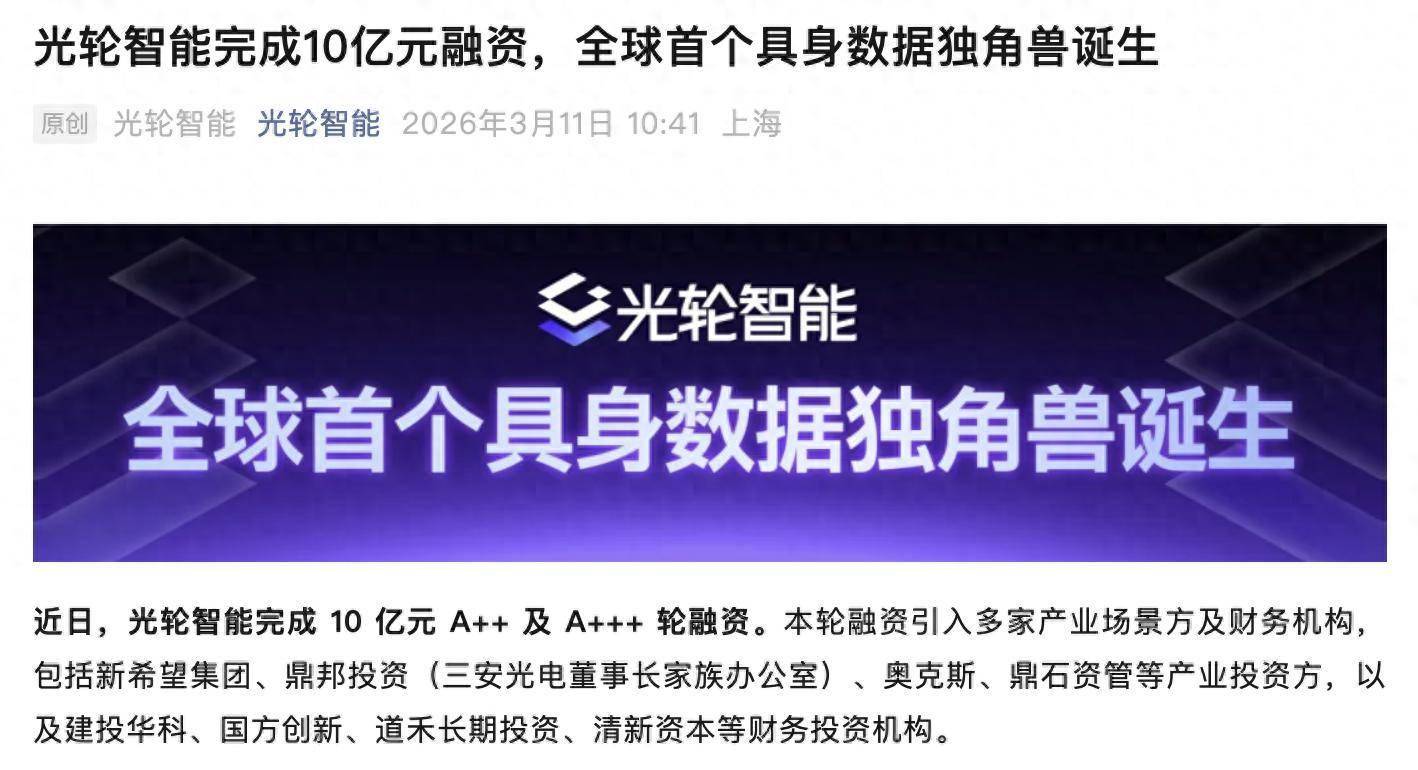
Group 1 - The core viewpoint of the news is that Guanglun Intelligent has completed a financing round of 1 billion yuan, making it the world's first unicorn in the field of embodied data [1][4] - The financing round attracted multiple industry players and financial institutions, including New Hope Group, Dingbang Investment, and others [1] - The funds will be primarily used for the continuous research and development of physical simulation engines, upgrading large-scale model evaluation systems, and enhancing global delivery and local deployment capabilities [4] Group 2 - Guanglun Intelligent was established in 2023 and has a founding team composed of top talents in generative AI, simulation, and synthetic data research [4] - The founder and CEO, Dr. Xie Chen, is a well-known expert in simulation, having previously held leadership roles in autonomous driving simulation at companies like NVIDIA, Cruise, and NIO [4] - The company is recognized for its innovative integration of generative AI into simulation processes [4]
比亚迪闪充之后,蔚来的换电模式还值钱吗
3 6 Ke· 2026-03-11 08:39
Core Viewpoint - The introduction of BYD's fast-charging technology poses a potential threat to NIO's battery swap model, but the immediate impact is expected to be manageable due to NIO's established market position and operational strategies [2][8]. Group 1: NIO's Business Model and Performance - NIO's rebound in performance is closely tied to its battery swap model, which has created a competitive moat for the company [2]. - The company's profitability improvement is primarily driven by optimized supply chain management and increased delivery volumes, which have reduced market expenses [2][12]. - NIO's battery-as-a-service (BaaS) model allows the company to transfer battery assets to a joint venture, alleviating pressure on its balance sheet while still benefiting from the user experience [6][8]. Group 2: Impact of Fast-Charging Technology - The introduction of fast-charging technology by BYD is seen as a potential challenge to NIO's battery swap model, but the short-term impact is expected to be limited [8][9]. - The attractiveness of NIO's battery swap model lies not only in alleviating charging anxiety but also in lowering the purchase threshold for consumers, which fast-charging cannot replicate [8]. - NIO's financial statements indicate a significant increase in receivables from battery sales to its joint venture, suggesting a shift towards the BaaS purchasing model among consumers [8]. Group 3: Profitability and Cost Management - NIO's gross margin improved to 13.62% in 2025, with automotive gross margin at 14.6%, despite a decline in average selling price (ASP) [12]. - The reduction in operating expenses, with Q4 2025 sales and administrative expenses dropping to 3.5 billion from 4.9 billion the previous year, has been a key factor in returning to profitability [14]. - The current environment of reduced price competition in the automotive industry is expected to support the maintenance of gross margins for manufacturers like NIO [15].

蔚来:2025 年第四季度初步解读:成本节约推动营业利润超预期,联营企业投资亏损扩大;中性评级
2026-03-11 08:12
Summary of NIO Inc. 4Q25 Conference Call Company Overview - **Company**: NIO Inc. (NIO) - **Industry**: Electric Vehicles (EVs) Key Financial Results - **Total Revenue**: RMB 34.65 billion, in line with Goldman Sachs estimates (GSe) [1] - **EBIT**: RMB 807 million, exceeding GSe by 108.7% due to cost savings in SG&A [1] - **Non-GAAP Net Income**: RMB 728 million, missing expectations by 30.7% primarily due to increased losses from equity investees [1][2] - **Vehicle Sales Volume**: Expected to be between 80,000 and 83,000 units for 1Q26, reflecting a 7% increase year-over-year [1] - **Revenue Guidance for 1Q26**: Projected between RMB 24.5 billion and RMB 25.2 billion, a 3% increase year-over-year [1] Key Highlights and Surprises - **Vehicle Average Selling Price (ASP)**: Increased by 4.5% compared to GSe, attributed to a better product mix, particularly the ES8 model [2] - **Vehicle Gross Margin**: Reported at 18.1%, slightly lower than GSe by 1.7 percentage points, due to higher-than-expected Bill of Materials (BOM) costs [2] - **Operating Expenses**: Total operating expenses were 13.4% lower than GSe, driven by a 17.3% reduction in SG&A expenses due to personnel cuts and decreased marketing activities [2] - **Losses from Equity Investees**: Increased to RMB 529 million, compared to RMB 182 million in 3Q25 and RMB 210 million in 4Q24 [2] Operational Metrics - **Sales Volume**: 124,000 units in 4Q25, a 71.1% increase year-over-year [5] - **Gross Margin**: Overall gross margin at 17.5%, with vehicle sales gross margin at 18.1% [5] - **Net Income (GAAP)**: Reported at RMB 122 million, a decrease of 72.3% year-over-year [5] Investment Thesis - **Market Position**: NIO is a pioneer in the pure EV market in China, with three brands targeting different segments: premium BEV, mid-end family market, and niche boutique market [6] - **Market Share Decline**: NIO's market share in the New Energy Vehicle (NEV) sector has decreased from 3.9% in 2020 to 2.0% in 2024 due to increased competition [6] - **Future Outlook**: Anticipated new model launches (L80 and ES9) and a facelift for the ES7 are expected to enhance competitiveness and sales momentum [6] - **Cost Control Measures**: Management has implemented cost reduction strategies since March 2025, achieving adjusted operating profit for the first time in 4Q25 [6] Price Target and Risks - **Price Target**: Neutral rating with a 12-month DCF-based price target of US$6.6 for ADR and HK$52.0 for H-share [7] - **Key Risks**: Include potential government policy support for the auto industry, lower-than-expected sales volume, and potential price cuts [7] Conclusion - NIO Inc. has shown resilience in its financial performance despite challenges in the competitive landscape. The company's focus on cost control and new product launches may provide a pathway for recovery and growth in the EV market.
A股三大指数收涨,港股蔚来大涨14%,美团、网易、京东健康跌超2%
2 1 Shi Ji Jing Ji Bao Dao· 2026-03-11 07:54
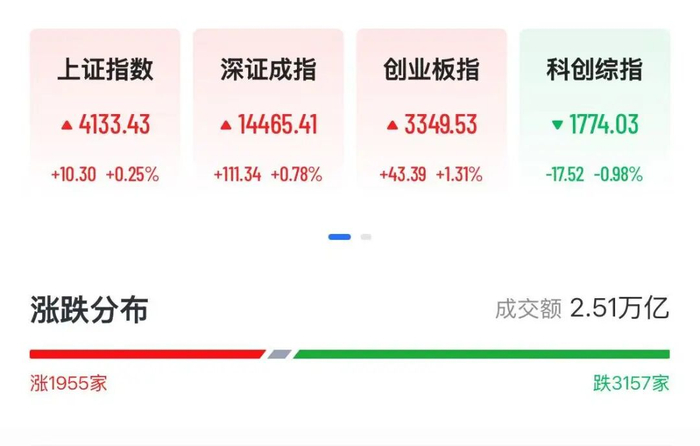
Market Overview - On March 11, the three major indices collectively rose, with the ChiNext Index initially increasing over 2% before retreating, while the Sci-Tech Innovation Index fell by 0.98%. Over 3,200 stocks in the market declined [1][2]. Index Performance - Shanghai Composite Index closed at 4,133.43, up by 10.30 points or 0.25% - Shenzhen Component Index closed at 14,465.41, up by 111.34 points or 0.78% - ChiNext Index closed at 3,349.53, up by 43.39 points or 1.31% - Sci-Tech Innovation Index closed at 1,774.03, down by 17.52 points or 0.98% - The total trading volume reached 2.51 trillion yuan, with 1,955 stocks rising and 3,157 stocks falling [2]. Sector Performance - The energy storage and lithium mining sectors were active throughout the day, with green energy concepts experiencing a surge. Green power stocks saw consecutive gains, and energy-saving wind power stocks hit the daily limit [2]. - The chemical sector saw a strong rally, particularly in coal and salt chemicals, with stocks like Jinniu Chemical and Zhongyan Chemical hitting the daily limit. The ongoing geopolitical conflict in the Middle East has pushed up international oil prices, supporting chemical product costs [2]. - The chemical fiber sector collectively rose, with companies like Zhongfu Shenying increasing over 14%. The price of spandex was raised, with increases of 2,000 yuan/ton for Taihe New Materials and 3,000 yuan/ton for Huahai Spandex reported [2]. Coal Sector - The coal sector experienced fluctuations, with Huadian Energy achieving consecutive gains. Other companies like China Coal Energy and Yanzhou Coal Mining also saw increases [3]. Downward Trends - The small metals sector declined, with companies like Xianglu Tungsten and Zhongtung High-tech dropping over 5%. The gas turbine sector also weakened, with stocks like Jereh and Tunan falling collectively [3]. - The "lobster" concept stocks saw a collective decline, with companies like Kunlun Wanwei and Qingyun Technology dropping over 4% [4]. Hong Kong Market - In the Hong Kong market, the Hang Seng Index fell by 0.21% and the Hang Seng Tech Index decreased by 0.14%. Most popular tech stocks declined, with Meituan, NetEase, and JD Health dropping over 2%. However, automotive stocks surged, with NIO rising over 14% and other companies like Li Auto and Xpeng increasing over 4%. NIO reported a quarterly operating profit of 1.25 billion yuan, marking the company's first quarterly profit [7].