古茗

Search documents
昔日奶茶排队王,年轻人不想陪它演戏了
36氪· 2025-07-24 00:00
Core Viewpoint - The article discusses the decline of the tea brand Cha Yan Yue Se, which was once a top player in the tea beverage market, highlighting its struggles to maintain popularity and adapt to changing consumer preferences [1][3][36]. Group 1: Market Position and Competition - Cha Yan Yue Se was once a standout brand in the tea beverage market, known for its unique offerings and poetic branding, but has recently lost its competitive edge as new brands emerge [5][8][36]. - The brand's expansion efforts have been slow, with only a few new stores opened outside its home base, allowing competitors like Ba Wang Cha Ji to gain ground in key markets [21][25]. - Despite still being a part of local culture, the brand's popularity has waned, with many consumers no longer willing to wait in long lines for its products [14][40]. Group 2: Consumer Experience and Brand Perception - Consumers have expressed frustration with the lengthy ordering process and the brand's insistence on in-store experiences, which contrasts with the growing trend of online ordering and quick service [31][42]. - The brand's previous charm and novelty have diminished, leading to negative perceptions and complaints about its service and product offerings [19][28][36]. - Cha Yan Yue Se's attempts to innovate and expand its product line have not resonated well with loyal customers, who feel that the quality of beloved items has declined [19][36]. Group 3: Financial Performance and Growth Strategy - In 2023, Cha Yan Yue Se reported a net profit of approximately 5 billion yuan, which is competitive compared to other brands in the industry, despite its declining market presence [13]. - The company plans to open 268 new stores in 2024, marking a significant increase in its expansion efforts, particularly in new first-tier cities [25][27]. - The brand's recent foray into online sales of snacks and merchandise indicates a shift in strategy, but it has not generated the same buzz as its earlier initiatives [27][36].

冰杯背后的「尝鲜经济」,是赔本赚吆喝,还是万能饮品接口?
3 6 Ke· 2025-07-23 11:50
Core Insights - The rise of ice cups in the beverage market is driven by consumer demand for refreshing drinks during hot weather, with significant sales growth reported in major cities [1][2] - Ice cups are not just simple products; they serve as a marketing tool for brands to attract customers and increase overall sales through upselling [2][3] Group 1: Market Dynamics - The popularity of ice cups surged after the introduction of the "1 yuan ice cup" by Mixue Ice City, which was a loss leader strategy to drive foot traffic and sales of other products [2] - Other brands, such as Guming and Shuyi, have adopted similar strategies, offering low-cost ice cups to stimulate additional purchases, with Guming reporting that 35% of customers who bought the 1 yuan ice water also purchased other items [2][3] Group 2: Consumer Behavior - The trend reflects a "tasting economy," where consumers are willing to pay for new experiences and instant gratification, leading to increased sales of fresh beverages [6][11] - The combination of ice cups with drinks allows for creative DIY beverage experiences, enhancing consumer engagement and satisfaction [6][9] Group 3: Retail Innovations - Instant retail platforms like Ele.me and Meituan have introduced their own ice cup brands, with significant growth in sales of beverage and ice cup combinations, indicating a shift in consumer purchasing behavior [5][12] - The market for ice cups is expected to grow significantly, with projections indicating a 39% increase in sales over the next three years on instant retail platforms [5][12] Group 4: Product Evolution - Ice cups are evolving in terms of flavor and packaging, with innovative designs and combinations that enhance the consumer experience, such as bear-shaped coffee ice cups and MBTI-themed packaging [12][13] - The trend is not limited to China, as countries like Japan and South Korea have normalized ice cup consumption, suggesting a potential for similar growth in the domestic market [14]

自提30个冰淇淋被店员“背刺”,蜜雪冰城回应
Guan Cha Zhe Wang· 2025-07-23 11:41
Group 1 - The incident involving a customer at a Mixue Ice Cream store highlights potential service quality issues within the company, as the customer reported negative interactions with staff when attempting to pick up 30 ice creams [1] - The store's response indicates a recognition of the situation, with an apology issued to the customer and a commitment to enhance employee training [1] Group 2 - The coffee market in China is experiencing significant growth, with a 19.54% year-on-year increase in the registration of coffee-related enterprises in the first half of the year, indicating a strong trend towards coffee consumption [2] - Major tea beverage companies, including Mixue Group, are expanding into the fresh coffee sector, leveraging existing resources to reduce operational costs and enhance product offerings [2] - The compound annual growth rate for the fresh coffee market in China is projected to be 19.8% from 2023 to 2028, making it the fastest-growing segment in the ready-to-drink beverage market [2] Group 3 - Five coffee industry projects with a total signed amount of approximately 400 million yuan have been established in Changsha County, focusing on key areas such as coffee equipment research and development, roasting, product processing, and green bean trade [3] - The construction of the largest and most comprehensive coffee industry complex in Central and Southern China is underway in Hunan (Changsha) [3] Group 4 - The first industry standard for the new tea beverage sector has been officially released, addressing quality requirements for raw materials, inspection methods, packaging, transportation, and storage [4] - This standard, effective from January 1, 2026, aims to regulate various components used in the production of fresh tea beverages, including tea leaves, fruits, dairy products, and sweeteners [4]

港股新消费概念股部分下跌,老铺黄金(06181.HK)跌超6%,古茗(01364.HK)、布鲁可(00325.HK)、巨子生物(02367.HK)跌超4%。
news flash· 2025-07-23 06:31
Group 1 - The new consumption concept stocks in the Hong Kong market experienced a decline, with notable drops in specific companies [1] - Old Poo Gold (06181.HK) fell over 6%, indicating significant market reaction [1] - Other companies such as Gu Ming (01364.HK), Bluco (00325.HK), and Juzi Bio (02367.HK) also saw declines exceeding 4% [1]
外卖大战:残暴的开始必将以残暴结束
创业邦· 2025-07-23 03:13
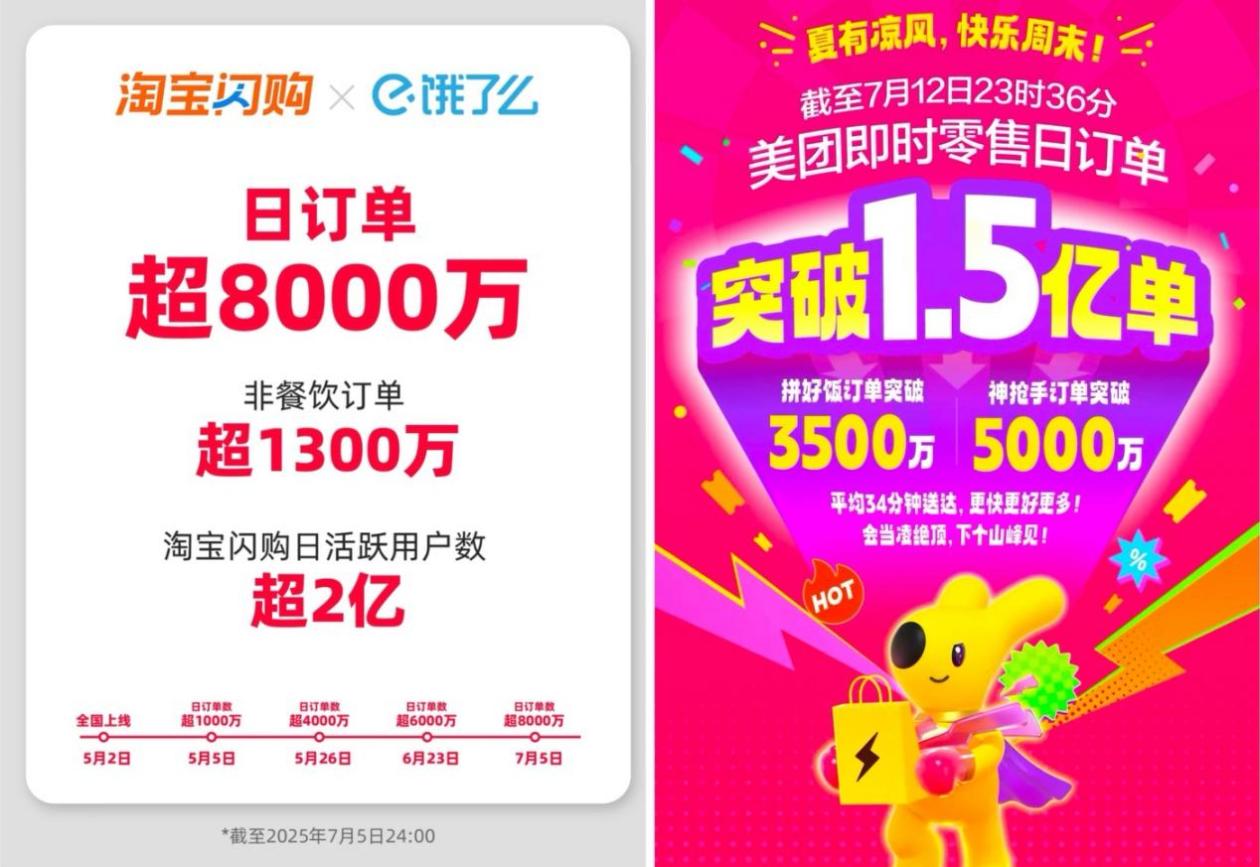
Core Viewpoint - The article discusses the intense competition in the food delivery market in China, particularly focusing on the aggressive subsidy strategies employed by major players like Meituan, Alibaba, and JD.com, and the implications of these strategies on market dynamics and consumer behavior [4][10][12]. Summary by Sections Market Dynamics - The food delivery market in China is experiencing a significant increase in order volume, with a record of 200 million orders on July 5, driven by substantial subsidies from major companies [4][10]. - Meituan, Alibaba, and JD.com are collectively burning through approximately 20 billion RMB monthly in subsidies, despite the average daily order volume being less than 100 million [4][10]. Company Strategies - Alibaba's delayed entry into the subsidy war is attributed to internal organizational adjustments and the need to consolidate its resources before launching a competitive response [6][7]. - The timeline of Alibaba's strategic moves includes integrating its food delivery service Ele.me into its e-commerce division and announcing a 50 billion RMB subsidy plan [8][10]. Competitive Landscape - The competition is characterized by a focus on resource allocation and execution rather than ethical considerations, with companies prioritizing market share over profitability [12][20]. - Meituan's strategic response to the competition includes a focus on maintaining high operational efficiency, which is seen as a critical factor in its market leadership [22]. Financial Implications - The intense competition has led to stock price declines for all major players, with JD.com down 20%, Meituan down 10.3%, and Alibaba down 16% since the onset of the subsidy war [16][18]. - The article highlights the fragile profitability model of the food delivery business, which relies heavily on subsidies to attract customers and maintain market share [21][22]. Future Outlook - The article suggests that the food delivery market may face a reckoning as companies struggle to balance aggressive growth strategies with sustainable profitability [19][22]. - The potential for new entrants like Pinduoduo and Douyin to disrupt the market is acknowledged, indicating that the competitive landscape may continue to evolve rapidly [22].



连锁茶饮的外卖战争“大逃杀”
华尔街见闻· 2025-07-22 11:13
Core Viewpoint - The article discusses the ongoing competition among food delivery platforms, highlighting that large subsidies and promotional offers have not diminished despite regulatory scrutiny. The competition has shifted from a short-term battle to a more cyclical and normalized state, particularly affecting the tea beverage industry [1][2][3]. Group 1: Market Dynamics - The market has seen a transition from intense competition to a more regularized form, with tea beverages becoming a key tool for platforms to increase order volume [4][5]. - The expectation of a "win-win-win" scenario for platforms, merchants, and consumers has not been realized, leading to questions about the role of tea brands in this competitive landscape [6][7]. - The current phase of the competition is characterized by direct confrontations among platforms, with a focus on increasing order volumes and reducing the effectiveness of competitors' promotions [13][14]. Group 2: Merchant Perspective - Merchants face a lack of transparency regarding the costs associated with promotional orders, as platform subsidies are often tied to merchant discounts [9][10]. - The burden of promotional costs is shared between merchants and platforms, with merchants typically bearing a significant portion of the costs [11][12]. - The influx of low-priced orders has led to a decline in normal sales, with many merchants reporting that a large percentage of their orders are now promotional [22][23]. Group 3: Financial Implications - The tea beverage industry has seen significant order growth due to platform subsidies, with leading brands benefiting the most due to their strong supply chain capabilities [27][28][29]. - However, the financial burden on brands is increasing, as they often have to share a larger portion of the promotional costs over time [38][39]. - The average price of tea beverages has decreased from 15-20 yuan to 10-15 yuan, leading to a decline in industry profit margins from 21.4% in 2023 to 14.7% in 2024 [46]. Group 4: Competitive Landscape - The competitive environment is becoming increasingly challenging, with a high rate of store openings and closures indicating a struggle for profitability among tea brands [49]. - The reliance on platforms for order volume is raising operational costs and may lead to a decline in efficiency for offline operations [50][51]. - The article suggests that the ongoing price competition may lead to a market correction in the future, but brands that prioritize sales may continue to offer additional subsidies [57][58].


连锁茶饮的外卖战争“大逃杀”
Hua Er Jie Jian Wen· 2025-07-22 02:39
Group 1 - The large subsidies on food delivery platforms have not disappeared despite regulatory discussions, indicating ongoing competitive practices among major players like Ele.me, Meituan, and JD [1] - The food delivery battle is shifting from short-term bursts to a more normalized cyclical competition, with low-priced tea drinks becoming a key tool for platforms to boost order volumes [2][4] - The expectation of a "win-win-win" scenario for platforms, merchants, and consumers has not been realized, raising questions about the role of chain tea brands in this competitive landscape [3] Group 2 - Merchants face opaque cost structures behind discount orders, with platform subsidies often tied to merchant concessions, leading to increased operational costs [5][6] - The "explosive red envelope" subsidy model requires merchants to bear a minimum cost per order, complicating their financial outcomes [6][7] - The current phase of the food delivery competition has intensified, with platforms directly targeting each other to suppress competitors like Taobao Flash Sale [8] Group 3 - The surge in low-priced orders is squeezing normal product sales, leading to a decline in actual revenue for merchants despite high order volumes [16][12] - Merchants are increasingly reliant on external platforms, which may undermine their offline business efficiency and raise operational costs [31] - The average price of tea drinks has dropped significantly, with industry profit margins declining from 21.4% in 2023 to an estimated 14.7% in 2024 [29] Group 4 - The competitive landscape is marked by a high store opening and closing ratio, indicating a challenging environment for new tea brands [30] - The reliance on platform subsidies may provide temporary relief for merchants but could lead to long-term sustainability issues once subsidies are reduced [32] - The ongoing price competition is reshaping consumer perceptions, with lower price points becoming the new norm in the market [33]
朝闻国盛:业绩预告陆续披露,企业持续积极布局
GOLDEN SUN SECURITIES· 2025-07-22 00:04
Group 1: Market Overview - The report highlights that the market is expected to reach a new level, with a focus on the performance of various sectors and companies [2] - The A-share market has shown resilience, with indices rebounding after a pullback, indicating a return of positive sentiment [3] - The report notes that global equity markets have mostly risen, with Asian markets leading the gains [3] Group 2: Industry Insights - The food and beverage sector is experiencing a cyclical bottom, with the dairy industry moving towards supply-demand balance and beef prices recovering [4] - In the retail sector, companies are actively positioning themselves for growth, with a focus on new consumption trends and improving performance in the restaurant and tourism industries [6] - The C-REITs market is witnessing strong interest, particularly in data center REITs, with a positive outlook for the low-interest environment and macroeconomic recovery [8] Group 3: Company Performance - Zhongwei Company (688012.SH) is projected to achieve a revenue of 4.96 billion yuan in H1 2025, reflecting a year-on-year growth of 43.9%, driven by significant increases in etching equipment sales [10] - The company has increased its R&D investment to approximately 1.49 billion yuan in H1 2025, representing a growth of about 53.7%, which is significantly higher than the average R&D investment level of companies listed on the Sci-Tech Innovation Board [11] - Zhongwei Company aims to cover over 60% of semiconductor front-end equipment categories through both acquisitions and internal R&D, positioning itself as a leading supplier in the etching, film deposition, and measurement sectors [12][13]

外卖内卷,私域深耕:第三方即配或成餐饮商家“博弈牌”
Huan Qiu Wang· 2025-07-21 11:31
Core Viewpoint - The recent discussions by the Market Supervision Administration with major platforms like Ele.me, Meituan, and JD.com signal a regulatory intervention aimed at curbing aggressive promotional behaviors in the food delivery sector, promoting a healthier ecosystem for consumers, merchants, delivery riders, and platform companies [1] Group 1: Market Dynamics - The food delivery war has intensified, with platforms offering significant discounts and promotions, leading to a surge in order volumes [2][4] - During the first weekend of July, Taobao Flash Sale recorded over 80 million daily orders, while Meituan surpassed 120 million, indicating a total daily order volume of around 200 million [2] - The order volume spike has benefited large chain restaurants, with brands like Nayuki's Tea and Tim's Coffee experiencing substantial increases in delivery orders [4] Group 2: Merchant Challenges - The influx of orders has created operational challenges for many merchants, particularly small and medium-sized businesses, leading to staff shortages and increased pressure to fulfill orders [8][9] - Merchants are facing a "losing balance" situation, where the costs associated with promotional discounts are shared between platforms and merchants, often leading to unsustainable pricing models [9][11] - The competitive environment has intensified price wars, resulting in declining average transaction values for well-known brands [9][10] Group 3: Capital Market Response - The capital markets reacted positively to the benefits brought by the food delivery war, with stocks in the new tea beverage sector seeing collective gains following the promotional weekends [8] - Notable stock movements included a 2.17% increase for Gu Ming and a 0.74% rise for Mixue Group, reflecting investor optimism in the sector [8] Group 4: Strategic Shifts for Merchants - Merchants are beginning to explore alternative strategies to reduce dependency on platforms, such as building private domains and utilizing third-party delivery services [15][19] - Successful examples include Luckin Coffee, which has effectively developed its private domain strategy, reducing reliance on external platforms and enhancing customer loyalty [19][20] - The emergence of third-party delivery platforms like SF Express has provided merchants with flexible and cost-effective delivery solutions, allowing them to regain some control over pricing and operations [19][22]

一年闭店20万+?2025饮品上半场:“活着就是最大胜利”
3 6 Ke· 2025-07-21 03:21
Core Insights - The beverage industry is facing significant challenges, with many businesses struggling to survive amidst a wave of closures and market adjustments [1][4][9] Group 1: Market Overview - In the past year, 157,000 milk tea shops and 52,000 coffee shops have exited the market, indicating a severe contraction in the beverage sector [2][7] - The total number of milk tea shops in China is currently 426,000, with a net decrease of 39,225 shops over the past year, while the coffee shop count stands at 228,000, with 5,200 closures [7][9] - The industry is undergoing a significant reshuffle, with the "Matthew Effect" intensifying, leading to a concentration of market share among top brands, which may capture up to 80% of the market [10][12] Group 2: Impact of Subsidies - The ongoing wave of delivery subsidies has temporarily boosted market activity but has also restructured the survival logic of the industry, favoring larger brands with established delivery systems [12][16] - The average price of coffee under 10 yuan has increased by over 25% compared to last year, while milk tea sales in the same price range have risen by over 10% [16][18] - This shift towards lower price points is compressing profit margins, with many businesses reporting significant drops in profitability despite increased sales volume [20][22] Group 3: Strategies for Survival - Industry experts suggest focusing on differentiated innovation and avoiding price wars to navigate the current market challenges [24][28] - Enhancing product experience and creating perceived value beyond just price is crucial for brand survival [28][30] - Improving operational efficiency across supply chains and store management is essential for brands to endure the ongoing market pressures [30][31]